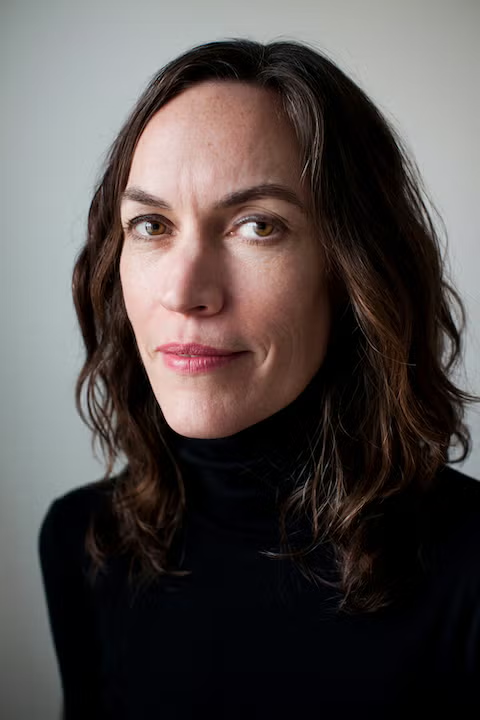
There is an interview in Writer’s Digest of author Rae Meadows about how her love of gymnastics shaped one of her novels.
Rae Meadows is the author of four previous novels, including I Will Send Rain. She is the recipient of multiple awards, including the Goldenberg Prize for Fiction, the Hackney Literary Award for the novel, and the Utah Book Award. Her work has appeared in many literary journals, as well as Under Purple Skies: The Minneapolis Anthology, Contexts, and online.
She grew up admiring the Soviet gymnasts of the 1970s, and in her 40s decided to go back to the thing she loved as a child. She now trains regularly in adult gymnastics. She lives with her family in Brooklyn.
Rae Meadows
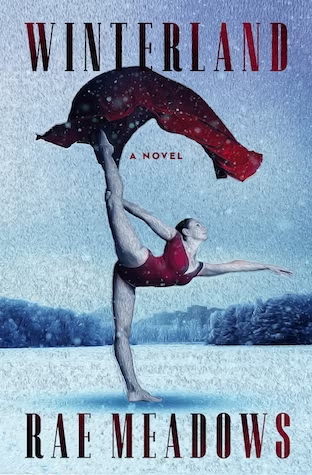
Elevator pitch for the book: In 1970, in an Arctic town on the far edge of the Soviet Union, a young mother disappears leaving a mystery that haunts her husband and daughter, Anya, a gymnast in the grueling state system. From the wild tundra of Norilsk to the golden age of Soviet gymnastics to gritty late-90s Brooklyn, Winterland is the story of a woman—and an era—shaped by glory and loss.
What prompted you to write this book?
If I could point to one thing that set the novel in motion for me, it was reading about Elena Mukhina, the Soviet gymnast who won all-around gold at the 1978 World Championships. She broke her neck two years later, just before the Olympics, performing a skill on the floor she was not prepared for, which left her a quadriplegic.
Her injury was then covered up by the Soviets. There is a character in the book based on Mukhina, and she plays a pivotal role in Anya’s life.
How long did it take to go from idea to publication? And did the idea change during the process?
It took about four years from idea to publication, with COVID mucking up the process. When I first began the novel, there was going to be a peripheral character who was a former gymnast. But I loved researching so much—my life orbits around gymnastics as a mom, a fan, and a passionate adult gymnast—gymnastics soon took over.
I could spend hours watching videos of Soviet gymnasts and call it research. I wrote much of the book in the parent area of the gym where my daughter trains.
Were there any surprises or learning moments in the publishing process for this title?
It’s hard for me to believe this is my fifth novel. I feel so fortunate. Each publishing experience has been different, but this one has been by far the best.
I had the absolute lottery win of having Amy Einhorn as an editor, and I felt like she “got” this book from the beginning. I am an understated writer to a fault, and she pushed me to be less subtle, which I think improved the book immensely. I was able to trust the editing process more than I ever had before.
Were there any surprises in the writing process for this book?
For one, I never thought I would use my high school Russian! I am a big believer in serendipity in the process. Winterland was initially going to be set entirely in Brooklyn, but I read an article about Norilsk, where the novel is set, and it just took root in my imagination.
I don’t outline or do much planning when I write. I generally know the beginning and the end, which makes for many surprises along the way.
What do you hope readers will get out of your book?
I hope Winterland feels transportive, a book readers can immerse themselves in. It’s set in the not-too-distant past, but the Soviet Union is a vanished place, despite some eerie similarities of late. Much of the novel takes place in a city carved out of the Arctic by gulag labor, one that is still closed to anyone not granted permission to enter, so to me it has an otherworldly quality.
And, of course, I want readers to feel for the characters, especially Anya, to follow her from age eight into adulthood. I have always been drawn to the idea of extraordinary stories behind ordinary lives. She could be someone you see on the subway and she has this remarkable past.
If you could share one piece of advice with other writers, what would it be?
My very first writing teacher used to call excess setting up of a scene “furniture moving.” Streamline, take out the furniture moving, trust your reader to get from A to B without describing every last detail in between.
In last Saturday’s Telegraph there was an article by Tom McArdle with the title “Waterstones chief: AI could produce the next War and Peace”.
James Daunt, CEO, Waterstones and Barnes & Nobel
THE chief executive of Waterstones has said he is open to the company selling books created by Artificial Intelligence, as long as they are clearly labelled.
James Daunt said it would be “up to the reader” whether to purchase them if they end up on his stores’ bookshelves.
There are major concerns from authors about the impact AI-generated content will have on the book industry, after a recent study found most writers feared their jobs were at risk from the technology.
But Mr Daunt, who has been the CEO of Waterstones since 2011, told BBC’s Big Boss podcast that AI could produce “the next War and Peace”.
“There’s a huge proliferation of AI-generated content and most of it is not books that we should be selling,” he said. “Hopefully, publishers avoid it; we as booksellers would certainly, naturally and instinctively, disdain it.”
A University of Cambridge study last month found widespread concerns from novelists about their jobs being replaced by the technology and fears that work written by humans could become “an expensive luxury”.
In response, Mr Daunt said: “At the more literary end I don’t see that being the case. There is a clear identification of readers with authors, and booksellers play an important role in joining authors and readers.
“That does require a real person.
“As a bookseller, we sell what publishers publish, but I can say that, instinctively, that is something we would recoil [from]. It’s really important that authors earn a living.”
Asked whether the high-street bookshop would sell AI books, he said: “We would never intentionally sell an AI-generated book that was disguising itself as being other than that.”
When pressed on whether he would consider it if they were clearly labelled, he responded: “Yeah, if it was clear what it was, then I think it’s up to the reader.
“Do I think that our booksellers are likely to put those kinds of books front and centre? I would be surprised.”
He warned that given the exorbitant sums of money being spent by tech companies on AI, it was hard to know its limits.
“Who’s to know,” he said. “They are spending trillions and trillions on AI and maybe it’s going to produce the next War and Peace. If people want to read that book – AI-generated or not – we will be selling it. As long as it doesn’t pretend to be something that it isn’t.”
There is an article in today’s Telegraph written by Tom Mc Ardle which reports on a study done by Dr Clementine Collett at Cambridge University on AI’s effects on literary trends.
Dr Clementine Collett is a DPhil student on the ‘Information, Communication and the Social Sciences’ course at the Oxford Internet Institute. Clementine’s doctoral research explores gender bias in artificial intelligence (AI) recruitment technology.
Clementine has worked as lead author on reports such as IA and Gender: Four Proposals for Future Research (2019) with the Leverhulme Centre for the Future of Intelligence at the University of Cambridge and The Effects of AI on the Working Lives 0f Women (2022) with the IDB, OECD and UNESCO.
Dr Clementine Collett
Novels written without artificial intelligence will become an “expensive luxury”, according the report.
Dr Clementine Collett has claimed that the creative market could become “tiered”, with only those who could afford human-written work being able to read it.
“[There] is a real concern from literary creatives that we will have a two-tier market, more so than we have already,” she told BBC Radio 4’s Today programme.
“Where human-written work will be more expensive – a luxury item.Those who can afford it will read human-written novels and AI generated content will be cheap or free and that will potentially have big societal implications as well.”
Dr Collett, who conducted the study at the University of Cambridge’s Minderoo Centre for Technology and Democracy (MCTD), interviewed to nearly 400 literary creatives across the UK about the threat of generative AI.
“There is widespread concern from novelists that generative AI trained on vast amounts of fiction will undermine the value of writing and compete with human novelists,” she said.
Dr Collett called on the Government to weigh up the economic growth it has so far prioritised by developing AI, against the potential impact on the creative industries, including readers and the novel itself.
The study found that almost two thirds (59 per cent) of novelists reported that their work had already been used to train large language models, which power AI tools, without permission or payment.
Such practices have already impacted the livelihoods of those surveyed, with more than a third (39 per cent) reporting their income being negatively affected by AI.
The report found genre fiction, especially romance, thrillers and crime, is more at risk from displacement than more highbrow literary fiction. Dr Collett said this was because of their more “formulaic” make up.
“We don’t know what generative AI is going to be able to do in the future in terms of producing more original content,” she added.
“It’s really important because novels are such a bedrock of our thriving British creative industry and they’re the core part of our humanity.” She called on Government intervention to help protect the industry.
Prof Gina Neff, executive director of the MCTD, said: “Our creative industries are not expendable collateral damage in the race to develop AI. They are national treasures worth defending.”
A spokesman for the Department for Science, Innovation and Technology said: “We’ve always been clear on the need to work with both the creative industries and the AI sector to drive AI innovation and ensure robust protections for creators.”
There is an article in the Atlantic magazine on 19 September about how the publishing industry views AI. It is written by Boris Kachka, Senior Editor of the Atlantic. He titles the article ‘Publishing’s New Microgenre’
Boris Kachka
“Book publishing has, let’s say, a complicated relationship with artificial intelligence. Earlier this month, Anthropic settled a lawsuit brought by authors and publishers, agreeing to pay $1.5 billion after training its chatbot, Claude, on pirated text; hundreds of such copyright lawsuits against data-scraping tech companies are still making their way through the courts. Many in the culture industries see AI as not just a thief but an existential competitor, ready to replace human writers at every turn. Yet publishers are also fascinated by the technology (and not only because they use it for marketing and other tasks). The major imprints have been churning out a robust collection of books (more than 20 this year, by my count) that explain, extol, deride, fictionalize, and occasionally incorporate AI.
Among these recent releases, one overarching theme is a debate occurring between so-called accelerationists and doomers—those who think superintelligence will hugely benefit humanity and those who suspect it will kill us all. Adam Becker, a journalist and former astrophysicist, disagrees with both groups. Becker, the author of the recent anti-utopian critique More Everything Forever, wrote about his problems with a new dystopian manifesto, If Anyone Builds It, Everyone Dies, by Eliezer Yudkowsky and Nate Soares.
Becker’s main objection to both sides is that they overhype the long-term, world-altering effects of superintelligence while downplaying the “much more immediate and well-founded concerns about the dangers of thoughtlessly deployed technology,” he writes. The kinds of ongoing changes that he would prefer to focus on are well accounted for in 2025’s AI book haul. Readers can find out more about how AI’s processes resemble the workings of our brains (or don’t); how the technology is changing medicine, warfare, education, business, and politics; how it has already profoundly altered society. But to me, the most interesting of the crop (or maybe just the most fun) are the works that explore our individual relationships with AI, through fiction or memoir.
Novels such as Amy Shearn’s Animal Instinct and Jayson Greene’s UnWorld imagine chatbots standing in for boyfriends or dead loved ones; politician-author Stacey Abrams invents a rogue medical-AI company in her latest legal thriller, Coded Justice. Hamid Ismailov’s wildly experimental novel We Computers, translated from Uzbek and longlisted for a 2025 National Book Award, creates an alternate history in which a 1980s computer intelligently generates a new kind of mind-expanding, transnational literature.
Occupying a category all its own is Searches, a fragmented memoir in which Vauhini Vara works through her complex feelings about technology. Vara interweaves the story of the rise of the internet with the narrative of her life and work as a tech reporter. She also includes strange interludes: prose-poetic lists of her Google searches; a collection of her Amazon-purchase reviews; and, most strikingly, a series of long interactions with ChatGPT-3 as she works to revise an essay about a sister who died years ago. As Matteo Wong noted in his Atlantic article about the book, the large language model produced what Vara considered to be the essay’s best lines while also inserting plenty of lies. She wound up employing the bot not to think for her, but to prod her into a different kind of thinking; it forced her, she writes, “to assert my own consciousness by writing against the falsehoods.” I enjoyed the book in part because it was less about what technology is doing to us than what we are doing in response.”
Tara Deal has an article on the Writer’s Digest website, dated December 9, 2024 in which she talks about the’Allure’ of the novella for both readers and writers.
Tara Deal is the author of the award-winning novellas That Night Alive (Miami University Press) and Palms Are Not Trees After All (Texas Review Press). Her most recent novel, Life/Insurance, is the winner of the Fugere Prize from Regal House Publishing. She lives in New York City.
Tara Deal
Tara says, “Everyone talks about novellas getting a lot of attention these days because everyone’s attention span is shrinking (a novella is somewhere between 20,000 and 40,000 words), but short books have always been around, enduring, durable, made of quality materials. Stealth Wealth. Novellas are versatile, subtle, changing to suit the times. Metamorphosis. Because think of what a novella represents. The good life!(“Instagram’s Hottest Trend? Flexing Your Favorite Paperback,” according to Nylon magazine.)
Imagine spotting someone reading a novella from afar, the flash of a bright blue dust jacket across the subway platform, the park, the plaza, or the palazzo. And even though it does take a bit of effort to read a novella, it’s not too much.
But what if you’re a writer rather than a reader? What if you’re at home, with a computer, rather than out buying paperbacks with abandon, traveling around the world, and enjoying life at night? Is it really worth the effort to invest your time and money and short attention span into crafting a beautifully made, eternally desirable novella? Yes!
Imagine the exhilaration and accomplishment! Mild Vertigo. But how are you going to do it? With something so slim, almost fragile, approaching evanescence, you don’t want any shoddy workmanship to slip in.
How are you going to get a handle on it? I don’t know, but I’ve been working for years on novellas, trying to get it right. Working for years, sometimes giving up and escaping, packing too much into too many suitcases, heavy books for long flights, but always coming home to strip down, pare back, refresh, and rewrite. Back to trying to write a novella that will stand out from the crowd. How?
You want to make a good first impression, ideally on the first page. Your hook doesn’t have to be flashy, but it should be substantial, weighty. Quality at a Glance. Sopick out a few essentials that work together, that you can repeat (if necessary), that you can recombine as your write.
If you focus on one or two characters (rather than a crowd) and one strong story line (rather than trailing subplots), then you need to insert only a scattering of telling details (objects, phrases, names? Who can say.). But it’s always smart to invest in those evocative (provocative?) items that can go from day to evening.
And this is no time to be frugal. Go all out on a few well-chosen items, as if you’re in Paris. Pretend there’s Never Any End to Paris. But it doesn’t matter where you are, in a city or on an island, in an apartment, An Apartment in Athens or New York, either way, wherever. Make room for what matters.
Strip away things from your text, as if you are a devoted minimalist committed to black and white. You can cut more than you think: description, dialogue, digressions. Think of Chanel, who said to always remove something from your outfit. Think of Hemingway and his iceberg. You need see only a little to imagine the depths. The Torrents of Spring. In a novella, everything is washed away to reveal a vein of gold. Or a vein of blood, depending.
As if you’re running for a plane about to leave for somewhere glamorous (Fez, Lisbon, Osaka? I don’t know. You have your own itinerary.). Keep checking your watch to make sure things are on schedule. Keep checking your novella, rereading as fast as possible, looking for any snags in the fabric. Time is running out. You are losing hours as you travel. Flatland.
Are there any rough edges in your reading like burrs in the desert that make you look up and think of going somewhere else? Or are you lost in a dream? Does your novella feel like an enduring design that can’t be improved upon? The Time Machine.
Like the clasp on a necklace, with a satisfying click, the end of the story feels solid, satisfying. The Diamond as Big as the Ritz. You’ve strung along some scenes, some thoughts, and although they might have seem unbalanced to the casual reader, a window shopper who wasn’t committed, now everything hangs together, tight or loose, depending on your style. A gift. The Pearl.
Afterward, a moment of luxuriating. Self-Care. Whether you’re a reader or a writer. The Lover. Has the novella transported you? What do you remember? What will you tell people at dinner? Nothing. Quiet Luxury. You’re happy to have avoided the packaged tour through a bloated book that feels like a typical tourist’s itinerary with too much time wasted while waiting for those bits that are tender and delightful.
With a novella, you always go straight to the heart of the matter, the marrow, the best parts, presented on a platter. As if on a terrace in Venice or looking out over Bangkok. The Stranger. The suburbs are far behind you, beyond you. The night turns purple. Do Not Disturb. Dream Story.“
This biography attracted my attention because in covers an extremely powerful autocrat about whom relatively little is known, it had good reviews and was written by a very senior politician, Kevin Rudd, the former prime minister of Australia, who had personal dealings with Xi.
Kevin Rudd was also a former foreign minister of Australia and the founding president of the Asia Society Policy Institute, and established its Centre for China Analysis. He has a PhD from the China Centre at Oxford University. He is the author of The Avoidable War, among other books.
Kevin Rudd
I found the subtitle of the book particularly interesting: ‘How Xi’s Marxist Nationalism is Shaping China and the World’.
This biography is certainly a scholarly work, covering just over four hundred pages of text, sixty-five pages of footnotes, over one hundred pages of bibliography, much of it in Chinese and a twenty page index. But I found it difficult to put the book down for very long. I was continually thinking tell me more and where is this leading.
The book is very well organised for non-experts like me. It begins with purpose and its core arguments, continuing through definitions of Chinese core ideological concepts, and presents a historical survey of Chinese ideology. Then it moves subject-by-subject through Xi’s evolving ideology, and its effects on China’s domestic and foreign policy. There are three final chapters dealing with China’s future and China’s future after Xi. The book makes it clear that Xi’s ideology has evolved considerably from Mao, Deng, Jiang and Hu.
It is also clear that Xi is deeply intellectually committed to Marxism and to Leninism ‘with Chinese characteristics’, and he speaks about these theories as being ‘scientific’ and ‘proven effective in the Chinese context’.
Mr Rudd backs up every bit of Xi’s ideology with multiple historical references, usually in the form of published quotations. For example, he documents China’s shift in its foreign policy with quotations from high-ranking diplomats.
On the subject of whether or not China will invade Taiwan, he says that Xi has demanded that the People’s Liberation be ready to do so by 2027, and that he would like to do it by 2032, but that if there is a significant chance of failure, he would delay.
Xi clearly thinks that his political ideology is clearly superior to democracy/capitalism. He has apparently conceded that capitalism is superior for economic growth, because he has reigned in the Chinese private sector, knowing that this would slow economic growth. He is aware that Leninism, which Xi has applied to the running of the Communist Party, and Marxist surveillance of the Chinese people represent a risk of revolution. But surveillance is growing, not shrinking.
Xi argues that Marxism is completely congruent to classical Chinese culture, and he enumerates examples of Chinese culture without seeming to recognise the apparent conflicts between the two. Religious freedom, individual freedom and true justice are clear examples. Unfortunately, Mr Rudd and Mr Xi are not able to debate these points, but perhaps Western diplomats and politicians can do so.
This book is a timely, very welcome, thought-provoking study of an influential, but largely unknown national leader.
Beth Kander is interviewed by Robert Lee Brewer Writer’s Digest (published 12 December 2024) on how she entered a competition at the last minute.
Beth Kander is a novelist and playwright with tangled roots in the Midwest and Deep South. The granddaughter of immigrants, her writing explores how worlds old and new intertwine—or collide. Her work has been described as “riveting,” “emotional,” “expertly crafted,” and “habit-forming.” Expect twists, turns, and secrets, with surprising heart and humor. Beth has too many degrees and drinks too much coffee. Her favorite characters are her dashing husband and their two lovely kids.
Beth Kander
What prompted you to write this book?
This book definitely has a non-traditional origin. I was knee deep in another project when a friend texted to let me know that the pop culture site Hey Alma was having a Hanukkah movie pitch competition. Eager to procrastinate on my existing project, I checked the pitch competition deadline—and found out it was the very next day. Long story short (literally), I threw together a pitch for I Made It Out Of Clay, a quirky romcom-with-a-golem concept, submitted it at the 11th hour, and ultimately won the competition.
Industry folks started reaching out to me to inquire about film rights. My literary agent, Alli, passed along some great advice from a film agent colleague: “Write the book first, not the movie.” So, I set aside my other book projects and prioritized writing this novel. The story immediately provided myriad unconventional opportunities to explore big topics: grief and family dynamics and identity and adult friendships and turning 40 … I got to write about these heavy things while laughing and making monsters. What a gift.
How long did it take to go from idea to publication? And did the idea change during the process?
I won the pitch competition in December 2022. I was so inspired, I drafted the novel in two blurry months. My agent took it out on sub in February 2023. It sold at auction in March 2023, and publication was set for December 2024. So all told, a two-year-process from idea to publication. That’s fast—often, the writing alone can take longer than that! I’m grateful that although the acquisition happened fast, I had a great editor and plenty of time to revise the book, several times over. I loved spending the time really developing the story and connecting with each character.
Were there any surprises or learning moments in the publishing process for this title?
I’ve learned so much in the process of publishing this book that it’s honestly hard to even know where to begin, and there have been plenty of surprises along the way. But if I had to pull out the biggest lesson, it’s this: You just never know.
You can spend years working on a story you really believe in, only to have it languish and eventually fade away. You can have an overnight idea that becomes the story everyone’s eager to read. You can’t trust trends or tricks. You just have to keep trying. I think a lot about this two-panel meme, where the first panel is labeled “what people think success looks like” and shows an arrow moving steadily forward and up, and the second panel is labeled “what success actually looks like” and it shows a tangled mess that a forward-facing arrow finally re-emerges from… which feels relevant to the publishing process. But I’ve been over-the-top lucky to work with my agent, Alli, to navigate every detour along the way. And working on I Made It Out Of Clay with my editor, April, and the team at Mira/HarperCollins, has been a delight. Sometimes, gracefully and gratefully, the puzzle pieces slide into place.
You just never know.
Were there any surprises in the writing process for this book?
This was the fastest writing process I’ve ever undertaken. To go from a paragraph-long idea to a 90,000-word novel in two months is… well, not something I’d necessarily recommend, honestly. Thank God for coffee.
But what I realized is that I didn’t speed-write this book in a vacuum; it wasn’t an anomaly, or a fluke. It was a culmination. All those years, all those other stories; that was my training for this manuscript-marathon. I doubt I’ll keep that pace up with many subsequent projects, but I’m definitely holding fast to the lesson that even the projects that don’t pan out help shape the ones that will fly.
What do you hope readers will get out of your book?
There’s so much I hope that readers will get out of this book—catharsis, cackling-laughter, genuine enjoyment, a sense of release. There’s some strange stuff in the story (an actual monster!) but it’s really rooted in characters that I hope are relatable in all their imperfections and deep desires for something better. Most of all, I hope this book gives readers permission to laugh in the midst of sorrow or acknowledge sadness even as they dance for joy; to let complicated, conflicting emotions exist alongside each other on the page and in our lives. The publication of this book intersected with a profound loss in my own life, and I’ve become so grateful for anyone and anything that acknowledges that we can feel many things at once. If readers come away with that affirmation, I’ll be thrilled.
If you could share one piece of advice with other writers, what would it be?
Write the book you want to rewrite—because most of writing is revising! Don’t agonize over every word in a first draft; that will only slow you down. Just write the story. Get it onto the page. Drafting is the stage where you capture the idea. Revising is where you figure out how to really tell the story well.
The Conversation website has an interesting article on this subject, written by Katherine Day, Lecturer, Publishing, The University of Melbourne, Reneé Otmar, Honorary Research Fellow, Faculty of Health, Deakin University, Rose Michael,Senior Lecturer, Program Manager BA (Creative Writing), RMIT University, and Sharon Mullins, Tutor, Publishing and Editing, The University of Melbourne, all of whom,presumably, are Australians. The article is dated February 12, 2024.
They say, “Writers have been using AI tools for years – from Microsoft Word’s spellcheck (which often makes unwanted corrections) to the passive-aggressive Grammarly. But ChatGPT is different.
ChatGPT’s natural language processing enables a dialogue, much like a conversation – albeit with a slightly odd acquaintance. And it can generate vast amounts of copy, quickly, in response to queries posed in ordinary, everyday language. This suggests, at least superficially, it can do some of the work a book editor does.
We are professional editors, with extensive experience in the Australian book publishing industry, who wanted to know how ChatGPT would perform when compared to a human editor. To find out, we decided to ask it to edit a short story that had already been worked on by human editors – and we compared the results.
The experiment: ChatGPT vs human editors
The story we chose, The Ninch (written by Rose), had gone through three separate rounds of editing, with four human editors (and a typesetter).
The first version had been rejected by literary journal Overland, but its fiction editor Claire Corbett had given generous feedback. The next version received detailed advice from freelance editor Nicola Redhouse, a judge of the Big Issue fiction edition (which had shortlisted the story). Finally, the piece found a home at another literary journal, Meajin, where deputy editor, Tess Smurthwaite, incorporated comments from the issue’s freelance editor and also their typesetter in her correspondence.
We had a wealth of human feedback to compare ChatGPT’s recommendations with.
We used a standard, free ChatGPT generative AI tool for our edits, which we conducted as separate series of prompts designed to assess the scope and success of AI as an editorial tool.
We wanted to see if ChatGPT could develop and fine tune this unpublished work – and if so, whether it would do it in a way that resembled current editorial practice. By comparing it with human examples, we tried to determine where and at what stage in the process ChatGPT might be most successful as an editorial tool.
The story includes expressive descriptions, poetic imagery, strong symbolism and a subtle subtext. It explores themes of motherhood, nature, and hints at deeper mysteries.
We chose it because we believe the literary genre, with its play and experimentation, poetry and lyricism, offers rich pickings for complex editorial conversations. (And because we knew we could get permission from all participants in the process to share their feedback.)
In the story, a mother reflects on her untamed, sea-loving child. Supernatural possibilities are hinted at before the tale turns closer to home, ending with the mother revealing her own divergent nature – and looping back to offer more meaning to the title:
pinching the skin between my toes … Making each digit its own unique peninsula.
Round 1: the first draft
We started with a simple, general prompt, assuming the least amount of editorial guidance from the author. (Authors submitting stories to magazines and journals generally don’t give human editors a detailed, prescriptive brief.)
Our initial prompt for all three examples was: “Hi ChatGPT, could I please ask for your editorial suggestions on my short story, which I’d like to submit for publication in a literary journal?”
Responding to the first version of the story, ChatGPT provided a summary of key themes (motherhood, connection to nature, the mysteries of the ocean) and made a list of editorial suggestions.
Interestingly, ChatGPT did not pick up that the story was now published and attributed to an author. Raising questions about its ability, or inclination, to identify plagiarism. Nor did it define the genre, which is one of the first assessments an editor makes.
ChatGPT’s suggestions were: to add more description of the coastal setting, provide more physical description of the characters, break up long paragraphs to make the piece more reader-friendly, add more dialogue for characterisation and insight, make the sentences shorter, reveal more inner thoughts of the characters, expand on the symbolism, show don’t tell, incorporate foreshadowing earlier, and provide resolution rather than ending on a mystery.
All good, if stock standard, advice.
ChatGPT also suggested reconsidering the title – clearly not making the connection between mother and daughter’s ocean affinity and their webbed toes – and reading the story aloud to help identify awkward phrasing, pacing and structure.
While this wasn’t particularly helpful feedback, it was not technically wrong.
ChatGPT picked up on the major themes and main characters. And the advice for more foreshadowing, dialogue and description, along with shorter paragraphs and an alternative ending, was generally sound.
In fact, it echoed the usual feedback you’d get from a creative writing workshop, or the kind of advice offered in books on the writing craft.
They are the sort of suggestions an editor might write in response to almost any text – not particularly specific to this story, or to our stated aim of submitting it to a literary publication.
Stage two: AI (re)writes
Next, we provided a second prompt, responding to ChatGPT’s initial feedback – attempting to emulate the back-and-forth discussions that are a key part of the editorial process.
We asked ChatGPT to take a more practical, interventionist approach and rework the text in line with its own editorial suggestions:
Thank you for your feedback about uneven pacing. Could you please suggest places in the story where the pace needs to speed up or slow down? Thank you too for the feedback about imagery and description. Could you please suggest places where there is too much imagery and it needs more action storytelling instead?
That’s where things fell apart.
ChatGPT offered a radically shorter, changed story. The atmospheric descriptions, evocative imagery and nods towards (unspoken) mystery were replaced with unsubtle phrases – which Rose swears she would never have written, or signed off on.
Lines added included: “my daughter has always been an enigma to me”, “little did I know” and “a sense of unease washed over me”. Later in the story, this phrasing was clumsily suggested a second time: “relief washed over me”.
The author’s unique descriptions were changed to familiar cliches: “rugged beauty”, “roar of the ocean”, “unbreakable bond”. ChatGPT also changed the text from Australia English (which all Australian publications require) to US spelling and style (“realization”, “mom”).
In summary, a story where a mother sees her daughter as a “southern selkie going home” (phrasing that hints at a speculative subtext) on a rocky outcrop and really sees her (in all possible, playful senses of that word) was changed to a fishing tale, where a (definitely human) girl arrives home holding up, we kid you not, “a shiny fish”.
It became hard to give credence to any of ChatGPT’s advice.
Esteemed editor Bruce Sims once advised it’s not an editor’s job to fix things; it’s an editor’s job to point out what needs fixing. But if you are asked to be a hands-on editor, your revisions must be an improvement on the original – not just different. And certainly not worse.
It is our industry’s maxim, too, to first do no harm. Not only did ChatGPT not improve Rose’s story, it made it worse.
What did the human editors do?
ChatGPT’s edit did not come close to the calibre of insight and editorial know-how offered by Overland editor Claire Corbett. Some examples:
There’s some beautiful writing and fantastic themes, but the quotes about drowning are heavy-handed; they’re given the job of foreshadowing suspense, creating unease in the reader, rather than the narrator doing that job.
The biggest problem is that final transition – I don’t know how to read the narrator. Her emotions don’t seem to fit the situation.
For me stories are driven by choices and I’m not clear what decision our narrator, or anyone else, in the story faces.
It’s entirely possible I’m not getting something important, but I think that if I’m not getting it, our readers won’t either.
Freelance editor Nicola, who has a personal relationship with Rose, went even further in her exchange (in response to the next draft, where Rose had attempted to address the issues Claire identified). She pushed Rose to work and rework the last sentence until they both felt the language lock in and land.
I’m not 100% sold on this line. I think it’s a little confusing … It might just be too much hinted at in too subtle a way for the reader.
Originally, the final sentence read: “Ready to make my slower way back to the house, retracing – overwriting – any sign of my own less-than more-than normal prints.”
The final version is: “Ready to make my slower way back to the house, retracing, overwriting, any sign of my own less-than, more-than, normal prints.” With the addition of a final standalone line: “I have seen what I wanted to see: her, me, free.”
Claire and Nicola’s feedback show how an editor is a story’s ideal reader. A good editor can guide the author through problems with point of view and emotional dynamics – going beyond the simple mechanics of grammar, sentence length and the number of adjectives.
In other words, they demonstrate something we call editorial intelligence.
Editorial intelligence is akin to emotional intelligence. It incorporates intellectual, creative and emotional capital – all gained from lived experience, complemented by technical skills and industry expertise, applied through the prism of human understanding.
Skills include confident conviction, based on deep accumulated knowledge, meticulous research, cultural mediation and social skills. (After all, the author doesn’t have to do what we say – ours is a persuasive profession.)
Round 2: the revised story
Next, we submitted a revised draft that had addressed Claire’s suggestions and incorporated the conversations with Nicola.
This draft was submitted with the same initial prompt: “Hi ChatGPT, could I please ask for your editorial suggestions on my short story, which I’d like to submit for publication in a literary journal?”
ChatGPT responded with a summary of themes and editorial suggestions very similar to what it had offered in the first round. Again, it didn’t pick up that the story had already been published, nor did it clearly identify the genre.
For the follow-up, we asked specifically for an edit that corrected any issues with tense, spelling and punctuation.
It was a laborious process: the 2,500-word piece had to be submitted in chunks of 300–500 words and the revised sections manually combined.
However, these simpler editorial tasks were clearly more in ChatGPT’s ballpark. When we created a document (in Microsoft Word) that compared the original and AI-edited versions, the flagged changes appeared very much like a human editor’s tracked changes.
But ChatGPT’s changes revealed its own writing preferences, which didn’t allow for artistic play and experimentation. For example, it reinstated prepositions like “in”, “at”, “of” and “to”, which slowed down the reading and reduced the creativity of the piece – and altered the writing style.
This makes sense when you know the datasets that drive ChatGPT mean it explicitly works toward the word most likely to come next. (This might be directed differently in the future, towards more creative, and less stable or predictable models.)
Round 3: our final submission
In the third and final round of the experiment, we submitted the draft that had been accepted by Meanjin.
The process kicked off with the same initial prompt: “Hi ChatGPT, could I please ask for your editorial suggestions on my short story, which I’d like to submit for publication in a literary journal?”
Again, ChatGPT offered its rote list of editorial suggestions. (Was this even editing?)
This time, we followed up with separate prompts for each element we wanted ChatGPT to review: title, pacing, imagery/description.
ChatGPT came back with suggestions for how to revise specific parts of the text, but the suggestions were once again formulaic. There was no attempt to offer – or support – any decision to go against familiar tropes.
Many of ChatGPT’s suggestions – much like the machine rewrites earlier – were heavy-handed. The alternative titles, like “Seaside Solitude” and “Coastal Connection”, used cringeworthy alliteration.
In contrast, Meanjin’s editor Tess Smurthwaite – on behalf of herself, copyeditor Richard McGregor, and typesetter Patrick Cannon – offered light revisions:
The edits are relatively minimal, but please feel free to reject anything that you’re not comfortable with.
Our typesetter has queried one thing: on page 100, where “Not like a thing at all” has become a new para. He wants to know whether the quote marks should change. Technically, I’m thinking that we should add a closing one after “not a thing” and then an opening one on the next line, but I’m also worried it might read like the new para is a response, and that it hasn’t been said by Elsie. Let me know what you think.
Sometimes editorial expertise shows itself in not changing a text. Different isn’t necessarily good. It takes an expert to recognise when a story is working just fine. If it ain’t broke, don’t fix it.
It also takes a certain kind of aerial, bird’s-eye view to notice when the way type is set creates ambiguities in the text. Typesetters really are akin to editors.
The verdict: can ChatGPT edit?
So, ChatGPT can give credible-sounding editorial feedback. But we recommend editors and authors don’t ask it to give individual assessments or expert interventions any time soon.
A major problem that emerged early in this experiment involved ethics: ChatGPT did not ask for or verify the authorship of our story. A journal or magazine would ask an author to confirm a text is their own original work at some stage in the process: either at submission or contract stage.
A freelance editor would likely use other questions to determine the same answer – and in the process of asking about the author’s plans for publication, they would also determine the author’s own stylistic preferences.
Human editors demonstrate their credentials through their work history, and keep their experience up-to-date with professional training and qualifications.
What might the ethics be, we wonder, of giving the same recommendations to every author asking for editing advice? You might be disgruntled to receive generic feedback if you expect or have paid for for individual engagement.
As we’ve seen, when writing challenges expected conventions, AI struggles to respond. Its primary function is to appropriate, amalgamate and regurgitate – which is not enough when it comes to editing literary fiction.
Literary writing aims to – and often does – convey so much more than what the words on screen explicitly say. Literary writers strive for evocative, original prose that draws upon subtext and calls up undercurrents, making the most of nuance and implication to create imagined realities and invent unreal worlds.
At this stage of ChatGPT’s development, literally following the advice of its editing tools to edit literary fiction is likely to make it worse, not better.
In Rose’s case, her oceanic allegory about difference, with a nod to the supernatural, was turned into a story about a fish.
ChatGPT is ‘like the new intern’
This experiment shows how AI and human editors could work together. AI suggestions can be scrutinised – and integrated or dismissed – by authors or editors during the creative process.
And while many of its suggestions were not that useful, AI efficiently identified issues with tense, spelling and punctuation (within an overly narrow interpretation of these rules).
Without human editorial intelligence, ChatGPT does more harm than help. But when used by human editors, it’s like any other tool – as good, or bad, as the tradesperson who wields it.
There is an article on the New York Times website by Emma Goldberg, dated 25 May 2025, which is interesting in that it reports on the methods of a high level, successful professor at a prestige university.
Sam Freedman has taught for thirty-five years at Columbia. His students have obtained 113 deals for 95 books.
Emma Goldberg is a business features writer for The New York Times. She reports on cultural, societal and economic change.
Sam Freedman leading the course on book writing that he taught for the last time this spring. “This is a big part of my life’s work,” he said.
Ms Goldberg says: “The night before the start of his final semester teaching, after 35 years, Sam Freedman had a dream that he was going to miss class. He woke up with a strange jolt of relief. What comfort, he thought, to know that after three decades he still couldn’t shake his pre-semester agita.
The most difficult work, he has always believed, ought to evoke fear.
“All these years later I’m still anxious the night before, still concerned about getting here at 7:15 in the morning to be ready for all of you,” he said, facing his students on a Monday morning in January, wearing the same dark suit that he purchased in 1989 at Rothmans when he was first starting to teach and realized he needed formal professional attire.
The seminar that Freedman teaches at Columbia Journalism School began in 1991 as something of an experiment, testing whether students could, in the course of a semester, produce a book proposal to sell and hopefully publish. The results have proved his hunch: The class has led to 113 book contracts and 95 published books, out of some 675 people who have taken it.
This spring Freedman taught the course for the last time. He didn’t want to become one of those fading professors he remembers from college, the types who used laminated notes and made students wish they’d been around to take the class in its glory years. The journalism school does not have plans to continue the class in the same form after his departure.
“The course is an institution in itself and you could almost say that about Sam — his retirement is certainly the end of an era,” said Jelani Cobb, the dean of Columbia Journalism School, who regularly meets with Freedman at an Upper West Side diner to trade ideas about books and teaching.
Freedman began his career as a reporter at the Courier-News in Bridgewater, N.J., and later worked on the culture and metro desks at The New York Times. He went on to write 10 books, including one following a New York City public-school teacher for a year. But he realized, at a certain point, that teaching the book-writing seminar for young journalists was one way of creating something that would outlive him.
“This is a big part of my life’s work,” he told the class on their first day of the semester. “Teaching this class, it feels like it’s OK for me to keel over.”
The day had echoes of a religious induction, as Freedman told his students to be “worthy of the ancestors,” his term for class alumni. He projected onto the whiteboard at the front of the room a photo of his office “shelf of honor,” crammed with most of the 95 books that came out of the class. Midway through that first day, four ancestors came to speak.
“If he believes you have a book in you,” said Grace Williams, the author of a 2024 history of a women-owned bank, glancing around the classroom, “you definitely have a book in you.”
The relationship between books and authors is obvious and glorified, but the relationship between books and teachers is less clear. The teachers behind books are often invisible, not the hand stirring the ladle to make the stew but the hand that once wrote the recipe down on some well-worn index card.
When I wrote a book in 2020, about young doctors graduating from medical school early in the pandemic, I reached out for guidance to Freedman, the father of a childhood friend, because I’d heard about his Columbia course. He shared audio clips and met with me, over Zoom, to explain his approach to narrative writing.
What struck me then was the exactitude with which he approached the craft, the lessons he pulled from his own career and then passed around the room: that the reader should never know more than the character, that authors should master methods before trying to subvert them, that narrative is an equation comprised of character, event, place and theme (N = C + E + P + T).
“Nothing in the class is contingent on having a gift, or having the muse speak to you,” said Leah Hager Cohen, who studied with Freedman in 1991, which led her to write Train Go Sorry, about a school for the deaf.
Freedman focuses particularly on demystifying the book proposal, a piece of writing that he likens to the albino alligators which, according to urban legend, once lived in the New York City subways — surviving without exposure to the public world, and therefore evolving to be mysterious and often misunderstood creatures. During the semester, his students draft such proposals. Afterward, he sometimes connects them to agents who he feels might be interested in their reporting topics, though he emphasizes that this won’t always lead to representation.
“He’s been the godfather to an awful lot of publishing over the years,” said George Gibson, the executive editor at Grove Atlantic.
Over the decades that Freedman has taught, the publishing industry has gotten far more corporate. And other mentors who work with aspiring authors noted a recent increase in programs that support young book writers outside of journalism school, which can be costly to attend.
What has stayed consistent, Freedman insists, is the need for an obsessive work ethic, and many of his lectures are paeans to just that.
He emphasizes that there is no such thing as writer’s block, only a failure to have done enough reporting, or an ego that’s getting in the way of putting words on the page. He closes the classroom door at 9 a.m. and those who are late have to wait outside until the first break, at least an hour later. (“Latecomers will be seated at intermission,” read the sign he used to post on the door.) He tracks every grammatical error a student makes, with the expectation it will never be repeated.
Kelly McMasters, who took the class in 2003 and went on to co-teach with Freedman, recalled that when she was his student, he got so fed up with her use of parentheses that he drew her a picture of parentheses, curling up like an old pet near a rug and a bowl of food, and showed it to the whole class. “Your parentheses are fine,” she recalled him saying. “Here’s the rug they can lie down on, here’s their food bowl. You may never use parentheses again.”
“I was so mad and hurt,” McMasters said. “But you know what? He was one hundred percent right.”
If Freedman enters his classroom a bundle of nerves, his students do far more so. One current student, Ally Markovich, 29, was so intent on getting into the class that she flew to Ukraine last summer to begin reporting her book proposal even before she had applied. Another, Carl David Goette-Luciak, 33, made a ritual of meeting his girlfriend for cheap pizza every Monday night so he could share with her the notes he took during Freedman’s lectures. “You can’t go to the bookstore to tell the reader what you meant,” one of them read.
What a great experience to have had a professor like Freedman!
On the Writer’s Digest website, May 5,2025, author Paul Vidich examines the way three novels portray deception in fictional marriages to build tension and compelling stories.
Paul Vidich is the acclaimed author of The Mercenary, The Coldest Warrior, An Honorable Man, and The Good Assassin, and his fiction and nonfiction have appeared in the Wall Street Journal, LitHub, CrimeReads, Fugue, The Nation, Narrative Magazine, Wordriot, and others. He lives in New York City.
Paul Vidich
Paul says: “What is more intimate than trust in a marriage? My new novel,The Poet’s Game, explores the marriage between a widower who left behind a long career in the CIA and his new, younger wife who works as a Russian translator in the agency. I wanted to examine a loving relationship that is full of joy and laughter, but where one spouse has a toxic secret that calls into question the loving relationship.
“Can two people love each other and still betray each other? In The Poet’s Game, Alex Matthews and his wife, Anna Kuschenko, are trained to use lies and deceit in the course of their intelligence work, and they ultimately contend with a dark secret that will forever keep them from being entirely truthful with each other. How does a couple that uses deception in the normal course of their professional duties, approach intimacy in marriage?
“The marriages portrayed in TheOdyssey, Rebecca, and Berlin Game artfully depict the tension between love and deception, and I studied the texts to see how the authors succeeded.
“Odysseus’s wife Penelope, often described by the epithet, long-suffering, is surrounded by suitors seeking her hand in marriage during her husband’s 20-year absence. He is gone and presumed dead. Penelope defends against the suitors’ entreaties, but it becomes increasingly difficult for her to remain steadfastly faithful. When Odysseus returns, he appears in disguise as a beggar, recognized only by his household’s elderly swineherd. He hides his identity from Penelope. Is he suspicious that she betrayed him and he doesn’t want to reveal himself while he investigates? His deception is one of the epic’s curiosities, but Odysseus’s withholding makes their ultimate reunion more satisfying and Odysseus’s deceit adds dimension to his character.
“Odysseus’s behavior is a good example of what John Le Carré said of complex characters: “The more identities a man has, the more they express the person they conceal.”
“Rebecca, Daphne Du Maurier’s 1938 romantic thriller, uses suspense and deceit in a marriage differently. The unnamed first-person narrator, a naïve young woman in her 20s who is a companion to an older woman in Monte Carlo, happens to meet a vacationing wealthy Englishman, Maxim de Winter, a 42-year-old widower. They fall in love, marry, and he brings his new wife back to his estate in Cornwall – Manderley. Maxim’s household servants, and particularly his spinster housekeeper, Mrs. Danvers, take an immediate dislike to the young wife—comparing her disparagingly to the first Mrs. de Winter, Rebecca, who died a year earlier in a sailing accident.
“At Mrs. Danvers’s suggestion, the new wife dresses in Rebecca’s clothes to please her husband, who mourns the dead Rebecca. But rather than please Maxim, he is angered. The new wife suspects something is not right in their marriage, but she is helpless to discover what is wrong. Only a freak storm one night that sinks a ship off the coast results in the discovery of the missing sunken sailboat, and Rebecca’s body. The discovery causes Maxim to confess to his new wife that his marriage to Rebecca was a sham. Rebecca was cruel and selfish, took many lovers, and on the night that he murdered her, Rebecca confessed she was with child from a beau.
“Layers of deceit are drawn back in the final scenes and all that was hidden from the narrator about Rebecca’s death comes to light, drawing Maxim and the narrator closer together. Jeopardy of the shared secret deepen their bond.
“Len Deighton’s 1983 novel, Berlin Game, features the loving couple of Bernard Samson, a middle-aged British intelligence officer working for MI6, and his wife, Fiona, also an MI6 intelligence officer. They have two children, live a respectable middle-class London life that is filled with the demands of parenting, family and friend obligations, and office scandals of adulterous colleagues. Samson is charged with exfiltrating an important East German asset and in the process confronts uncomfortable evidence that there may be a KGB traitor among his MI6 colleagues. Samson’s suspicions of treachery are confirmed when he is arrested in East Germany as he helps his asset escape, and is confronted by his wife, Fiona, dressed in a KGB uniform. She joined the enemy as a young college student drawn to communist ideology.
“The villain in Berlin Game is the wife. But, in spite of Fiona’s treachery, her relationship to Samson has all the appearances of an affectionate marriage with young children, an active social life, and the little intimacies of a hard-working couple.
“In each of these marriages, one character’s lies and deceptions deepens the complexity of the relationship, and provide the surprises that make for a compelling story. One partner hides an important detail of their life, and the revelation of that detail operates to bring the couple closer together, or thrust them irreversibly apart. The reveal provides an insight into what a character wants from the spouse—Odysseus wants to test Penelope’s fidelity, Maxim wants to protect his new marriage, Fiona wants to hide her treason. Deception and a surprise reversal in the relationships propels the plots of these stories.
“Exposition is helpful to establish scenes and context, but dialogue provides the beating heart of the relationship and deployed effectively reveals the dynamic between husband and wife. Dialogue is used to imply, suggest, and hide and always for the purpose of adding to the unstable relationship between spouses. When characters come in contact with each other, sparks fly and the reader is riveted by the uncomfortable arguments and unexpected intimacies. The appearance of trust masks the inconsistencies and lies that point to betrayal. The best scenes are laden with uncertainty.
“A character’s hidden motives make use of complex maneuvers to maintain the dark secret, all the while under cover of a gauzy film of intimacy and love. The layering of intimacy and artifice creates three-dimensional characters who come alive on the page.”



 William Peace Blog