As I mentioned in a previous post, with the release of the movie by this same title made it necessary for me to read this classic novel. I wouldn’t be able to see the movie, because I know my wife wouldn’t enjoy it, and I had not bought a copy because its theme struck me as gruesome. I’ve had the same problem with the Hunger Games, but with that movie out, I had to buy and read it, I’m glad I read both of them. In neither case does the author write the story as gruesomely as its theme. In both cases, the story is told without emotional embroidery, leaving the reader to consider what the author is saying about humanity.
Lord of the Flies was written by William Golding (19 September 1911 – 19 June 1993) who was a British novelist, playwright, and poet. Best known for his debut novel Lord of the Flies (1954), Golding published another 12 volumes of fiction in his lifetime. In 1980, Golding was awarded the Booker Prize for Rites of Passage, the first novel in what became his sea trilogy, To the Ends of the Earth. Golding was awarded the 1983 Nobel Prize in Literature. As a result of his contributions to literature, Golding was knighted in 1988. He was also a fellow of the Royal Society of Literature. In 2008, The Times ranked Golding third on its list of “The 50 greatest British writers since 1945”.
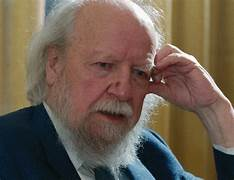
William Golding
From 1935 to 1940, Golding taught English, Greek, drama and philosophy at English schools. In 1940 he joined the Royal Navy, was assigned to a destroyer and left the Navy in 1945 as a lieutenant. He was married and had two children. He had a difficult relationship with alcohol most of his adult life. Golding published 12 novels, 2 collections and 3 non-fiction works.
The novel begins when a British aeroplane has crashed on an isolated island. The only survivors are boys in their middle childhood. A fair-haired boy named Ralph and a fat boy nicknamed Piggy find a conch shell, which Ralph uses as a horn to gather the survivors. Ralph immediately commands authority over the other surviving boys using the conch, and is elected their “chief”. A red-haired boy named Jack, and a quiet boy named Simon use Piggy’s glasses to create a signal fire. The boys become paranoid about an imaginary monster called the ‘beast’. One night, an air battle occurs near the island and the body of a fighter pilot drifts down in a parachute. Twin boys Sam and Eric mistake the corpse for the beast. Ralph leads some of the boys, including those who were to attend the fire on a wild pig hunt which culminates in a feast. Tensions rise over the maintenance of the fire and the reality of the beast. Jack makes a tribe of his boys, who paint their faces and engage in ritual dances. Simon, who discovers who the beast really is, rushes to tell Jack, but he is mistaken for the beast and killed by the frenzied boys. Jack and his tribe steal Piggy’s glasses, the only means of starting a fire. Ralph goes to Jack’s camp with Piggy, Sam, and Eric to confront Jack and retrieve the glasses. In the rebellious spirit against Ralph’s authority, the tribe drops a boulder that kills Piggy and shatters the conch. Ralph learns that Jack plans to hunt him. The next morning, Jack’s tribe sets fire to the forest. Ralph narrowly escapes the boys and the fire, and while fleeing, falls down in front of a uniformed adult – a British naval officer who has landed on the island to investigate the fire.
How can pre-adolescent boys lose their humanity, forsaking all values of friendship, kindness and justice, and become savage, murderous animals? Golding’s novel answers the question with convincing credibility. The author makes use of the wild environment, the perilous situation, the lack of any supervision, and the uncertain outlook to nudge the boys down the wrong path, but he also paints vulnerable characters, communicating inadequately, misperceiving reality to make such a horrible result entirely believable. A truly masterful piece of writing!
 William Peace Blog