World-Building with Sound

Jaimi Ryan has an article dated 11 October 2025 in Writer’s Digest on the subject of using descriptions of sound creating the world of a novel. She says, “Audio drama isn’t just about dialogue. It’s the hiss of a radiator, the crunch of boots on dry leaves and the pause before a truth is revealed. Just as novelists use language to build immersive worlds, audio creators use sound to transport listeners into spaces that exist only in the imagination.”

Jaimi Ryan is a seasoned Podcast Producer and Sound Designer with a background in music production. After pivoting from music to podcasting in 2017, she has had a wide range of podcasting experiences including podcast creation, remote recording, audio restoration, post production, content editing and hosting.

Jaimi Ryan

Jaimi offers ten examples of how sound effectively in fiction deepen world-building and heighten storytelling. Sound provides another sensory dimension to our creation of the world in the reader’s imagination.

1. Establish Setting Through Ambient Sound

Think of ambient sound as the aural equivalent of a setting paragraph. In prose, you might write: The bustling tavern smelled of smoke and spilled ale. In a podcast, you can build the same tavern with clinking glasses, murmured conversations, a lute playing softly in the corner, and the occasional burst of laughter.

A great example of this is The Magnus Archives, which often drops listeners into a location without explanation, simply using a faint hum of fluorescent lights or the drone of a tape recorder to situate listeners in an archival office.

2. Use Sound as Characterization

Characters don’t have to be introduced only with dialogue. Their sound signatures (the objects, rhythms, or textures that follow them) can give immediate recognition.

For instance, maybe a character’s arrival is always marked by the swish of warm-up pants or heavy footsteps with an irregular gate. A fantasy warrior might be defined by the clanking of armor, and maybe a futuristic smuggler always powers down a ship with a metallic sigh. These repeated cues become auditory shorthand.

3. Control Pacing With Silence

Writers know the power of white space. A sentence fragment on its own line can punch harder than a full paragraph. In audio, silence has the same effect.

A long pause before a confession can feel like holding your breath. A sudden drop into stillness after a loud scene can jar listeners into alertness. Even half a second of silence can sharpen a joke’s timing.

Think of silence not as empty, but as intentional space. The absence of sound is still a sound choice, and you want to be sure there are no unintentional silences.

4. Layer Sound for Emotional Resonance

Prose layers tone through metaphor, diction, and rhythm. Dialogue sits in the foreground, but what happens underneath can amplify emotion.

Example: A tender scene might include a faint piano or the distant chirp of crickets, lending warmth. A horror moment could include barely audible whispers under a monologue, or a low drone slowly increasing in volume, unsettling the listener without ever being directly acknowledged.

The trick is subtlety. Too many layers muddy the track. But the right two or three can make a scene unforgettable.

5. Build Tension With Repetition

Writers often use recurring images or motifs, and sound can do the same.

Consider the steady drip of water in a dungeon scene. If it returns across episodes, it builds anticipation: Why does it matter? Or a few distant, unexplained “monster roars” early on. Each recurrence adds dread until the beast finally appears.

6. Use Perspective and Proximity

Audio production can mimic point of view. A voice whispering directly in one ear (using stereo panning) creates intimacy, an almost conspiratorial feel. A muffled argument heard through a wall distances the listener, making them an eavesdropper rather than a participant.

This is the audio equivalent of close third-person versus omniscient narration. Ask yourself: how “close” should the audience feel to this moment? Then adjust the sound perspective accordingly.

7. Contrast Soundscapes

Sometimes the most effective worldbuilding comes from playing the sound against the situation. A gruesome scene underscored by cheerful music, or a high-stakes conversation happening over chirping birds or children playing can disorient the listener in interesting ways and create dramatic tension.

8. Map Geography Through Sound Cues

Listeners can “see” a space through audio cues. Footsteps shifting from tile to gravel tell us a character is moving outdoors. A voice echoing differently in each room maps an environment in our heads. For even more immersion, consider stereo panning sound effects to the left or right, or even moving from one ear to the other to put the listener in the middle of a scene. Those footsteps can move from tile to gravel, and they can also move from the left ear to the right as though the character is walking by the listener.

9. Treat Sound Effects as Symbols

Sounds can function like symbols in prose. A tolling bell might signal both time passing and the inevitability of death. If you repeat sounds strategically, they accrue significance. They become thematic shorthand, much like recurring images and motifs in a novel.

10. Marry Soundscape and Dialogue

Finally, remember that sound is your setting, your imagery, even your punctuation. Pacing is heavily affected by the way the dialogue interacts with the sound environment.

A rapid-fire exchange over pounding rain creates urgency. Slow, deliberate dialogue against a hushed forest soundscape encourages reflection. Moments of soundscape without dialogue can create immersion, tension, reflection, or whatever mood you’re trying to build while also giving the listener a moment to digest what is happening in the story.

As you experiment, listen to how other audio dramas and films use sound. Notice when a silence unnerves you, when a sound effect feels over-the-top, when background noise deepens immersion. Don’t forget to have some fun with it, audio is an exciting medium for creative storytelling.


Review: The Bustamante Story

The subtitle of this book is ‘& Behind the Scenes of Shadow Cell’. The author is ‘Harry Greene’.

After reading an article in the Atlantic about two CIA agents who fell in love on an assignment involving the creation of a shadow cell inside a global competitor of USA, I searched on Amazon for their book.

There appeared to be several, but I couldn’t find one with Shadow Cell in the main title. So I picked this one out as a likely candidate.

This book at 135 pages. The interesting information in it could have been divulged in ten pages. It is repetitious on several subjects: tight security at CIA; the two agents felt under great pressure at CIA for their relationship; the agents were clever, top performers. There were almost no examples backing up these assertions. The author is very careful to speak kindly of the CIA and the agents, and not to mention even a trivial fact which might be classified. He probably wants to be clear of any litigation, should his real name be known.

How wrong my choice was! This one is most likely a knock off of the real book (pictured below). A knock-off written by a Joe Bloggs under the pen name of a Harry Green. There is a Harry Green listed on Amazon who has written 16 fiction and non-fiction books on various subjects, none of which include the CIA. This book has an ISBN number (which no longer comes up on Amazon searches). In fact, this book no longer exists according to Amazon. This book doesn’t mention its publisher or its printer. It says only that the book was printed in New Haven, Connecticut on 10 September 2025. There is no author biography or statement of his/her relationship to the agents or the CIA. The narrator starts right in as if he had permission to tell the story.

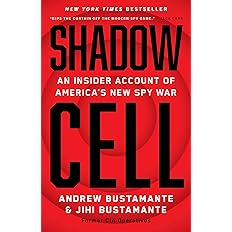
The real book: a New York Times Bestseller!

Interestingly, I don’t believe the real book was listed on amazon.co.uk when I bought the knock-off. In fact, it still doesn’t seem to be listed. I just bought a real copy on amazon.com. It was published on 9 September 2025.

So what’s all the hubbub about? Well, here’s the publicity from the real thing:

INSTANT NEW YORK TIMES BESTSELLER | A thrilling firsthand account by husband-and-wife CIA operatives who, against all odds, triumphed in a deadly cat-and-mouse game against a mole within the agency—an unprecedented insider account of 21st-century spycraft in the tradition of Argo and Black Ops.
 
Andrew and Jihi Bustamante were a “tandem couple”: married spies who’d dedicated their lives to the CIA. They met as trainees at Langley, and got married while hunting terrorists across the globe. Then, suddenly, they were assigned to a mission so sensitive and explosive that the CIA still has never acknowledged it. The CIA’s source network in a country code-named “Falcon”—one of America’s most formidable rivals—had been compromised by a mole, and the agency needed a new way to collect intelligence there. Young newlyweds, the Bustamantes were considered safe choices for this daunting task precisely because they had no experience in Falcon. They were also loyal, forgettable, and completely disposable—operatives who could help to strengthen the CIA’s position in Falcon while simultaneously serving as bait for the mole.
 
But although their superiors at the CIA didn’t realize it, the Bustamantes also brought another advantage to the table: a granular understanding of how terrorist cells operate, and how the agency could exploit those same tactics to keep America safe. Assembling a rag-tag team of fellow operatives and recruiting new sources from Falcon, the Bustamantes pioneered a new way of spying by building a cell of their own—right at the heart of the CIA.

The propulsive, untold tale of one of history’s greatest intelligence crises and the unlikely band of agents who were sent in to clean up the mess, Shadow Cell allows us to peer behind the curtain to see how today’s spy wars are being fought—and won.”

AI Controversy

There is an article in the Atlantic magazine on 19 September about how the publishing industry views AI. It is written by Boris Kachka, Senior Editor of the Atlantic. He titles the article ‘Publishing’s New Microgenre’

Boris Kachka

“Book publishing has, let’s say, a complicated relationship with artificial intelligence. Earlier this month, Anthropic settled a lawsuit brought by authors and publishers, agreeing to pay $1.5 billion after training its chatbot, Claude, on pirated text; hundreds of such copyright lawsuits against data-scraping tech companies are still making their way through the courts. Many in the culture industries see AI as not just a thief but an existential competitor, ready to replace human writers at every turn. Yet publishers are also fascinated by the technology (and not only because they use it for marketing and other tasks). The major imprints have been churning out a robust collection of books (more than 20 this year, by my count) that explain, extol, deride, fictionalize, and occasionally incorporate AI.

Among these recent releases, one overarching theme is a debate occurring between so-called accelerationists and doomers—those who think superintelligence will hugely benefit humanity and those who suspect it will kill us all. Adam Becker, a journalist and former astrophysicist, disagrees with both groups. Becker, the author of the recent anti-utopian critique More Everything Forever, wrote about his problems with a new dystopian manifesto, If Anyone Builds It, Everyone Dies, by Eliezer Yudkowsky and Nate Soares.

Becker’s main objection to both sides is that they overhype the long-term, world-altering effects of superintelligence while downplaying the “much more immediate and well-founded concerns about the dangers of thoughtlessly deployed technology,” he writes. The kinds of ongoing changes that he would prefer to focus on are well accounted for in 2025’s AI book haul. Readers can find out more about how AI’s processes resemble the workings of our brains (or don’t); how the technology is changing medicine, warfare, education, business, and politics; how it has already profoundly altered society. But to me, the most interesting of the crop (or maybe just the most fun) are the works that explore our individual relationships with AI, through fiction or memoir.

Novels such as Amy Shearn’s Animal Instinct and Jayson Greene’s UnWorld imagine chatbots standing in for boyfriends or dead loved ones; politician-author Stacey Abrams invents a rogue medical-AI company in her latest legal thriller, Coded Justice. Hamid Ismailov’s wildly experimental novel We Computers, translated from Uzbek and longlisted for a 2025 National Book Award, creates an alternate history in which a 1980s computer intelligently generates a new kind of mind-expanding, transnational literature.

Occupying a category all its own is Searches, a fragmented memoir in which Vauhini Vara works through her complex feelings about technology. Vara interweaves the story of the rise of the internet with the narrative of her life and work as a tech reporter. She also includes strange interludes: prose-poetic lists of her Google searches; a collection of her Amazon-purchase reviews; and, most strikingly, a series of long interactions with ChatGPT-3 as she works to revise an essay about a sister who died years ago. As Matteo Wong noted in his Atlantic article about the book, the large language model produced what Vara considered to be the essay’s best lines while also inserting plenty of lies. She wound up employing the bot not to think for her, but to prod her into a different kind of thinking; it forced her, she writes, “to assert my own consciousness by writing against the falsehoods.” I enjoyed the book in part because it was less about what technology is doing to us than what we are doing in response.”

Dan Brown’s New Novel

On the AP website there is an interview of Dan Brown written by Hillel Italie, which explores his writing techniques in the context of his new novel, Secret of Secrets.

Dan Brown

Brown says, “Anybody who writes a thriller needs to have a plan. There’s a great saying that the thriller writer who starts a book without knowing where’s he’s going is just lying,” he told The Associated Press on Tuesday.

“And certainly these books are very complicated. One way I sort of battle, trying to keep it all straight, is to write every single day, just to keep it fresh. If I go through two sleep cycles (without writing), it starts to evaporate. And, of course, I also have what looks like a detective’s chalkboard in a police station. We’ve got the pictures and the yarn and the notes and the sticky notes, all that on my wall trying to keep it straight as well.”

Brown’s “The Secret of Secrets” has been published this week, a 650-page thriller and mind-bender from the author known worldwide for “The Da Vinci Code”, “Angels & Demons” and other million sellers. Brown again combines suspense, philosophical digressions and travelogues, along with codes and puzzles and secret societies as he dispatches favorite protagonist Robert Langdon to Prague and ensnares him in a deadly, international race for the key to ultimate wisdom — what happens when we die.

Besides Langdon, the Harvard symbologist who has found adventure and trouble everywhere from Paris to Washington, D.C., Brown has brought back love interest/noetic scientist-in-distress Katherine Solomon and a New York-based book editor with a very real-life counterpart. “Jonas Faukman” is an anagram for Brown’s editor at Doubleday Books, Jason Kaufman, who has worked with the author for more than 20 years. Author and editor are good friends, they say, although that didn’t keep Brown from subjecting Faukman to abduction and other un-literary experiences in his latest book.

“I always enjoy getting manuscripts from Dan and seeing where he’s going,” Kaufman told the AP recently. “I have to ask him not to tell me in advance what he has in mind. He always finds new ways to surprise me.”

Brown also spoke with the AP about how he decides on his subjects, his evolving thoughts on mortality and why Prague is the perfect setting for a few conspiracies. This interview has been edited for clarity and brevity.

AP: How do you go about deciding what to write about?

BROWN: It’s no secret that I like to write about big topics and there really is no topic that is bigger than consciousness. It is the lens through which we see ourselves. And so the real challenge was how to make a concrete urgent modern thriller about something that’s so ethereal.

About eight years ago, my mom passed away about the time that I was thinking of writing about consciousness, and I started asking myself, “What happens when we die?” and if you’d asked me eight years, ago, I’d say nothing It’s full stop total blackness. Over the course of the eight years that took me to write this book and all the conversations that I had with philosophers and physicists and noetic scientists, I’ve come out the other side with a totally different mindset. And in fact, it sounds crazy. I no longer fear death.

AP: Before you worked on this book, did you consider yourself an atheist? An agnostic? How would you have described yourself?

BROWN: I grew up Christian, Episcopalian, but I moved away from the organized nature of religion. I’ve always been spiritual and sensed there’s something else, but I’ve also been skeptical and said, “Well, that sense of there’s just something else could just be wishful thinking.” It could be because it’s so hard to imagine that there’s nothing else that we just sort of say, “Well, I sense there’s some thing else.”

And now I do sense there’s something else. And that is from an intellectual standpoint. I have not had a religious experience, a spiritual experience, an outer body experience, or near death experience. This change of mind comes from looking at the science that is happening right now in the world of physics and noetics.

AP: Some people talk about the creative process, so to speak, as almost a religious experience, that moment the idea comes to you, whether it’s the right phrase or a piece of music.

BROWN: It’s called flow, a muse. Certainly, we writers have that experience of, “Ah, I’ve got it. It’s just flowing through me.” I have certainly felt that. Not every day, unfortunately. There’s a lot of trial and error, but that is the feeling that creative people are always looking for. My mom was a professional musician. I was brought up to be a musician. I thought I would be a musician. I still play piano every day. I studied music composition in university, and I’ve had that experience also with music.

That sort of muse moment when something flows in, it’s different between writing and music. Writing sort of feels like finding the right Lego piece to put in. You say, “Ah.” It’s almost like doing a jigsaw puzzle. You’re like, “Got it. It fits.” And music is a little bit more fluid. It’s like making a big brush stroke. And the melody just sort of flows in and finds its way to your hands, and then it exists.

AP: The cities you set your books in are so important to what you do. Do you have a kind of wish list? Like, “I need to set a book in this city.”

BROWN: I mean, there are a few of them that I won’t mention because I don’t want people running out, and they’re sort of off the beaten path, kind of like Prague is.

I like to use location as a character. I want to make sure that, whatever book it is, it could only be set there. “The Lost Symbol” could only be set in D.C. because it’s about the symbology of D.C. “The Da Vinci Code” could only be set in Paris because it is about the Roseland. “The Secret of Secrets,” about human consciousness, could only be set in Prague. It’s been the mystical capital of Europe since Emperor Rudolf II (in the late 16th-early 17th centuries) brought all the mystics and scribes and alchemists to Prague. And as a character, Prague is perfect for Langdon. It’s full of secret passageways and cathedrals and monasteries and all, that’s his world.

AP: Puzzles and mystery and passageways, that’s just endlessly fascinating to you? It’s as interesting to you now as when you were 10 or 20?

BROWN: I don’t know what that says about me, but yeah, I still love secret passageways. You talk about that “aha” moment. It’s kind of the same thing to say, “Wait, there’s something here that you don’t see and now you see it.” It’s the same kind of sensation of “aha.”

Review: The Road to Freedom

This book was recommended to me by an Italian niece, a brilliant mathematician, who works at a university, guiding doctoral candidates in writing their economic theses. She said, “Joseph Stiglitz is my hero.”

Joseph Eugene Stiglitz (born February 9, 1943) is an American New Keynesian economist, a public policy analyst, political activist, and a professor at Columbia University. He is a recipient of the Noble Memorial Prize in Economic Sciences (2001) and the John Bates Clark Medal (1979). He is a former senior vice president and chief economist of the World Bank. He is also a former member and chairman of the U.S. Council of Economic Advisers. He is known for his support for the Georgist public finance theory and for his critical view of the management of globalization, of laissez-faire economists (whom he calls “free-market fundamentalists”), and of international institutions such as the International Monetary Fund and the World Bank.

Joseph Stiglitz

The sub-title of this book is “Economics and the Good Society”, but the key word is “freedom”, and the key theme is that in society if one individual, group, company, institution, or market is given more freedom, some individual or group will have less freedom. And Stiglitz’ point is that in the US today (and in much of the developed world), the economic system (neoliberal capitalism) and its attendant political philosophy has failed because it waves the freedom flag but it neglects the many people who are harmed by the freedoms given to corporations, institutions and powerful individuals. The US does not understand that markets are not self-correcting, and require regulation. The author says that free and unfettered markets have conveyed great wealth and power to a few individuals but have exploited consumers, workers and the environment. Moreover, free markets have delivered financial, opioid and inequality crises. The book is rich with specific examples of how free markets have failed. He contends, in addition, that control of the environment, health and property – particularly intellectual property – should be improved. His arguments for what he calls progressive capitalism, and what it would do differently are compelling.There is an eight page chart summarizing the failures of neoliberal economics and what progressive capitalism’s corrective policies would be.

One cannot help feeling that the prescription for putting progressive capitalism in place is missing. I, for one, am sold on progressive capitalism. How can we implement it? But the barriers to change are enormous. The entire Republican party is wholly committed to neoliberal capitalism. Millions of wealthy, powerful people depend on it. It is ingrained in the American culture. A huge educational effort would be required to gain the understanding of the American people. The change is so fundamental that it cries out for a constitutional change. But that would never happen. What is more possible is the Democratic Party taking up the ideology and implementing it gradually over the course of a generation. In the meantime we have the first step in Stiglitz’ book: we know what’s wrong with neoliberal economics, and that makes it essential reading for every American.

Getting Accents and Dialects Right

Harry Bingham’s email of last week deals with the tricky subject of how to write in accents or dialogue convincing but not condescending.

Harry is the founder and CEO of Jericho Writers.

Harry said, “So here is an example of transcribing a character’s voice in a patronising way:

Eet eez ’orrible to ’ear ze proud Frensh race beleettled in zis stooped manner.

But what the character involved has actually said here is:

It is horrible to hear the proud French race belittled in this stupid manner.

The first sentence, by transcribing its pronunciations in a very literal way, makes the speaker come across as ludicrous – cartoony, a circus clown with a striped jumper, a string of onions and a comical moustache. But what’s actually comical? The sentence itself displays perfect command of English, and what’s being apparently laughed at here is an accent, over which the speaker has very little control.

And, golly gosh, that’s a slippery slope.

Most people writing a non-English character in this way will (if English) speak roughly RP, or Received Pronunciation – in effect, roughly what a BBC newsreader used to sound like. In the US, it’s much the same thing, except that the reference dialect is Standard American English.

(And, please note, in RP English, we say “She placed the glahss on the grahss next to her great big – handbag.” But we wouldn’t even conceive of inserting the letter H into the two italicised words to mark the weird pronunciation. Nor do we adjust the spelling to take care of the flat “a” sound in American and North-British versions of those words. So when it comes to our weird pronunciations, we don’t even think of trying to reflect them in spelling.)

And of course, as soon as you start to accord any kind of typographic privilege to a particular accent – whether RP or SAE – you get into all sorts of bother.

It’s one thing to have a comical Frenchman – France is a nuclear power and can look after itself – but do you really want to apply the same diminishing treatment to, say, a black resident of Harlem? Or a Scouser? Or a northern woman of Pakistani heritage? Or a Mexican immigrant?

The answer, if you haven’t already figured it out is, No, certainly not. Don’t go there. Step away from the quirky spellings.

That’s partly because of a perfectly legitimate anxiety about racism.

But it’s also just a recognition of modern linguistics. The RP / SAE dialects are simply two dialects amongst many, many others. They don’t come with a halo over them that says, “the king/President speaks this way, so this version is right and everything else is wrong.” The fact is that we all speak the dialect of our culture and each dialect has no more or less validity than the next.

That’s not just true of pronunciation. It’s true of grammar too. Any significant dialect has its own grammar, which may differ from SAE / RP grammar (which, by the way, each differ from each other.) So African-American Vernacular English has its own strict rules of grammar, that are just different from SAE – and not just different, but with subtleties that SAE struggles to cope with. SAE has four basic past tenses: I did buy it, I have bought it, I bought it, I had bought it. AAVE has five, but differently structured: I been bought it, I bought it, I done bought it, I did buy it, I do buy it.

What does all this tell us?

It tells us (duh!) that other people may speak differently from us.

It tells us (duh!) that it’s not respectful or, in fact, linguistically accurate, to privilege one set of accents or grammars over another.

And that means that the solution for a novelist is quite easy:

  1. Don’t try to capture nuances of accent in the way you transcribe speech. We don’t write “grahss” if we try to capture how the king of England speaks. We don’t write “eet eez ’orrible” if we try to capture how President Macron expresses himself.
  2. Do use the actual words that your character uses. President Macron is probably more likely than the rest of us to use the word voila even when speaking English. And if he says it, that’s what you write. Likewise, if a Black American character says finna (a contraction of fixing to or going to) then that’s the word you write down. It IS a word; it just isn’t an SAE / RP word. Don’t patronise your characters by editing their speech.
  3. Do use the grammar that your character adopts. So if your character is African-American, she might say ‘I done bought it’, in which case you write, ‘I done bought it.’
  4. For that matter, most of us are perfectly adept at code-shifting, so that same character might speak using AAVE when at home with her mother, but might use SAE when (say) running for President of the United States. And if your character code-shifts, you code-shift right along with her.
  5. The same goes for English spoken as a second language. Let’s say your novel features a top French footballer, who possibly now plays for Real Madrid. Perhaps that footballer says, “I do not chase after the records.” No native English speaker would naturally put the word “the” into that sentence, and nearly all English footballers would say “don’t” rather than “do not.” So you don’t need to do anything as condescending as write “Eet ees ’orrible” in order to hear the Frenchness in the speaker. You just have a careful ear for those non-native uses and let the reader intuit the rest. They definitely will.

I think the only time this is liable to get complicated is in relation to languages that are highly related to English, but aren’t actually English.

A lot of you will have encountered the broad Yorkshire speech of Wuthering Heights. This for example:

‘What are ye for?’ he shouted. ‘T’ maister’s down i’ t’ fowld. Go round by th’ end o’ t’ laith, if ye went to spake to him.’

Would that be better with “the master’s down in the fold”? And well – I don’t know. You can call it both ways. The modern tendency would be to eliminate some of the non-standard spelling, but in Bronte’s day, the fact was that broad Yorkshire dialect (“Tyke”) was pretty much a language to itself, related to English in much the same way as Robert Burns’ Scots is. In which case – honour the language. Give it leg room. That’s what I chose to do with my Orcadian sailor, Caff, and deliberately wrote a version of Orcadian that was damn close to impenetrable to an ordinary reader.

And if you want to do that then, (a) have fun! It’s really entertaining. And (b) get it right. I don’t speak Orcadian, I’m not Scottish, and I’ve never been to the Orkneys. So I did the best that I could with books and online resources … then wrote to the editor of an Orkney newspaper and asked for her help. She was very happy to give that to me, and I was very happy to receive it, and my readers have the joy of having a little bit more Orcadian in their lives: something we all need.”

Review: All Things Are Full of Gods

This book caught my attention as a philosophical, perhaps religious book with its subtitle: The mysteries of Mind and Life. It was written by David Bentley Hart, who is a philosopher, scholar of religion, writer, and cultural commentator. His books include The Experience of God: Being, Consciousness, Bliss and Roland in Moonlight. His current position is collaborative researcher at the University of Notre Dame.

David Bentley Hart

This book is not an easy read. The text brims with philosophical terms so that I found myself reading with my phone within easy reach to look up the unfamiliar terms. It is 483 pages long with 11 pages of footnotes and a 14 page index. Clearly, it is a scholarly masterpiece. And yet, one wants to keep reading to discover the revelation one can sense is coming, to achieve new insights, and to rediscover important truths. Rather than frame the book as an extended first-person lecture, the author has assigned the debate on the nature of existence to four Greek gods who have near infinite knowledge, the authority of being gods and engaging characters. They are: Psyche, the goddess of soul and life, Eros, Psyche’s husband and god of love, Hermes, the messenger of the gods and the divine intermediary between heaven and earth, and Hephaistos, the god of craftsmen and manufacturing; he is the deity of all technical virtuosity, ingenuity and skill. The dialogue takes place at the estate of Eros and Psyche, in one of its many gardens. Everything is in blossom. In that place everything always is. Psyche begins the debate by picking a rose and commenting on its beauty. She then leads the discussion of existence over the next several days. Hephaistos role, throughout the debate, is the represent the position of reductionist materialism philosophy, which takes the position that everything can be explained scientifically.Topics include mind, life, matter, brain, machine, soul and nature. Much of the discussion centers on the inability of some philosophers (current and ancient) to demonstrate that science (including nuclear physics, modern chemistry and quantum mechanics) does, in fact, answer all of the interesting questions.There are revelations about genetic science which prompt questions about how a living single cell ‘knows’ how to modify its own capability to respond better to its environment. The conclusion is that life, mind and language must be put it place by a ‘higher power’. In spite of many scientific attempts, life has never been produced in a laboratory. Likewise, there is no explanation for the existence of mind, in all its glory, including consciousness. Language owes its existence to mind.

Why isn’t there a condensed version of this book which uses everyday language to make the point that atheism is a dead end belief?

A must read!

“Government Speech”: A New Threat to Library Books

The Atlantic Daily, August 20, 2025, has an interesting article by Justin Richardson and Peter Parnell about how a new legal theory is being used by some libraries to ban certain books. The theory is that library books are government speech protected by the First Amendment. The government must be allowed to speak as it wishes. Thus, it can remove any library book it finds objectionable for any reason.

Justin Richardson is an associate clinical professor of psychiatry at Columbia University and the director of the university’s Center for Psychoanalytic Training and Research. In October, he will receive the Eleanor Roosevelt Award for Bravery in Literature.

Peter Parnell is a Broadway and Off Broadway playwright and TV writer. In October, he will receive the Eleanor Roosevelt Award for Bravery in Literature.

The authors say: “A decade ago, when the government of Singapore announced its decision to pulp every copy of our picture book, And Tango Makes Three, in the nation’s libraries, we felt profoundly lucky. Not for the pulping—that was alarming—but for the fact that the First Amendment guaranteed that this could never happen in America.

We’re not feeling quite so lucky anymore.

In 2023, our book was one of thousands pulled from library shelves around the country, and as we write, an evolving legal strategy being used to defend many such bans threatens to upend decades of precedent preserving the right to read. The danger this doctrine poses to free speech should worry us all—even those who would rather their children not learn about gay penguins.

In Tango, a pair of male chinstrap penguins in the Central Park Zoo become parents when a kindhearted zookeeper gives them an egg to hatch. (The story is both true and personal to us; when we wrote it, we were also trying to have a child.) Tango turned 20 in June, and for many of its years in print, it has been one of the most frequently challenged books in America. But until recently, it had never actually been removed from the collection of a public-school library, or any public library for that matter. That’s because of a 1982 Supreme Court decision establishing that freedom of speech includes the right to access the speech of others through their books. Every challenge to a public-library book since has been subject to the Court’s ruling that officials may not remove a book simply because they disagree with its viewpoint.

Things started to change for us when a teacher in Escambia County, Florida, complained that the goal of Tango was the “indoctrination” of students through an “LGBTQ agenda using penguins.” A committee responsible for reviewing educational materials for the county disagreed, concluding that the story teaches valuable lessons about science and tolerance and is appropriate for students of all ages. But the school board balked at the book’s message of acceptance. As one board member put it, “The fascination is still on that it’s two male penguins raising a chick.” Escambia pulled Tango from its school libraries, which serve roughly 40,000 children.

We sued Escambia in federal court for viewpoint discrimination (the case is ongoing). In casting about for a way to defend the ban, the school board landed on the theory that library books represent “government speech.” The government, the board explained, has its own First Amendment rights and must be allowed to speak as it wishes. Thus, it can remove any library book it finds objectionable for any reason.

When we first heard this argument, we thought it was absurd. But government-speech doctrine is not new. It was invoked by the Supreme Court in 2009, for example, to allow a Utah town to refuse to install a religious monument in a public park, and again in 2015 to permit the state of Texas to refuse to issue certain specialty license plates. Roughly speaking, the doctrine holds that any action deemed “government speech” is immune to the First Amendment claims of those whose speech is being censored.

No court had ever found that library books represent government speech before May of this year, when the United States Court of Appeals for the Fifth Circuit swept aside decades of precedent, including its own previous decisions, to allow the removal of 17 books—Isabel Wilkerson’s Caste, Maurice Sendak’s In the Night Kitchen, and Jazz Jennings’s Being Jazz, among others—from the public libraries of Llano County, Texas. Seven judges in the majority agreed that “a library’s collection decisions are government speech and therefore not subject to Free Speech challenge.” And with that, the books were gone.

The ruling will likely be appealed, and many expect that the Supreme Court will eventually have to decide whether the welter of books and opinions found in every public-library collection represents private speech that the government cannot suppress or government speech that it can censor as it wishes. Imagine the implications if the Court decides the latter. With each new school board, town council, or presidential election, a new set of books deemed out of step with the winner’s political agenda could be swept off the shelves. The government could choose with impunity to destroy any book it dislikes, whether On the Origin of Species or the Bible. The censorship of other forms of speech in public settings could soon follow.

Concern over the expanding use of government-speech claims is not limited to liberals. No less a conservative than Justice Samuel Alito has warned that the doctrine “is susceptible to dangerous misuse.” When the Supreme Court decided that Texas could censor specialty license plates, Alito issued a stinging dissent decrying what he saw as the doctrine’s encroachment on individual liberties. “Here is a test,” he offered: Imagine yourself next to a highway watching the license plates pass—plates variously honoring colleges, clubs, athletes, and cheeseburgers. “As you sat there watching these plates speed by, would you really think that the sentiments reflected in these specialty plates are the views of the State of Texas and not those of the owners of the cars?”

And what if you walked into your child’s school library and saw on its shelves Harry PotterAdventures of Huckleberry Finn, and Captain Underpants; the writings of James Baldwin and William F. Buckley Jr., Karl Marx and Adam Smith, Philip Roth, Laura Ingalls Wilder, and Alison Bechdel? Would you really think that each of these books expressed the views of your government?

We are not legal scholars. We are a playwright and a psychiatrist who wrote a children’s book about penguins. We cannot know how the justices of the Supreme Court might parse the precedents and the details of a case like ours if and when it reaches their bench. But we know where library books come from, and we know what they are for. They are not made by the government. They do not speak the government’s mind. Even small elementary-school collections speak in hundreds of disparate voices offering a wealth of perspectives on our children’s lives and their world—perspectives that all children deserve to hear.

Our daughter is one of them. Bans such as the one on Tango have marched for the past few years under the banner of “parents’ rights.” We’re parents too. And as the fathers of a now-16-year-old girl, we are determined to defend our daughter’s right to read and write and say what she wishes.

Eleven years ago, we followed the Singapore ban from a distant position of privilege that we now find embarrassing. Today, we hope Americans can learn from that example. In a nation where public demonstrations are tightly policed, hundreds of parents stood up to the government’s threat to destroy our book. On a July afternoon, they brought their young children—some in strollers, others holding their stuffies—along with copies of our book and others like it, to the steps of the National Library Building. They sat down and read to their kids. Their quietly powerful protest made international news, and the Singapore government backed down.

As we await decisions in our case and others like it across the country, we would do well to remember the value of putting our own voices to use, even or especially when the government would speak over us.”

The Death of Reading

Kara Kennedy has an article on The Telegraph, dated 21 August with the subtitle, “Britain is sprinting toward idiocracy with eyes glued to a screen”. It makes pretty disturbing reading.

Kara Kennedy is a staff writer at The Spectator World and serves as the royal correspondent for The Spectator. She also co-writes the Mom Wars on Substack, where she discusses contemporary issues relating to parental issues and societal expectations.

Ms Kennedy writes: “If you’ve made it this far, congratulations: you’re doing something most of your countrymen can’t. You’re reading, not scrolling, not skimming, not letting TikTok spoon-feed you dopamine while your eyes glaze over. Actual reading. Consecutive sentences. Whole paragraphs.

It’s a vanishing practice, according to new data. The numbers are apocalyptic. Researchers at the University of Florida and University College London have found that, in America, reading for leisure has collapsed by 40 per cent in just two decades.

In Britain, according to the National Literacy Trust, the percentage of children who say they enjoy reading has plummeted by more than a third, while the number aged between eight and 18 who read daily has been cut in half. The verdict is in: books have lost to phones. 

And when reading goes, so does everything else. Literacy isn’t ornamental. It is the bedrock of thought, imagination, politics, democracy itself. Strip it away, and what remains? A public incapable of parsing a story, let alone a policy. Already, 43 million American adults have what the government delicately calls “low literacy skills”.

The cheerier headlines insist that at least young women are still “reading”, thanks to something called “BookTok”. But what are they reading? According to reports, the hottest sellers are “the smuttiest, spiciest erotic novels” the publishing industry can churn out. This is not a literacy renaissance; it’s a paperback version of junk food, or, maybe more analogously, internet porn. If civilisation rests on werewolf fetishes, we may be in trouble.

Otherwise, no. Talk to teachers, and the picture turns bleak. Pupils twitch for their phones after three pages, as if suffering withdrawal. A professor told me his college students – legal adults – glaze over after a few paragraphs. He finally banned phones in his classroom. Miraculously, they began to read again.

And the official response to this collapse of attention? More screens. More apps. More “gamified learning”. The same poison repackaged as medicine.

Suggest banning phones and you’ll be accused of authoritarianism. Just this week, one prominent tech reporter, Taylor Lorenz, lamented that phone bans in schools “harm the most marginalised kids” since “for many underprivileged kids their phones are their only word processor”. God forbid children be forced to look at words on a paper page.

Meanwhile, the adults are just as guilty. Parents outsource parenting to iPads. Schools treat literacy as a boutique concern rather than the foundation of civilisation.

Politicians prattle on about “innovation” and “equity” while shrugging at the fact that an entire generation can no longer follow a story longer than a tweet. And Silicon Valley? They’re delighted. An illiterate, screen-addicted population is their dream market: easy to manipulate, impossible to resist. At home, of course, the tech elite send their children to phone-free Waldorf schools. “I don’t generally want my kids to be sitting in front of a TV or a computer for a long period of time,” Mark Zuckerberg once said. Quite.

Every year, fewer children read. Every year, more adults sink into functional illiteracy. The cultural muscles of focus, imagination, and memory wither further. We are not drifting into dystopia. We are sprinting toward idiocracy, eyes glued to a screen. We’re seeing the start of it now. History becomes gossip. Politics becomes memes. Culture becomes noise. The end won’t be televised. It will be reduced to bullet points for an audience that can no longer follow a sentence.”

Kurt Vonnegut Rules for Authors

In his Friday email, Harry Bingham gives his views on Kurt Vonnegut’s rules.

Harry is founder and CEO of Jericho Writers.

Harry Bingham

“1. Use the time of a total stranger in such a way that he or she will not feel the time was wasted.

That rule, I think, is bomb-proof. And, in fact, I’d make it a little stricter. I think that even high-end literary fiction has to entertain. It can’t be enough that I have a sense of having done my duty by the Gods of Literature. I need to have had fun – or have been moved – or basically just liked my experience with the book. I think entertainment is core. I’ve never knowingly broken that rule, not even writing non-fiction.

  1. Give the reader at least one character he or she can root for.

I’ve never broken that rule either, but I think it’s probably possible to break it effectively. American Psycho is a yukky book, but it’s a work of proper genius … and its genius isn’t because its protagonist likes home-baking, cat rescue and volunteering at church-run soup kitchens. That said, it’s not even 1% of books that can break that rule effectively. So as a general guide, I’m with you, Kurt.

  1. Every character should want something, even if it is only a glass of water.

Every character? I don’t know. If your protagonist has a momentary interaction with a receptionist, say, then does the receptionist need obvious motivation? On the one hand, no: truly minor characters can simply fall off the table of things you have to think about. On the other hand, here’s a snippet where Fiona does in fact interact extremely briefly with a receptionist – at a modern, ultra-secure, psychiatric institution for very violent, very dangerous offenders. (Fiona is the key character in Harry’s thrillers.)

The driver takes us in. Hands us over to a neat, blue-suited receptionist – Alys, to go by her fabric badge. She is almost blushingly young, a late teenager at a guess. She wears a tri-coloured scarf, like a seriously out-of-place air stewardess.

‘Inspector Rogers? Miss Griffiths? Etta is expecting you.’

The ‘Etta’ in question is, I assume Dr. Etta Gulleford, the hospital director, and the woman we’re here to see.

No badges, I think because the metal clips could make a weapon. Instead, plastic cards, like the key-cards they use in hotels.

‘Upstairs. Right on to the end. Julie-Ann will find you there.’

She does a crinkle-eyed smile at us, the sort you’d get at an upmarket spa.

There’s no obvious sense of desire there, of wanting something … but on the other hand, I think there probably IS something. She’s blushingly young. She wears a scarf like an out-of-place stewardess. And she offers Fiona a spa-quality, crinkle-eyed smile.

What does all that amount to? I think it amounts to the Alys very much wanting Fiona not to make a fuss. Not to do something that breaks the spell. And the spell is, effectively, that this place can be considered like a nice, posh, modern spa rather than a quasi-prison full of extremely dangerous men. It’s like Alys is saying – pleading – don’t call this out for what it really is.

So, OK, I’m going to go with Vonnegut on this one. Even extremely minor characters should have some kind of want, even if it’s undeclared, even if it’s trivial.

  1. Every sentence must do one of two things—reveal character or advance the action.

That’s probably mostly true, but it can’t be quite literally true. I think that, in the passage I just quoted, every sentence does do one of those two things. But what about this:

We watch for a while. The gulls. The waves. The rolling print of the wind on the water. Stippling squalls that turn the sea’s smooth watercolour into something jumpy and agitated, like the surface has been rubbed with gorse.

That’s not really advancing any action and it doesn’t really tell us much about Fiona, except I suppose glancingly, in the sense that the way she expresses what she sees would be different from yours or mine. But really, the point about those lines is that they describe something – they reveal the character of a place, not a person. That’s fine with me. I expect Kurt wouldn’t have a fight with me over lines like that. I like description. It’s fine.

  1. Start as close to the end as possible.

Vonnegut thought a lot about short stories and I think this rule applies both to short stories and to scenes. Enter late. It’s really easy to write 200 words of intro before you get to the meat of a scene. It’s often better to start with the meat, then use just 20-30 words a few paragraphs in to explain to the reader how they got to where they now are.

But does this rule make sense for novels? Don’t think so – or at least, I don’t think that it’s especially useful. Most of my Fiona novels start with a corpse discovery. Yes, that’s as close to the end “as possible”, but really: it’s right at the start. So: useful rule for scenes. Silly rule for books.

  1. Be a sadist. No matter how sweet and innocent your leading characters, make awful things happen to them—in order that the reader may see what they are made of.

Oh yes. Definitely. No quibbles here.

Here at Jericho Writers, we occasionally get books that tell a story such as: middle aged woman divorces cheating husband, feels a lack of purpose, gets diagnosed with cancer, takes up pottery, makes great ceramics, meets dashing ceramicist, gets the cancer all clear.

And, yeah, OK. I mean: in an actual person’s life, that’s all bad (to start with) then heart-warming (to end with.) But we all know people with stories like that. And – readers don’t care. They want really bad stuff to happen to characters. They’re sadists. So you have to be too. That’s just how it is.

  1. Write to please just one person. If you open a window and make love to the world, so to speak, your story will get pneumonia.

Yes. I agree with that. (It’s also, by the way, an exceptionally good rule for marketing books too. Sell hard to your ideal reader. Bore the rest. Ignore the rest.)

But I think it’s not clear enough. Who is that person? In the end, there’s only one person who matters and that’s you. Every line you write, every word choice you make, you’re just asking the question: do I like this? Or that? Which pleases me more?

So your task as a writer is to develop your tastes as far and as finely as possible. You can’t do that in isolation from the broad sweep of contemporary writing. You have to develop your own taste with reference to what others read. But still – write to please just one person. And make it you.

  1. Give your readers as much information as possible as soon as possible. To heck with suspense. Readers should have such complete understanding of what is going on, where and why, that they could finish the story themselves, should cockroaches eat the last few pages.

Uh, Kurt? This is just BS, and he surely knew it.

I mean the cockroaches/pages thing: OK, yes, at that point, I think there is often a kind of solid inevitability in play … but not always. In one of my Fiona books, Fiona ends up clapping handcuffs on the dastardly people who tried to imprison her (in a very weird way.) That part plays out as the reader should by then expect.

But then, a Ukrainian millionaire tries to bribe her … and she (in a Fiona-y way) semi-accepts the offer.

And a girl who went missing needs to be reunited with her father, and Fiona does just that.

Both of those things make sense from what went before, but I don’t think any reader could plausibly have mapped out either scene. So, sorry, Kurt, no way. I think you were having a laugh.”