Review: Do No Harm

My wife recommended this book to me.  It was written by a neurosurgeon, Henry Marsh, to whom she was referred with back pain.  We both met him in his outpatient clinic, and he impressed us – partly because he said that no surgery would be required.  When Mr Marsh’s book was published and was shortlisted for a 2014 Costa Award, my wife naturally wanted to read it.
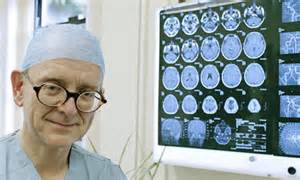
thNU4LCIHQ

Henry Marsh

The book is subtitled “Stories of Life, Death and Brain Surgery”, and I found it to be a very engaging read.  The subject matter: brain surgery is quite mysterious, but Mr Marsh explains procedures so that the main points are quite understandable without being technically obscure.  His writing flows pleasantly, and sincerely; one never feels that he is the least bit condescending.  In fact, he lays bare the mistakes he has made in surgery, and reveals the anguish he has felt.  Successful, life-saving procedures are dealt with matter-of-factly.  With twenty-five chapters, each dealing with a different condition, one feels well-exposed to brain surgery.  Mr Marsh tells the reader of his development from nursing aide to med school, through the doctors’ hierarchy to consultant, and includes vignettes of the teaching of junior doctors.  The book is not from a doctor’s perspective only; he reveals the thinking and the feelings of patients, too.  The hospital setting is covered: nurses are caring but over-worked; managers are bureaucratic, unsympathetic and stubborn.  Stories from his voluntary practice in Ukraine are included, as well, and these provide a strong contrast to the state of the art and the clinical and management culture in the UK.

One can’t help but feel, as one reads the book: Why in the world would anyone want to be a neurosurgeon, given the complex opportunities for failure?  Mr Marsh doesn’t answer this question directly, but I think his view would be that the euphoria that one can feel from saving a life or advancing the technology more than offsets the anguish one feels from a mistake that leaves a patient paralysed.  Given, therefore, that a neurosurgeon has control over the life and death of his (or her) patients, Isn’t it tempting for a neurosurgeon to feel like a god?  Again, Mr Marsh does not answer directly.  He seems to say that any pretence at being a god is destroyed in the humility of the learning process.

Do No Harm was one of five books shortlisted in the biography category of a Costa Book Award in 2014.  The winning book was H is for Hawk by Helen Macdonald about  her struggle to train a goshawk.  On the face of it, one would think that Marsh’s book would have a leg up: after all, a book about the ramifications of life-saving surgery sounds more important than the difficulty of training a very wild animal.  Perhaps a clue can be found in what the Costa judges said about H is for Hawk: “A unique and beautiful book with a searing emotional honesty, and descriptive language that is unparalleled in modern literature.”  I haven’t read H is for Hawk, but what I think the judges are saying is that Helen Macdonald’s writing is what won the prize for her.  Still, I would recommend putting Do No Harm at the top of your reading list.

Review: Sable Shadow and The Presence

Readers Favorite has awarded Sable Shadow and The Presence Five Stars:

5star-flat-hr

Their review of the novel is as follows:

Author: William Peace

Genre: Fiction –

General   Appearance: Cover, Construction, Chapter Headings, Illustrations, Table of Contents 5

The appearance of a book makes a dramatic difference in the experience of the reader. Appearance includes everything from an enticing cover and intriguing table of contents, to interesting chapter headings and eye-catching illustrations. This book excelled in all of these areas.

Plot: Concept, Characters, Originality 5

The characters of a book should be well defined, and while they do not have to be likable, the reader does have to be able to form a connection with them. The theme should be consistent and the plot should be original or told from a unique perspective. All of these elements are exceptionally well done in this book.

Development: Description, Dialogue, Creativity, Organization, Length, Fluidity, Coherence 5

Besides the plot, the development of a book is the most critical. The dialogue should be realistic, the descriptions should be vivid, and the material should be concise and flow smoothly. The development of this book is very well done.

Formatting: Editing, Proofreading, Layout 4

Editing and proofreading is where most authors fail. An author should have more than one person proofread their book. The best plot will fail if the reader has to stumble through misspelled words, misused words, bad punctuation, and poor grammar. This book needs a bit of editing.

Marketability: Theme, Subject Matter, Size of Target Audience 5

Marketability refers to how well your book can be marketed and sold. The larger the target audience a book has, the greater the value it will have to publishers and retailers. Although this element is not indicative of the quality of a book, it is important to the success of a book. This book has a wide appeal and can be marketed to many types of readers.

Overall Opinion: Overall Starred Rating 5

This rating takes into account all previous elements and the reader’s overall opinion of the book. This is an excellent, very well written book.

Review: Reviewed by Mamta Madhavan for Readers’ Favorite
Sable Shadow & The Presence by William Peace is the the fictional autobiography of Henry Lawson who hears two voices from his childhood. These two voices represent good and evil and, like any of us, Henry also hears them while making decisions. The story takes us through Henry’s childhood to his college days, to his relationships, to his marriage and his business. Henry suffers a series of tragedies at the peak of his career which sees him attempting suicide. He recovers from that dark phase with the help of his wife and a psychiatrist. It is a story of triumph, tragedy, good, and evil.
The book has many interesting twists and turns in the plot. The author’s fascination for existentialism is revealed through Henry Lawson’s interest in the writings of Jean-Paul Sartre. That contributes a lot of wisdom in the discussions that occur in the story. The characters are well developed and they help in making the plot strong and powerful. There are some thought provoking details on good and evil which give readers an opportunity to think more about their individual beliefs and ideas. I found the representation of the good and the bad voices very practical and relatable. Readers can connect to that very easily.
The character of Henry Lawson has many shades which make him an interesting person. The author has captured well the triumph, tragedy, good, evil, sorrows, and happiness of human life that are palpable
good, evil, sorrows, and happiness of human life that are palpable while reading the book.

Recent Award

Sable Shadow and The Presence just received its sixth literary award: Reader’s Choice Awards 2014: Honourable Mention, Memoir/ Autobiography/Biography.  I am grateful for the recognition, but I’m not sure Sable Shadow and The Presence fits into the Memoir/Autobiography/Biography category.  As fiction, it isn’t an autobiography, and while my dictionary doesn’t say so, I think that, in common usage, the subject of a memoir or biography is a real person, living or dead.  Any way, thank you, Reader’s Choice.

Four of the awards were presented in Hollywood on the 22nd of March.  If Hollywood were a bit less than a 10 hour flight away, I might have gone to receive the awards.  I tried to call on family members in the vicinity of Hollywood to attend on my behalf, without success.  If someone had been able to attend for me, and if they wanted to know what to say in the way of an acceptance speech, I would have given them the gist of my acceptance at the London Book Festival (fifth award – runner-up – general fiction), which was:

When I started to write Sable Shadow and The Presence, I had in mind writing it in the first person (as a fictional autobiography) – something I had never done before.  I also wanted the story to be about a person, who, as a child, hears voices that he eventually attributes to representatives of God and the devil.  I wrote about four chapters and sent them to a friend of mine who is very well educated, a reader of quality literature and quite direct in his views on matters of interest.  He sent me an email a couple of weeks later in which he said: “Boring!”

I had to admit that I saw his point, and I, too, was struggling with the book.  I put it aside, and I wrote The Iranian Scorpion.  But, I still felt that, hidden in the basic idea, was a good book.  By the time The Iranian Scorpion was finished, I had some new ideas to add to the abandoned manuscript.  I wanted to say some things about existentialism, human identity, tragedy, religion and relationships.  So, I developed a new outline, re-wrote the first four chapters and finished the novel.  It was edited and published.  I decided to give the printer’s proof copy to my friend Peter, who had thought that my aborted attempt was ‘Boring!”‘.  About three days later, I got an email from him in which he said: “Congratulations Bill!  An outstanding achievement!  I couldn’t put it down, meals no meals, I swallowed the book in two days. Your prose has become self assured. you dominate it, rather  than being dominated by it.  The research, as ever is superb, and also completely open to being understood by the layman. . . . You have certainly managed to recreate  life as it is lived – even to the pertinent introduction of the meta-physical element – though a bit wobbly in spots, it stands solid, protected by Sartre. . . . I like it and feel close to it – I guess that’s one of the reasons why I think it such a  remarkable creation.  Your progressive development of style, skills and plot makes my mouth water for the goodies to come.Thank you from me, but really from all your readers.”

In London, I said I wanted to thank Peter for his two critiques, but, in particular, for the first critique.  And I thanked the London Book Festival for their selection.