There is an article on the Writer’s Digest website written by Jenna Kernan in which she says, “How much backstory is too much backstory, and how do we know when we haven’t given enough?”
Jenna Kernan
‘Bestselling author Jenna Kernan writes gripping domestic thrillers. Her 2021 release, A Killer’s Daughter, won the bronze medal from the Florida Book Awards in the popular fiction category and her next release, The Adoption, arrives in May 2022 and features a couple whose adoption goes from blissful to terrifying when a dark secret and menacing stranger threaten the baby.’
Ms Kernan says, “My upcoming domestic thriller, The Adoption, has a complicated backstory. That got me thinking how best to weave all those interesting, life-changing events from the past into the book. These experiences proved pivotal in the thriller, but how to reveal the past for the biggest punch in the present?
1. Don’t relate more than the briefest backstory in the first chapter because you need to create momentum, and backstory will stop progress dead. Too much too early can halt the main plot. Also, the reader won’t care about all those details until you’ve established empathy for and curiosity about your protagonist.
2. Do avoid dropping a block of backstory as introspection, where the protagonist is deep in thought. Consider dribbling in backstory, drop-by-drop, like a drip coffee maker. I know of one popular author who writes out the entire traumatic experience of each protagonist in real time, including dialogue. After she has this all-important, pivotal, life-shaping, worldview-shifting scene, she breaks it into tiny pieces and inserts it as internal thought at critical times in the first half of the story. It works and keeps the narrative moving.So, consider breaking up the flashback and weaving it into several scenes for greater impact.
3. Don’t forget that introspection is only one way to introduce backstory. Other options are dialogue and action.
4. Do use actions to present core beliefs forged in the past. Does your character repeatedly check the front door lock as they recall a traumatic experience with a home invasion?
5. Don’t skimp on the use of discourse to reveal backstory. A conversation or argument is an interesting way to reveal a character’s past. Dialogue amps up the conflict more effectively than a slap. Who can forget the plot shifting backstory dialogue, “Luke I am your father?”
6. Do show a character holds a certain mistaken core belief because of a past trauma or life-shaping event. Such backstory details can make irrational actions believable. In fact, if you want a character to adopt a particular conviction, creating the right past experience is critical. Your characters come to situations holding certain core beliefs and assumptions and will respond accordingly. A person attacked by a strange dog might assume all big dogs are dangerous unless additional life-experiences oppose this belief and cause the character to change, for example, by meeting several lovely, gentle big dogs.
7. Don’t make the backstory more compelling than the forward story. The backstory creates the character’s worldview, their belief system, and the mistaken belief which will change as they experience their journey. But the past isn’t the story, or it should be told in real time.
8. Do consider using a flashback for a longer backstory incident which relates to the forward narrative. Some writers avoid flashbacks, others use them to great effect.
9. Don’t create details which do not affect the narrative or aren’t needed to understand the story or your protagonist’s motivation and beliefs. Remember, not everything which happened in a protagonist’s past applies to the main plot. If there is no dog in your story, you don’t need to have the protagonist mention he hates them unless this is the reason for the fight with his dog-loving girlfriend.
10. Do relate backstory naturally, avoiding contrived reveals. You know, those scenes when one character explains something which another character already knows for the sole purpose of disclosing this information to the reader. “Remember when we were attacked by that bear, and it tore your arm off?” The reader might be thinking, “Oh, so that’s how that arm came off!” and then, “Wait a minute, that other character should definitely know that without being reminded.” Two characters talking about stuff they clearly already know is an awkward way to deliver backstory, so avoid it when possible.
11. Don’t let anyone tell you backstory shouldn’t be in your story. It might well be the most important part of your characterization.
12. Just do be conscientious about how, where, and why you include backstory.
This all very good advice. Backstory can be vital to a vibrant story, if just enough is revealed. Too much becomes a distraction. I should add that there is another way to tell backstory apart from introspection, dialogue and action. It can also be told through research on the Internet or the media.
I was attracted to this book by a favourable review and by it having been on the Sunday Times bestseller list. It was written by Layla F Saad, “who is a writer, speaker, and podcast host on the topics of race, identity, leadership, personal transformation and social change. As a East African, Arab, British, Black, Muslim woman who was born in and grew up in the UK and currently lives in Qatar, Layla has always sat at a unique intersection of identities from which she us able to draw rich and intriguing perspectives.”
The book cover
You’ll notice the subtitle, “How to Recognise Your Privilege, Combat Racism and Change the World”. Before I opened the book, I didn’t expect to learn a great deal from it, but I do recognise my privilege, having grown up in an environment of private education. And I think it is fair to say that my mother and grandparents were racist. I never accepted my mother’s views, or the views of my Navy colleagues who were white, Southern officers. I felt they were wrong, but I’m sorry to admit that I didn’t ‘call them out’.
Ms Saad’s book is very well organised. After several chapters which lay the groundwork very clearly and well, the book has a chapter-a-day format for four weeks. In each chapter, a particular aspect of white supremacy is described in depth. There is a chapter, for example, on white fragility in which the action is explained, examples are given, when it shows up, why it’s important to understand it, and some searching questions for the reader on his/her experience and understanding of white fragility. The reader is asked to write their answers in a journal. For me the number of actions which make up white supremacy is astonishing. Many of them, like tone policing, I never heard of before, but I could see how each action contributed to the white supremacy structure.
Toward the end of the book, Ms Saad begins to move the reader gradually toward action, with chapters like, You and Your Friends, You and Your Family, You and Your Values, You and Losing Privilege, You and Your Commitments. She lists a number of possible commitments. One, for example, is “I am committed to my lifelong antiracist education by . . .” There is also a section toward the end of the book that deals with how groups should work through the book together.
Probably the best aspect of this book is its persuasiveness. Ms Saad’s tone is friendly, factual, clear and certain. She knows what is wrong and how to correct it. This book will stay with me for the rest of my life. It should be required reading for every sensible white person.
My tenth novel “Grand Uncle Bertie” has just been published by Austin Macauley.
The synopsis of the novel is: Granduncle Bertie is the story of a frightened but determined man’s struggles to live a life that has value for him and others in the face of death. It is set in contemporary Wandsworth, London.
Sarah, a gay, free-spirited artist in her late twenties, accepts the assignment from her granduncle, Bertie Smithson, to write his memoir.
In her first interview, Sarah discovers that Bertie has a morbid premonition of his own death brought about by his father’s remonstrations against God during his fatal illness. During his mother’s funeral, Bertie reveals his own agnosticism, and his brother’s partner tells him that the fear of death can be overcome by a combination of faith, a deeply satisfying vocation, and meaningful family relationships. Bertie has none of these. With the death of his mother, Bertie must also become the patriarch of the family.
Bertie and his wife, Jo, move into his parents larger, memory-filled home. During a holiday in Seaford, Bertie is shocked by the sudden death of a close relative. This reinforces his own fears that his life may be cut short. Bertie turns to his Catholic wife, Jo, for solace but Jo tells him that for his faith to be real, he must develop it himself.
Later, Bertie is shocked to discover that Jo had an affair with another man. He confronts Jo who confesses her ‘dreadful sin’ in agony. Bertie weighs the alternatives and forgives her.
Confronted with a series of family misadventures, including an incipient affair, theft, and selfishness, Bertie learns that a patriarch must be a disciplinarian as well as a wise leader.
Bertie is unable to relieve his younger brother Jason’s depression. When Jason commits suicide, Bertie fails to understand Jason’s death.
Sarah recalls Heather, Bertie’s granddaughter, who dies of leukaemia in spite of a stem cell transplant. Bertie wishes he could have given up his life to save her.
There is an argument between Bertie and Jo about whether their youngest, Elizabeth, should have an abortion as a result of a failed liaison, Bertie accompanies his daughter to the clinic.
In chance meetings with the ‘Professor’, a black mystic-philosopher, Bertie is introduced to the idea of a ‘fourth dimension’, a spiritual universe which parallels the matter-space universe.
Later, Bertie, in his struggle to find faith, discovers the Jewish concept of Emunah, a commitment to God. In debates with a Catholic priest, he acknowledges the role of the devil in human tragedies.
Determined to start a meaningful second career as a writer of children’s books, Bertie overcomes obstacles and enjoys success with Sarah as a writer-artist team. He learns that Sarah is gay. Despite her fears, Bertie accepts her.
Bertie discovers Hindu concepts of an infinite universe. He tries to reconcile the events of his life, concluding that life comes from God in the form of a spirit.
Enrolling on the Alpha Course, Bertie experiences awareness, completeness and asylum that never leaves him. With Jo, he discovers the delight of teaching year four Sunday school. He learns that he has an incurable brain cancer and dies in his sleep, surrounded by family and friends.
When I first drafted Granduncle Bertie, the narrator was the protagonist, and one literary agent told me that the story lacked tension. In order to increase the temperature of the narration, I re-wrote it to make Sarah, a young woman with a different view of life the co-narrator. This allows for disagreements and different interpretations of events.
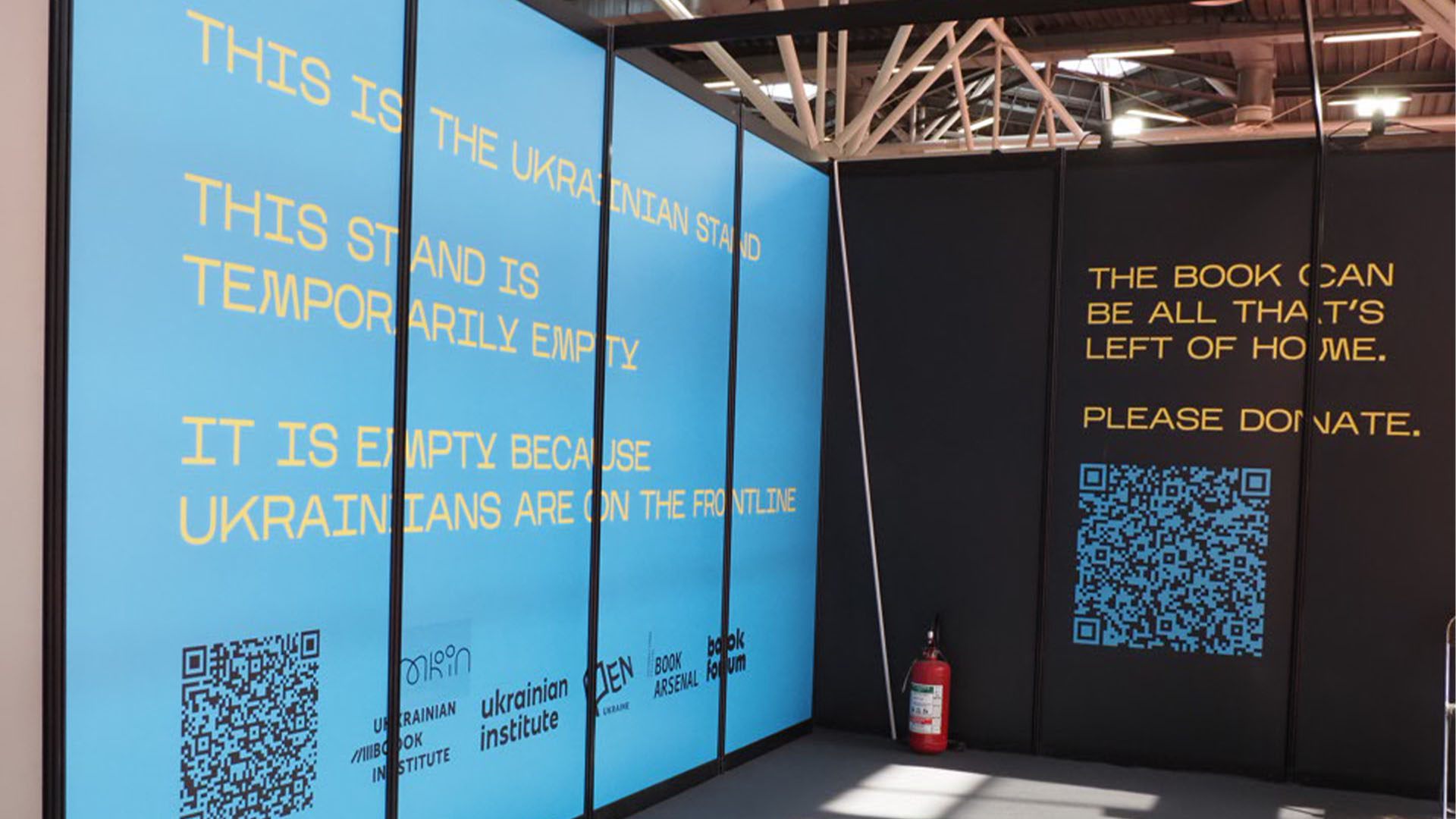
There is an article on The Bookseller website if April 8, 2022, written by Kateryna Nosko, a Ukrainian publisher, who describes how colleagues and peers continue to write, publish, sell and salvage their work in the midst of war. At the top of the article is this photograph of an empty Ukrainian stand at an international book fair:
The Ukrainian strand at the Bologna Children’s Book Fair
Ms Nosko says: “It is the 42nd day of the war, and we continue living in the traumatic landscape. Sometimes this landscape shakes even more, such as when we and the whole world witnessed the photos of the Russian crimes in Bucha and Irpin, the Kyiv suburbs. After this, words become powerless. What arrives is a state of numbness.
In this sense, the Ukrainian stand at the international book fairs manifest this desolation. The organisers say the idea of the empty stand in Bologna shows that Ukraine is at war, and the publishers are saving lives: their own and the ones of their loved ones. Indeed, today such a thing as a trip to an international book fair is blocked. Still, there is a feeling that publishers and cultural agents, who continue working or are already abroad, should turn the empty stalls into a platform for loud Ukrainian voices that represent the contemporary Ukrainian cultural and book publishing sectors.
Because of the impossibility of talking about war when it unfolds in one’s country, images with short captions seem helpful. A week ago, a comic strip was released by Borys Filonenko and Danyl Shtangeev called “How to protect yourself and save others when you are a terrorist leader” The comic has 10 pages and resembles an instruction manual. All images are low-quality and grainy, as if from soviet handbooks. Filonenko wrote the text in an hour and a half after seeing the stage during a concert rally in Moscow’s Luzhniki where Putin spoke on 18th March. The scene resembled a cage and became a key element of the comic. The work took a week in total, but only because there is not enough time for making a comic nowadays. While the authors were working, the missiles fell on Western Ukraine: Lviv, Lutsk, Rivne, Khmelnytskyi. Shtangeev’s mother called him for the first time in two weeks, but the call was only eight seconds long as she was in Rubizhne, right on the frontline. During this time, the Mykolaiv Regional State Administration, where some people were staying, was bombed and destroyed. Our friends – artists from Mariupol – from whom we’d heard almost nothing since the beginning of the war were finally found.
Meanwhile, with help our publishing team has managed to rescue some book stock from Kyiv and Kharkiv. In particular, we rescued copies of art book KYIV by Sergiy Maidukov, by an artist who often creates illustrations for the New Yorker. He likes to draw from life in the city, but now it isn’t easy to manage. On the streets of Kyiv, as soon as you get a camera or a tablet out, the Territorial Defense comes up to you to identify who you are and why you are recording. This is necessary to determine whether you are working as a saboteur or enemy reporter.
Our office, where some of the books by Sergiy Maidukov are stored, is located in the Kyiv historical city centre, in Podil, on the right bank of the river. On a regular day before the war, we would put a key from our office in our pocket, and we would take the number of books needed for delivery and bring them to the post office – a straightforward set of actions. During the war, all of this doesn’t seem as clear anymore. Firstly, only one team member remained in Kyiv – our designer Dima Frolov. However, he didn’t have a key. Apart from a neighbour on the left bank, no one did. This made the task even more difficult since the bridges are blocked, and those that remain open are dangerous to cross. Still, this hadn’t stopped Frolov from going to the left bank, spending three hours in traffic while all the block-posts checked the documents and the car tank several times. The next day he managed to send the books to Western Ukraine.
When we published KYIV by Sergiy Maidukov last year, Maidukov said that the book was his declaration of love for Kyiv.
Several days ago, the Russians were pushed away from the Kyiv region. So, Kyiv citizens are gradually returning to the capital, even though the government says there is a significant death threat. The people are coming anyway, a remarkable testament to their love for Kyiv.
Summing up this story about the evacuation, I want to say that when the books finally arrived in the west of the country, in theory to a “safer place”, that night, not far from the storage where we put them, the missile struck an oil depot. Neighbours’ windows flew out, but no one was injured. A few kilometres from the explosion, the books were also not damaged. I realised that wherever we looked for quiet places, it was still dangerous everywhere.
Yet, people keep ordering books online, and there are some open bookstores. We, in turn, began to send the orders where delivery allows. However, in my last column here I wrote that we were not planning to deliver the orders yet. We decided to transfer the proceeds from the book sales to two charitable organisations: the Social Adaptation Complex, where adults with mental disabilities live, and Sirius – the biggest dog shelter in Ukraine.
For the first time during the war, we managed to print a stock in Ukraine. Brave printing staff in Kyiv have finished printing and stitching our new book Conversations about Architecture with Oleg Drozdov and Bohdan Volynsky, which was interrupted by the war starting in February. Unfortunately, the most powerful printing houses are located in Kharkiv, which is in the East of Ukraine, and they cannot operate since the city is constantly under shellfire. Recently, the world-famous Ukrainian poet and writer Sergiy Zhadan came under fire in Kharkiv, which he announced on Facebook. Yet, this hasn’t stopped him from volunteering and going to the city’s most dangerous areas. He writes about Kharkiv nearly every day. One day, he said that Kharkiv residents were cleaning around their houses, raking glass and bricks, because they were used to the cleanness of the city. In the same way, we in the publishing industry, strive to continue doing what we are used to.”
Marc Chacksfield has a post on Shortlist.com in which he identifies the 40 worst (or best?) villains in literature.
“As Editor in Chief of Shortlist, Marc likes nothing more than to compile endless lists of an evening by candlelight. He started out life as a movie writer for numerous (now defunct) magazines and soon found himself online – editing a gaggle of gadget sites, including TechRadar, Digital Camera World and Tom’s Guide UK. At Shortlist you’ll find him mostly writing about movies and tech, so no change there then.”
Marc Chacksfield
Marc says, “To have a hero, you need a villain. And in the annals of literary history, there have been some downright scoundrels, to put it mildly – as this best literary villains guide showcases. No deed is too dark, no action too despicable for this list of utter reprobates. You should feel very very glad that these dastardly characters are confined to the pages of the books that contain them.
1. Shere Khan (The Jungle Book) Author: Rudyard Kipling He had a tough start in life, being born with a crippled leg, and given a derogatory nickname by his own mother (“Lungri – the lame one”), but that doesn’t excuse Shere Khan becoming the villainous creature that he did. Scheming to disrupt the Wolf Pack and claim the life of young Mowgli, this evil tiger will stop at nothing to obtain his prey. A tough upbringing is no excuse you know (his Dad was probably quite nice).
2. Professor Moriarty (The Final Problem)Author: Arthur Conan Doyle The good detective’s arch-nemesis ruled the criminal underground of London and this evil mastermind was one of the few who actually rivaled Sherlock’s intellectual capacity. Ruthless, vindictive and remorseless, he will stop at nothing to destroy Sherlock. One critic has epitomised Moriarty as “crime itself”, whilst Sherlock himself describes him as the “Napoleon of Crime.”
3. Norman Bates (Psycho)Author: Robert Bloch A woman is found dead in Bates’ apartment. Bates is convinced it is his mother, but it is revealed that Mrs Bates committed suicide years earlier, taking her lover with her. In actual fact, Bates’ villainy is revealed in a dark secret: he was the one who killed his mother and her lover. His dissociative personality disorder causes him to assume the identity of his mother, Norma, who was the one who murdered Mary. Here’s the kicker: he stole and preserved her corpse, dressed up in her clothes and spoke to himself in her voice. Psycho indeed.
4. Count Dracula (Dracula)Author: Bram Stoker Vampire lovers of late might contest this one, but Count Dracula is the ultimate blood-sucking villain. Different from traditional Eastern European vampires, Dracula’s charm is what makes him all the more villainous; enticing victims by seducing them, only to inflict a fatal bite.
5. Hannibal Lecter (Red Dragon)Author: Thomas Harris Not only a psychotic murderer, Hannibal Lecter took it one more step too far by sinking his teeth into cannibalism. Having been consulted as a psychiatrist by the FBI on a series of murders, Lecter helps agent Will Graham through the case before revealing that it was him who committed the crimes. Following a lengthy incarceration in a mental facility, Lecter is approached by Graham to catch another culprit by the name of the Tooth Fairy; Lecter finds him and leads the murderer to Graham’s home, with an order to kill him and his family.
6. Captain Hook (Peter Pan And Wendy)Author: JM Barrie He’s got a hook for a hand, he’s a pirate, and he hates Peter Pan, the boy who never grew up. There you go. Apparently, he’s also apparently the only man who Long John Silver ever feared. He loathes Peter Pan for hacking off his hand and feeding it to a crocodile, as well as for Peter and the Lost Boy’s innate moral goodness. He captures Wendy, challenging Peter Pan to a final duel. He gets an ending that is well and truly deserved.
7. Agatha Trunchbull (Matilda)Author: Roald Dahl Children’s books get all the best villains, and Roald Dahl created more than most. The worst of a despicable bunch is Mrs Agatha Trunchbull, headmistress of Crunchem Hall Elementary School. A cruel sadist who hates children (ideal for a teacher), tortures them in a glass-and-nail-filled cupboard known as “The Chokey” and torments her nicest member of staff, Ms Honey, Trunchbull is a true bully, and a fantastic villain.
8. Nurse Ratched (One Flew Over The Cuckoo’s Nest) Author: Ken Kesey A true monster of a woman, Nurse Ratched is every hospital nightmare rolled into one ultra-villainous character. Ruling over a mental institution with absolute power, she uses fear, humiliation and brutality to abuse her vulnerable patients – at least, until Randle McMurphy arrives. Next time you have a slightly cold, unfriendly nurse remember – it could be a whole lot worse.
9. Annie Wilkes (Misery) Author: Stephen King Mentally unstable Annie takes Paul Sheldon in after he breaks both his legs in an accident. As the writer of her favourite novels, Wilkes’ reveals a psychotic obsession for him and his books, taking him hostage, subjecting him to psychological and physical torture and forcing him to write his latest novel how she wants it. It’s also revealed that she’s an infamous serial killer. She stabs a state trooper with a wooden cross and runs him over with a lawnmower, after having chopped Sheldon’s foot off with an axe, setting it alight with a blowtorch.
10. Bill Sykes (Oliver Twist)Author: Charles Dickens A cruel and vicious man, a criminal and murderer, Sykes’ lawless behaviour leads him into a life of destitution and immorality, taking up with a prostitute and carrying out petty crimes. Despite Nancy’s love for him, Sykes brutally murders her when he thinks she has betrayed him. The murder is especially graphic and gruesome, especially for a Dickens novel.
11. Sauron (Lord Of The Rings)Author: JRR Tolkien Tyrannical ring bearer Sauron’s insatiable lust for power provides the foundation for his villainy in the Lord of The Rings trilogy. Desperately seeking the tenth ring in order to bind the magical power that surrounds it, Sauron will stop at nothing to achieve his evil goal, including torturing the little critter Gollum to find the missing ring’s whereabouts. He’s the all-seeing eye and a source of true evil and villainy to the arbiters of good.
12. Patrick Bateman (American Psycho)Author: Bret Easton Ellis To call Patrick Bateman a villain is probably underplaying it a little. A wealthy and successful investment banker yes – but also a violent psychopath, whose hobbies include drug addiction, murder, rape, cannibalism, mutilation and necrophilism. Of course, whether or not any of the violent acts described actually happen or are just figments of his own imagination is open to debate, but this is his story and he is the undisputed villain of it, so in he goes to the list.
13. Humbert Humbert (Lolita)Author: Vladimir Nabokov Humbert, the narrator of Lolita, uses wordplay and humour in his writing, whilst also seemingly expressing regret for many of his actions, but the fact remains that he is a paedophile, taking the young 12-year-old Dolores, aka Lolita, and leading her into a life of abuse at his hands. Nabokov’s genius lies in making us almost sympathise with him – but he remains a undisputed villain.
14. Lord Voldemort (Harry Potter) Author: J.K. Rowling A foe so fearsome that people are scared to say his name out loud. ‘You-Know-Who’, ‘The Dark Lord’ and ‘He-Who-Must-Not-Be-Named’ are some of his more snappy nicknames, but we shouldn’t joke, for Rowling herself described him as “the most evil wizard for hundreds and hundreds of years” – that’s pretty evil. Harry Potter’s nemesis and a psychopath with a skull-like face, red eyes and snake-like slits for nostrils, he’s unlikely to win any beauty contests: a vile and villainous creature all round.
15. Iago (Othello) Author: William Shakespeare Iago, the scoundrel, hates Othello so much that he tricks him into believing that his wife is having an affair with his Lieutenant. The sneaky devil plans a vendetta against him, driving Othello to kill his own wife. Noted as one of Shakespeare’s most sinister villains, Iago possesses carefully nurtured qualities of deception and manipulation. You might not shake in terror if you met him in a dark alley, but if you’ve wronged him, you’d pay.
16. Alec D’Urberville (Tess Of The D’Urbervilles)Author: Thomas Hardy “I was born bad, and I have lived bad, and I shall die bad, in all probability.” Evidence: he takes a liking to innocent, country bumpkin Tess, entices her into his home and forcibly steals her virginity in the mist, branding her impure. He then manipulates her into thinking her one true love isn’t returning to her. But it’s fine because Tess gets her own back in the end. Doesn’t make him any less of a bastard though.
17.Long John Silver (Treasure Island)Author: Robert Louis Stevenson One legged pirate Long John Silver was the first man to instil fear in Captain Flint. A manipulative and fearful pirate, Silver gains the trust of protagonist Jim Hawkins, only to reveal himself to be the leader of a mutiny, planning to murder the ship’s officers once the treasure is found. Jim catches Silver murdering Tom, one of the crew’s loyal seaman. Gives pirates a bad, if not rather fitting, name.
18. Kevin (We Need To Talk About Kevin) Author: Lionel Shriver That Kevin is the sociopath behind a school massacre should be evidence enough for his villainy. He also hates his mother, manipulates a girl into gouging her eczema affected skin, and it’s implied that he is behind an accident in which his sister loses an eye. Not exactly the makings of a President. His remorselessness is eerie as his mother visits him in prison, trying to understand why he killed all those children. His lack of justification is chilling – a testament to his truly villainous qualities.
19. Nils Bjurman (The Girl With The Dragon Tattoo)Author: Stieg Larsson This guy could possibly be one of the worst (or best) modern super villains. After the guardian of Lisbeth Sander becomes seriously ill, Nils Bjurman is assigned as her new guardian. He is a sexual sadist who manipulates Lisbeth, only allowing her access to her funds if she performs sexual acts. After a horrific rape scene (which Lisbeth tapes as collateral), Lisbeth gets her own back by tattooing “I’m a sadistic rapist pig” on his stomach. A loathsome villain at his best.
20. Cathy Ames (East Of Eden)Author: John Steinbeck Described in the novel as a “psychic monster”, and having a “malformed soul”, it’s safe to say that Cathy Ames is a high-ranking villain. From a young age, it is clear that Cathy is sexually depraved, causing harm to anyone she holds a relationship with. She manipulates men by using her promiscuity and sexual identity against them; she accuses two young boys of raping her as well as leading her Latin professor to suicide with her wily ways. Perhaps one of the worst events is Cathy’s attempt at a primitive abortion using knitting needles. When she fails and gives birth to two sons, she feels nothing for them. She poisons her beneficiary and turns her brothel into a sadistic sex den.
I suppose we might want to revise the order in which these villains are presented, maybe dropping some and adding a few others, but this list makes an interesting starting point.
An MFA (Master of Fine Arts in creative writing) Is a program which aspiring authors often consider as a stepping stone to a professional writing career. There is an article In Creative Writing News, of 23 January 2022, by Chiziterem Chijioke which analyses the pros and cons surrounding MFA’s.
Chiziterem Chijioke
Chiziterem Chijioke is a creative writer, editor and a student of mass communication. She has worked as a volunteer and is a member of Fresh Writers Community and currently works as an editor for Creative Writing News.
Ms Chijioke says: “In recent years, MFA programs have become so competitive because many writers see them as gateways to building successful writing careers. Research shows that in the U.S alone, there are over 350 creative writing programs at the MFA. And each year, an estimate of over 20,000 people apply to be admitted into MFA programs. But some literary greats have continued to debate whether an MFA is a prerequisite for a successful career in writing.
Many writers want an MFA based on myths that surround the program. One of such myths is that an MFA is the key to a successful career. While the program has served as a catapult for some successful writers, many others with the degree have failed to take off. You need much more than an MFA to carve out a niche for yourself in your creative writing career.
Pros of Getting an MFA in Creative Writing.
An MFA helps writers grow in their craft.
Writers must understand that learning is an endless process. When getting an MFA, learning is basically what you would be doing. You would learn in order to harness your inborn craft. It is an opportunity to learn to write better than you already do. There is always a great advantage in expanding your knowledge. It makes you more exposed, more aware and better in any field.
2. It connects a writer with a community of writers:
The beauty of creativity is sharing that creativeness with people who understand. While taking a writing program, you meet people who understand your skill and share similar experiences with you. These experiences may bewriter’s block, story setting, narrative style, genre, niche. Most times, your knowledge may bloom from discussions with your pairs, who have been through similar situations like you have and although they might not have a manual on how to overcome certain blocks, their experiences might inspire you on how to go about yours.
3. It makes a writer more open to Criticism:
Creatives receive criticisms all the time. Most times, you may feel your work or that what you have written is perfect. But then, criticisms can shatter that perception and make us wonder why our perfect work is unworthy to someone. Again, some writers can question the sanity of someone who criticized their written content. An MFA program helps a writer grow a thick skin for criticism. The lecturers would have you correcting written work time and time again. Your ideas or writing standard may not align with theirs and this may lead to a lot of criticism.
4. An MFA helps a writer read more:
Many writers are selective in their reading habits. An MFA program forces you to read books you would not consider on a normal day. Reading widely exposes students to various writing styles, which can help you become a better writer. Many writers do not understand that reading widely is a big part of being a better writer. You read to learn, you read to understand, you read to know more. Where better to improve your reading than in a school? Reading is part of a learning process and it is therefore inevitable during an MFA program.
5. An MFA makes a writer dynamic while discovering their niche:
Although many people can juggle different genres, some writers struggle with settling on what genre is their niche. A writing program might help you uncover that. An MFA does not give you what you want to read or know — it throws in various aspects of writing and helps you understand it.
6. Writers’ Workshops:
A writers’ workshop is an instructional program created to gradually build a person’s independent writing skills. It focuses on the writer. Each workshop is organized to provide a gradual release of instruction, moving writers from a class writing exercise to independent writing. During an MFA program, a lot of writing workshops would take place and this would help broaden your mind. It would also make you more open to learning, because a writers’ workshop focuses on nurturing a writer.
Cons/ Myths about getting an MFA in Creative Writing
An MFA does not guarantee that you get published as a writer:
Many writers think getting an MFA in creative writing is a ticket to getting published. It is not true. An MFA only helps you become a better writer, it does not guarantee that publishing houses would choose your work.
2. MFA does not determine your success as a writer:
Whether or not you become published, an MFA is not what guarantees how far you go or how successful you would be in this field.
3. An MFA is Expensive:
One important question to ask when considering getting an MFA in creative writing is “how much does an MFA in creative writing cost?” A con of aiming to get an MFA as a creative writer is that the program is costly. Research shows that the average fee of getting an MFA in creative writing in the USA is $13,800 a year at Public Universities; $36,300 at Private Universities.
4.Making a community does not mean it lasts forever:
Most times in life we encounter beautiful people and things and we hold great hope that it is everlasting. An MFA in a creative writing program would introduce you to people, but this does not mean that these connections would last forever especially after graduation. It also does not mean that your success rate might be the same.
5. A masters of fine art program does not give you access to literary agents:
Another myth about MFA programs is that it guarantees you access to literary agents. Just like the statement about getting published, an MFA does not guarantee that you would get a literary agent.
6. It might affect your writing:
One criticism of MFA programs is that it stifles originality and creativity. During the process of learning and gathering novel ideas and knowledge, the mind becomes affected. There might be a clash between your voice and that of the person whom you are learning from. Always hold on to who you are. Hold on to the fact that every story needs to be told, including yours. Always hold on to who you are. Hold on to the fact that every story needs to be told, including yours.
Final Thoughts.
A creative writer doesn’t necessarily need an MFA. It doesn’t help you get a job. It doesn’t help you get published, and it doesn’t teach you how to be a successful writer. It just gives you an opportunity to focus and grow in writing.”
The Reader Views blog of January 30, 2022, written by A J Smee, answers this question on four dimensions.
A. J. SMEE has been an international teacher for over twenty years, specializing in environment, languages, philosophy and design. He holds an advanced degree in Environmental Studies and an MA in Political Philosophy. His passion for learning and experience has carried him around the world, living and teaching in numerous countries in South America and Asia. He lives internationally with his wife and cats.
A J Smee
Mr Smee says, “Understanding the underlying purpose of these two different genres is a starting point. Broadly speaking, genre fiction aims to entertain, and there is a technical toolbox that accompanies this type of popular fiction, which reaches into movies as well. But literary fiction probes deeply into our humanity, demanding more of both the author and the reader. What differentiates literary fiction from genre fiction can be summarised by four hierarchical points. As an author, if you write literary fiction or would like to venture into the genre, adhering to these targets will help you to penetrate the genre’s true depths.
Dealing with Social Constructs
In some respect, good literature will contend with existing social constructs, economic, and social systems that we have created to help advance and establish social order. The caveat, of course, is how the protagonist fits into these systems and how these systems are failing her. The character’s confrontation with this world is what, in part, defines the actions of the protagonist; her response to the world is, in part what drives the story. Consider the social constructs that are most compelling to address and you’ll likely find a good literary story to write about.
2. The Human Condition
As the protagonist confronts the social situation, she is forced to discover the best and the worst of humanity. This may be evident from various sides. Antagonists that embody or advance the established systems often exhibit some element of human virtue that are most unbecoming, clashing with the protagonist’s ideals and forcing her to reconsider established beliefs. Out of this come actions and reactions that exhibit the behavioural tendencies of our humanity. Why we do what we do is a common thread that the reader is forced to consider in these literary stories.
3. Internal Struggle and Compromise
As stories in the literary genre are character driven as opposed to plot driven, much of the conflict should be centred around the internal struggles of the protagonist. Ostensibly, this leads the story and helps define it as literature. Committed to dealing with the conflict of the situation, the character must manage the internal frailties of her own moral and ethical fabric. How she comes to terms with her flaws or how she discovers aspects of herself that help her to overcome the conflict demonstrates the growth of the character. The depth of this character arc hinges of the authors ability to develop the internal conflict of the protagonist.
4. Style in Writing
To generalise, genre fiction is created to target specific audiences that would be most entertained by that type of writing and storytelling. Because of this, certain expectations about language, grammar and the story must be upheld. This constraint around the technique of storytelling in genre fiction has evolved mostly because of commercial factors; the author must comply with audience expectations. The literary genre has greater flexibility in this area, as the audience comes to applaud digressions from the norm if they are done effectively. This may include the complexity of language (although I don’t consider this a critical condition); a play with language that influences the effect on the reader; originality in exploring time, backstory and memory; or innovative ways to put the words on the page. And for the author, this can be liberating and creative in terms of how they choose to get their story across to the reader.”
“Whichever genre you prefer, some writing in the literary genre can prove to be an enlightening and useful endeavour. Not only can it aid in the author’s process of self-discovery, it hones an ability to write more complex characters, easily translating to other genres you write in. The literary genre most definitely presents other challenges to your writing, but some honest effort will surely improve your skill and technique as a writer.”
There was an article in The New York Times on 2 October 2020, written by the “Best Seller Lists Staff” and I quote from it below:
“Times Insider explains who we are and what we do, and delivers behind-the-scenes insights into how our journalism comes together.
“Come holiday or hurricane, one thing you can count on is that The New York Times’ best-seller lists will be published online every Wednesday at 7 p.m. Eastern. And those lists will be dated for the print Book Review, where they will appear 11 days later. This is just one of the many quirks of the work we — the three-member BSL team, as we call ourselves — do, combining data science, investigative reporting and our own special blend of foxhole humor.
“As much as we wish some myths were true, such as that the lists are determined by an automated data spigot with a secret algorithm or our executive editor’s throwing darts at the wall, the work of putting together the lists requires the full-time efforts of the three of us and the support of an information technology team.
“The sales data that drives what books make the lists, and where they land within them, is sent by stores giant, tiny and in-between all across the country. It reflects the previous week’s Sunday-to-Saturday sales period, which stores begin to report to us over the weekend. We receive numbers on millions of titles each week from tens of thousands of storefronts and online retailers as well as specialty and independent bookstores.
“So there’s a lot of data in need of herding. This is complicated by the fact that a single title in one binding, such as hardcover, can have a dozen or more International Standard Book Numbers or I.S.B.N.s, which are like Social Security numbers for books, depending on the different kinds of stores where it is sold. We must tie them together in our system and track all of them appropriately. Since our work must be kept under wraps until we publish, we use an assortment of code names for books, authors and stores.
“By noon on Mondays, we have received roughly 75 percent of the data and have some idea of what the best bets are going to be for new titles. But, as in sports, it’s not over until the final buzzer, which will come the following afternoon. Monday afternoons fly by because we continue to gather reports, help stores with technical issues and begin the stressful task of writing things we know will eventually be read by a lot of famous authors.
“We write descriptions for the new titles based on the blurbs on the books’ jackets or publishers’ websites. Most weeks, we have a dozen or so new titles across our 11 weekly lists. On busy weeks when we also close our seven monthly lists, we can have over 40 new titles. We have to make sure we have the correct title, author(s), publisher’s imprint and pertinent facts about the book before squeezing everything into a limited space on a tight deadline.
“Yes, this means we are ranking the books and writing their descriptions without having read the works. You might ask how we can choose which books are good if we aren’t first reading all of them. We don’t. Unlike the staff members of the Book Review, from whom we work independently, we aren’t making value judgments. We go off the sales data.
“The window for reporting each week closes at noon on Tuesdays. For the next few hours, we determine the final rankings, based on the sales data and details provided by stores. We want the lists to reflect what individual consumers are buying across the country instead of what is being bought in bulk by individuals or associated groups.
“During the finalization stage, the three of us gather in a room (or, these days, we get on the phone), and one editor reads each list from top to bottom as the other two double-check information. To stay alert, we sing some book titles to the tune of familiar songs. Recent chart toppers include: Tara Westover’s “Educated,” crooned to the rhythm of Peaches & Herb’s “Reunited”; Ijeoma Oluo’s “So You Want to Talk About Race,” delivered in the style of Salt-N-Pepa’s “Let’s Talk About Sex”; and Sean Hannity’s “Live Free or Die,” belted like Axl Rose wailing “Live and Let Die.”
“Once we complete the descriptions for the new titles, we send them to get copy-edited before they get published in our subscriber newsletter, online and in the print Book Review. On Wednesday evenings, people are either popping Champagne corks or calling for our heads. Whatever the reaction, it’s important to remember that the lists are less of a final judgment by readers on a book or topic and more of an ongoing conversation. Each week tells a different story. The only way to get a true sense of trends in the book world and in our culture is to look at the lists over many weeks, months and even years.”
This sounds like a complicated process, but maybe it’s the fairest way to do it.
I heard Robert Reich speak on a subscription program – was it a Guardian program? And I was impressed enough to order his book, The System: Who Rigged it, How We Fix It.
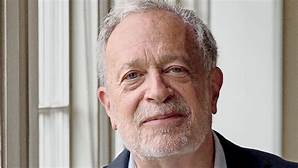
Robert B Reich is Chancellor’s Professor of Public Policy at the Goldman School of Public Policy at the University of California, Berkley. He has served in three national administrations and written sixteen books. His articles have appeared in top newspapers and journals. He writes a weekly column for The Guardian and Newsweek. He lives in Berkeley.
Robert B Reich
This book is about what has gone wrong with the American political system, how it has occurred, and what can be done to recover our democracy. Professor Reich says there are three major power shifts which have occurred and, together, they have, over the last forty years transformed the United States from a democracy to an oligarchy, where power is concentrated in the hands of an elite group of very wealthy individuals. The power shift was brought about by corporate raiders who made the shareholder the only stakeholder in publically traded companies. Previously, the employees, the communities in which they were located, their suppliers and customers were also stakeholders. This led to a strict focus on profits, resulting in wage stagnation, loss of union power, off-shoring of production, and, in turn, to tremendous increases in CEO compensation. CEO’s gained tremendous wealth and power. So, Professor Reich says that the first power shift was from stakeholder capitalism to shareholder capitalism, and the second was a shift in bargaining power from large unions to large corporations. And the third shift was unleashing the financial sector (Wall Street) from laws regulation. This meant huge financial rewards for CEO’s, hedge funds, derivatives traders, and others. With vast financial resources available to few people, and with the Supreme Court’s ruling on political campaign finance, it became possible for this limited pool of powerful people to ‘bribe’ politicians with huge contributions to obtain the laws, regulations and taxation they wanted. The top ten percent of Americans became richer, the bottom ninety percent became poorer, with lower quality education, health care and basic infrastructure. Professor Reich argues that it is possible for the ninety percent to act in concert to change the system.
In the book, Professor Reich singles out Jamie Dimon, the CEO of JPMorgan, the huge bank, as an example of an individual who uses his power to change the system. He and many other specific examples populate this book with a host of convincing evidence. A multi-page appendix lists the sources of the evidence. There is also much evidence of the wage, benefits, health care and educational erosion for the ninety percent, including personal examples. The book is written with considerable emotion and conviction.
As accurate and convincing as the book is, I have two minor criticisms of it. It is often repetitive, making the same point repeatedly. It is also not organized like a legal brief, the points are all there, but they tend to get somewhat tangled. Perhaps these ‘faults’ were intentional on the part of the author and his publisher. They intended this book to be an emotional tirade. If so, it is very convincing.
On September 10, 2020, Writer’s Digest ran a reprint of a 1925 article written by Thomas H Uzzell, the former fiction editor of Colliers Weekly and author of Narrative Technique. He also wrote The Technique of the Novel – a Handbook on the Craft of the Long Narrative, Grandee Jim: A Novel of Action, Romance and History in Old Santa Fe, and was the editor of Short Story Hits. I was unable to fine a picture of Mr Uzzell, who said:
“Just before I sat down to write this article, a young woman came to me saying she wanted help in writing short stories. I asked her how much writing she had done, and her answer was, “None,” and she had been wanting to write for eight years! A hopeless case. People who want to write, write; they don’t think about it. They may write very badly because they are too subjective and have no idea of an audience and know nothing about technique, but—they will write something. Their interest gives them the energy needed to get the writing done.
On the intensity and the endurance of a person’s interest in his writing does his success hang more utterly than on any other single factor. Love of the medium and love of the deed or want of that love make or break 95 out of every 100 aspirants. Where that love is, you find something as deep as life itself. How much writing have you already done? The answer to this question will offer the best solution I know as to how much writing you are going to do.
Legions of people with literary ambitions who get nowhere are more pre-occupied with the thought of why they would like to success than with the thought of how they are going to win success. They want to “win fame,” “earn some money,” to “fulfill ambition,” “make their friends proud of them;” and, alas, too many of them have turned to fiction after failing at everything else they have tried, as the one thing within their slender powers.
Desire for money or fame are not at all inconsistent with a genuine literary purpose; they are generally incentives to energetic action; but if the action is not the putting of ideas in the shape of words on paper, all resolutions will come to nothing.
One of the commonest errors with regard to this desire to write is the mistaking of a love of reading for a talent for writing. Once he realizes that the easier a book is to read the more painful the labor that produced it, the person with this “book-lover” complex becomes discouraged. His interest was not in self-expression, but in being “literary.”
A handicap even greater than this “book-lover complex” is that caused by some pathological inhibition, some nervous disorder which prevents the writer from comprehending the conduct of normal human beings. His writings express not life as it is, but some suppressed personal desires. This psychopathologic problem of writers is too wide and intricate a subject to be more than touched on here.
The highest mark of genuine writing talent is an interest in the art so deep that copy in quantity is produced. Jack London was fond of quoting his favorite author, Conrad, as follows: “An artist is a man of action.” Action for the literary artists is writing.
Nearly every student writer postpones too long the hour of beginning. He hopes for the beautifully finished plot, the perfect word, the high inspiration. The art of writing is a well-developed habit under constant control. Years of writing are necessary for practically every aspirant to develop this habit effectively enough to release his message to the world. For the average student a million words are needed for this training in habit only.
Whether or not you should write is a question you must decide for yourself. It is both a moral and a literary problem. Most of us do the things we want to do, and writing is no exception. If you have an interest in writing you are writing; if you haven’t you are not, and that is just about all there is to it—on the moral side. If, however, you have been writing persistently without attaining satisfactory results, you may well seek expert advice as to the things which may be hindering you. Such advice can only direct and guide your energies which in themselves are your main asset.
If it were possible to give a “formula for literary success,” such analyses of writers’ assets as I have made would lead me to say that, in the case of the average writer of second and third-rate popular stories we would find that his success depended
60 percent on sheer industry or energy,
10 percent on personality,
30 percent on technical skill.
The writer who produces a bestseller or wins national fame for the high quality of his art owes his success, we would find,
45 percent to sheer industry,
45 percent to personality,
10 percent to technique.
If I am even approximately right in my analysis, the factor of energy or industry plays a larger role in literary talent than is generally supposed. It is also my belief that beyond a certain point, when sufficient energy is allowed, a writer succeeds in his work in exact proportion to the depth and richness of his personality. This last factor is the variable one. It is the only true inspiration. It is that gift which may most truly be said to be born in us, and the possession of which may be said to rest in the laps of the gods and, as one disappointed writer I know says, “The gods sometimes stand up!””
I certainly agree with Mr Uzzell that ‘love of the craft’ is essential to literary success, but I don’t see ‘love of the craft’ as being literary talent. I think one has to have Love of the Craft and Technique/Skill in about equal measure. I also agree that personality enters into the equation, as well, in the from of Creativity, Imagination, Intelligence, and a Sense of Freedom.





 William Peace Blog