As I mentioned in a previous post, with the release of the movie by this same title made it necessary for me to read this classic novel. I wouldn’t be able to see the movie, because I know my wife wouldn’t enjoy it, and I had not bought a copy because its theme struck me as gruesome. I’ve had the same problem with the Hunger Games, but with that movie out, I had to buy and read it, I’m glad I read both of them. In neither case does the author write the story as gruesomely as its theme. In both cases, the story is told without emotional embroidery, leaving the reader to consider what the author is saying about humanity.
Lord of the Flies was written by William Golding (19 September 1911 – 19 June 1993) who was a British novelist, playwright, and poet. Best known for his debut novel Lord of the Flies (1954), Golding published another 12 volumes of fiction in his lifetime. In 1980, Golding was awarded the Booker Prize for Rites of Passage, the first novel in what became his sea trilogy, To the Ends of the Earth. Golding was awarded the 1983 Nobel Prize in Literature. As a result of his contributions to literature, Golding was knighted in 1988. He was also a fellow of the Royal Society of Literature. In 2008, The Times ranked Golding third on its list of “The 50 greatest British writers since 1945”.
William Golding
From 1935 to 1940, Golding taught English, Greek, drama and philosophy at English schools. In 1940 he joined the Royal Navy, was assigned to a destroyer and left the Navy in 1945 as a lieutenant. He was married and had two children. He had a difficult relationship with alcohol most of his adult life. Golding published 12 novels, 2 collections and 3 non-fiction works.
The novel begins when a British aeroplane has crashed on an isolated island. The only survivors are boys in their middle childhood. A fair-haired boy named Ralph and a fat boy nicknamed Piggy find a conch shell, which Ralph uses as a horn to gather the survivors. Ralph immediately commands authority over the other surviving boys using the conch, and is elected their “chief”. A red-haired boy named Jack, and a quiet boy named Simon use Piggy’s glasses to create a signal fire. The boys become paranoid about an imaginary monster called the ‘beast’. One night, an air battle occurs near the island and the body of a fighter pilot drifts down in a parachute. Twin boys Sam and Eric mistake the corpse for the beast. Ralph leads some of the boys, including those who were to attend the fire on a wild pig hunt which culminates in a feast. Tensions rise over the maintenance of the fire and the reality of the beast. Jack makes a tribe of his boys, who paint their faces and engage in ritual dances. Simon, who discovers who the beast really is, rushes to tell Jack, but he is mistaken for the beast and killed by the frenzied boys. Jack and his tribe steal Piggy’s glasses, the only means of starting a fire. Ralph goes to Jack’s camp with Piggy, Sam, and Eric to confront Jack and retrieve the glasses. In the rebellious spirit against Ralph’s authority, the tribe drops a boulder that kills Piggy and shatters the conch. Ralph learns that Jack plans to hunt him. The next morning, Jack’s tribe sets fire to the forest. Ralph narrowly escapes the boys and the fire, and while fleeing, falls down in front of a uniformed adult – a British naval officer who has landed on the island to investigate the fire.
How can pre-adolescent boys lose their humanity, forsaking all values of friendship, kindness and justice, and become savage, murderous animals? Golding’s novel answers the question with convincing credibility. The author makes use of the wild environment, the perilous situation, the lack of any supervision, and the uncertain outlook to nudge the boys down the wrong path, but he also paints vulnerable characters, communicating inadequately, misperceiving reality to make such a horrible result entirely believable. A truly masterful piece of writing!
One of my sons-in law sent me this book. Since he is a widely-read, intelligent and very likeable guy, I have read it and enjoyed it.
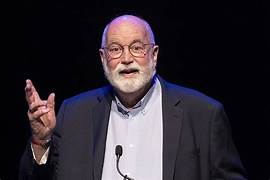
Cherished Belonging was written by Gregory Joseph Boyle (born May 19, 1954), who is an American Jesuit priest and the founder and director of Homeboy Industries, the world’s largest gang intervention and rehabilitation program. He is the former pastor of Dolores Mission Church in Los Angeles.
Gregory Boyle
At the conclusion of his theology studies, Boyle spent a year living and working with Christian communities in Cochabamba, Bolivia. Upon his return in 1986, he was appointed pastor of Dolores Mission Church, a Jesuit parish in the Boyle Heights neighborhood of East Los Angeles that was then the poorest Catholic church in the city. At the time, the church sat between two large public housing projects and amid the territories of eight gangs. Referred to as the “decade of death” in Los Angeles between 1988-1998, there were close to a thousand people per year killed in Los Angeles from gang related crime.
By 1988, in an effort to address the escalating problems and unmet needs of gang-involved youth, Boyle, alongside parish and community members, began to develop positive opportunities for them, including establishing an alternative school and a day-care program, and seeking out legitimate employment, calling this initial effort Jobs for a Future.
In the wake of the 1992 Los Angeles riots, Jobs for a Future and Proyecto Pastoral, a community organising project begun at the parish, launched their first social enterprise business, Homeboy Bakery. Initial funding for the bakery was donated by the late film producer Ray Stark. In the ensuing years, the success of the bakery created the groundwork for additional social enterprise businesses, leading Jobs for a Future to become an independent nonprofit organization, Homeboy Industries.
This book doesn’t really have a plot, but that doesn’t make it any less readable. The nine chapters each have a title which may serve as a summary of the content. But for me, the chapters are unimportant, apart from dividing the book (212 pages) into nine convenient parts. The content, alone, is what makes this book a thought-provoking, fascinating collection of stories and reflections on the stories.
Here’s an example of a story. “Adrian stands in front of an almost entirely white group of criminal justice majors and graduate counselors at Lorcas College in Dubuque. He’s a stocky guy, with the expected tattoos etched on his neck and face and shaved-smooth head. After fifteen years in prison and only a brief three months with us at Homeboy, his trip here was his first on a plane and the only time he’s stood in front of a group to tell his story. Actually, he had been out of state before. During his tenure locked up, they had transferred Adrian to Oklahoma from Calipatria State Prison. It took them thirty-nine hours on a bus. He was shackled at the ankles, the waist, and the wrists. The inmates never got off the bus the entire time. ‘To me,’ he tells me. ‘it was torture’. The most noticeable feature of Adrian’s presentation is his sweet-natured voice. It’s not just younger than his thirty-four years it has a quality that is so pure and gentle. It is soulful and true. You just want to listen to him. His authenticity keeps folks spellbound: ‘I know that most people would take one look at me . . . i mean you would see me walking down the street, and you would cross to the other side. But what you don’t know about me is that if I had only one dollar left and you needed it, it would be yours. If you were shirtless, I would give you mine. If your car conked out, I’d help you push it.’ Everyone in the room believed him,”
There are about two hundred stories like that in the book. What’s more each of the characters in those stories stands out as unique: each with his/her own peculiarities. So, the theme of the book is that God loves each of in spite of our faults, and that each of us should show love to the other regardless of the circumstances. It is clear that the culture of Homeboy is primarily one of love. What isn’t covered by the book is how Homeboy gets new members to shed their aggression and defensive nastiness. Apparently the culture of love is so strong that it is both a magnet and a force for change. There are also coaches who are assigned to the new ‘homies’.
I persuaded myself to buy this book after reading that, “The Confessions of Saint Augustine is one of the most influential autobiographies ever written. In this timeless work, Saint Augustine, Bishop of Hippo, candidly reflects on his moral struggles, spiritual journey, and ultimate conversion to Christianity. With honesty and depth, his shares his transformation from a life of sin to one of faith and grace.”
The Conversion of Saint Augustine
Augustine was born in 354 in Thagaste (now Souk Ahras, Algeria) in the Roman privince of Numidia. His mother, Monnica, was a devout Christian; his father Patricius was a pagan who converted to Christianity on his deathbed. Scholars generally agree that Augustine and his family were Berbers, an ethnic group indigenous to North Africa, but were heavily Romanized, speaking only Latin at home as a matter of pride and dignity.
At the age of 11, Augustine was sent to school at Madaurus a small Numidian city about 31 kilometres south of Thagaste. There he became familiar with Latin literature, as well as pagan beliefs and practices. His first insight into the nature of sin occurred when he and a number of friends stole pears from a neighbourhood garden.
At the age of 17, through the generosity of his fellow citizen Romanianus, Augustine went to Carthage to continue his education in rhetoric, though it was above the financial means of his family. Despite the good warnings of his mother, as a youth Augustine lived a hedonistic lifestyle for a time, associating with young men who boasted of their sexual exploits. Augustine began a relationship with a young woman in Carthage. Though his mother wanted him to marry a person of his class, the woman remained his lover. He was warned by his mother to avoid fornication (sex outside marriage), but Augustine persisted in the relationship for over fifteen years. He ended his relationship with his lover in order to prepare to marry a teenage heiress. By the time he was able to marry her, however, he had already converted to Christianity and decided to become a Christian priest and the marriage did not happen.
After converting to Christianity, Augustine turned against his profession as a rhetoric professor in order to devote more time to preaching. In 391 Augustine was ordained a priest in Hippo Regius (now Annaba), in Algeria. He was especially interested in discovering how his previous rhetorical training in Italian schools would help the Christian Church achieve its objective of discovering and teaching the different scriptures in the Bible. He became a famous preacher, and was noted for combating the Manichaean religion, to which he had formerly adhered. He preached around 6,000 to 10,000 sermons when he was alive; however, there are only around 500 sermons that are accessible today. In 395, he was made Bishop of Hippo. He remained in that position until his death in 430. Bishops were the only individuals allowed to preach when he was alive and he scheduled time to preach after being ordained despite a busy schedule made up of preparing sermons and preaching at other churches besides his own.
As a theologian and philosopher, his writings deeply influenced the development of Western philosophy and Western Christianity, and he is viewed as one of the most important Church Fathers of the Latin Church. His many important works include The City of God, On Christian Doctrine and Confessions.
When I started reading Confessions, I was expecting a clear and complete confession of his sins, together with a detailed account of what persuaded him to convert to Christianity. The detail is missing. He confesses, however, to the theft of the pears and to relationships with concubines. He mentions the influence of his mother, but there is little about his conversion. Much of the book is devoted to his praise of God. From the very beginning if the book, he is clearly a man of very deep faith, though he regarded himself as sinner, and the transition from sinner to saint is granted. He also engages in philosophical discussions. The book was translated into ‘thou and thee English’. I found the book long (345 pages) and disappointing.
The subtitle of this book is ‘& Behind the Scenes of Shadow Cell’. The author is ‘Harry Greene’.
After reading an article in the Atlantic about two CIA agents who fell in love on an assignment involving the creation of a shadow cell inside a global competitor of USA, I searched on Amazon for their book.
There appeared to be several, but I couldn’t find one with Shadow Cell in the main title. So I picked this one out as a likely candidate.
This book at 135 pages. The interesting information in it could have been divulged in ten pages. It is repetitious on several subjects: tight security at CIA; the two agents felt under great pressure at CIA for their relationship; the agents were clever, top performers. There were almost no examples backing up these assertions. The author is very careful to speak kindly of the CIA and the agents, and not to mention even a trivial fact which might be classified. He probably wants to be clear of any litigation, should his real name be known.
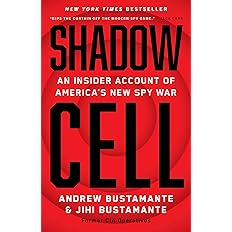
How wrong my choice was! This one is most likely a knock off of the real book (pictured below). A knock-off written by a Joe Bloggs under the pen name of a Harry Green. There is a Harry Green listed on Amazon who has written 16 fiction and non-fiction books on various subjects, none of which include the CIA. This book has an ISBN number (which no longer comes up on Amazon searches). In fact, this book no longer exists according to Amazon. This book doesn’t mention its publisher or its printer. It says only that the book was printed in New Haven, Connecticut on 10 September 2025. There is no author biography or statement of his/her relationship to the agents or the CIA. The narrator starts right in as if he had permission to tell the story.
The real book: a New York Times Bestseller!
Interestingly, I don’t believe the real book was listed on amazon.co.uk when I bought the knock-off. In fact, it still doesn’t seem to be listed. I just bought a real copy on amazon.com. It was published on 9 September 2025.
So what’s all the hubbub about? Well, here’s the publicity from the real thing:
“INSTANT NEW YORK TIMES BESTSELLER | A thrilling firsthand account by husband-and-wife CIA operatives who, against all odds, triumphed in a deadly cat-and-mouse game against a mole within the agency—an unprecedented insider account of 21st-century spycraft in the tradition of Argo and Black Ops.
Andrew and Jihi Bustamante were a “tandem couple”: married spies who’d dedicated their lives to the CIA. They met as trainees at Langley, and got married while hunting terrorists across the globe. Then, suddenly, they were assigned to a mission so sensitive and explosive that the CIA still has never acknowledged it. The CIA’s source network in a country code-named “Falcon”—one of America’s most formidable rivals—had been compromised by a mole, and the agency needed a new way to collect intelligence there. Young newlyweds, the Bustamantes were considered safe choices for this daunting task precisely because they had no experience in Falcon. They were also loyal, forgettable, and completely disposable—operatives who could help to strengthen the CIA’s position in Falcon while simultaneously serving as bait for the mole.
But although their superiors at the CIA didn’t realize it, the Bustamantes also brought another advantage to the table: a granular understanding of how terrorist cells operate, and how the agency could exploit those same tactics to keep America safe. Assembling a rag-tag team of fellow operatives and recruiting new sources from Falcon, the Bustamantes pioneered a new way of spying by building a cell of their own—right at the heart of the CIA.
The propulsive, untold tale of one of history’s greatest intelligence crises and the unlikely band of agents who were sent in to clean up the mess, Shadow Cell allows us to peer behind the curtain to see how today’s spy wars are being fought—and won.”
This book was recommended to me by an Italian niece, a brilliant mathematician, who works at a university, guiding doctoral candidates in writing their economic theses. She said, “Joseph Stiglitz is my hero.”
Joseph Eugene Stiglitz (born February 9, 1943) is an American New Keynesian economist, a public policy analyst, political activist, and a professor at Columbia University. He is a recipient of the Noble Memorial Prize in Economic Sciences (2001) and the John Bates Clark Medal (1979). He is a former senior vice president and chief economist of the World Bank. He is also a former member and chairman of the U.S. Council of Economic Advisers. He is known for his support for the Georgist public finance theory and for his critical view of the management of globalization, of laissez-faire economists (whom he calls “free-market fundamentalists”), and of international institutions such as the International Monetary Fund and the World Bank.
Joseph Stiglitz
The sub-title of this book is “Economics and the Good Society”, but the key word is “freedom”, and the key theme is that in society if one individual, group, company, institution, or market is given more freedom, some individual or group will have less freedom. And Stiglitz’ point is that in the US today (and in much of the developed world), the economic system (neoliberal capitalism) and its attendant political philosophy has failed because it waves the freedom flag but it neglects the many people who are harmed by the freedoms given to corporations, institutions and powerful individuals. The US does not understand that markets are not self-correcting, and require regulation. The author says that free and unfettered markets have conveyed great wealth and power to a few individuals but have exploited consumers, workers and the environment. Moreover, free markets have delivered financial, opioid and inequality crises. The book is rich with specific examples of how free markets have failed. He contends, in addition, that control of the environment, health and property – particularly intellectual property – should be improved. His arguments for what he calls progressive capitalism, and what it would do differently are compelling.There is an eight page chart summarizing the failures of neoliberal economics and what progressive capitalism’s corrective policies would be.
One cannot help feeling that the prescription for putting progressive capitalism in place is missing. I, for one, am sold on progressive capitalism. How can we implement it? But the barriers to change are enormous. The entire Republican party is wholly committed to neoliberal capitalism. Millions of wealthy, powerful people depend on it. It is ingrained in the American culture. A huge educational effort would be required to gain the understanding of the American people. The change is so fundamental that it cries out for a constitutional change. But that would never happen. What is more possible is the Democratic Party taking up the ideology and implementing it gradually over the course of a generation. In the meantime we have the first step in Stiglitz’ book: we know what’s wrong with neoliberal economics, and that makes it essential reading for every American.
This book caught my attention as a philosophical, perhaps religious book with its subtitle: The mysteries of Mind and Life. It was written by David Bentley Hart, who is a philosopher, scholar of religion, writer, and cultural commentator. His books include The Experience ofGod: Being, Consciousness, Bliss and Roland in Moonlight. His current position is collaborative researcher at the University of Notre Dame.
David Bentley Hart
This book is not an easy read. The text brims with philosophical terms so that I found myself reading with my phone within easy reach to look up the unfamiliar terms. It is 483 pages long with 11 pages of footnotes and a 14 page index. Clearly, it is a scholarly masterpiece. And yet, one wants to keep reading to discover the revelation one can sense is coming, to achieve new insights, and to rediscover important truths. Rather than frame the book as an extended first-person lecture, the author has assigned the debate on the nature of existence to four Greek gods who have near infinite knowledge, the authority of being gods and engaging characters. They are: Psyche, the goddess of soul and life, Eros, Psyche’s husband and god of love, Hermes, the messenger of the gods and the divine intermediary between heaven and earth, and Hephaistos, the god of craftsmen and manufacturing; he is the deity of all technical virtuosity, ingenuity and skill. The dialogue takes place at the estate of Eros and Psyche, in one of its many gardens. Everything is in blossom. In that place everything always is. Psyche begins the debate by picking a rose and commenting on its beauty. She then leads the discussion of existence over the next several days. Hephaistos role, throughout the debate, is the represent the position of reductionist materialism philosophy, which takes the position that everything can be explained scientifically.Topics include mind, life, matter, brain, machine, soul and nature. Much of the discussion centers on the inability of some philosophers (current and ancient) to demonstrate that science (including nuclear physics, modern chemistry and quantum mechanics) does, in fact, answer all of the interesting questions.There are revelations about genetic science which prompt questions about how a living single cell ‘knows’ how to modify its own capability to respond better to its environment. The conclusion is that life, mind and language must be put it place by a ‘higher power’. In spite of many scientific attempts, life has never been produced in a laboratory. Likewise, there is no explanation for the existence of mind, in all its glory, including consciousness. Language owes its existence to mind.
Why isn’t there a condensed version of this book which uses everyday language to make the point that atheism is a dead end belief?
After reading the biography of Xi Jinping, I decided I needed to refresh my knowledge of Marxism. If Xi thinks Marxism is so good, what have I forgotten? So I bought this rather thin book by Richard D. Wolff.
Wikipedia says, “Richard David Wolff (born April 1, 1942) is an American Marxian economist known for his work on economic methodology and class analysis. He is a professor emeritus of economics at the University of Massachusetts Amherst and a visiting professor in the graduate program in international affairs at The New School. Wolff has also taught economics at Yale University, City College of New York, University of Utah, Paris 1 Panthéon-Sorbonne University and The Brecht Forum in New York City.
Richard D Wolff
I was disappointed in this book. At only 75 pages, it can be read in less than two hours. It was written by an American professor with impressive teaching experience. I was hoping for a learned set of arguments about the benefits of Marxist economics, but what I got was a largely a high school level set of criticisms of capitalism. I know that capitalism treats many people unfairly. What I wanted to know was how and why Marxism would treat every one fairly with universal freedom.
Professor Wolff described how Marx defined various classes of people involved in the productive process, and how conflicts between the classes leads to inequities in the distribution of ‘surplus’. Marx’s theory was that the class of ‘surplus providers’ (workers) should be given an equal say to the ‘surplus appropriators’ (executives and investors), and Professor Wolff mentions cooperative organisations. These organisations can be successful in low technology organisations such as farming, where all class members have about the same level of knowledge. But in a pharmaceutical business, for example, a laboratory technician would not understand market dynamics, pharmaceutical pricing, approval processes, etc, and a cooperative model will not work there. While Marx himself did not advocate it, some communist governments have used government ownership as a sort of cooperative, usually without a formal voting process or much success, because government bureaucrats do not have either the knowledge or the experience to make vital resource-allocation decisions.
Marx appears to have been a social/economic class expert. He wasn’t particularly knowledgeable about modern economics.
If you are looking fora strong defense of Marxism, I would suggest you look elsewhere.
This biography attracted my attention because in covers an extremely powerful autocrat about whom relatively little is known, it had good reviews and was written by a very senior politician, Kevin Rudd, the former prime minister of Australia, who had personal dealings with Xi.
Kevin Rudd was also a former foreign minister of Australia and the founding president of the Asia Society Policy Institute, and established its Centre for China Analysis. He has a PhD from the China Centre at Oxford University. He is the author of The Avoidable War, among other books.
Kevin Rudd
I found the subtitle of the book particularly interesting: ‘How Xi’s Marxist Nationalism is Shaping China and the World’.
This biography is certainly a scholarly work, covering just over four hundred pages of text, sixty-five pages of footnotes, over one hundred pages of bibliography, much of it in Chinese and a twenty page index. But I found it difficult to put the book down for very long. I was continually thinking tell me more and where is this leading.
The book is very well organised for non-experts like me. It begins with purpose and its core arguments, continuing through definitions of Chinese core ideological concepts, and presents a historical survey of Chinese ideology. Then it moves subject-by-subject through Xi’s evolving ideology, and its effects on China’s domestic and foreign policy. There are three final chapters dealing with China’s future and China’s future after Xi. The book makes it clear that Xi’s ideology has evolved considerably from Mao, Deng, Jiang and Hu.
It is also clear that Xi is deeply intellectually committed to Marxism and to Leninism ‘with Chinese characteristics’, and he speaks about these theories as being ‘scientific’ and ‘proven effective in the Chinese context’.
Mr Rudd backs up every bit of Xi’s ideology with multiple historical references, usually in the form of published quotations. For example, he documents China’s shift in its foreign policy with quotations from high-ranking diplomats.
On the subject of whether or not China will invade Taiwan, he says that Xi has demanded that the People’s Liberation be ready to do so by 2027, and that he would like to do it by 2032, but that if there is a significant chance of failure, he would delay.
Xi clearly thinks that his political ideology is clearly superior to democracy/capitalism. He has apparently conceded that capitalism is superior for economic growth, because he has reigned in the Chinese private sector, knowing that this would slow economic growth. He is aware that Leninism, which Xi has applied to the running of the Communist Party, and Marxist surveillance of the Chinese people represent a risk of revolution. But surveillance is growing, not shrinking.
Xi argues that Marxism is completely congruent to classical Chinese culture, and he enumerates examples of Chinese culture without seeming to recognise the apparent conflicts between the two. Religious freedom, individual freedom and true justice are clear examples. Unfortunately, Mr Rudd and Mr Xi are not able to debate these points, but perhaps Western diplomats and politicians can do so.
This book is a timely, very welcome, thought-provoking study of an influential, but largely unknown national leader.
The Conversation website has an interesting article on this subject, written by Katherine Day, Lecturer, Publishing, The University of Melbourne, Reneé Otmar, Honorary Research Fellow, Faculty of Health, Deakin University, Rose Michael,Senior Lecturer, Program Manager BA (Creative Writing), RMIT University, and Sharon Mullins, Tutor, Publishing and Editing, The University of Melbourne, all of whom,presumably, are Australians. The article is dated February 12, 2024.
They say, “Writers have been using AI tools for years – from Microsoft Word’s spellcheck (which often makes unwanted corrections) to the passive-aggressive Grammarly. But ChatGPT is different.
ChatGPT’s natural language processing enables a dialogue, much like a conversation – albeit with a slightly odd acquaintance. And it can generate vast amounts of copy, quickly, in response to queries posed in ordinary, everyday language. This suggests, at least superficially, it can do some of the work a book editor does.
We are professional editors, with extensive experience in the Australian book publishing industry, who wanted to know how ChatGPT would perform when compared to a human editor. To find out, we decided to ask it to edit a short story that had already been worked on by human editors – and we compared the results.
The experiment: ChatGPT vs human editors
The story we chose, The Ninch (written by Rose), had gone through three separate rounds of editing, with four human editors (and a typesetter).
The first version had been rejected by literary journal Overland, but its fiction editor Claire Corbett had given generous feedback. The next version received detailed advice from freelance editor Nicola Redhouse, a judge of the Big Issue fiction edition (which had shortlisted the story). Finally, the piece found a home at another literary journal, Meajin, where deputy editor, Tess Smurthwaite, incorporated comments from the issue’s freelance editor and also their typesetter in her correspondence.
We had a wealth of human feedback to compare ChatGPT’s recommendations with.
We used a standard, free ChatGPT generative AI tool for our edits, which we conducted as separate series of prompts designed to assess the scope and success of AI as an editorial tool.
We wanted to see if ChatGPT could develop and fine tune this unpublished work – and if so, whether it would do it in a way that resembled current editorial practice. By comparing it with human examples, we tried to determine where and at what stage in the process ChatGPT might be most successful as an editorial tool.
The story includes expressive descriptions, poetic imagery, strong symbolism and a subtle subtext. It explores themes of motherhood, nature, and hints at deeper mysteries.
We chose it because we believe the literary genre, with its play and experimentation, poetry and lyricism, offers rich pickings for complex editorial conversations. (And because we knew we could get permission from all participants in the process to share their feedback.)
In the story, a mother reflects on her untamed, sea-loving child. Supernatural possibilities are hinted at before the tale turns closer to home, ending with the mother revealing her own divergent nature – and looping back to offer more meaning to the title:
pinching the skin between my toes … Making each digit its own unique peninsula.
Round 1: the first draft
We started with a simple, general prompt, assuming the least amount of editorial guidance from the author. (Authors submitting stories to magazines and journals generally don’t give human editors a detailed, prescriptive brief.)
Our initial prompt for all three examples was: “Hi ChatGPT, could I please ask for your editorial suggestions on my short story, which I’d like to submit for publication in a literary journal?”
Responding to the first version of the story, ChatGPT provided a summary of key themes (motherhood, connection to nature, the mysteries of the ocean) and made a list of editorial suggestions.
Interestingly, ChatGPT did not pick up that the story was now published and attributed to an author. Raising questions about its ability, or inclination, to identify plagiarism. Nor did it define the genre, which is one of the first assessments an editor makes.
ChatGPT’s suggestions were: to add more description of the coastal setting, provide more physical description of the characters, break up long paragraphs to make the piece more reader-friendly, add more dialogue for characterisation and insight, make the sentences shorter, reveal more inner thoughts of the characters, expand on the symbolism, show don’t tell, incorporate foreshadowing earlier, and provide resolution rather than ending on a mystery.
All good, if stock standard, advice.
ChatGPT also suggested reconsidering the title – clearly not making the connection between mother and daughter’s ocean affinity and their webbed toes – and reading the story aloud to help identify awkward phrasing, pacing and structure.
While this wasn’t particularly helpful feedback, it was not technically wrong.
ChatGPT picked up on the major themes and main characters. And the advice for more foreshadowing, dialogue and description, along with shorter paragraphs and an alternative ending, was generally sound.
In fact, it echoed the usual feedback you’d get from a creative writing workshop, or the kind of advice offered in books on the writing craft.
They are the sort of suggestions an editor might write in response to almost any text – not particularly specific to this story, or to our stated aim of submitting it to a literary publication.
Stage two: AI (re)writes
Next, we provided a second prompt, responding to ChatGPT’s initial feedback – attempting to emulate the back-and-forth discussions that are a key part of the editorial process.
We asked ChatGPT to take a more practical, interventionist approach and rework the text in line with its own editorial suggestions:
Thank you for your feedback about uneven pacing. Could you please suggest places in the story where the pace needs to speed up or slow down? Thank you too for the feedback about imagery and description. Could you please suggest places where there is too much imagery and it needs more action storytelling instead?
That’s where things fell apart.
ChatGPT offered a radically shorter, changed story. The atmospheric descriptions, evocative imagery and nods towards (unspoken) mystery were replaced with unsubtle phrases – which Rose swears she would never have written, or signed off on.
Lines added included: “my daughter has always been an enigma to me”, “little did I know” and “a sense of unease washed over me”. Later in the story, this phrasing was clumsily suggested a second time: “relief washed over me”.
The author’s unique descriptions were changed to familiar cliches: “rugged beauty”, “roar of the ocean”, “unbreakable bond”. ChatGPT also changed the text from Australia English (which all Australian publications require) to US spelling and style (“realization”, “mom”).
In summary, a story where a mother sees her daughter as a “southern selkie going home” (phrasing that hints at a speculative subtext) on a rocky outcrop and really sees her (in all possible, playful senses of that word) was changed to a fishing tale, where a (definitely human) girl arrives home holding up, we kid you not, “a shiny fish”.
It became hard to give credence to any of ChatGPT’s advice.
Esteemed editor Bruce Sims once advised it’s not an editor’s job to fix things; it’s an editor’s job to point out what needs fixing. But if you are asked to be a hands-on editor, your revisions must be an improvement on the original – not just different. And certainly not worse.
It is our industry’s maxim, too, to first do no harm. Not only did ChatGPT not improve Rose’s story, it made it worse.
What did the human editors do?
ChatGPT’s edit did not come close to the calibre of insight and editorial know-how offered by Overland editor Claire Corbett. Some examples:
There’s some beautiful writing and fantastic themes, but the quotes about drowning are heavy-handed; they’re given the job of foreshadowing suspense, creating unease in the reader, rather than the narrator doing that job.
The biggest problem is that final transition – I don’t know how to read the narrator. Her emotions don’t seem to fit the situation.
For me stories are driven by choices and I’m not clear what decision our narrator, or anyone else, in the story faces.
It’s entirely possible I’m not getting something important, but I think that if I’m not getting it, our readers won’t either.
Freelance editor Nicola, who has a personal relationship with Rose, went even further in her exchange (in response to the next draft, where Rose had attempted to address the issues Claire identified). She pushed Rose to work and rework the last sentence until they both felt the language lock in and land.
I’m not 100% sold on this line. I think it’s a little confusing … It might just be too much hinted at in too subtle a way for the reader.
Originally, the final sentence read: “Ready to make my slower way back to the house, retracing – overwriting – any sign of my own less-than more-than normal prints.”
The final version is: “Ready to make my slower way back to the house, retracing, overwriting, any sign of my own less-than, more-than, normal prints.” With the addition of a final standalone line: “I have seen what I wanted to see: her, me, free.”
Claire and Nicola’s feedback show how an editor is a story’s ideal reader. A good editor can guide the author through problems with point of view and emotional dynamics – going beyond the simple mechanics of grammar, sentence length and the number of adjectives.
In other words, they demonstrate something we call editorial intelligence.
Editorial intelligence is akin to emotional intelligence. It incorporates intellectual, creative and emotional capital – all gained from lived experience, complemented by technical skills and industry expertise, applied through the prism of human understanding.
Skills include confident conviction, based on deep accumulated knowledge, meticulous research, cultural mediation and social skills. (After all, the author doesn’t have to do what we say – ours is a persuasive profession.)
Round 2: the revised story
Next, we submitted a revised draft that had addressed Claire’s suggestions and incorporated the conversations with Nicola.
This draft was submitted with the same initial prompt: “Hi ChatGPT, could I please ask for your editorial suggestions on my short story, which I’d like to submit for publication in a literary journal?”
ChatGPT responded with a summary of themes and editorial suggestions very similar to what it had offered in the first round. Again, it didn’t pick up that the story had already been published, nor did it clearly identify the genre.
For the follow-up, we asked specifically for an edit that corrected any issues with tense, spelling and punctuation.
It was a laborious process: the 2,500-word piece had to be submitted in chunks of 300–500 words and the revised sections manually combined.
However, these simpler editorial tasks were clearly more in ChatGPT’s ballpark. When we created a document (in Microsoft Word) that compared the original and AI-edited versions, the flagged changes appeared very much like a human editor’s tracked changes.
But ChatGPT’s changes revealed its own writing preferences, which didn’t allow for artistic play and experimentation. For example, it reinstated prepositions like “in”, “at”, “of” and “to”, which slowed down the reading and reduced the creativity of the piece – and altered the writing style.
This makes sense when you know the datasets that drive ChatGPT mean it explicitly works toward the word most likely to come next. (This might be directed differently in the future, towards more creative, and less stable or predictable models.)
Round 3: our final submission
In the third and final round of the experiment, we submitted the draft that had been accepted by Meanjin.
The process kicked off with the same initial prompt: “Hi ChatGPT, could I please ask for your editorial suggestions on my short story, which I’d like to submit for publication in a literary journal?”
Again, ChatGPT offered its rote list of editorial suggestions. (Was this even editing?)
This time, we followed up with separate prompts for each element we wanted ChatGPT to review: title, pacing, imagery/description.
ChatGPT came back with suggestions for how to revise specific parts of the text, but the suggestions were once again formulaic. There was no attempt to offer – or support – any decision to go against familiar tropes.
Many of ChatGPT’s suggestions – much like the machine rewrites earlier – were heavy-handed. The alternative titles, like “Seaside Solitude” and “Coastal Connection”, used cringeworthy alliteration.
In contrast, Meanjin’s editor Tess Smurthwaite – on behalf of herself, copyeditor Richard McGregor, and typesetter Patrick Cannon – offered light revisions:
The edits are relatively minimal, but please feel free to reject anything that you’re not comfortable with.
Our typesetter has queried one thing: on page 100, where “Not like a thing at all” has become a new para. He wants to know whether the quote marks should change. Technically, I’m thinking that we should add a closing one after “not a thing” and then an opening one on the next line, but I’m also worried it might read like the new para is a response, and that it hasn’t been said by Elsie. Let me know what you think.
Sometimes editorial expertise shows itself in not changing a text. Different isn’t necessarily good. It takes an expert to recognise when a story is working just fine. If it ain’t broke, don’t fix it.
It also takes a certain kind of aerial, bird’s-eye view to notice when the way type is set creates ambiguities in the text. Typesetters really are akin to editors.
The verdict: can ChatGPT edit?
So, ChatGPT can give credible-sounding editorial feedback. But we recommend editors and authors don’t ask it to give individual assessments or expert interventions any time soon.
A major problem that emerged early in this experiment involved ethics: ChatGPT did not ask for or verify the authorship of our story. A journal or magazine would ask an author to confirm a text is their own original work at some stage in the process: either at submission or contract stage.
A freelance editor would likely use other questions to determine the same answer – and in the process of asking about the author’s plans for publication, they would also determine the author’s own stylistic preferences.
Human editors demonstrate their credentials through their work history, and keep their experience up-to-date with professional training and qualifications.
What might the ethics be, we wonder, of giving the same recommendations to every author asking for editing advice? You might be disgruntled to receive generic feedback if you expect or have paid for for individual engagement.
As we’ve seen, when writing challenges expected conventions, AI struggles to respond. Its primary function is to appropriate, amalgamate and regurgitate – which is not enough when it comes to editing literary fiction.
Literary writing aims to – and often does – convey so much more than what the words on screen explicitly say. Literary writers strive for evocative, original prose that draws upon subtext and calls up undercurrents, making the most of nuance and implication to create imagined realities and invent unreal worlds.
At this stage of ChatGPT’s development, literally following the advice of its editing tools to edit literary fiction is likely to make it worse, not better.
In Rose’s case, her oceanic allegory about difference, with a nod to the supernatural, was turned into a story about a fish.
ChatGPT is ‘like the new intern’
This experiment shows how AI and human editors could work together. AI suggestions can be scrutinised – and integrated or dismissed – by authors or editors during the creative process.
And while many of its suggestions were not that useful, AI efficiently identified issues with tense, spelling and punctuation (within an overly narrow interpretation of these rules).
Without human editorial intelligence, ChatGPT does more harm than help. But when used by human editors, it’s like any other tool – as good, or bad, as the tradesperson who wields it.
T S Eliot said, “The first, the longest, and the best of modern English detective novels.” That is a fulsome recommendation of The Moonstone. Edgar Allen Poe wrote several mysteries as short stories in the early 1840’s, but in 1868, Wilkie Collins pioneered the following features of The Moonstone:
an English country house robbery
an “inside job”
red herrings
a celebrated, skilled, professional investigator
a bungling local constabulary
detective enquiries
a large number of false suspects
the “least likely suspect”
a reconstruction of the crime
a final twist in the plot
which became became classic attributes of the twentieth-century detective story in novel form. At 436 pages The Moonstone is quite long.
William Wilkie Collins (8 January 1824 – 23 September 1889) was an English writer and the son of an English painter. He published his first story in 1843. He wrote his first novel, Tahiti as It Was, in 1844, but it was rejected in 1845 and remained unpublished during his lifetime. He was introduced to Charles Dickens in 1851 and they became fast friends. In 1852 his novel, Basil, was published. In 1853 while writing Hide and Seek, he suffered his first bout of gout, from which he was to suffer for the rest of his life. The novels Collins published in the 1860s are the best and most enduring of his career. The Woman in White, No Name, Armadale and The Moonstone were written in less than a decade. They sold in large numbers and made him a wealthy man. The inconsistent quality of Collins’s dramatic and fictional works in the last decade of his life was accompanied by a general decline in his health, including diminished eyesight. He was often unable to leave home and had difficulty writing. During these last years, he focused on mentoring younger writers. In 1858, Collins had begun living with Caroline Graves and her daughter Harriet. Collins disliked the institution of marriage, but remained dedicated to Caroline and Harriet, considering them to be his family. In 1868, Collins met Martha Rudd in Norfolk, and the two began a liaison. She was 19 years old and from a large, poor family. A few years later, she moved to London to be closer to him. Their daughter Marian was born in 1869; their second daughter, Harriet Constance, in 1871; and their son, William Charles, in 1874. When he was with Martha, Collins assumed the name William Dawson, and she and their children used the last name of Dawson themselves. For the last 20 years of his life Collins divided his time between Caroline, who lived with him at his home in Gloucester Place, and Martha, who was nearby.
The Plot: Rachel Verinder, a young English woman, inherits a large Indian diamond on her eighteenth birthday. It is a legacy from her uncle, a corrupt British army officer who seized it in India. The diamond is of great religious significance and extremely valuable, and three Hindu jugglers/priests have dedicated their lives to recovering it. She wears the diamond at her birthday, but it has disappeared the next day. Superintendent Seegrave, an incompetent local policeman, investigates the Indians and Rosanna Spearman, a housemaid, without success. During the ensuing year there are hints that the diamond was removed from the house and may be in a London bank vault, having been pledged as surety to a moneylender. The Indian jugglers are still nearby, watching and waiting. Franklin Blake, a cousin and suitor of Rachel’s, and who attended her 18th party, returns from overseas and resolves to solve mystery left unsolved by Sergeant Cuff, the famous English detective. Franklin learns that he was given laudanum (an opiate) by Dr Candy, the family doctor, because of his anxiety about Rachel and the diamond. Rachel herself tells Franklin that she saw him take the diamond, but she has not revealed the theft because of the consequences for him. Franklin tracks down the holder of the diamond when he redeems it from the bank at an appointed time. That man turns out to be Godfrey Ablewhite, who has embezzled a large sum and wanted the diamond to repay his debt. He, too, is a suitor of Rachel, and he had convinced Franklin, in his drugged stupor to give him the diamond to place it in safe keeping. After recovering the diamond from the bank, Godfrey is murdered by the Indians, who escape to India. Rachel and Franklin marry and a noted adventurer, Mr Murthwaite, explains that he has followed the Indians and seen the diamond returned to its proper place: in the forehead of a statue of an Indian god.
The story is quite a bit more complicated than that with a dozen more characters, and considerably more involvement. There are also multiple narrators of the story. The characters are all unique, with their defects and attractions, and their motives are clear, even if not well reasoned. It is difficult to put the book aside, in spite of its length. A modern editor would have abbreviated it by at least 100 pages by cutting the passages where the characters review in detail what has happened after each event. Still, it is an enchanting story of a Victorian crime in a Victorian setting.




 William Peace Blog