Harry Bingham, the Founder and CEO of Jericho Writers, makes a good point about the inertia we sometimes feel as writers.
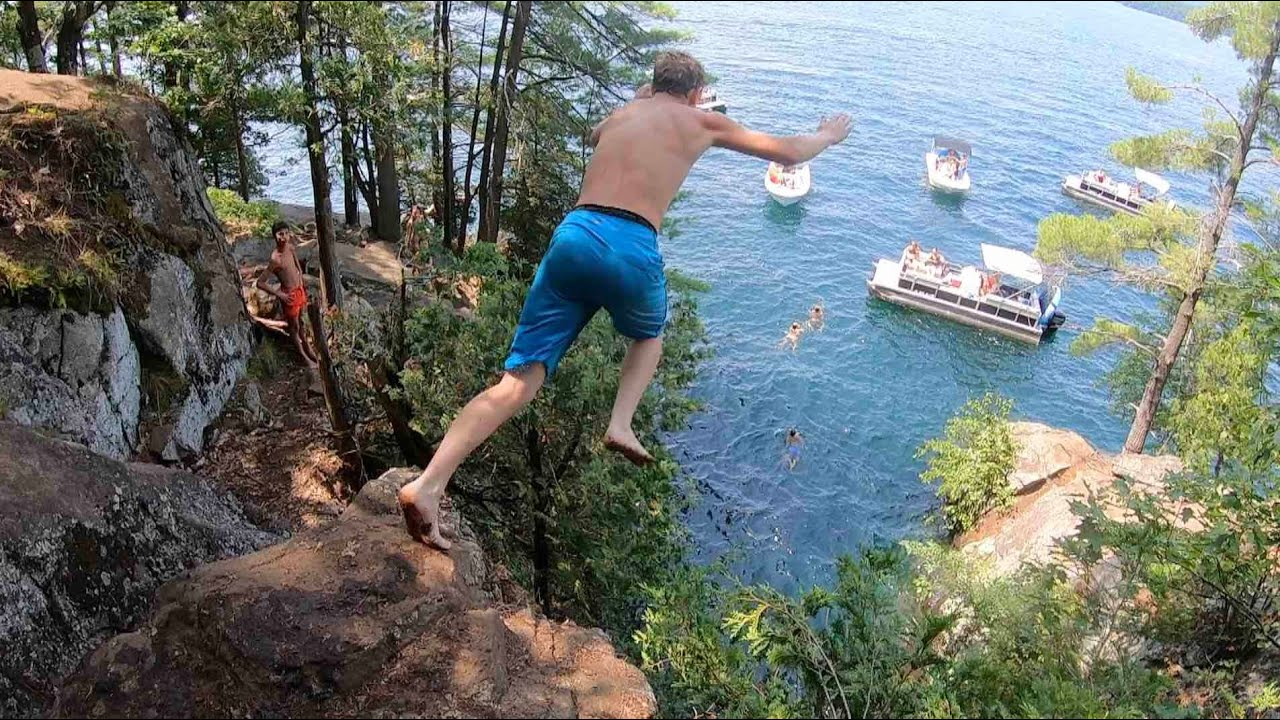
He says, “Just Jump!”
Harry says, “
Ray Bradbury, the author of Farenheit 451 and much else, was a fan of the future. A fan of boldness and technological adventure. In an interview with the New York Times, he said, “If we listened to our intellect, we’d never have a love affair. We’d never have a friendship. We’d never go into business because we’d be cynical: ‘It’s gonna go wrong.’ Or ‘She’s going to hurt me.’ Or ‘I had a couple of bad love affairs so therefore …’ Well, that’s nonsense. You’re going to miss life. You’ve got to jump off the cliff all the time and build your wings on the way down.” That cliff-jumper is you. It’s me. It’s all of us. It’s certainly true for any first-time novelist. My first book was a giant 180,000 words long. (And yes, it went to print at that length. And no, it’s not a length that publishers are especially looking for. But if a book is good enough, the length is kinda immaterial.) I was naïve. I literally had no idea that writing a book and getting it published might be hard. I just assumed I could do it, and would do it. My track record (Oxford University, fancy American bank) was one of achievement. I knew I liked reading. I’d always assumed I’d end up being an author. So: write a book – how hard could it be? I knew how to write a sentence, so just do that over and over, and I’d have a book. Everyone receiving this email is less naïve. The tone of voice needed for a fast commercial adventure-caper was not the same tone as that had produced success in Oxford philosophy essays. Once I’d written 180,000 words, I looked back at the start and realised it was … ahem, in need of vigorous editing. The kind of editing that involved selecting 60,000 words and hitting Delete. So I deleted the rubbish and rewrote it. Wrote it better. But: That wasn’t a failure. It was the second most important step on the road to success. The most important was writing the first word, the first sentence, the first paragraph, the first chapter. The most important step is always the same: it’s jumping off the cliff in the first place. Deleting 60,000 words was the next crucial step: acknowledging that what I’d done wasn’t good enough; that more work could fix it; that I needed to design and use some better wings. But you don’t get to the better-wing-design stage until you’ve got to the plummeting-downwards-out-of-control stage. You need them both. And honestly: the challenges probably get a little bit less as you write more books, get them published, get paid, learn the industry, build a readership. But each book is its own cliff – its own well of uncertainty. As you know, I’m a huge believer in nailing an elevator pitch before you start writing. I don’t care about pretty formulations – I don’t mind whether you have the kind of phrase that would look good on a book jacket or movie poster. But a list of ingredients that would spark interest in a potential book-buyer? That’s essential. But oh sweet lord, there is a huge gap between knowing that you have, in theory, a commercially viable novel and actually making it so. I have sometimes written books that flowed, start to finish, with no huge mid-point challenges, but those have been the exception. Mostly, there’s been a hole – a gap – a problem. I’m not a huge fan of pre-planning novels in vast detail. (But do what you like: it’s whatever works for you.) The only way to find that hole is to leap off the cliff. It’s the flying through the air that tells you what wings you need. So jump. Be uncertain. Jump anyway. Take the biggest boldest leap you can, knowing that you don’t have the answers. Just jump. Jump knowing that your wings aren’t ready. They get born by jumping. Wings that surprise you and delight you and complete you. So jump. Good luck. And happy Christmas.
Beth Kander is interviewed by Robert Lee Brewer Writer’s Digest (published 12 December 2024) on how she entered a competition at the last minute.
Beth Kander is a novelist and playwright with tangled roots in the Midwest and Deep South. The granddaughter of immigrants, her writing explores how worlds old and new intertwine—or collide. Her work has been described as “riveting,” “emotional,” “expertly crafted,” and “habit-forming.” Expect twists, turns, and secrets, with surprising heart and humor. Beth has too many degrees and drinks too much coffee. Her favorite characters are her dashing husband and their two lovely kids.
Beth Kander
What prompted you to write this book?
This book definitely has a non-traditional origin. I was knee deep in another project when a friend texted to let me know that the pop culture site Hey Alma was having a Hanukkah movie pitch competition. Eager to procrastinate on my existing project, I checked the pitch competition deadline—and found out it was the very next day. Long story short (literally), I threw together a pitch for I Made It Out Of Clay, a quirky romcom-with-a-golem concept, submitted it at the 11th hour, and ultimately won the competition.
Industry folks started reaching out to me to inquire about film rights. My literary agent, Alli, passed along some great advice from a film agent colleague: “Write the book first, not the movie.” So, I set aside my other book projects and prioritized writing this novel. The story immediately provided myriad unconventional opportunities to explore big topics: grief and family dynamics and identity and adult friendships and turning 40 … I got to write about these heavy things while laughing and making monsters. What a gift.
How long did it take to go from idea to publication? And did the idea change during the process?
I won the pitch competition in December 2022. I was so inspired, I drafted the novel in two blurry months. My agent took it out on sub in February 2023. It sold at auction in March 2023, and publication was set for December 2024. So all told, a two-year-process from idea to publication. That’s fast—often, the writing alone can take longer than that! I’m grateful that although the acquisition happened fast, I had a great editor and plenty of time to revise the book, several times over. I loved spending the time really developing the story and connecting with each character.
Were there any surprises or learning moments in the publishing process for this title?
I’ve learned so much in the process of publishing this book that it’s honestly hard to even know where to begin, and there have been plenty of surprises along the way. But if I had to pull out the biggest lesson, it’s this: You just never know.
You can spend years working on a story you really believe in, only to have it languish and eventually fade away. You can have an overnight idea that becomes the story everyone’s eager to read. You can’t trust trends or tricks. You just have to keep trying. I think a lot about this two-panel meme, where the first panel is labeled “what people think success looks like” and shows an arrow moving steadily forward and up, and the second panel is labeled “what success actually looks like” and it shows a tangled mess that a forward-facing arrow finally re-emerges from… which feels relevant to the publishing process. But I’ve been over-the-top lucky to work with my agent, Alli, to navigate every detour along the way. And working on I Made It Out Of Clay with my editor, April, and the team at Mira/HarperCollins, has been a delight. Sometimes, gracefully and gratefully, the puzzle pieces slide into place.
You just never know.
Were there any surprises in the writing process for this book?
This was the fastest writing process I’ve ever undertaken. To go from a paragraph-long idea to a 90,000-word novel in two months is… well, not something I’d necessarily recommend, honestly. Thank God for coffee.
But what I realized is that I didn’t speed-write this book in a vacuum; it wasn’t an anomaly, or a fluke. It was a culmination. All those years, all those other stories; that was my training for this manuscript-marathon. I doubt I’ll keep that pace up with many subsequent projects, but I’m definitely holding fast to the lesson that even the projects that don’t pan out help shape the ones that will fly.
What do you hope readers will get out of your book?
There’s so much I hope that readers will get out of this book—catharsis, cackling-laughter, genuine enjoyment, a sense of release. There’s some strange stuff in the story (an actual monster!) but it’s really rooted in characters that I hope are relatable in all their imperfections and deep desires for something better. Most of all, I hope this book gives readers permission to laugh in the midst of sorrow or acknowledge sadness even as they dance for joy; to let complicated, conflicting emotions exist alongside each other on the page and in our lives. The publication of this book intersected with a profound loss in my own life, and I’ve become so grateful for anyone and anything that acknowledges that we can feel many things at once. If readers come away with that affirmation, I’ll be thrilled.
If you could share one piece of advice with other writers, what would it be?
Write the book you want to rewrite—because most of writing is revising! Don’t agonize over every word in a first draft; that will only slow you down. Just write the story. Get it onto the page. Drafting is the stage where you capture the idea. Revising is where you figure out how to really tell the story well.
The Conversation website has an interesting article on this subject, written by Katherine Day, Lecturer, Publishing, The University of Melbourne, Reneé Otmar, Honorary Research Fellow, Faculty of Health, Deakin University, Rose Michael,Senior Lecturer, Program Manager BA (Creative Writing), RMIT University, and Sharon Mullins, Tutor, Publishing and Editing, The University of Melbourne, all of whom,presumably, are Australians. The article is dated February 12, 2024.
They say, “Writers have been using AI tools for years – from Microsoft Word’s spellcheck (which often makes unwanted corrections) to the passive-aggressive Grammarly. But ChatGPT is different.
ChatGPT’s natural language processing enables a dialogue, much like a conversation – albeit with a slightly odd acquaintance. And it can generate vast amounts of copy, quickly, in response to queries posed in ordinary, everyday language. This suggests, at least superficially, it can do some of the work a book editor does.
We are professional editors, with extensive experience in the Australian book publishing industry, who wanted to know how ChatGPT would perform when compared to a human editor. To find out, we decided to ask it to edit a short story that had already been worked on by human editors – and we compared the results.
The experiment: ChatGPT vs human editors
The story we chose, The Ninch (written by Rose), had gone through three separate rounds of editing, with four human editors (and a typesetter).
The first version had been rejected by literary journal Overland, but its fiction editor Claire Corbett had given generous feedback. The next version received detailed advice from freelance editor Nicola Redhouse, a judge of the Big Issue fiction edition (which had shortlisted the story). Finally, the piece found a home at another literary journal, Meajin, where deputy editor, Tess Smurthwaite, incorporated comments from the issue’s freelance editor and also their typesetter in her correspondence.
We had a wealth of human feedback to compare ChatGPT’s recommendations with.
We used a standard, free ChatGPT generative AI tool for our edits, which we conducted as separate series of prompts designed to assess the scope and success of AI as an editorial tool.
We wanted to see if ChatGPT could develop and fine tune this unpublished work – and if so, whether it would do it in a way that resembled current editorial practice. By comparing it with human examples, we tried to determine where and at what stage in the process ChatGPT might be most successful as an editorial tool.
The story includes expressive descriptions, poetic imagery, strong symbolism and a subtle subtext. It explores themes of motherhood, nature, and hints at deeper mysteries.
We chose it because we believe the literary genre, with its play and experimentation, poetry and lyricism, offers rich pickings for complex editorial conversations. (And because we knew we could get permission from all participants in the process to share their feedback.)
In the story, a mother reflects on her untamed, sea-loving child. Supernatural possibilities are hinted at before the tale turns closer to home, ending with the mother revealing her own divergent nature – and looping back to offer more meaning to the title:
pinching the skin between my toes … Making each digit its own unique peninsula.
Round 1: the first draft
We started with a simple, general prompt, assuming the least amount of editorial guidance from the author. (Authors submitting stories to magazines and journals generally don’t give human editors a detailed, prescriptive brief.)
Our initial prompt for all three examples was: “Hi ChatGPT, could I please ask for your editorial suggestions on my short story, which I’d like to submit for publication in a literary journal?”
Responding to the first version of the story, ChatGPT provided a summary of key themes (motherhood, connection to nature, the mysteries of the ocean) and made a list of editorial suggestions.
Interestingly, ChatGPT did not pick up that the story was now published and attributed to an author. Raising questions about its ability, or inclination, to identify plagiarism. Nor did it define the genre, which is one of the first assessments an editor makes.
ChatGPT’s suggestions were: to add more description of the coastal setting, provide more physical description of the characters, break up long paragraphs to make the piece more reader-friendly, add more dialogue for characterisation and insight, make the sentences shorter, reveal more inner thoughts of the characters, expand on the symbolism, show don’t tell, incorporate foreshadowing earlier, and provide resolution rather than ending on a mystery.
All good, if stock standard, advice.
ChatGPT also suggested reconsidering the title – clearly not making the connection between mother and daughter’s ocean affinity and their webbed toes – and reading the story aloud to help identify awkward phrasing, pacing and structure.
While this wasn’t particularly helpful feedback, it was not technically wrong.
ChatGPT picked up on the major themes and main characters. And the advice for more foreshadowing, dialogue and description, along with shorter paragraphs and an alternative ending, was generally sound.
In fact, it echoed the usual feedback you’d get from a creative writing workshop, or the kind of advice offered in books on the writing craft.
They are the sort of suggestions an editor might write in response to almost any text – not particularly specific to this story, or to our stated aim of submitting it to a literary publication.
Stage two: AI (re)writes
Next, we provided a second prompt, responding to ChatGPT’s initial feedback – attempting to emulate the back-and-forth discussions that are a key part of the editorial process.
We asked ChatGPT to take a more practical, interventionist approach and rework the text in line with its own editorial suggestions:
Thank you for your feedback about uneven pacing. Could you please suggest places in the story where the pace needs to speed up or slow down? Thank you too for the feedback about imagery and description. Could you please suggest places where there is too much imagery and it needs more action storytelling instead?
That’s where things fell apart.
ChatGPT offered a radically shorter, changed story. The atmospheric descriptions, evocative imagery and nods towards (unspoken) mystery were replaced with unsubtle phrases – which Rose swears she would never have written, or signed off on.
Lines added included: “my daughter has always been an enigma to me”, “little did I know” and “a sense of unease washed over me”. Later in the story, this phrasing was clumsily suggested a second time: “relief washed over me”.
The author’s unique descriptions were changed to familiar cliches: “rugged beauty”, “roar of the ocean”, “unbreakable bond”. ChatGPT also changed the text from Australia English (which all Australian publications require) to US spelling and style (“realization”, “mom”).
In summary, a story where a mother sees her daughter as a “southern selkie going home” (phrasing that hints at a speculative subtext) on a rocky outcrop and really sees her (in all possible, playful senses of that word) was changed to a fishing tale, where a (definitely human) girl arrives home holding up, we kid you not, “a shiny fish”.
It became hard to give credence to any of ChatGPT’s advice.
Esteemed editor Bruce Sims once advised it’s not an editor’s job to fix things; it’s an editor’s job to point out what needs fixing. But if you are asked to be a hands-on editor, your revisions must be an improvement on the original – not just different. And certainly not worse.
It is our industry’s maxim, too, to first do no harm. Not only did ChatGPT not improve Rose’s story, it made it worse.
What did the human editors do?
ChatGPT’s edit did not come close to the calibre of insight and editorial know-how offered by Overland editor Claire Corbett. Some examples:
There’s some beautiful writing and fantastic themes, but the quotes about drowning are heavy-handed; they’re given the job of foreshadowing suspense, creating unease in the reader, rather than the narrator doing that job.
The biggest problem is that final transition – I don’t know how to read the narrator. Her emotions don’t seem to fit the situation.
For me stories are driven by choices and I’m not clear what decision our narrator, or anyone else, in the story faces.
It’s entirely possible I’m not getting something important, but I think that if I’m not getting it, our readers won’t either.
Freelance editor Nicola, who has a personal relationship with Rose, went even further in her exchange (in response to the next draft, where Rose had attempted to address the issues Claire identified). She pushed Rose to work and rework the last sentence until they both felt the language lock in and land.
I’m not 100% sold on this line. I think it’s a little confusing … It might just be too much hinted at in too subtle a way for the reader.
Originally, the final sentence read: “Ready to make my slower way back to the house, retracing – overwriting – any sign of my own less-than more-than normal prints.”
The final version is: “Ready to make my slower way back to the house, retracing, overwriting, any sign of my own less-than, more-than, normal prints.” With the addition of a final standalone line: “I have seen what I wanted to see: her, me, free.”
Claire and Nicola’s feedback show how an editor is a story’s ideal reader. A good editor can guide the author through problems with point of view and emotional dynamics – going beyond the simple mechanics of grammar, sentence length and the number of adjectives.
In other words, they demonstrate something we call editorial intelligence.
Editorial intelligence is akin to emotional intelligence. It incorporates intellectual, creative and emotional capital – all gained from lived experience, complemented by technical skills and industry expertise, applied through the prism of human understanding.
Skills include confident conviction, based on deep accumulated knowledge, meticulous research, cultural mediation and social skills. (After all, the author doesn’t have to do what we say – ours is a persuasive profession.)
Round 2: the revised story
Next, we submitted a revised draft that had addressed Claire’s suggestions and incorporated the conversations with Nicola.
This draft was submitted with the same initial prompt: “Hi ChatGPT, could I please ask for your editorial suggestions on my short story, which I’d like to submit for publication in a literary journal?”
ChatGPT responded with a summary of themes and editorial suggestions very similar to what it had offered in the first round. Again, it didn’t pick up that the story had already been published, nor did it clearly identify the genre.
For the follow-up, we asked specifically for an edit that corrected any issues with tense, spelling and punctuation.
It was a laborious process: the 2,500-word piece had to be submitted in chunks of 300–500 words and the revised sections manually combined.
However, these simpler editorial tasks were clearly more in ChatGPT’s ballpark. When we created a document (in Microsoft Word) that compared the original and AI-edited versions, the flagged changes appeared very much like a human editor’s tracked changes.
But ChatGPT’s changes revealed its own writing preferences, which didn’t allow for artistic play and experimentation. For example, it reinstated prepositions like “in”, “at”, “of” and “to”, which slowed down the reading and reduced the creativity of the piece – and altered the writing style.
This makes sense when you know the datasets that drive ChatGPT mean it explicitly works toward the word most likely to come next. (This might be directed differently in the future, towards more creative, and less stable or predictable models.)
Round 3: our final submission
In the third and final round of the experiment, we submitted the draft that had been accepted by Meanjin.
The process kicked off with the same initial prompt: “Hi ChatGPT, could I please ask for your editorial suggestions on my short story, which I’d like to submit for publication in a literary journal?”
Again, ChatGPT offered its rote list of editorial suggestions. (Was this even editing?)
This time, we followed up with separate prompts for each element we wanted ChatGPT to review: title, pacing, imagery/description.
ChatGPT came back with suggestions for how to revise specific parts of the text, but the suggestions were once again formulaic. There was no attempt to offer – or support – any decision to go against familiar tropes.
Many of ChatGPT’s suggestions – much like the machine rewrites earlier – were heavy-handed. The alternative titles, like “Seaside Solitude” and “Coastal Connection”, used cringeworthy alliteration.
In contrast, Meanjin’s editor Tess Smurthwaite – on behalf of herself, copyeditor Richard McGregor, and typesetter Patrick Cannon – offered light revisions:
The edits are relatively minimal, but please feel free to reject anything that you’re not comfortable with.
Our typesetter has queried one thing: on page 100, where “Not like a thing at all” has become a new para. He wants to know whether the quote marks should change. Technically, I’m thinking that we should add a closing one after “not a thing” and then an opening one on the next line, but I’m also worried it might read like the new para is a response, and that it hasn’t been said by Elsie. Let me know what you think.
Sometimes editorial expertise shows itself in not changing a text. Different isn’t necessarily good. It takes an expert to recognise when a story is working just fine. If it ain’t broke, don’t fix it.
It also takes a certain kind of aerial, bird’s-eye view to notice when the way type is set creates ambiguities in the text. Typesetters really are akin to editors.
The verdict: can ChatGPT edit?
So, ChatGPT can give credible-sounding editorial feedback. But we recommend editors and authors don’t ask it to give individual assessments or expert interventions any time soon.
A major problem that emerged early in this experiment involved ethics: ChatGPT did not ask for or verify the authorship of our story. A journal or magazine would ask an author to confirm a text is their own original work at some stage in the process: either at submission or contract stage.
A freelance editor would likely use other questions to determine the same answer – and in the process of asking about the author’s plans for publication, they would also determine the author’s own stylistic preferences.
Human editors demonstrate their credentials through their work history, and keep their experience up-to-date with professional training and qualifications.
What might the ethics be, we wonder, of giving the same recommendations to every author asking for editing advice? You might be disgruntled to receive generic feedback if you expect or have paid for for individual engagement.
As we’ve seen, when writing challenges expected conventions, AI struggles to respond. Its primary function is to appropriate, amalgamate and regurgitate – which is not enough when it comes to editing literary fiction.
Literary writing aims to – and often does – convey so much more than what the words on screen explicitly say. Literary writers strive for evocative, original prose that draws upon subtext and calls up undercurrents, making the most of nuance and implication to create imagined realities and invent unreal worlds.
At this stage of ChatGPT’s development, literally following the advice of its editing tools to edit literary fiction is likely to make it worse, not better.
In Rose’s case, her oceanic allegory about difference, with a nod to the supernatural, was turned into a story about a fish.
ChatGPT is ‘like the new intern’
This experiment shows how AI and human editors could work together. AI suggestions can be scrutinised – and integrated or dismissed – by authors or editors during the creative process.
And while many of its suggestions were not that useful, AI efficiently identified issues with tense, spelling and punctuation (within an overly narrow interpretation of these rules).
Without human editorial intelligence, ChatGPT does more harm than help. But when used by human editors, it’s like any other tool – as good, or bad, as the tradesperson who wields it.
In response to the article mentioned in my last post about the AI-powered service available from the BBC consisting of digital tutorials by famous writers like Agatha Christie, there is the article below which thoroughly trashes the idea. This article was published on the 3rd of May in the Telegraph and was written by Ruth Dudley Edwards.
Ruth Dudley Edwards (born 24 May 1944) is an Irish Unionist historian and writer, with published work in the fields of history, biography and crime fiction, and a number of awards won. Born in Dublin, Ireland, she has lived in England since 1965, and describes herself as British-Irish. Her revisionist approach to Irish history and her views have sometimes generated controversy or ridicule. She has been a columnist with the Irish Sunday Independent, the Daily Telegraph and Sunday Telegraph, and The News Letter.
Ruth Dudley Edwards
Ms Edwards said, “I try to be positive, so in my frequent Luddite moments I call upon my inner Pollyanna and remind myself of the many blessings of technology. Yet the news that the BBC has added to Maestro, its educational streaming platform, a course of 11 short online videos in which a recreated Agatha Christie tells you how to write crime fiction made me feel appropriately murderous.
Indeed, it’s given me inspiration for another short story deriding and killing publishers. But I won’t be asking AI for help. It’s likely to be the nuclear weapon employed by Big Brother to destroy original thought.
Yes, James Pritchard – who through Agatha Christie Ltd is the custodian of her legacy – has insisted that all writing advice given in 11 videos by his great-grandmother’s recreated voice and face be drawn wholly from her own words.
But after a lifetime of reading crime novels and more than four decades writing them, I think the whole idea of a disembodied voice mouthing the words selected by a team of academics is a horrid and dangerous way to go.
Agatha – which as a fellow member of the Detection Club I feel entitled to call her even though she died 20 years before I was elected – was a genius. She became the world’s best selling author because of her innate gifts when it came to plotting and her rare, unsentimental understanding of human nature and good and evil.
I read all her books in my youth, sneered at her writing in my pretentious years at university and during a bad bout of flu in my early 30s reread her and repented. I imbibed from her and others of her contemporaries like G K Chesterton and Edmund Crispin a love of the genre, especially when humour was added to the pot.
And then, unexpectedly, I was invited to write a crime novel, joined the Crime Writers’ Association and discovered a world of fun and friendship and very varied lives, for our members included cops and ex-convicts, doctors and nurses, musicians, bureaucrats and publicans. We would swap stories of how an episode in our lives had inspired us to have a go at telling a story from an improbable viewpoint. No subject was off-limits.
I’ve had several occupations, including in academia, public service and journalism, and have never come across such a congenial and sociable bunch as crime writers and readers. There’s a humility about them that I love and found rarely among academics and the literati. You couldn’t get from an algorithm or from lectures what I’ve learnt from my lovely, irreverent, self-deprecating and sometimes mad companions in that world.
You learn how to write primarily through reading. I don’t believe it can be taught, though I admit some people benefit from good editing, and there’s nothing wrong with handy hints. Indeed, I was a contributor to the highly entertaining Howdunit – published in honour of the 90th anniversary of the Detection Club – in which 90 of the living and some dead members muse on our trade. We collaborate on books occasionally, our planning meetings are hilarious and we donate the proceeds toward subsidising the next communal dinner.
My passion is free speech, and my blood freezes at the thought of how AI will be used by Big Brother. I bet all the casual racism and other kinds of wrongthink expressed in throwaway lines in the work of Agatha and her generation will not survive the first algorithmic sanitising.
“Who controls the past controls the future; who controls the present controls the past,” Orwell taught us.
AI can see off originality, courage, and truth in no time.”
Harry Bingham of Jericho Writers sent an email today about how writers are vulnerable to Imposter Syndrome.
Imposter Syndrome
He says: “Writers are hopelessly vulnerable to Impostor Syndrome.
That might be part of our psychological make-up (dreamy, introverted, bookish) – but I don’t think it’s mostly that. Perhaps it isn’t that at all.
If I were a stone-walling guy, I’d drop my tools in the late afternoon and look at my day’s work and think, ‘Yes, I just built that.’
If I were a drainage-contractor or a chimney-sweep, I could count my accomplishment in yards of drain unblocked, or so many vertical feet of chimney cleared. (I once cleaned my own chimneys, then set the house on fire, but it was only a little fire, and the fire brigade came, not once but three times, and the kids were all at home with friends, and got to watch everything, and the firemen let the kids try on their helmets and climb around the fire engine, and everyone had a very nice time.)
And, OK, lots of white-collar jobs can’t be measured by the yard, but there’s still a rhythm of feedback: client meetings, reports, ad campaigns, emails. What’s unusual about the job of novelist is that you have essentially two ways to measure accomplishment, the first of which is phoney and stupid and you know it to be those things. So, novelists can measure accomplishment, via:
Word Counts. Which gives you a sort of feedback, the way a dry stone wall gives you feedback as you build it, but if the words are sh*te, then the feedback is meaningless. And because you know that, you don’t trust the feedback. And because first drafts are first drafty, the words probably are sh*te, so you are right to be suspicious.
Book deals. And yes, a book deal comes with an actual contract, signed by a serious and moneyed counterpart. And there’s money. And there’s the whole hoop-la of publication. So this is serious, meaningful feedback. Same thing with self-pub: you don’t achieve meaningful sales unless your work has been good, so sales is also a metric that matters. But book deals come along once in a blue moon. I mean, if you produce a book a year and work with a standard two-book deal, then you only get confirmation that you’re not an idiot once every two years. That’s a very long time.
So authors get regular meaningless feedback (word counts) and very, very infrequent feedback that matters (book deal, or successful book launch.)
And a lot of what we do involves creating a bad first draft so we can then turn it slowly into a good final draft.
The result? Impostor Syndrome is endemic among writers. It’s endemic among proper published authors too. I know plenty of top 10 bestselling novelists who are pretty much guaranteed to feel like their work is hopeless before they (once again) do what they do and produce an excellent book.
The solution? There ain’t no solution, except to recognise the problem. You will feel that your work is inadequate, because – right now – it is inadequate. And that’s fine. That’s a stage we clamber through to get to adequate and then excellent.
The ladder from rubbish to excellent is editing. It’s self-editing to start with and – even if you’re wise enough to get a professional manuscript assessment – it’s still self-editing after that, because it’s still you that has to choose how to react to your editor’s comments. So. Write, Edit, Publish, Repeat. You may only get meaningful feedback on your output about once a year. That’s just the way it is. Other indicators may not be accurate. You are not an impostor. You’re a writer.”
T S Eliot said, “The first, the longest, and the best of modern English detective novels.” That is a fulsome recommendation of The Moonstone. Edgar Allen Poe wrote several mysteries as short stories in the early 1840’s, but in 1868, Wilkie Collins pioneered the following features of The Moonstone:
an English country house robbery
an “inside job”
red herrings
a celebrated, skilled, professional investigator
a bungling local constabulary
detective enquiries
a large number of false suspects
the “least likely suspect”
a reconstruction of the crime
a final twist in the plot
which became became classic attributes of the twentieth-century detective story in novel form. At 436 pages The Moonstone is quite long.
William Wilkie Collins (8 January 1824 – 23 September 1889) was an English writer and the son of an English painter. He published his first story in 1843. He wrote his first novel, Tahiti as It Was, in 1844, but it was rejected in 1845 and remained unpublished during his lifetime. He was introduced to Charles Dickens in 1851 and they became fast friends. In 1852 his novel, Basil, was published. In 1853 while writing Hide and Seek, he suffered his first bout of gout, from which he was to suffer for the rest of his life. The novels Collins published in the 1860s are the best and most enduring of his career. The Woman in White, No Name, Armadale and The Moonstone were written in less than a decade. They sold in large numbers and made him a wealthy man. The inconsistent quality of Collins’s dramatic and fictional works in the last decade of his life was accompanied by a general decline in his health, including diminished eyesight. He was often unable to leave home and had difficulty writing. During these last years, he focused on mentoring younger writers. In 1858, Collins had begun living with Caroline Graves and her daughter Harriet. Collins disliked the institution of marriage, but remained dedicated to Caroline and Harriet, considering them to be his family. In 1868, Collins met Martha Rudd in Norfolk, and the two began a liaison. She was 19 years old and from a large, poor family. A few years later, she moved to London to be closer to him. Their daughter Marian was born in 1869; their second daughter, Harriet Constance, in 1871; and their son, William Charles, in 1874. When he was with Martha, Collins assumed the name William Dawson, and she and their children used the last name of Dawson themselves. For the last 20 years of his life Collins divided his time between Caroline, who lived with him at his home in Gloucester Place, and Martha, who was nearby.
The Plot: Rachel Verinder, a young English woman, inherits a large Indian diamond on her eighteenth birthday. It is a legacy from her uncle, a corrupt British army officer who seized it in India. The diamond is of great religious significance and extremely valuable, and three Hindu jugglers/priests have dedicated their lives to recovering it. She wears the diamond at her birthday, but it has disappeared the next day. Superintendent Seegrave, an incompetent local policeman, investigates the Indians and Rosanna Spearman, a housemaid, without success. During the ensuing year there are hints that the diamond was removed from the house and may be in a London bank vault, having been pledged as surety to a moneylender. The Indian jugglers are still nearby, watching and waiting. Franklin Blake, a cousin and suitor of Rachel’s, and who attended her 18th party, returns from overseas and resolves to solve mystery left unsolved by Sergeant Cuff, the famous English detective. Franklin learns that he was given laudanum (an opiate) by Dr Candy, the family doctor, because of his anxiety about Rachel and the diamond. Rachel herself tells Franklin that she saw him take the diamond, but she has not revealed the theft because of the consequences for him. Franklin tracks down the holder of the diamond when he redeems it from the bank at an appointed time. That man turns out to be Godfrey Ablewhite, who has embezzled a large sum and wanted the diamond to repay his debt. He, too, is a suitor of Rachel, and he had convinced Franklin, in his drugged stupor to give him the diamond to place it in safe keeping. After recovering the diamond from the bank, Godfrey is murdered by the Indians, who escape to India. Rachel and Franklin marry and a noted adventurer, Mr Murthwaite, explains that he has followed the Indians and seen the diamond returned to its proper place: in the forehead of a statue of an Indian god.
The story is quite a bit more complicated than that with a dozen more characters, and considerably more involvement. There are also multiple narrators of the story. The characters are all unique, with their defects and attractions, and their motives are clear, even if not well reasoned. It is difficult to put the book aside, in spite of its length. A modern editor would have abbreviated it by at least 100 pages by cutting the passages where the characters review in detail what has happened after each event. Still, it is an enchanting story of a Victorian crime in a Victorian setting.
Harry Bingham, of Jericho Writers, sent out an excellent, comprehensive email a week ago last Friday about how to describe the emotions of a character without TELLING.
He said, “Today I want to give a more comprehensive, more fully ordered list of options.
Honestly, I doubt if many of you will want to pin those options to the wall and pick from them, menu-style, as you write. But having these things in your awareness is at least likely to loosen your attachment to the clench-n-quake school of writing.
Let’s say that we have our character – Talia, 33, single. She’s the keeper of Egyptian antiquities at a major London museum, and the antiquities keep going missing. She’s also rather fond of Daniel, 35, a shaggy-haired archaeologist. Our scene? Hmm. Talia and a colleague (Asha, 44) are working late. They hear strange noises from the vault. They go to investigate and find some recent finds, Egyptian statuary, have been unaccountably moved. In the course of the scene, Asha tells Talia that she fancies Daniel … and thinks he fancies her back.
In the course of the scene, Talia feels curious about the noises in the vault, feels surprise and fear when she finds the statues have been moved. And feels jealousy and uncertainty when Asha speaks of her feelings for Daniel.
We need to find ways to express Talia’s feelings in the story.
Here’s one way:
Direct statements of emotion
Talia felt a surge of jealousy, that almost amounted to anger.
Bingo. Why not? That’s what she feels, so why not say it? No reason at all. Some writers will panic that they’re telling not showing, and they’ve read somewhere that they shouldn’t do that (at all, ever), so they’ll avoid these direct statements. But why? They work. They’re useful. They help the reader.
More complicated but still direct statements
Somewhere, she felt a shadow-self detach from her real one, a shadow self that wanted to claw Asha’s face, pull her hair, draw blood, cause pain.
That’s still saying “Talia felt X”, we’ve just inserted a more complicated statement into the hole marked X, but it still works. And that dab of exotic imagery gives the whole thing a novelly feel, so we’re good, right? Even though technically, we’re still telling not showing.
Physical statements: inner report
Talia felt her belly drop away, the seaside roller-coaster experience, except that here she was no child. There was no sand, no squinting sunshine, no erupting laughter.
Now as you know, I don’t love text that overuses physical statements as a way to describe emotion, but that’s because overuse of anything is bad, and because the statements tend to be very thin (mouth contorting, chest shuddering, etc). If you don’t overuse the statements and enrich the ones you do make, there’s not an issue.
Notice that here, we have Talia noticing something about her physical state – it’s not an external observation. But both things are fine.
Physical statements: external observation
Colour rushed into Talia’s face. She turned her head abruptly to prevent the other woman seeing but Asha was, in any case, more interested in the case of funerary amulets.
Here, we’re only talking about physical changes that are apparent on the outside, and that snippet is fine too. It doesn’t go very deep and, for my money, it feels like a snippet that would best go after a more direct statement. “Talia felt a surge of jealousy, anger almost. Colour rushed into her face, and she turned her head …”
Dialogue
“Daniel?” said Talia. “But he’s so much younger. I really doubt that he’d …”
Dialogue conveys emotion. It can also provide text and subtext in one. So here, the overt meaning is Talia’s doubt that a mid-thirties Daniel could fancy a mid-forties Asha… but the clear sub-text is a catty jealousy on Talia’s part. And readers love decoding those subtexts, so the more you offer them, the better.
Direct statement of inner thought
“Daniel?” said Talia. “But he’s so much younger. I really doubt that he’d …”
Doubt what? That he’d fancy the glamorous, shaggy-haired Asha, with her white shirts and big breasts and pealing laughter?
The second bit here is a direct statement of Talia’s actual thought. We could also have written:
Doubt what, she wondered. That he’d fancy …
That inserts a “she wondered” into things, but as you see, we can have a direct statement of her thoughts with or without that “she wondered”. Either way, it works.
Memory
Talia remembered seeing the two of them, at conference in Egypt. Holding little white coffee cups on a sunny balcony and bawling with laughter at something, she didn’t know what. Asha’s unfettered, unapologetic booming laughter and all the sunlit roofs of Cairo.
That doesn’t quite go directly to emotions, but it half-does and we could take it nearer with a little nudging. And, for sure, if you want a rounded set of tools to build out your emotional language, then memory will play a part.
Action
When Asha spoke, Talia had been holding a small pot in elaborately worked clay. It would once have held a sacred oil with which to anoint a new bride. Talia felt Asha looking sharply at her, at her hands, and when she looked, she saw the pot was split in two, that she’d broken it, now, after two thousand three hundred years.
OK, is that a bit on the nose? Breaking a marriage pot. Well, maybe, but it’s better than quaking, clenching and contorting all the time.
Use of the setting
They were in the vault now, marital relics stored in the shelves behind them, funerary relics and coinage on the shelves in front. Leaking through the walls from the offices next door, there was the wail of Sawhali music, the mourning of a simsimiyya.
At one level, that snippet is only talking about hard physical facts: what’s stored on the shelves, what music they can hear. But look at the language: we have marital and funerary in the same sentence. The next sentence brings us wail and mourning. This is a pretty clear way of saying that Talia’s not exactly joyful about things. Every reader will certainly interpret it that way.
And there are probably more alternatives too, and certainly you can smush these ones up together and get a thousand interesting hybrids as a result.”
Beth Kander has an article on Writers Digest website dated 12 December 2024, about how she entered a writing contest at the last minute an won more than the contest!
Beth Kander
Beth Kander is a novelist and playwright with tangled roots in the Midwest and Deep South. The granddaughter of immigrants, her writing explores how worlds old and new intertwine—or collide. Her work has been described as “riveting,” “emotional,” “expertly crafted,” and “habit-forming.” Expect twists, turns, and secrets, with surprising heart and humor. Beth has too many degrees and drinks too much coffee. Her favorite characters are her dashing husband and their two lovely kids.
She says, “This book definitely has a non-traditional origin. I was knee deep in another project when a friend texted to let me know that the pop culture site Hey Alma was having a Hanukkah movie pitch competition. Eager to procrastinate on my existing project, I checked the pitch competition deadline—and found out it was the very next day. Long story short (literally), I threw together a pitch for I Made It Out Of Clay, a quirky romcom-with-a-golem concept, submitted it at the 11th hour, and ultimately won the competition.
Industry folks started reaching out to me to inquire about film rights. My literary agent, Alli, passed along some great advice from a film agent colleague: “Write the book first, not the movie.” So, I set aside my other book projects and prioritized writing this novel. The story immediately provided myriad unconventional opportunities to explore big topics: grief and family dynamics and identity and adult friendships and turning 40 … I got to write about these heavy things while laughing and making monsters. What a gift.
I won the pitch competition in December 2022. I was so inspired, I drafted the novel in two blurry months. My agent took it out on sub in February 2023. It sold at auction in March 2023, and publication was set for December 2024. So all told, a two-year-process from idea to publication. That’s fast—often, the writing alone can take longer than that! I’m grateful that although the acquisition happened fast, I had a great editor and plenty of time to revise the book, several times over. I loved spending the time really developing the story and connecting with each character.
I’ve learned so much in the process of publishing this book that it’s honestly hard to even know where to begin, and there have been plenty of surprises along the way. But if I had to pull out the biggest lesson, it’s this: You just never know.
You can spend years working on a story you really believe in, only to have it languish and eventually fade away. You can have an overnight idea that becomes the story everyone’s eager to read. You can’t trust trends or tricks. You just have to keep trying. I think a lot about this two-panel meme, where the first panel is labeled “what people think success looks like” and shows an arrow moving steadily forward and up, and the second panel is labeled “what success actually looks like” and it shows a tangled mess that a forward-facing arrow finally re-emerges from… which feels relevant to the publishing process. But I’ve been over-the-top lucky to work with my agent, Alli, to navigate every detour along the way. And working on I Made It Out Of Clay with my editor, April, and the team at Mira/HarperCollins, has been a delight. Sometimes, gracefully and gratefully, the puzzle pieces slide into place.
You just never know.
This was the fastest writing process I’ve ever undertaken. To go from a paragraph-long idea to a 90,000-word novel in two months is… well, not something I’d necessarily recommend, honestly. Thank God for coffee.
But what I realized is that I didn’t speed-write this book in a vacuum; it wasn’t an anomaly, or a fluke. It was a culmination. All those years, all those other stories; that was my training for this manuscript-marathon. I doubt I’ll keep that pace up with many subsequent projects, but I’m definitely holding fast to the lesson that even the projects that don’t pan out help shape the ones that will fly.
There’s so much I hope that readers will get out of this book—catharsis, cackling-laughter, genuine enjoyment, a sense of release. There’s some strange stuff in the story (an actual monster!) but it’s really rooted in characters that I hope are relatable in all their imperfections and deep desires for something better. Most of all, I hope this book gives readers permission to laugh in the midst of sorrow or acknowledge sadness even as they dance for joy; to let complicated, conflicting emotions exist alongside each other on the page and in our lives. The publication of this book intersected with a profound loss in my own life, and I’ve become so grateful for anyone and anything that acknowledges that we can feel many things at once. If readers come away with that affirmation, I’ll be thrilled.
Write the book you want to rewrite—because most of writing is revising! Don’t agonize over every word in a first draft; that will only slow you down. Just write the story. Get it onto the page. Drafting is the stage where you capture the idea. Revising is where you figure out how to really tell the story well.”
On the Writer’s Digest website, this article by Steven James appeared in Aril 24, 2018.
The writer claims that the answers to these questions will fix any problem you might be having with your plot.
Steven James is the critically acclaimed author of thirteen novels. He serves as a contributing editor to Writer’s Digest magazine, hosts the biweekly podcast The Story Blender, and has a master’s degree in storytelling. Publishers Weekly calls him “[a] master storyteller at the peak of his game.” Steven’s groundbreaking book Story Trumps Structure: How to Write Unforgettable Fiction by Breaking the Rules won a Storytelling World award as one of the best resources for storytellers in 2015. When he’s not working on his next novel, Steven teaches Novel Writing Intensive retreats across the country with New York Times Bestselling author Robert Dugoni.
Steven James
Steven says: “Initially, most authors land somewhere on the continuum between outlining and organic writing. If you try to fit your story into a predetermined number of acts or a novel template, you’re more of an outliner.
If you don’t care how many acts your story has as long as you let your characters struggle through the escalating tension of your story in a believable way, you’re more organic.
Both organic writing and outlining have their inherent strengths and weaknesses. (Yes, even organic writing can, in some cases, lead you astray if you don’t let all three questions listed below guide your writing.) Outliners often have great high-concept climax ideas. Their stories might escalate exponentially and build to unforgettable endings. However, characters will sometimes act in inexplicable ways on their journey toward the climax. You’ll find gaps in logic. People will do things that don’t really make sense but that are necessary to reach the climax the writer has decided to build toward.
Organic writers are usually pretty good at crafting stories that flow well. The events are believable and make sense. However, sometimes the narratives can wander, and although the stories are believable, they might also end up being anticlimactic as they just fizzle out and don’t really go anywhere.
So outlining often results in problems with continuity and causality, while organic writers often stumble in the areas of focus and escalation.
Outliners tend to have cause-effect problems because they know where they need to go but don’t know how to get there. Organic writers tend to have directionality problems because they don’t necessarily know where they’re going, but things follow logically even if they lead into a dead end.
Whichever approach you’ve been using, you can build on its strengths and solve its weaknesses by asking the following three questions and letting the answers influence the direction of your story.
1. “What would this character naturally do in this situation?”
This focuses on the story’s believability and causality—everything that happens in a novel needs to be believable even if it’s impossible, and because of the contingent nature of fiction, everything needs to follow causally from what precedes it.
2. “How can I make things worse?”
This dials us in to the story’s escalation. Readers always want the tension to tighten. If the story doesn’t build, it’ll become boring and they’ll put it aside.
3. “How can I end this in a way that’s unexpected and inevitable?”
Here we’re shaping the scenes, and the story as a whole, around satisfaction and surprise. So the story has to move logically, one step at a time, in a direction readers can track—but then angle away from it as they realize that this new direction is the one the story was heading in all along. However, readers don’t want that ending to come out of nowhere. It needs to be natural and inherent to the story.
The first question will improve your story’s believability. The second will keep it escalating toward an unforgettable climax. The third will help you build your story, scene by twisting, turning scene.
Organic writers are good at asking that first question; outliners are good at asking the second one. As far as the third, organic writers will tend to have believable endings and outliners will tend to have unpredictable ones.
The way you approach writing will determine which of those questions you most naturally ask and which ones you need to learn to ask in order to shape effective stories. …
DIVE INTO THE QUESTIONS
I should mention that, in regard to the first of the three key questions listed above, some writing instructors teach that we should ask ourselves “If I were this character in this situation, what would I do?” rather than “What would this character naturally do in this situation?”
There’s a subtle but significant difference. One of these questions puts you in the scene, and the other emphasizes the character’s response.
It’s important that you move yourself out of the story and let the characters you’ve created take over. I don’t want to imagine myself as the character. I want to observe the character responding as she would, not as I would if I were her. Step further away from yourself, and remove your own views as much as possible from the situation.
Incidentally, the first two questions also help authors who strive to write books that are either character-centered or plot-centered (remember, however, that no story is character-driven or plot-driven because all stories are tension-driven).
The first question helps plot-centered authors develop deeper characterizations. The second question helps character-centered authors develop plots that are more gripping.
The central struggles of the main character (internal, external, and interpersonal) will only be ultimately satisfied at the story’s climax. As we write the scene-by-scene lead-up, we are constantly deepening and tightening the tension in those three areas.
Some climaxes implode because they lack believability, others because they don’t make sense or they’re too predictable, others because they don’t contain escalation of everything else in the story and end up being disappointing.
Let me reiterate: The solution to most of these problems is keeping the promises you’ve made to your readers by maintaining believability, creating endings that are inevitable and yet unexpected, tightening the tension, ratcheting up the action, relentlessly building up the suspense, heightening the stakes, and escalating to a finish that reaches its pinnacle at just the right moment for the protagonist and for your readers.
Let those three questions filter through every scene you write.
“What would this character naturally do in this situation?”
“How can I make things worse?”
“How can I end this in a way that’s unexpected and inevitable?”
If you’re attentive to them, they’ll crack open the nut of the tale for you.”
This post is from an article by Steven James on the Writers Digest website dated September 7, 2018. The focus of his article is making co-incidents believable.
“We’ve all read stories in which the cavalry arrives just in time to save the day, or the hero just happens to find the time machine/ray gun/escape hatch/shark repellent right when he needs it in order to survive the climax. Although coincidences may happen in real life, they can kill believability if they appear at the wrong time or aren’t handled the right way in a story.
Coincidence is necessary to get a story started, but is often deadly at the end. However, too many authors use it backward: They work hard to get readers to buy into the plausibility of the beginning, but then bring in chance or convenience at the climax—when readers’ coincidence tolerance is at its lowest.
For handling coincidence deftly, follow these seven strategies to unlock its power.
7 Clever Strategies for Harnessing Coincidences in Fiction
Strategy 1: Capitalize on the coincidence that initiates your story
We don’t typically think of it this way, but really all stories start with a coincidence.
Stories begin when the author dips into the stream of cause and effect and pulls out a moment that initiates all that will follow. Readers accept this without consciously identifying the event as coincidental:
The young couple serendipitously meets in a tiny Parisian cafe.
The suicide bomber ends up killing the president’s niece in the airline attack.
The woman’s fiancé is diagnosed with terminal cancer the day he proposes marriage.
Readers don’t say, “Yeah right. The detective who ends up being the protagonist just happens to be assigned to the case that this book is about. I don’t buy it.”
Of course not. Readers know that a story must start somewhere and, whether they realize it or not, an event that doesn’t require much in the way of explanation typically gets things rolling.
Use the story’s opening sequence to justify incidents that would otherwise seem too convenient. This is where coincidences will fly under your readers’ radar.
For example, a cryptic phone call can set up a number of storylines:
“So, is the meeting still on for 7?”
“No. We’ve had to move it back an hour so Fayed can make it.”
“And we’re still on target for tomorrow at the raceway for—”
“It’s all set. Everything is set. Now, no more questions.”
If this type of conversation occurs early on in the book, readers won’t much care why it was Fayed couldn’t come at the originally scheduled time, and you don’t have to explain. However, if the conversation were to happen later in the story, readers may very well be wondering why Fayed was going to be late—and they’ll be expecting a good reason.
If your story requires the inclusion of an unlikely event, move it closer to the start—or even use it as the inciting incident—to capitalize on your readers’ willingness to suspend disbelief.
Strategy 2: Avoid justifying what readers readily accept
In contrast to what we’ve just established—that the earlier a coincidence occurs in the story, the less it needs to be justified in the minds of readers—many authors spend excessive time trying to explain why the opening should make sense.
Often, they’ll include an exciting hook, then drop into backstory to explain what instances led up to the hook occurring. This not only hurts the flow of the narrative, but also decreases escalation and hampers your readers’ engagement with the story.
Can lightning strike the person standing beside your protagonist during the first scene of the story? Yes, of course. Is that a coincidence? Absolutely. Will readers accept it? Sure, because that’s how the story begins.
Can lightning strike the bad guy at the climax right when it looks like he’s about to kill the hero? Well, technically anything can happen, but if it does, it’s likely to solicit eye rolls and book throwing—unless the main character somehow causes that to happen through a conscious choice and in a way that readers will readily believe but not anticipate.
Does your hero need to know karate late in the story? Show him sparring early. You don’t need to explain why or when he started sparring; you don’t need to give a history of all the karate tournaments he’s been in since high school. All of that information is unnecessary. He’s a black belt. Got it. Now move on.
Strategy 3: Leverage genre conventions
Coincidences are more acceptable in some genres than in others. For instance, fate tends to play a bigger role in romance, fantasy, and horror: The lovers are destined to be together (regardless of when in the story that destiny is revealed), the prophecy about the young wizard must come true, and readers might anticipate that the demon will somehow survive at the end to wreak havoc again.
In those cases, or when the thematic nature of a story revolves around fate, destiny, prophecy, or divine intervention, coincidences play a bigger role in the story’s progression.
However, most people believe that free will plays a more significant role in our destiny than fate does, so even in genres that are friendly to coincidences, consider searching for a way to have a freely made choice rather than simply destiny or an act of God resolve things at the climax.
Strategy 4: Point out coincidences in the middle
Every coincidence except the opening one requires a leap of faith. So, the further you move into a story, the more coincidences will undermine believability.
Certain forces press in upon a story to help shape it—believability, tension, escalation, characterization, and so on. Sometimes authors overlook the importance of causality, or the fact that each subsequent event in a story is causally linked. In other words, every event is caused by the one that precedes it.
At times, the flow of a story might require a break-in causality, a jump in logic, or the necessity for something inexplicable to happen. If that’s the case in your story, readers will often sense a gap in believability—unless you point it out to them.
You can do this by having a character note that what’s happening seems unbelievable:
“It just doesn’t seem like Judy to lose her patience like that.”
“I can’t believe he would say that.”
“I could tell something was up. She just wasn’t acting like herself.”
Readers will think, “Aha! Yes! I thought something weird was going on, too!” And, rather than be turned off by what seems too unbelievable or too convenient, they’ll be drawn deeper into the story. They’ll trust that there’s more going on than meets the eye and that, in the broader context of where the story is heading, this event will retrospectively make sense.
Strategy 5: Anticipate readers’ reactions
Be your own worst critic of seemingly arbitrary events in your story. Think through the reactions that readers will have to the events as they occur:
Oh, that’s convenient.
I don’t buy it.
Yeah, right.
This doesn’t make sense.
Why doesn’t he just …?
We often talk about silencing our inner critics when we write, but this is one time when you should listen to that voice. When it pipes up, find a way in your story to answer it.
Strategy 6: Look for what’s missing
Avoiding coincidence isn’t just about spotting what does occur that’s not the logical result of the preceding events, it’s also about recognizing what doesn’t occur that should, given the current circumstances.
For example, the woman is being chased by the knife-wielding killer. She runs out of the house and tries to fire up the car—it won’t start. (Oh, that’s convenient.)
So, she gets out of the car and runs to the cellar instead of toward the highway. (I don’t buy it.)
Where she rallies her strength and punches the killer in the face, knocking him out. (Yeah, right.)
In those three cases, the coincidence comes from the actions she takes. But such contrivances are equally ineffective when they come from what should happen but too conveniently does not:
She carefully and quietly steps over his unconscious body to get to the staircase again. (This doesn’t make sense. Why doesn’t she tie him up, finish him off, use that knife of his against him?)
Any time your readers would have one of those reactions, you’ve identified a coincidence that needs to be addressed in the service of the story’s believability.
Strategy 7: Foreshadow to remove coincidence from the climax
Of all the scenes in your story, the climax should contain the least amount of coincidence. Foreshadowing is a powerful tool that can serve to remove coincidence, and thus the climax should be foreshadowed more than any other scene.
I’ve already pointed out that in far too many stories, things are reversed. Why do so many authors use coincidence to resolve the climax? Well, because they’re trying to come up with an ending that readers won’t guess. As the author brainstorms ways to surprise them, he also runs out of believable ways for the protagonist to solve his own problem, or to make the defining choice of the story in a way that will satisfy readers. It’s much easier to just put the protagonist in a terrible fix, stick her in a situation that looks impossible to escape from, and then have someone else show up in the nick of time to save her.
But that’s lazy writing, and it’s not giving readers what they want.
Conclusions depend on choices, not on chance, coincidence, or rescue. By definition the hero should do the rescuing rather than needing to be rescued. He makes a choice that depends not on coincidence but instead on causality, and that choice determines the ending of the story.
Think back to Strategy 2: If your character needs that Swiss Army Knife at the climax, foreshadow earlier that she has it with her. If he needs to be a rock climber, show him on the crag with his buddies in a previous scene. If she needs to be able to solve complex mathematic equations in her head, foreshadow that she’s a human calculator.
The location, the character, the asset (or liability) that comes into play at the climax—anything that ends up being significant to the outcome of the struggle—should have been introduced long ago, or it’ll seem too convenient that it arrives when the protagonist needs it most.
At its best, foreshadowing should make so much sense in that earlier scene that readers don’t notice that the scene is foreshadowing anything at all. Only later, when that special skill, ability, or asset shows up again, will readers think, Oh yeah! That’s right. He knows how to fly a helicopter. Excellent. I forgot about that.
Readers should never think that the story’s conclusion “came out of nowhere,” but rather that it logically followed all that preceded it, even if the story ends with a twist.”


 William Peace Blog