Review: Truth to Power: My Three Years Inside Eskom

Eskom used to be a customer of mine when I worked for Westinghouse in the 1970’s. I took several trips to South Africa, but never got any business. Retrospectively, possibly because Westinghouse didn’t pay bribes. Eskom’s current severe load shedding attracted me to this book by André de Ruyter, the CEO of Eskom during the three year period 2020 -2022.

André de Ruyter must have written this book in a hurry. He resigned as CEO of Eskom in late February this year, and the book was distributed in late August. That’s six months to strike a deal with the publisher, Penguin, write the book, have it edited, publicised and published. At just over 300 pages it is filled with facts that he would have had to look up. As most novels have a ‘gestation time’ of at least a year, it is a remarkable feat to publish this book in six months.

de Ruyter got the top job at Eskom in January 2020. He says that 28 presumably qualified black candidates turned down the job. This gives an indication of how tough the job was. Eskom was shedding load regularly, deeply in debt, owned by the South African state, subject to political manipulations, and racked by corruption. de Ruyter says he took the job because it represented a challenge, and out of patriotism to South Africa and not for the low compensation.

In the book, de Ruyter describes the difficulties he faced as CEO:

  • Eskom had no reserve generating capacity, owing to years of indecision by the government. Government regulation made it impossible for privately owned generation to enter the market. The government wanted 100% control of the electric power market.
  • Eskom’s tariffs were below cost, and the government resisted efforts to raise tariffs, on the basis that cheap energy was desirable, but this only led to a huge debt mountain.
  • Municipalities did not pay the bills for power delivered to them. They had to be taken to court.
  • The government was biased in favor of coal fuel. This made it difficult to plan for renewables for power generation. Moreover, the quality of available coal was deteriorating, contributing to maintenance and output problems.
  • Corruption was rife in the purchasing of coal fuel oil and goods. A major, privately funded investigation found that senior ANC members were involved in corruption.
  • Local police did not co-operate in the prosecution of criminal employees
  • Violent threats were made against whistle blowers, including the CEO who had to have body guards.
  • The CEO was served a cup of coffee that had been laced with cyanide
  • The skills base was badly eroded. Regulations made it difficult to re-hire skilled white workers and difficult also to dismiss under performing black workers.
  • The average age of the power stations was more than forty years, and they had not been subject to routine maintenance
  • Regulations made it difficult to obtain OEM spare parts directly. This opened the possibilities of corruption
  • Sabotage of operating plant for political ends was not uncommon.

In spite of these challenges, de Ruyter did accomplish quite a lot:

  • a plan to transition to a low carbon future with privately- and Eskom-owned renewable generation
  • a culture change in Eskom: loyalty, accountability, and values based
  • the division of Eskom into three entities: generation, transmission and distribution

de Ruyter resigned when a new chairman was appointed with a brief to run a ‘hands on’ board. This led to management being undermined and second-guessed by amateurs at every turn. Unfortunately, that chairman is still in place.

This book will have caused consternation within the ANC. There are many specific accounts of named government leaders taking decisions and actions which are contrary to the interests of the country.

I have two criticisms of this book. First, it is not well organised. Topics and the timeline are frequently switched around. The whole story still gets told, but in a somewhat disjointed way. Second, de Ruyter lectures the reader frequently about why his management style and techniques are right. They are right, but the average reader will not need the lecture.

This book is a very valuable piece of work. It exposes the inherent weaknesses of a naive, Marxist-oriented government, shows the risks in government ownership of business, and makes the undoubtable case for competent, modern management.

Reconsidered: Jack Kerouac

Left without a new book I had ordered but which had not arrived, I went to our bookshelves, to find something to read in the meantime. I selected On the Road by Jack Kerouac, which I had read and reviewed on this blog in October 2020. I have now read it again, and I think I enjoyed it more this time.

Rather than re-review it, I’m going to share some of the research I have done on the book and its author.

Jack Kerouac

Jean-Louis Lebris de Kerouac was born in 1922 in Lowell, Mass to an immigrant French-Canadian family. His mother tongue was French and it took him some time to become fluent in English. He was brought up in a strict Roman Catholic environment. His father’s business was not successful, he drank heavily, and the family was short of money. However, young Jack was a good student, who excelled at football and he won a scholarship to Columbia University. At Columbia, he met the poet Allan Ginsberg (1926-1997) who would become the character Carlo Marx in On the Road, and the writer William S Burroughs (1914-1997) who would become the character Old Bull Lee. He also met Neal Cassaday, a wildly-driven intellectual who would become the central figure, Dean Moriarity in On the Road. These four men became the founders of the Beat Generation which loved bebop music, alcohol, drugs, sex and wild experiences. Kerouac greatly admired Neal Cassady for his total lack of inhibitions, his enthusiasm, his great spirit of adventure, his love of women, risk and fast cars, idealized him and considered him a hero.

Kerouac dropped out of Columbia when his football career ended. He joined the merchant marine in 1942 and wrote The Sea Is My Brother which was published in 2011, forty years after his death. For a short time he was in the US Navy reserve, but was discharged honorably on psychological grounds (a diagnosis of schizoid personality).

In 1947, Kerouac and Cassady embarked on a cross-country trip, after which the writer completed Town and the City which included the details of his daily life and was published in 1950 having had 400 pages edited out. In 1949 he began work on On the Road. In its original form, Kerouac typed it on a continuous sheet of paper 120 feet long, during 22 days in April 1950, relying on copious notes. Though the book was written quickly, it was not well received by publishers who objected to its sexual content (including homosexuality), drug use and its experimental writing style. According to Kerouac, On the Road “was really a story about two Catholic buddies roaming the country in search of God. And we found him.” According to his biographer, historian Douglas Brinkley, On the Road has been misinterpreted as a tale of companions out looking for kicks, but the most important thing to comprehend is that Kerouac was an American Catholic author – for example, virtually every page of his diary bore a sketch of a crucifix, a prayer, or an appeal to Christ to be forgiven.

For the next several years Kerouac continued writing and traveling, taking long trips through the U.S. and Mexico. He often experienced episodes of heavy drinking and depression. During this period, he finished drafts of what became ten more novels, including The Subterraneans , Doctor Sax, Tristessa and Desolation Angels, which chronicle many of the events of these years.

In 1954 Kerouac discovered The Buddhist Bible in the San Jose library; this was the beginning of his interest in eastern religion and philosophy, of which The Dharma Bums is an example.

Wikipedia says, “Kerouac found enemies on both sides of the political spectrum, the right disdaining his association with drugs and sexual libertinism and the left contemptuous of his anti-communism and Catholicism; characteristically, he watched the 1954 Senate McCarthy smoking marijuana and rooting for the anti-communist crusader, Senator Joseph McCarthy.” and “Kerouac’s novel is often described as the defining work of the post-World War II Beat Generation and Kerouac came to be called “the king of the beat generation,” a term with which he never felt comfortable. He once observed, “I’m not a beatnik. I’m a Catholic”, showing the reporter a painting of Pope Paul VI and saying, “You know who painted that? Me.” (Kerouac was, in fact a portrait painter, having painted Joan Crawford, Truman Capote, Dody Muller and even Cardinal Montini.)

On October 20, 1969, Kerouac vomited blood and was taken to the hospital in St Petersburg, Florida, where he was found to have an esophageal hemorrhage. He was given transfusions and an operation, but cirrhosis of the liver would not allow his blood to clot, and he never regained consciousness. At the time of his death, he was living with his third wife, Stella Sampas Kerouac, and his mother, Gabrielle. Kerouac’s mother inherited most of his estate.

Jack Kerouac was clearly a man in fraught search of himself. There are many conflicts in his character. But even if we set aside the subjects of his novels because we are unsure of the rationale, one has to admit that his characterisations, his descriptions of scenes, and the urgency of his writing are brilliant.

Page One

In yesterday’s email, Harry Bingham , whose company, Jericho Writers, is running a First 500 Novel Competition, provided some feedback from his reading of the submissions. His comments all have to do with Page One, of course, which includes the first 500 words.

“This last week, I’ve spent quite a bit of time looking at your opening chunks. A few things struck me, including how amazingly common it is for people to have multiple time threads on their very first page. Normally, we think a book starts at time T0, then proceeds in a logical sequence to time T100. Contemporary readers are, of course, well used to more complex schemes – multiple time strands, some flashbacks, perhaps a flashforward in a prologue and so on. But the only real purpose of your first page is to get your reader into your story-train. Unless your reader has chosen to embark with you, nothing else can happen. And it’s just astonishing how many impediments we writers put in the way of readers climbing on board. One of the most common issues is that people insert multiple timelines into their first page. So one (otherwise perfectly capable) opening chunk ran like something this: Para 1: Very short para saying what happened at the end of the conference, let’s say Sunday evening. Para 2: Step back to summarise the weekend that had just elapsed. Para 3: Step back to the Friday drinks reception. Para 4: Step back again to what arrival had been like on Friday morning. Written out like that, it’s nuts – but as I say, multiple timelines on the first page are genuinely common. And each time you shift the time, the reader has to mentally relocate. (“Where are we now? We were on Sunday night, I think, but we’re surely now talking about the weekend generally. OK, so yes, we’re in a new place. Righty-ho. Let’s see if I can make sense of what’s happening now.”) Each of those relocations is a small mental challenge to the reader and each of those challenges makes it more likely that the reader’s going to think, “You know, there are other books out there which are going to make me work less for the same rewards.” Perplexing chronology is a common problem. A lot of same-sounding names and relationships all laid out on page 1 is also challenging. Ditto anything without a clear physical setting (such as for example, the reflections of a character about something you don’t properly understand.) Or prologues than run to literally no more than 2-3 paragraphs, before the book starts all over again. The key question to ask yourself is simply this: am I making it easy or hard for a reader to enter my book and get to grips with it? If you are writing high-end literary work (and I mean the sort of stuff that could win the Booker Prize), you have my permission to make things complicated. In all other cases, you have to seduce your reader. Make their life easy and rewarding. And talking of which … If it sounds like writing Elmore Leonard famously said, that ‘if it sounds like writing, I rewrite it.’ I got a deeper appreciation of what he meant when I read your opening chunks last week. Part of the problem, I think, is that we have a “First 500” Novel Competition and those competitions encourage a somewhat flashy response.
For what it’s worth, I doubt if any of my books ever would have been seriously considered for a prize in a “first 500” type competition. My books just don’t choose to reveal much in the first page and a bit. Why would they? But the problem goes deeper. Writers are tempted to write flashily, to show off, to draw praise. And, OK, none of us mind a bit of praise – but, please, not at the expense of clarity. So lots of you wrote something that had this kind of tenor: They were only kids, yes, but kids who could run the universe. Jake could ride the lip of the slide and fly. Crash landings happened sometimes, but even the bruises were proof of something. Jonno had his bruises too, from similar antics. Blood brothers. The universe twins.
Yes, there’s some flashy writing going on there. But what the hell does it mean? How does the reader get on board with a story, when it’s simply unclear what’s happening? Here’s the same kind of thing, delivered in a way that makes sense: It was the hardest trick in the playground, but Jake had mastered it. Ride the skateboard down the raised metal lip that formed the edge of the slide, then fly three or four feet through the air before hitting the scuffed-up dirt at its foot. Jake was confident now, though he’d collected enough bruises over those summer months … [and so on]
You’re more likely to elicit applause with the first of those two chunks, but you’re a damn sight more likely to get readers with the second. So when you’re writing your opening chunk – whether for Feedback Friday, or the First 500 Novel Competition, or just because you want to write a saleable book – please don’t ask, “Does this sound like great writing?”. Ask: Is this clear? Am I obstructing the reader? Can the reader get easily onto my story-train? If it sounds like writing, you really might want to rewrite it.

What Readers Hate

There is an interesting article on the Washington Post website dated 8 February 2023 by the Book Critic, Ron Charles, about what book readers hate.

Since the article is quite long, I have posted excerpts below:

“A few weeks ago, I asked readers of our Book Club newsletter to describe the things that most annoy them in books.

The responses were a tsunami of bile. Apparently, book lovers have been storing up their pet peeves in the cellar for years, just waiting for someone to ask. Hundreds and hundreds of people responded, exceeding my wildest dreams.

Dreams, in fact, are a primary irritation for a number of readers. Such reverie might have worked for Charles Dickens’s “A Christmas Carol” or Shakespeare’s “A Midsummer Night’s Dream” but no more, thank you very much. “I absolutely hate dream sequences,” writes Michael Ream. “They are always SO LITERAL,” Jennifer Gaffney adds, “usually an example of lazy writing.”

Laziness may be the underlying cause of several other major irritants.

Sharp-eyed readers are particularly exasperated by typos and grammatical errors. Patricia Tannian, a retired copy editor, writes, “It seems that few authors can spell ‘minuscule’ or know the difference between ‘flout’ and ‘flaunt.’” Katherine A. Powers, Book World’s audiobook reviewer, laments that so many “authors don’t know the difference between ‘lie’ and ‘lay.’”

“If those who write and publish the book won’t make the effort to get it right,” says Jane Ratteree, “the book doesn’t deserve my time and attention.”

A few words need to be retired or at least sent to the corner of the page for a timeout. Andrew Shaffer — a novelist himself — says no one should use “the word ‘lubricious’ more than once in a book (looking at you, James Hynes).” And don’t get that confused with “lugubrious,” which Wanda Daoust is equally tired of. Meanwhile, Cali Bellini finds that the word “preternatural” is “overused, abused and never necessary.”

While we’re at it, let’s avoid “bemused.” “It doesn’t mean what you think it means,” says Paula Willey.

If these responses suggest anything, it’s that readers don’t want to waste their time.

Excessive length was a frequent complaint. Jean Murray says, “First books by best-selling authors are reasonable in length; then they start believing that every word they write is golden and shouldn’t be cut.” She notes that Elizabeth George’s first novel, “A Great Deliverance” was 432 pages. Her most recent, “Something to Hide” is more than 700.

But it’s not just the books that are too long. Everything in them is too long, too. Readers complained about interminable prologues, introductions, expositions, chapters, explanations, descriptions, paragraphs, sentences, conversations, sex scenes, fistfights and italicized passages.

In fact, McCarthy may be the source of another frequent irritant: the evaporation of quotation marks. If it’s meant to seem sophisticated or streamlined, it’s not working. Speaking of Amor Towles’s “Lincoln Highway” Nancy George says the lack of “quotation marks for dialogue is just distracting.”

When authors don’t use quotation marks, “sometimes you have to reread a passage to determine who is speaking,” writes Linda Hahn.

It’s like a film director shooting in black-and-white to signal seriousness of purpose, writes Michael Bourne. Mostly, though, it just makes it hard to tell when the characters are talking. See?

Such confusion is akin to a larger objection: Readers have had quite enough of what Susan Mackay Smith calls “gratuitously confusing timelines.”

“Everything doesn’t have to be a linear timeline,” concedes Kate Stevens, “but often authors seem to employ a structure that makes the book unreadable (or at least very difficult to follow). There seems to be no reason why this is done other than to show off how clever they are.”

But clever authors are still preferable to preternaturally unrealistically clever children or talking animals, who are deeply irksome in novels — along with disabled characters who exist only to provide treacly inspiration.

And how discouraging at this late date to find so many “women who always need rescuing,” as Deborah Gravel puts it. The old sexist tropes are still shambling along in too many novels. Even when female characters are given modern-day responsibilities and occupations, they’re often pictured through the same old gauzy lens. “Nothing makes me put down a book faster,” writes Heather Martin-Detka, “than overly sexy descriptions of women in unsexy situations, e.g. a scientist at work in the lab.”

NJ Baker is done with “stupid women who start out with intelligence, then turn into blithering idiots over men who aren’t worth their shoe leather.” She admits, “Sure, it worked for Jane Austen (think ‘Pride and Prejudice’), but if you’re stuck in that type of story arc, you are not Austen.”

Of course, the classic objections that have dogged novels since they began are still current. Many readers are disgusted with explicit sex scenes (including references to “his member”) and gratuitous violence, especially against animals, children and women. “I love detective fiction of all sorts,” writes Margaret Crick, “but graphic descriptions that go on for pages, no.”

Surely, somewhere some cynical, market-driven AI scientist is working on a novel-writing program that can accommodate all these complaints for maximum marketability. Trouble is, the things we hate in books demonstrate not only infinite variety but infinite specificity.

And with that, we have come to the end.

Book writers, you’ve been warned.”

Books on Credit

The January 26th issue of the Daily Telegraph has an article by Chris Price which says much about the times the world is in.

“Egyptians have resorted to taking out loans to buy books as inflation surges in the country. Book prices have more than doubled as the value of the Egyptian pound plummeted by about 43% against sterling over the last year.

Authors have even reportedly begun cutting out characters and descriptions as the cost of paper and ink soars, with inflation hitting a five-year high of 21.3% in December, according to statistics agency Capmas.

Mohammed el-Baaly, of Sefsafa Publishing House, told the BBC: “A book has become a luxury item here in Egypt. It’s not a basic commodity like food and people are saving on luxuries.”

Keen readers now reportedly can spread the cost of a book over nine month at 1.5% interest, according to the Egyptian Publishers Association.

Teen fiction author Dina Afifi told the BBC she hoped the scheme would bolster sales. She said, ‘My book’s been downsized, slimmed down to just 60 pages from around 100, because of the rising printing costs.’

Mr Baaly added: ‘The cost of paper and ink has gone up tremendously. The cost of a ton of paper is nearly four times higher than the start of last year.'”

The interest rate of 1.5% quoted in the article must be a monthly rate which would be equivalent to about 20% per year.

The Guardian, in an article dated last October said; “The price of books is likely to go up, say publishers – which are acting to avoid steep rises for readers.

Some presses are exploring printing on cheaper and thinner paper, postponing reprints for older books and publishing fewer titles to reduce costs and avoid increasing recommended retail prices.

But the hike in costs of paper and energy and the effects of Brexit mean price rises are likely in the long term if not in the short and medium term, “if the current high production and distribution costs stabilise at the current levels”, said Juliet Mabey, co-founder of the independent publishing house Oneworld

Valerie Brandes, founder and publisher of Jacaranda Books Arts Music, said it was highly likely that book prices for consumers would have to increase “across all formats” by 10 to 20%.”

So, we’re fortunate not to be buying our books in Egypt!

Have Celebrities Ruined Kids’ Books?

Ben Lawrence has an article in today’s Daily Telegraph which makes the arguments that not only have celebrities seriously reduced the quality of kids’ books, but they have also captured the publishing space to the detriment of competent kids’ writers.

Ben Lawrence, Commissioning Editor of the Telegraph

In the article, he says: “Long ago, when I was young, I had a vivid imagination that needed feeding. While TV shows and computer games went a little way to inspiring me, nothing shaped my thoughts like a good book. This was the 1980s, so I caught the tail end of the second golden age of children’s literature. I happily lost myself in the vivid, sometimes strange worlds of Nina Bawden, Alan Garner, Leon Garfield and Susan Cooper, while supplementing my addiction with the classics: Kenneth Grahame, E Nesbit, C S Lewis and Eve Garnett. Books build a child, and my career in writing and editing would not have evolved without them.

I was lucky: I had bookish parents, both acting as in-house curators, full of ideas of what I should (and shouldn’t) read. Yet if I were small now, I am not sure that I would have the same access to great children’s fiction. You could make the usual noises about social media and attention spans, but there are other worrying factors in regard to the 21st-century child.

First, I benefitted greatly from my local library, which had a staggering selection of books both old and new – and we all know what has happened to Britain’s libraries. There were, I remember, plenty of friendly librarians, armed with incredible knowledge and an infectious love of reading, who could make recommendations to me. In an age when primary-school teachers were less constricted by a national curriculum, we also had the luxury of “reading afternoons”: we could sit and browse the books in both the school library and the shelves which lined our classroom.

There is now also the serious problem of brand recognition. Writers today (whose average salary, in Britain, is down to £7,000 per annum) are unable to gain a foothold in the children’s market because they are being muscled out by celebrity names whose publishers can afford the most prominent slots in bookshops and supermarkets.

It never felt like such a problem in the days of JK Rowling’s reign: she, at least, was a career writer whose works – though not, I’m afraid to say, that well written – displayed a vivid imagination, and who did a great deal to get children interested in reading.

For the harried parent trying to find a book for their child, a familiar name on a bookshelf is always going to be the obvious option. The Duchess of York went first in 1989, with Budgie the Little Helicopter. But in truth, blame Madonna: 14 years later, her wafty Kabbalah nonsense, The English Roses, started a ghastly trend. Fearne Cotton’s Yoga Babies, Katie Price’s Perfect Ponies, Clare Balding’s The Girl Who Thought She Was a Dog – they all feel like cynical cash-ins.

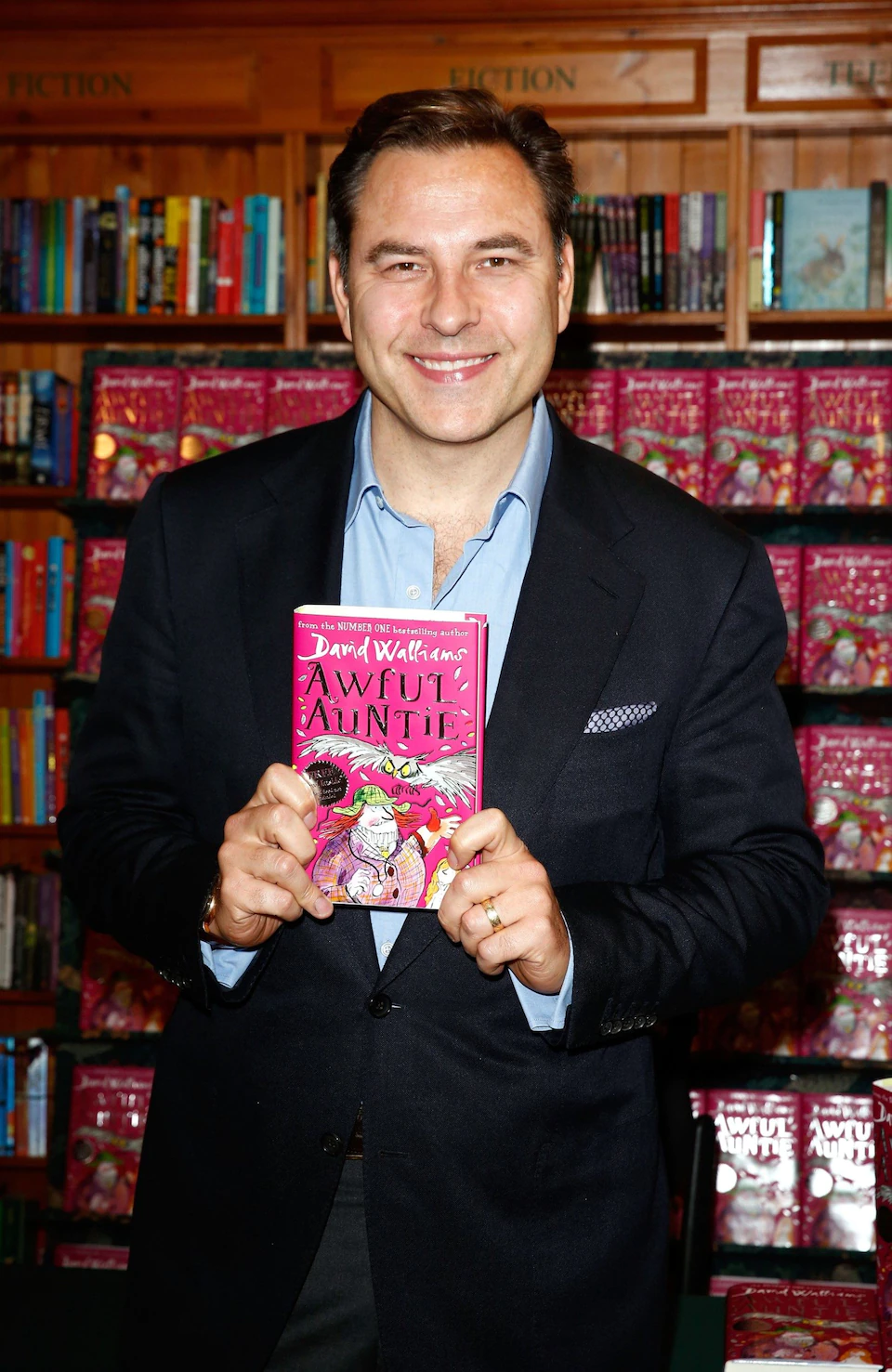
Perhaps the most egregious example, however, is the comedian David Walliams, now the most successful children’s author in Britain. Anecdotally, I’m told by parents who’ve bought his best-selling books that they’re appalling: sub-Roald Dahl (of whom Walliams is a fan), and devoid of heart or writerly flair.

David Walliams

The only thing worse than a child deprived of books is a child immersed in bad ones. Defenders might say that at least a writer such as Walliams gets more children interested in reading, but I see no evidence that he is acting as a gateway drug to better quality gear.

All of this is heartbreaking, because there’s so much to recommend. A quick ring-round to friends and colleagues resulted in my being bombarded with names. You should mention Emma Carroll, they said. Julia Copus is brilliant, said another. MG Leonard, Ross Montgomery, Nadia Shireen, SF Said, Katherine Rundell, Jenny McLachlan… Yet with the exception of Rundell, I’m ashamed to say that I hadn’t heard of any of them (even if, not having any children of my own, I have a reasonable excuse).

It was enough proof to me that children’s literature is as strong now as it was 40 years ago when I was young. So: enough is enough. It is time to attempt to end the depressing monopoly of a small selection of not-very-talented writers. A concert pianist never achieves success by being mediocre, so why should a children’s author?

There is, I admit, a slight air of nostra culpa here. Children’s fiction has always been the Cinderella of the book world, and we journalists need to work much harder in highlighting works for children. As the children’s author and scriptwriter Frank Cottrell-Boyce argued persuasively on Radio 4’s Today programme on Tuesday, newspapers run plenty of restaurant reviews, featuring swanky places that 99.9 per cent of the population are never going to actually visit. Books, on the other hand, are comparatively cheap, and even cheaper if they’re loaned or shared.

So I’m going to make a pledge. From January, we will review a new book by a children’s author once a week. It could be a picture book for younger readers, a novel for pre-teens, or perhaps some Young Adult fiction. It could be a book by an established (professional) author, or a debut by someone brilliant and unknown. What you won’t see, I promise, is anything by a non-writer who is pushing larger talents out of the way in order to extend their personal brand.”

It seems to me that publishers bear some responsibility for this situation. They certainly know what a good quality children’s book is. To favour a celebrity brand-builder, who offers a short-term sugar rush of poor quality sales, over a professional author, who offers long-term sales to happy customers, is making bad business decisions.

Are Publishers Becoming Censors?

There is an article by Anita Singh in Yesterday’s Daily Telegraph in which Chimamanda Ngozi Adichie is quoted as saying that it is unlikely that Salman Rushdie’s novel The Satanic Verses would have been published had Rushdie written it today. Adichie goes on to say that it is unlikely that Rushdie would have decided to write it today.

Chimamanda Ngozi Adichie was born in Enugu, Nigeria in 1977. She grew up on the campus of the University of Nigeria, Nsukka, where her father was a professor and her mother was the first female Registrar. She studied medicine for a year at Nsukka and then left for the US at the age of 19 to continue her education on a different path. She graduated summa cum laude from Eastern Connecticut State University with a degree in Communication and Political Science. She has a Master’s Degree in Creative Writing from Johns Hopkins University and a Master of Arts degree in African History from Yale University. Her first novel, Purple Hibiscus (2003), won the Commonwealth Writers’ Prize, and her second novel, Half of a Yellow Sun (2006), won the Orange Prize. Her 2013 novel Americanah won the US National Book Critics Circle Award. Her most recent work, Notes On Grief, an essay about losing her father, was published in 2021. She was named one of TIME Magazine’s 100 Most Influential People in the World in 2015. In 2017, Fortune Magazine named her one of the World’s 50 Greatest Leaders. She is a member of both the American Academy of Arts and Letters and the American Academy of Arts and Sciences.

Chimamanda Ngozi Adichie

The article says, “In the first of this year’s BBC Radio 4 Reith Lectures, Ngozi Adichie spoke about freedom of speech.

She said: “Here is a question I’ve been thinking about: would Rushdie’s novel be published today? Probably not. Would it even be written? Possibly not.

“There are writers like Rushdie who want to write novels about sensitive subjects, but are held back by the spectre of social censure.

“Literature is increasingly viewed through ideological rather than artistic lenses. Nothing demonstrates this better than the recent phenomenon of ‘sensitivity readers’ in the world of publishing, people whose job it is to cleanse unpublished manuscripts of potentially offensive words.”

Ngozi Adichie said that publishers are also wary of committing “secular blasphemy”.

She claimed that the issue went far beyond the publishing world, with young people caught in an “epidemic of self-censorship” because they are too afraid of being cancelled.

The author faced her own backlash in 2017 after stating in an interview: “When people talk about, ‘Are trans women women?’ my feeling is [that] trans women are trans women.”

In her lecture, Ngozi Adichie said: “We now live in broad settled ideological tribes. Our tribes demand from us a devotion to orthodoxy and they abide not reason, but faith.

“Many young people are growing up in this cauldron afraid to ask questions for fear of asking the wrong questions. And so they practise an exquisite kind of self-censorship. Even if they believe something to be true or important, they do not say so because they should not say so.”

Ngozi Adichie said the alternative to this “epidemic” of self-censorship was people stating their beliefs and as a result facing a “terrible” online backlash of “ugly personal insults, putting addresses of homes and children’s schools online, trying to make people lose their jobs”.

She said: “To anyone who thinks, ‘Well, some people who have said terrible things deserve it,’: no. Nobody deserves it. It is unconscionable barbarism.

“It is a virtual vigilante action whose aim is not just to silence the person who has spoken but to create a vengeful atmosphere that deters others from speaking. There is something honest about an authoritarianism that recognises itself to be what it is.

“Such a system is easier to challenge because the battle lines are clear. But this new social censure demands consensus while being wilfully blind to its own tyranny. I think it portends the death of curiosity, the death of learning and the death of creativity.”

Ngozi Adichie called for a raising of standards on social media, and reforms including the removal of anonymous accounts.

She suggested that “opinion sharers, political and cultural leaders, editors [and] social media influencers” across the political spectrum should form “a coalition of the reasonable” to moderate extreme speech.

I agree with Ngozi Adichie that social media needs drastic reform to stop harmful misinformation, libel and threats. She seems to believe that the ‘tech’ owners of the social media platforms will not regulate properly because of the cost. She is right, but the cavalry is coming in two regiments. One regiment is government regulation and legislation which is starting to be announced and enacted. This will say ‘reform or pay billions’ and if social media platforms want of survive, they must change their business models. The other regiment is the digital advertisers, who, as the defunding of Twitter shows, do not want to be a part of their customers’ misery.

Publishers and authors are different kinds of problems. Publishers have historically had to navigate a fine line between capturing the public interest on the one hand and not causing public outrage on the other. Some authors face a similar set of choices. But neither publisher nor author has an incentive to lie or cover up the truth. On the contrary.

It seems to me that The Satanic Verses is a special case that has nothing to do with current truths or falsehoods. Most Muslims would regard passages in Verses as blasphemous, though is seems doubtful that Rushdie actually intended such severe criticism of Islam. To me, it seems that he intended the dream sequences featuring Mohammad (the Messenger), the polytheistic deities, the devil and the Prophet’s companion as a demonstration of how absolutist systems can go horribly wrong – one of the themes of the book. But the author framed the example with fictional characters and action which are completely contrary to Islam.

In September 2012, Rushdie expressed doubt that The Satanic Verses would be published today because of a climate of “fear and nervousness”. I agree that it wouldn’t be published even today, in 2022, but I wouldn’t attribute the decision to ‘fear and nervousness’. Today, most publishers would look at the manuscript and think, Muslims won’t like it and there will be mass protests. If he wants us to publish it, the dream sequences have to go.

You can call it the ‘sensitivity reader effect’, but really it’s a question about what’s good for the business.

A Banned Author Talks

This week, I’ve decided to post the commentary from a black, gay author whose book has been banned from US school districts. The commentary is on HuffPost, 24 September 2022. I haven’t read the book, so I have no basis for deciding whether it should or should not be banned. But the author, George M Johnson, says he wrote it for 14 to 18 year olds, and it’s about his experience growing up, so, if I were a school librarian, I might discourage a ten-year-old from reading it on the basis that he or she probably wouldn’t have the life experience to deal with the book emotionally. But, I might not refuse a 15 year-old.

George M Johnson

“It was sometime during 2019, before COVID turned the world upside down, that I had the first meeting with my publisher. Her team and I sat in a room around a table and discussed the strategy — the marketing and promotion, mostly — for dropping my first book, which I’d recently finished. I was truly living my dreams. Amid the excited conversation, something in my spirit told me to ask a question: “What happens if you need security at an event?” They all looked puzzled. One of them asked why I’d need that. “I know this book will be banned, ” I replied. “I don’t know when or how widely, but I know that it will be.”

“A report from PEN America this week showed that my book, having survived various criminal complaints, was the second-most banned in the United States, with bans in 29 school districts. States’ continued efforts to ban my work is not easy to wake up to daily. For the past year, there have been constant Google alerts, messages on social media from people calling me a “pedophile or groomer,” and other unsavory attempts to deny my story and the very existence of Black queer people everywhere. I never thought I would be at the center of a political issue moving into an election — nor should I ever have been.

“My book, “All Boys Aren’t Blue,” is a young adult memoir about my experience growing up Black and queer in America. In my story, I discuss growing up in a Black family who loved and affirmed me; the good, bad and ugly truths about what teens really deal with; and my journey through gender and social identity. My life was and still is full of joy, but also include some painful moments involving nonconsensual sex, as well as my experience with losing my virginity. Unfortunately, my sexual experiences have been deemed “an issue” — pornographic by some. To be clear, this book is for ages 14-18 and it contains truths that many of us have experienced and are healing from.

“Books about our experience are not too “explicit” just because they discuss gender, race and other crucial topics that teen readers need to process as they learn about themselves and the world they live in.

“Our books (the banned ones, if you will) often tell stories that are uncomfortable and important. Book banning is nothing new in the U.S., but it has rarely been seen at this magnitude in recent decades. But we can’t just talk about book banning without discussing the suppression of storytelling. Books written by enslaved people, that described their reality, had to be written under pseudonyms to protect the authors. Some of the greatest literary icons of our time — Toni Morrison, James Baldwin and even Harper Lee — have had their books banned despite their works being part of the landscape and foundation for many generations of writers.

“But that is why writing and other types of storytelling are such revolutionary rights.They change lives, provide community, and serve as a lifeline for those who feel unseen, unheard and alone.

“When I first wrote my memoir, I kept reminding myself that this was not for the 33-year-old version of me. This was for my 10-year-old self who had important things to say and had been silenced for so many years. And as I wrote about my experience, I felt lighter. I felt freer. I felt I had tapped a power I never knew existed.

“And then I watched as reader after reader, from teenagers to people well into their 70s, discussed how this book made them feel — how the stories healed and informed them. I was told that my simple existence (me being out here and sticking to my intentions) was something that they could hold on to on their roughest of days. And that’s the truly revolutionary thing about art. Toni Morrison once said, “If there is a book you want to read and it hasn’t been written yet, then you must write it.” That’s what I did. And while all the book bans are weaponizing my words, I know that they’re providing armor for those who have gone through anything I did.

“I have more books to write and more stories to dismantle this system. And I’ll be damned if anyone denies my right to write them.”

I say, “Carry on, George!”

Publishing Today

Below are some of Harry Bingham’s thoughts on the state of book publishing today. Harry is the founder of Jericho Writers. It’s a good time to be a writer!

Harry Bingham

Self-publishing

Ten years ago, self-pub wasn’t really a thing. Now it certainly is. These days, there’s no longer any good public data for the scale of the self-pub market, but very roughly you should assume that self-published titles sell as many copies as all Big 5 titles on Amazon combined – in other words, one heck of a lot. Indeed, there are corners of the reading globe (romance and erotica especially) where self-publishing utterly dominates.

What’s more, indie authors make money. Again, public data is no longer available, but when it was, it was clear that at every single income level you care to name, there were more indie authors earning at that level than trad-published ones. More million-dollar indies. More $100K indies. And so on down. I’m certain that that basic picture hasn’t changed.

Multiple imprints

A friend of mine is currently selling a book, via a top British agent at a top British agency. The list of editors who are receiving that book include (of course) all the Big 5. It may surprise you to learn that the book doesn’t go to just one editor per publisher. It goes to as many editors, at as many imprints, as may be right for the book. From memory, the book is therefore going to two editors in different bits of HarperCollins, the same at PRH, and so on.

If an auction arises, those two HarperCollins editors, let’s say, might find themselves bidding against each other. A PRH / S&S merger wouldn’t necessarily reduce the number of editors that an agent pitched to. It would just change the email addresses of one recipient.

The long tail

Good publishing simply does not stop at the big firms.

My friend had as many small- to mid-sized publishers on that submissions list as Big 5 editors. And honestly? I think it’s simply 50/50 whether the book ends with a large house or a small one. The right publisher for that book will be one where the editorial, design and marketing visions align the best … along with a dollop of good chemistry between author and editor. A real passion from a Faber or a Bloomsbury or a Granta would (to my mind) be a better deal than a more lukewarm offer from a larger firm. (Those are British firms, but there are similar firms in the US and elsewhere too.)

The quality in some of these smaller houses is incredible. You often get more daring publishing, greater willingness to take risks, and generally bolder decisions at every level of the firm. You also, as an author, actually feel important to the firm, which is not something that’s easy to feel when you’re in the grip of one of the big machines. I once rejected an offer from a top, top quality British independent and I’ve always wonder if I did the right thing. If I had to guess, I’d say probably not.

Money

Most authors I know don’t ultimately care about money anyway. Yes, they want to be paid properly for their work, and they want that side of things to be handled with proper justice and professionalism, but the real payoff is more intangible. It’s the passion of a publisher, the respect of a community of peers, the book in the bookshop, the reviews and comments. All those things are every bit as likely – perhaps likelier – for authors working with strong indie presses as for those working with the Big 5.

The Big 5 firms are great. The indie publishers are better than they’ve ever been. Self-publishing creates a tremendously inspiring and effective route for countless authors.

Author-led marketing tools are the best they’ve ever been.

Barnes & Noble and Waterstones (respectively the flagship bookchains in the US and UK) are both in better shape than ever.

The independent bookstore sector has lost a lot of poor-quality stores, but the strong ones remain strong.

Books (thanks, especially to low cost ebook pricing) are insanely affordable – and you can read in any format you choose much more easily than before.

The simple fact is that it’s better to be an author today than at any point in the last two decades. Indeed, that’s probably underselling it. I think it’s easy to argue that this is the best ever time to be an author.”

Publishing in a War Zone

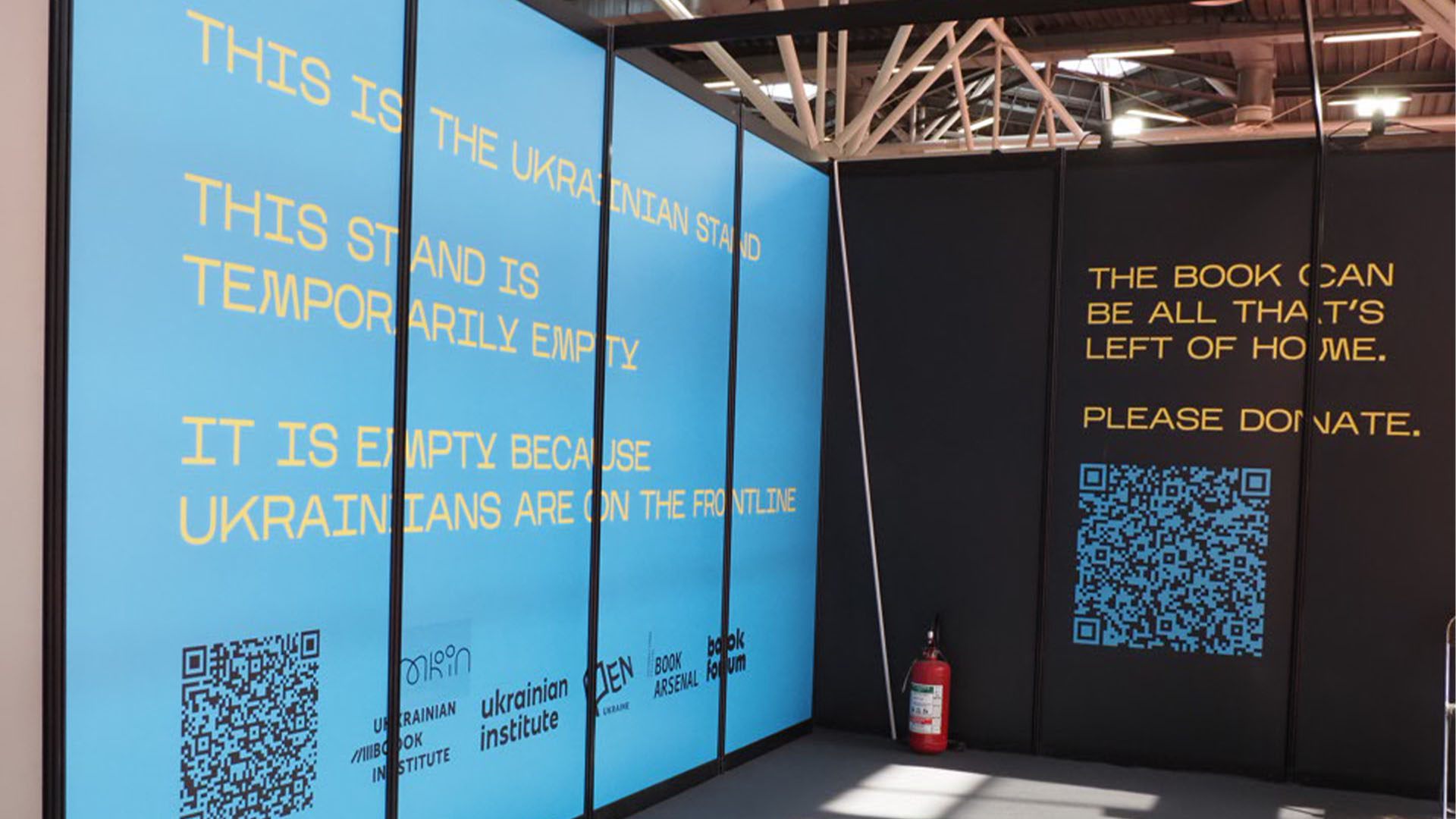
There is an article on The Bookseller website if April 8, 2022, written by Kateryna Nosko, a Ukrainian publisher, who describes how colleagues and peers continue to write, publish, sell and salvage their work in the midst of war. At the top of the article is this photograph of an empty Ukrainian stand at an international book fair:

The Ukrainian strand at the Bologna Children’s Book Fair

Ms Nosko says: “It is the 42nd day of the war, and we continue living in the traumatic landscape. Sometimes this landscape shakes even more, such as when we and the whole world witnessed the photos of the Russian crimes in Bucha and Irpin, the Kyiv suburbs. After this, words become powerless. What arrives is a state of numbness. 

In this sense, the Ukrainian stand at the international book fairs manifest this desolation. The organisers say the idea of the empty stand in Bologna shows that Ukraine is at war, and the publishers are saving lives: their own and the ones of their loved ones. Indeed, today such a thing as a trip to an international book fair is blocked. Still, there is a feeling that publishers and cultural agents, who continue working or are already abroad, should turn the empty stalls into a platform for loud Ukrainian voices that represent the contemporary Ukrainian cultural and book publishing sectors. 

Because of the impossibility of talking about war when it unfolds in one’s country, images with short captions seem helpful. A week ago, a comic strip was released by Borys Filonenko and Danyl Shtangeev called “How to protect yourself and save others when you are a terrorist leader” The comic has 10 pages and resembles an instruction manual. All images are low-quality and grainy, as if from soviet handbooks. Filonenko wrote the text in an hour and a half after seeing the stage during a concert rally in Moscow’s Luzhniki where Putin spoke on 18th March. The scene resembled a cage and became a key element of the comic. The work took a week in total, but only because there is not enough time for making a comic nowadays. While the authors were working, the missiles fell on Western Ukraine: Lviv, Lutsk, Rivne, Khmelnytskyi. Shtangeev’s mother called him for the first time in two weeks, but the call was only eight seconds long as she was in Rubizhne, right on the frontline. During this time, the Mykolaiv Regional State Administration, where some people were staying, was bombed and destroyed. Our friends – artists from Mariupol – from whom we’d heard almost nothing since the beginning of the war were finally found.

Meanwhile, with help our publishing team has managed to rescue some book stock from Kyiv and Kharkiv. In particular, we rescued copies of art book KYIV by Sergiy Maidukov, by an artist who often creates illustrations for the New Yorker. He likes to draw from life in the city, but now it isn’t easy to manage. On the streets of Kyiv, as soon as you get a camera or a tablet out, the Territorial Defense comes up to you to identify who you are and why you are recording. This is necessary to determine whether you are working as a saboteur or enemy reporter.

Our office, where some of the books by Sergiy Maidukov are stored, is located in the Kyiv historical city centre, in Podil, on the right bank of the river. On a regular day before the war, we would put a key from our office in our pocket, and we would take the number of books needed for delivery and bring them to the post office – a straightforward set of actions. During the war, all of this doesn’t seem as clear anymore. Firstly, only one team member remained in Kyiv – our designer Dima Frolov. However, he didn’t have a key. Apart from a neighbour on the left bank, no one did. This made the task even more difficult since the bridges are blocked, and those that remain open are dangerous to cross. Still, this hadn’t stopped Frolov from going to the left bank, spending three hours in traffic while all the block-posts checked the documents and the car tank several times. The next day he managed to send the books to Western Ukraine. 

When we published KYIV by Sergiy Maidukov last year, Maidukov said that the book was his declaration of love for Kyiv.

Several days ago, the Russians were pushed away from the Kyiv region. So, Kyiv citizens are gradually returning to the capital, even though the government says there is a significant death threat. The people are coming anyway, a remarkable testament to their love for Kyiv.

Summing up this story about the evacuation, I want to say that when the books finally arrived in the west of the country, in theory to a “safer place”, that night, not far from the storage where we put them, the missile struck an oil depot. Neighbours’ windows flew out, but no one was injured. A few kilometres from the explosion, the books were also not damaged. I realised that wherever we looked for quiet places, it was still dangerous everywhere. 

Yet, people keep ordering books online, and there are some open bookstores. We, in turn, began to send the orders where delivery allows. However, in my last column here I wrote that we were not planning to deliver the orders yet. We decided to transfer the proceeds from the book sales to two charitable organisations: the Social Adaptation Complex, where adults with mental disabilities live, and Sirius – the biggest dog shelter in Ukraine. 

For the first time during the war, we managed to print a stock in Ukraine. Brave printing staff in Kyiv have finished printing and stitching our new book Conversations about Architecture with Oleg Drozdov and Bohdan Volynsky, which was interrupted by the war starting in February. Unfortunately, the most powerful printing houses are located in Kharkiv, which is in the East of Ukraine, and they cannot operate since the city is constantly under shellfire. Recently, the world-famous Ukrainian poet and writer Sergiy Zhadan came under fire in Kharkiv, which he announced on Facebook. Yet, this hasn’t stopped him from volunteering and going to the city’s most dangerous areas. He writes about Kharkiv nearly every day. One day, he said that Kharkiv residents were cleaning around their houses, raking glass and bricks, because they were used to the cleanness of the city. In the same way, we in the publishing industry, strive to continue doing what we are used to.”

The Ukrainians are amazing!