Dan Brown’s Latest

Back is September, I reported on an interview with Dan Brown about his new novel, The Secret of Secrets, reported by Hillel Italie of the Associated Press.

For those of who are fans of Brown, I have to confess that Brown went to the same high school I did: Phillips Exeter Academy in Exeter, New Hampshire, although Brown was class of ’82 and I was ’56.

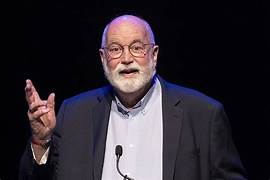
Dan Brown

The reason I mention this is that Brown is interviewed by Matt Miller, in the Fall 2025 issue of The Exeter Bulletin, the alumni magazine. Matt W. Miller is an award-winning poet, essayist and educator. He taught English and coached football at the Academy for 18 years and is currently an associate lecturer in creative writing at the University of Massachusetts Boston.

MM: The last installment of your Robert Langdon series came out eight years ago. What does it feel like to return to that character?

It’s like I never left. He and I share a lot of the same passions: history, art, codes, treasure hunts. I live vicariously through him. I sit alone in the dark with a computer, and he runs around the world. It’s a lot of fun.

MM: The book explores the noetic sciences, a multidisciplinary field that studies subjective experience and consciousness using scientific methods. What drew you to that subject?

I wrote a book called The Lost Symbol about 12 years ago in which there was a character, Katherine Solomon, and she was a noetic scientist. As I was writing that character and learning a little bit about noetics, I thought, oh my god, human consciousness is a book in itself. I thought it would be the book I wrote after The Lost Symbol, but it was too hard. I didn’t know enough about consciousness. I never imagined it would take eight years, but it’s an ethereal topic. I always felt like I was trying to get my arms around smoke, just trying to figure out how to write this.

MM: It’s a deeply researched book. Was there some “aha!” point when you knew this subject had to be the subject?

I read about an experiment in precognition where different parts of the brain light up when you see different kinds of images. In the study, the brain was lighting up before an image was seen. So, what does that mean? Perhaps the brain is creating what image to see. Or there was precognitive knowledge of what was about to be seen. Or perhaps time flows in two directions. Any of those answers, and you’re like, what? None of that makes sense. This experiment made me really think that, from a personal level, I had to understand consciousness. And as a writer, I had to figure out how to share it in a fun package.

MM: How do you balance getting all that researched information about politics, history, science, physics and metaphysics into the novel while also moving forward narrative action and character development?

You make sure that the data dump that you are performing is directly relevant to whatever character you’re writing about. Langdon could be walking down the street and think, oh, Petřín Tower, and I give a two-minute dissertation on Petřín Tower, which feels like an aside, and that’s boring. The information has to be part of solving a puzzle. It must be linear to the plot, not ancillary. And don’t fall in love with your research. If it doesn’t serve the plot, it goes.

MM: That’s the toughest thing for writers, knowing what to cut.

The delete key has to be your best friend. Any artist or musician understands the importance of blank space or silence. The rests and silences give the melody to that place. It’s the same way in writing. You need to let your writing breathe.

MM: You thank your editor Jason Kaufman in your acknowledgments. Does an editor, like a writing teacher, help you see where you need to pull back or where you need more?

That’s exactly what Jason does. He’ll read something and say: “Hey, this is great, but we don’t need four paragraphs about Prague Castle. We need two.” Then he’ll also say: “Oh, you just glossed over this thing. I want to know more about that.” He not only shares my taste, he has perspective, which is what you lose as a writer. It’s nice to have somebody come in and read it as a first-time reader, which is really the only way to know how it’s reading at all.

MM: The Secret of Secrets is set in Prague. What drew you to that city?

Setting is critical. Location is a character. Prague has a personality, as does Paris, as does the Arctic Circle. Wherever you’re setting a book, it needs to be integral to the plot. When I decided to write about consciousness, I knew it had to be Prague. Prague has been the mystical center of Europe since the 1500s, when Emperor Rudolf recruited mystics to come to Prague to talk to the Great Beyond. As far as character goes, Prague is perfect for a Langdon book. There are passageways and a door with seven locks and crypts and cathedrals and all sorts of secrets.

MM: As Langdon learns more about the nature of nonlocalized consciousness, I kept thinking about artificial intelligence. If AI could develop consciousness, where would that consciousness come from? Is it created? Is it tapped into?

Can we create artificial consciousness? When you have enough synapses, does it just happen? It seems unlikely that it just happens. And this whole new model of the brain as a receiver of consciousness changes everything because if we’re trying to build an AI to receive consciousness, it’s a much easier proposition. It’s not like you have to build something that can create all the hopes and dreams and creativity and memories and all that. You just have to receive it. I actually think that this model of consciousness is pretty exciting and makes the quest for artificial consciousness more attainable, as well as consciousness after bodily death.

MM: Not to give too much away, but there’s a fascinating section in the novel about halos and how they are rendered in art. Langdon saw the beams of light as emanating out of halos. But then he realizes he may have misread the images, that the beams are radiating back into the halos, and that is consciousness coming in.

Right. And if you read Scripture, really any religion, one receives the word of God. You don’t conjure God; God flows in. And we kind of miss that. That could be consciousness flowing in because it is not housed within the brain, as materialists presume, but outside the brain.

MM: You have a golem character. In the Jewish tradition, the Golem is a created being, an artificial intelligence with consciousness.

Yes, one of the reasons I chose the Golem is that it’s this inanimate object that can be infused with consciousness just by writing a magic symbol, or a code, on its forehead.

MM: Do you think that this novel and its topic of a nonlocalized consciousness may have a particular prescience in these times?

I hope so. There’s no bigger topic than human consciousness. It’s the lens through which we experience reality, experience ourselves and other people. The fear of death is the universal fear. Religious or atheist, we all are curious and unsettled by the fact that our lives are finite. This notion of what happens when we die is the big question. If we can adopt a mindset where we realize that human consciousness survives death, maybe some of that fear starts to dissolve. And the thing about the fear is that it’s really the catalyst for a lot of bad behavior.

MM: Do you believe in this idea you bring up in the novel that if consciousness transcends our physical self, then we can move beyond the borders of mortality and by doing so move beyond the borders between each other?

Yes, I do. If we can start to understand that this life is just one stop on a much bigger journey, bigger than things like nationalism, country, race and all those things that separate us, then it’s quite possible that humanity could move forward in a benevolent fashion.

Non-AI Novels Will Be a ‘Luxury’

There is an article in today’s Telegraph written by Tom Mc Ardle which reports on a study done by Dr Clementine Collett at Cambridge University on AI’s effects on literary trends.

Dr Clementine Collett is a DPhil student on the ‘Information, Communication and the Social Sciences’ course at the Oxford Internet Institute. Clementine’s doctoral research explores gender bias in artificial intelligence (AI) recruitment technology.

Clementine has worked as lead author on reports such as IA and Gender: Four Proposals for Future Research (2019) with the Leverhulme Centre for the Future of Intelligence at the University of Cambridge and The Effects of AI on the Working Lives 0f Women (2022) with the IDB, OECD and UNESCO.

Dr Clementine Collett

Novels written without artificial intelligence will become an “expensive luxury”, according the report.

Dr Clementine Collett has claimed that the creative market could become “tiered”, with only those who could afford human-written work being able to read it.

“[There] is a real concern from literary creatives that we will have a two-tier market, more so than we have already,” she told BBC Radio 4’s Today programme.

“Where human-written work will be more expensive – a luxury item.Those who can afford it will read human-written novels and AI generated content will be cheap or free and that will potentially have big societal implications as well.”

Dr Collett, who conducted the study at the University of Cambridge’s Minderoo Centre for Technology and Democracy (MCTD), interviewed to nearly 400 literary creatives across the UK about the threat of generative AI.

“There is widespread concern from novelists that generative AI trained on vast amounts of fiction will undermine the value of writing and compete with human novelists,” she said.

Dr Collett called on the Government to weigh up the economic growth it has so far prioritised by developing AI, against the potential impact on the creative industries, including readers and the novel itself.

The study found that almost two thirds (59 per cent) of novelists reported that their work had already been used to train large language models, which power AI tools, without permission or payment.

Such practices have already impacted the livelihoods of those surveyed, with more than a third (39 per cent) reporting their income being negatively affected by AI.

The report found genre fiction, especially romance, thrillers and crime, is more at risk from displacement than more highbrow literary fiction. Dr Collett said this was because of their more “formulaic” make up.

“We don’t know what generative AI is going to be able to do in the future in terms of producing more original content,” she added.

“It’s really important because novels are such a bedrock of our thriving British creative industry and they’re the core part of our humanity.” She called on Government intervention to help protect the industry.

Prof Gina Neff, executive director of the MCTD, said: “Our creative industries are not expendable collateral damage in the race to develop AI. They are national treasures worth defending.”

A spokesman for the Department for Science, Innovation and Technology said: “We’ve always been clear on the need to work with both the creative industries and the AI sector to drive AI innovation and ensure robust protections for creators.”

Review: The Confessions of Saint Augustine

I persuaded myself to buy this book after reading that, “The Confessions of Saint Augustine is one of the most influential autobiographies ever written. In this timeless work, Saint Augustine, Bishop of Hippo, candidly reflects on his moral struggles, spiritual journey, and ultimate conversion to Christianity. With honesty and depth, his shares his transformation from a life of sin to one of faith and grace.”

The Conversion of Saint Augustine

Augustine was born in 354 in Thagaste (now Souk Ahras, Algeria) in the Roman privince of Numidia. His mother, Monnica, was a devout Christian; his father Patricius was a pagan who converted to Christianity on his deathbed. Scholars generally agree that Augustine and his family were Berbers, an ethnic group indigenous to North Africa, but were heavily Romanized, speaking only Latin at home as a matter of pride and dignity.

At the age of 11, Augustine was sent to school at Madaurus a small Numidian city about 31 kilometres south of Thagaste. There he became familiar with Latin literature, as well as pagan beliefs and practices. His first insight into the nature of sin occurred when he and a number of friends stole pears from a neighbourhood garden.

At the age of 17, through the generosity of his fellow citizen Romanianus, Augustine went to Carthage  to continue his education in rhetoric, though it was above the financial means of his family. Despite the good warnings of his mother, as a youth Augustine lived a hedonistic lifestyle for a time, associating with young men who boasted of their sexual exploits. Augustine began a relationship with a young woman in Carthage. Though his mother wanted him to marry a person of his class, the woman remained his lover. He was warned by his mother to avoid fornication (sex outside marriage), but Augustine persisted in the relationship for over fifteen years.  He ended his relationship with his lover in order to prepare to marry a teenage heiress. By the time he was able to marry her, however, he had already converted to Christianity and decided to become a Christian priest and the marriage did not happen.

After converting to Christianity, Augustine turned against his profession as a rhetoric professor in order to devote more time to preaching. In 391 Augustine was ordained a priest in Hippo Regius (now Annaba), in Algeria. He was especially interested in discovering how his previous rhetorical training in Italian schools would help the Christian Church achieve its objective of discovering and teaching the different scriptures in the Bible. He became a famous preacher, and was noted for combating the Manichaean religion, to which he had formerly adhered. He preached around 6,000 to 10,000 sermons when he was alive; however, there are only around 500 sermons that are accessible today. In 395, he was made Bishop of Hippo. He remained in that position until his death in 430. Bishops were the only individuals allowed to preach when he was alive and he scheduled time to preach after being ordained despite a busy schedule made up of preparing sermons and preaching at other churches besides his own.

 As a theologian and philosopher, his writings deeply influenced the development of Western philosophy and Western Christianity, and he is viewed as one of the most important Church Fathers of the Latin Church. His many important works include The City of God, On Christian Doctrine and Confessions

When I started reading Confessions, I was expecting a clear and complete confession of his sins, together with a detailed account of what persuaded him to convert to Christianity. The detail is missing. He confesses, however, to the theft of the pears and to relationships with concubines. He mentions the influence of his mother, but there is little about his conversion. Much of the book is devoted to his praise of God. From the very beginning if the book, he is clearly a man of very deep faith, though he regarded himself as sinner, and the transition from sinner to saint is granted. He also engages in philosophical discussions. The book was translated into ‘thou and thee English’. I found the book long (345 pages) and disappointing.

Review: The Bustamante Story

The subtitle of this book is ‘& Behind the Scenes of Shadow Cell’. The author is ‘Harry Greene’.

After reading an article in the Atlantic about two CIA agents who fell in love on an assignment involving the creation of a shadow cell inside a global competitor of USA, I searched on Amazon for their book.

There appeared to be several, but I couldn’t find one with Shadow Cell in the main title. So I picked this one out as a likely candidate.

This book at 135 pages. The interesting information in it could have been divulged in ten pages. It is repetitious on several subjects: tight security at CIA; the two agents felt under great pressure at CIA for their relationship; the agents were clever, top performers. There were almost no examples backing up these assertions. The author is very careful to speak kindly of the CIA and the agents, and not to mention even a trivial fact which might be classified. He probably wants to be clear of any litigation, should his real name be known.

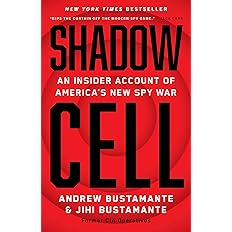
How wrong my choice was! This one is most likely a knock off of the real book (pictured below). A knock-off written by a Joe Bloggs under the pen name of a Harry Green. There is a Harry Green listed on Amazon who has written 16 fiction and non-fiction books on various subjects, none of which include the CIA. This book has an ISBN number (which no longer comes up on Amazon searches). In fact, this book no longer exists according to Amazon. This book doesn’t mention its publisher or its printer. It says only that the book was printed in New Haven, Connecticut on 10 September 2025. There is no author biography or statement of his/her relationship to the agents or the CIA. The narrator starts right in as if he had permission to tell the story.

The real book: a New York Times Bestseller!

Interestingly, I don’t believe the real book was listed on amazon.co.uk when I bought the knock-off. In fact, it still doesn’t seem to be listed. I just bought a real copy on amazon.com. It was published on 9 September 2025.

So what’s all the hubbub about? Well, here’s the publicity from the real thing:

INSTANT NEW YORK TIMES BESTSELLER | A thrilling firsthand account by husband-and-wife CIA operatives who, against all odds, triumphed in a deadly cat-and-mouse game against a mole within the agency—an unprecedented insider account of 21st-century spycraft in the tradition of Argo and Black Ops.
 
Andrew and Jihi Bustamante were a “tandem couple”: married spies who’d dedicated their lives to the CIA. They met as trainees at Langley, and got married while hunting terrorists across the globe. Then, suddenly, they were assigned to a mission so sensitive and explosive that the CIA still has never acknowledged it. The CIA’s source network in a country code-named “Falcon”—one of America’s most formidable rivals—had been compromised by a mole, and the agency needed a new way to collect intelligence there. Young newlyweds, the Bustamantes were considered safe choices for this daunting task precisely because they had no experience in Falcon. They were also loyal, forgettable, and completely disposable—operatives who could help to strengthen the CIA’s position in Falcon while simultaneously serving as bait for the mole.
 
But although their superiors at the CIA didn’t realize it, the Bustamantes also brought another advantage to the table: a granular understanding of how terrorist cells operate, and how the agency could exploit those same tactics to keep America safe. Assembling a rag-tag team of fellow operatives and recruiting new sources from Falcon, the Bustamantes pioneered a new way of spying by building a cell of their own—right at the heart of the CIA.

The propulsive, untold tale of one of history’s greatest intelligence crises and the unlikely band of agents who were sent in to clean up the mess, Shadow Cell allows us to peer behind the curtain to see how today’s spy wars are being fought—and won.”

AI Controversy

There is an article in the Atlantic magazine on 19 September about how the publishing industry views AI. It is written by Boris Kachka, Senior Editor of the Atlantic. He titles the article ‘Publishing’s New Microgenre’

Boris Kachka

“Book publishing has, let’s say, a complicated relationship with artificial intelligence. Earlier this month, Anthropic settled a lawsuit brought by authors and publishers, agreeing to pay $1.5 billion after training its chatbot, Claude, on pirated text; hundreds of such copyright lawsuits against data-scraping tech companies are still making their way through the courts. Many in the culture industries see AI as not just a thief but an existential competitor, ready to replace human writers at every turn. Yet publishers are also fascinated by the technology (and not only because they use it for marketing and other tasks). The major imprints have been churning out a robust collection of books (more than 20 this year, by my count) that explain, extol, deride, fictionalize, and occasionally incorporate AI.

Among these recent releases, one overarching theme is a debate occurring between so-called accelerationists and doomers—those who think superintelligence will hugely benefit humanity and those who suspect it will kill us all. Adam Becker, a journalist and former astrophysicist, disagrees with both groups. Becker, the author of the recent anti-utopian critique More Everything Forever, wrote about his problems with a new dystopian manifesto, If Anyone Builds It, Everyone Dies, by Eliezer Yudkowsky and Nate Soares.

Becker’s main objection to both sides is that they overhype the long-term, world-altering effects of superintelligence while downplaying the “much more immediate and well-founded concerns about the dangers of thoughtlessly deployed technology,” he writes. The kinds of ongoing changes that he would prefer to focus on are well accounted for in 2025’s AI book haul. Readers can find out more about how AI’s processes resemble the workings of our brains (or don’t); how the technology is changing medicine, warfare, education, business, and politics; how it has already profoundly altered society. But to me, the most interesting of the crop (or maybe just the most fun) are the works that explore our individual relationships with AI, through fiction or memoir.

Novels such as Amy Shearn’s Animal Instinct and Jayson Greene’s UnWorld imagine chatbots standing in for boyfriends or dead loved ones; politician-author Stacey Abrams invents a rogue medical-AI company in her latest legal thriller, Coded Justice. Hamid Ismailov’s wildly experimental novel We Computers, translated from Uzbek and longlisted for a 2025 National Book Award, creates an alternate history in which a 1980s computer intelligently generates a new kind of mind-expanding, transnational literature.

Occupying a category all its own is Searches, a fragmented memoir in which Vauhini Vara works through her complex feelings about technology. Vara interweaves the story of the rise of the internet with the narrative of her life and work as a tech reporter. She also includes strange interludes: prose-poetic lists of her Google searches; a collection of her Amazon-purchase reviews; and, most strikingly, a series of long interactions with ChatGPT-3 as she works to revise an essay about a sister who died years ago. As Matteo Wong noted in his Atlantic article about the book, the large language model produced what Vara considered to be the essay’s best lines while also inserting plenty of lies. She wound up employing the bot not to think for her, but to prod her into a different kind of thinking; it forced her, she writes, “to assert my own consciousness by writing against the falsehoods.” I enjoyed the book in part because it was less about what technology is doing to us than what we are doing in response.”

Dan Brown’s New Novel

On the AP website there is an interview of Dan Brown written by Hillel Italie, which explores his writing techniques in the context of his new novel, Secret of Secrets.

Dan Brown

Brown says, “Anybody who writes a thriller needs to have a plan. There’s a great saying that the thriller writer who starts a book without knowing where’s he’s going is just lying,” he told The Associated Press on Tuesday.

“And certainly these books are very complicated. One way I sort of battle, trying to keep it all straight, is to write every single day, just to keep it fresh. If I go through two sleep cycles (without writing), it starts to evaporate. And, of course, I also have what looks like a detective’s chalkboard in a police station. We’ve got the pictures and the yarn and the notes and the sticky notes, all that on my wall trying to keep it straight as well.”

Brown’s “The Secret of Secrets” has been published this week, a 650-page thriller and mind-bender from the author known worldwide for “The Da Vinci Code”, “Angels & Demons” and other million sellers. Brown again combines suspense, philosophical digressions and travelogues, along with codes and puzzles and secret societies as he dispatches favorite protagonist Robert Langdon to Prague and ensnares him in a deadly, international race for the key to ultimate wisdom — what happens when we die.

Besides Langdon, the Harvard symbologist who has found adventure and trouble everywhere from Paris to Washington, D.C., Brown has brought back love interest/noetic scientist-in-distress Katherine Solomon and a New York-based book editor with a very real-life counterpart. “Jonas Faukman” is an anagram for Brown’s editor at Doubleday Books, Jason Kaufman, who has worked with the author for more than 20 years. Author and editor are good friends, they say, although that didn’t keep Brown from subjecting Faukman to abduction and other un-literary experiences in his latest book.

“I always enjoy getting manuscripts from Dan and seeing where he’s going,” Kaufman told the AP recently. “I have to ask him not to tell me in advance what he has in mind. He always finds new ways to surprise me.”

Brown also spoke with the AP about how he decides on his subjects, his evolving thoughts on mortality and why Prague is the perfect setting for a few conspiracies. This interview has been edited for clarity and brevity.

AP: How do you go about deciding what to write about?

BROWN: It’s no secret that I like to write about big topics and there really is no topic that is bigger than consciousness. It is the lens through which we see ourselves. And so the real challenge was how to make a concrete urgent modern thriller about something that’s so ethereal.

About eight years ago, my mom passed away about the time that I was thinking of writing about consciousness, and I started asking myself, “What happens when we die?” and if you’d asked me eight years, ago, I’d say nothing It’s full stop total blackness. Over the course of the eight years that took me to write this book and all the conversations that I had with philosophers and physicists and noetic scientists, I’ve come out the other side with a totally different mindset. And in fact, it sounds crazy. I no longer fear death.

AP: Before you worked on this book, did you consider yourself an atheist? An agnostic? How would you have described yourself?

BROWN: I grew up Christian, Episcopalian, but I moved away from the organized nature of religion. I’ve always been spiritual and sensed there’s something else, but I’ve also been skeptical and said, “Well, that sense of there’s just something else could just be wishful thinking.” It could be because it’s so hard to imagine that there’s nothing else that we just sort of say, “Well, I sense there’s some thing else.”

And now I do sense there’s something else. And that is from an intellectual standpoint. I have not had a religious experience, a spiritual experience, an outer body experience, or near death experience. This change of mind comes from looking at the science that is happening right now in the world of physics and noetics.

AP: Some people talk about the creative process, so to speak, as almost a religious experience, that moment the idea comes to you, whether it’s the right phrase or a piece of music.

BROWN: It’s called flow, a muse. Certainly, we writers have that experience of, “Ah, I’ve got it. It’s just flowing through me.” I have certainly felt that. Not every day, unfortunately. There’s a lot of trial and error, but that is the feeling that creative people are always looking for. My mom was a professional musician. I was brought up to be a musician. I thought I would be a musician. I still play piano every day. I studied music composition in university, and I’ve had that experience also with music.

That sort of muse moment when something flows in, it’s different between writing and music. Writing sort of feels like finding the right Lego piece to put in. You say, “Ah.” It’s almost like doing a jigsaw puzzle. You’re like, “Got it. It fits.” And music is a little bit more fluid. It’s like making a big brush stroke. And the melody just sort of flows in and finds its way to your hands, and then it exists.

AP: The cities you set your books in are so important to what you do. Do you have a kind of wish list? Like, “I need to set a book in this city.”

BROWN: I mean, there are a few of them that I won’t mention because I don’t want people running out, and they’re sort of off the beaten path, kind of like Prague is.

I like to use location as a character. I want to make sure that, whatever book it is, it could only be set there. “The Lost Symbol” could only be set in D.C. because it’s about the symbology of D.C. “The Da Vinci Code” could only be set in Paris because it is about the Roseland. “The Secret of Secrets,” about human consciousness, could only be set in Prague. It’s been the mystical capital of Europe since Emperor Rudolf II (in the late 16th-early 17th centuries) brought all the mystics and scribes and alchemists to Prague. And as a character, Prague is perfect for Langdon. It’s full of secret passageways and cathedrals and monasteries and all, that’s his world.

AP: Puzzles and mystery and passageways, that’s just endlessly fascinating to you? It’s as interesting to you now as when you were 10 or 20?

BROWN: I don’t know what that says about me, but yeah, I still love secret passageways. You talk about that “aha” moment. It’s kind of the same thing to say, “Wait, there’s something here that you don’t see and now you see it.” It’s the same kind of sensation of “aha.”

Getting Accents and Dialects Right

Harry Bingham’s email of last week deals with the tricky subject of how to write in accents or dialogue convincing but not condescending.

Harry is the founder and CEO of Jericho Writers.

Harry said, “So here is an example of transcribing a character’s voice in a patronising way:

Eet eez ’orrible to ’ear ze proud Frensh race beleettled in zis stooped manner.

But what the character involved has actually said here is:

It is horrible to hear the proud French race belittled in this stupid manner.

The first sentence, by transcribing its pronunciations in a very literal way, makes the speaker come across as ludicrous – cartoony, a circus clown with a striped jumper, a string of onions and a comical moustache. But what’s actually comical? The sentence itself displays perfect command of English, and what’s being apparently laughed at here is an accent, over which the speaker has very little control.

And, golly gosh, that’s a slippery slope.

Most people writing a non-English character in this way will (if English) speak roughly RP, or Received Pronunciation – in effect, roughly what a BBC newsreader used to sound like. In the US, it’s much the same thing, except that the reference dialect is Standard American English.

(And, please note, in RP English, we say “She placed the glahss on the grahss next to her great big – handbag.” But we wouldn’t even conceive of inserting the letter H into the two italicised words to mark the weird pronunciation. Nor do we adjust the spelling to take care of the flat “a” sound in American and North-British versions of those words. So when it comes to our weird pronunciations, we don’t even think of trying to reflect them in spelling.)

And of course, as soon as you start to accord any kind of typographic privilege to a particular accent – whether RP or SAE – you get into all sorts of bother.

It’s one thing to have a comical Frenchman – France is a nuclear power and can look after itself – but do you really want to apply the same diminishing treatment to, say, a black resident of Harlem? Or a Scouser? Or a northern woman of Pakistani heritage? Or a Mexican immigrant?

The answer, if you haven’t already figured it out is, No, certainly not. Don’t go there. Step away from the quirky spellings.

That’s partly because of a perfectly legitimate anxiety about racism.

But it’s also just a recognition of modern linguistics. The RP / SAE dialects are simply two dialects amongst many, many others. They don’t come with a halo over them that says, “the king/President speaks this way, so this version is right and everything else is wrong.” The fact is that we all speak the dialect of our culture and each dialect has no more or less validity than the next.

That’s not just true of pronunciation. It’s true of grammar too. Any significant dialect has its own grammar, which may differ from SAE / RP grammar (which, by the way, each differ from each other.) So African-American Vernacular English has its own strict rules of grammar, that are just different from SAE – and not just different, but with subtleties that SAE struggles to cope with. SAE has four basic past tenses: I did buy it, I have bought it, I bought it, I had bought it. AAVE has five, but differently structured: I been bought it, I bought it, I done bought it, I did buy it, I do buy it.

What does all this tell us?

It tells us (duh!) that other people may speak differently from us.

It tells us (duh!) that it’s not respectful or, in fact, linguistically accurate, to privilege one set of accents or grammars over another.

And that means that the solution for a novelist is quite easy:

  1. Don’t try to capture nuances of accent in the way you transcribe speech. We don’t write “grahss” if we try to capture how the king of England speaks. We don’t write “eet eez ’orrible” if we try to capture how President Macron expresses himself.
  2. Do use the actual words that your character uses. President Macron is probably more likely than the rest of us to use the word voila even when speaking English. And if he says it, that’s what you write. Likewise, if a Black American character says finna (a contraction of fixing to or going to) then that’s the word you write down. It IS a word; it just isn’t an SAE / RP word. Don’t patronise your characters by editing their speech.
  3. Do use the grammar that your character adopts. So if your character is African-American, she might say ‘I done bought it’, in which case you write, ‘I done bought it.’
  4. For that matter, most of us are perfectly adept at code-shifting, so that same character might speak using AAVE when at home with her mother, but might use SAE when (say) running for President of the United States. And if your character code-shifts, you code-shift right along with her.
  5. The same goes for English spoken as a second language. Let’s say your novel features a top French footballer, who possibly now plays for Real Madrid. Perhaps that footballer says, “I do not chase after the records.” No native English speaker would naturally put the word “the” into that sentence, and nearly all English footballers would say “don’t” rather than “do not.” So you don’t need to do anything as condescending as write “Eet ees ’orrible” in order to hear the Frenchness in the speaker. You just have a careful ear for those non-native uses and let the reader intuit the rest. They definitely will.

I think the only time this is liable to get complicated is in relation to languages that are highly related to English, but aren’t actually English.

A lot of you will have encountered the broad Yorkshire speech of Wuthering Heights. This for example:

‘What are ye for?’ he shouted. ‘T’ maister’s down i’ t’ fowld. Go round by th’ end o’ t’ laith, if ye went to spake to him.’

Would that be better with “the master’s down in the fold”? And well – I don’t know. You can call it both ways. The modern tendency would be to eliminate some of the non-standard spelling, but in Bronte’s day, the fact was that broad Yorkshire dialect (“Tyke”) was pretty much a language to itself, related to English in much the same way as Robert Burns’ Scots is. In which case – honour the language. Give it leg room. That’s what I chose to do with my Orcadian sailor, Caff, and deliberately wrote a version of Orcadian that was damn close to impenetrable to an ordinary reader.

And if you want to do that then, (a) have fun! It’s really entertaining. And (b) get it right. I don’t speak Orcadian, I’m not Scottish, and I’ve never been to the Orkneys. So I did the best that I could with books and online resources … then wrote to the editor of an Orkney newspaper and asked for her help. She was very happy to give that to me, and I was very happy to receive it, and my readers have the joy of having a little bit more Orcadian in their lives: something we all need.”

Review: All Things Are Full of Gods

This book caught my attention as a philosophical, perhaps religious book with its subtitle: The mysteries of Mind and Life. It was written by David Bentley Hart, who is a philosopher, scholar of religion, writer, and cultural commentator. His books include The Experience of God: Being, Consciousness, Bliss and Roland in Moonlight. His current position is collaborative researcher at the University of Notre Dame.

David Bentley Hart

This book is not an easy read. The text brims with philosophical terms so that I found myself reading with my phone within easy reach to look up the unfamiliar terms. It is 483 pages long with 11 pages of footnotes and a 14 page index. Clearly, it is a scholarly masterpiece. And yet, one wants to keep reading to discover the revelation one can sense is coming, to achieve new insights, and to rediscover important truths. Rather than frame the book as an extended first-person lecture, the author has assigned the debate on the nature of existence to four Greek gods who have near infinite knowledge, the authority of being gods and engaging characters. They are: Psyche, the goddess of soul and life, Eros, Psyche’s husband and god of love, Hermes, the messenger of the gods and the divine intermediary between heaven and earth, and Hephaistos, the god of craftsmen and manufacturing; he is the deity of all technical virtuosity, ingenuity and skill. The dialogue takes place at the estate of Eros and Psyche, in one of its many gardens. Everything is in blossom. In that place everything always is. Psyche begins the debate by picking a rose and commenting on its beauty. She then leads the discussion of existence over the next several days. Hephaistos role, throughout the debate, is the represent the position of reductionist materialism philosophy, which takes the position that everything can be explained scientifically.Topics include mind, life, matter, brain, machine, soul and nature. Much of the discussion centers on the inability of some philosophers (current and ancient) to demonstrate that science (including nuclear physics, modern chemistry and quantum mechanics) does, in fact, answer all of the interesting questions.There are revelations about genetic science which prompt questions about how a living single cell ‘knows’ how to modify its own capability to respond better to its environment. The conclusion is that life, mind and language must be put it place by a ‘higher power’. In spite of many scientific attempts, life has never been produced in a laboratory. Likewise, there is no explanation for the existence of mind, in all its glory, including consciousness. Language owes its existence to mind.

Why isn’t there a condensed version of this book which uses everyday language to make the point that atheism is a dead end belief?

A must read!

Review: Understanding Marxism

After reading the biography of Xi Jinping, I decided I needed to refresh my knowledge of Marxism. If Xi thinks Marxism is so good, what have I forgotten? So I bought this rather thin book by Richard D. Wolff.

Wikipedia says, “Richard David Wolff (born April 1, 1942) is an American Marxian economist known for his work on economic methodology and class analysis. He is a professor emeritus of economics at the University of Massachusetts Amherst and a visiting professor in the graduate program in international affairs at The New School. Wolff has also taught economics at Yale University, City College of New York, University of Utah, Paris 1 Panthéon-Sorbonne University and The Brecht Forum in New York City.

Richard D Wolff

I was disappointed in this book. At only 75 pages, it can be read in less than two hours. It was written by an American professor with impressive teaching experience. I was hoping for a learned set of arguments about the benefits of Marxist economics, but what I got was a largely a high school level set of criticisms of capitalism. I know that capitalism treats many people unfairly. What I wanted to know was how and why Marxism would treat every one fairly with universal freedom.

Professor Wolff described how Marx defined various classes of people involved in the productive process, and how conflicts between the classes leads to inequities in the distribution of ‘surplus’. Marx’s theory was that the class of ‘surplus providers’ (workers) should be given an equal say to the ‘surplus appropriators’ (executives and investors), and Professor Wolff mentions cooperative organisations. These organisations can be successful in low technology organisations such as farming, where all class members have about the same level of knowledge. But in a pharmaceutical business, for example, a laboratory technician would not understand market dynamics, pharmaceutical pricing, approval processes, etc, and a cooperative model will not work there. While Marx himself did not advocate it, some communist governments have used government ownership as a sort of cooperative, usually without a formal voting process or much success, because government bureaucrats do not have either the knowledge or the experience to make vital resource-allocation decisions.

Marx appears to have been a social/economic class expert. He wasn’t particularly knowledgeable about modern economics.

If you are looking fora strong defense of Marxism, I would suggest you look elsewhere.

Review: On Xi Jinping

This biography attracted my attention because in covers an extremely powerful autocrat about whom relatively little is known, it had good reviews and was written by a very senior politician, Kevin Rudd, the former prime minister of Australia, who had personal dealings with Xi.

Kevin Rudd was also a former foreign minister of Australia and the founding president of the Asia Society Policy Institute, and established its Centre for China Analysis. He has a PhD from the China Centre at Oxford University. He is the author of The Avoidable War, among other books.

Kevin Rudd

I found the subtitle of the book particularly interesting: ‘How Xi’s Marxist Nationalism is Shaping China and the World’.

This biography is certainly a scholarly work, covering just over four hundred pages of text, sixty-five pages of footnotes, over one hundred pages of bibliography, much of it in Chinese and a twenty page index. But I found it difficult to put the book down for very long. I was continually thinking tell me more and where is this leading.

The book is very well organised for non-experts like me. It begins with purpose and its core arguments, continuing through definitions of Chinese core ideological concepts, and presents a historical survey of Chinese ideology. Then it moves subject-by-subject through Xi’s evolving ideology, and its effects on China’s domestic and foreign policy. There are three final chapters dealing with China’s future and China’s future after Xi. The book makes it clear that Xi’s ideology has evolved considerably from Mao, Deng, Jiang and Hu.

It is also clear that Xi is deeply intellectually committed to Marxism and to Leninism ‘with Chinese characteristics’, and he speaks about these theories as being ‘scientific’ and ‘proven effective in the Chinese context’.

Mr Rudd backs up every bit of Xi’s ideology with multiple historical references, usually in the form of published quotations. For example, he documents China’s shift in its foreign policy with quotations from high-ranking diplomats.

On the subject of whether or not China will invade Taiwan, he says that Xi has demanded that the People’s Liberation be ready to do so by 2027, and that he would like to do it by 2032, but that if there is a significant chance of failure, he would delay.

Xi clearly thinks that his political ideology is clearly superior to democracy/capitalism. He has apparently conceded that capitalism is superior for economic growth, because he has reigned in the Chinese private sector, knowing that this would slow economic growth. He is aware that Leninism, which Xi has applied to the running of the Communist Party, and Marxist surveillance of the Chinese people represent a risk of revolution. But surveillance is growing, not shrinking.

Xi argues that Marxism is completely congruent to classical Chinese culture, and he enumerates examples of Chinese culture without seeming to recognise the apparent conflicts between the two. Religious freedom, individual freedom and true justice are clear examples. Unfortunately, Mr Rudd and Mr Xi are not able to debate these points, but perhaps Western diplomats and politicians can do so.

This book is a timely, very welcome, thought-provoking study of an influential, but largely unknown national leader.