Books as Therapy

The November 7th issue of Time Magazine has an article Read a Novel: it’s just what the doctor ordered, written by Sarah Begley.   Ms Begley is a staff writer for Time; she writes book reviews and culture stories for the magazine.  She has worked at Newsweek, The Daily Beast and Hearst Magazines.  She lives in the New York City area and is a graduate of Vassar College.

download

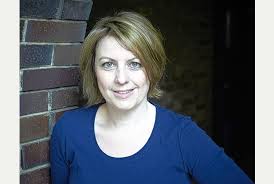
Sarah Begley

She says, “the latest round of research on the benefits of literature focuses on how it improves not our IQ but our EQ.”  Researchers at the New School for Social Research found a link between ‘theory of mind’ (the ability to know what a person is thinking or feeling) and reading a passage of literary fiction (as distinguished from popular fiction).  Ms Begley continues, “Maria Eugenia Panero of Boston College says it is ‘hard to know whether reading literary fiction increases theory of mind or if people who naturally have a higher theory of mind are more drawn to literary fiction'”.

Ms Begley reports that a 2012 study at Ohio State University had undergraduates read different versions of a story in which a protagonist overcomes challenges (car trouble, bad weather, long lines, etc.) in order to vote.  Those who read a version of the story which led them to identify strongly with the character were more likely to vote in a real election a few days later: 65% reported having voted as compared to 29% of those who read a less relatable version of the story.  The story did affect the behaviour of some readers.

Bibliotherapy, which involves the prescription of novels to ‘cure life’s ailments’, is practices at the School of Life in London.  Ella Berthoud, an artist, and Susan Elderkin, a novelist, are friends from their Cambridge days when they left books for each other to deal with the crisis of the week: be it romance, work stress, or whatever.  Now, while they are not trained at therapists, their clients pay £100 to spend 50 minutes with them, in person or via Skype.  The clients fill out a questionnaire about what they like to read and what is going on in their lives.  “The bibliotherapist makes an ‘instant prescription’ at the end of the session and then sends a list of six to eight books and the reasons for the recommendation a few days later.  They say the feedback is 99% positive.”

Ms Begley concludes: “The science behind reading for mental health is limited, but researchers like Panero are eager to continue exploring the benefits.  ‘I think we all have some intuitive sense that we get something from fiction’, Panero says.  ‘So in our field we’re interested in saying – well, what is it that we’re getting?’  Even the greatest novel cannot cure clinical depression, erase post-traumatic stress or turn an egomaniac into a self-denying saint.  But it might ease a midlife crisis or provide comfort in a time of grief.  As Elderkin says, it’s natural for readers to find it’satisfying when people come up with ‘proof’ of something which they’ve always felt to be true.'”

As for me, I certainly subscribe to the theories presented by Ms Begley in her article.  That is why I write novels like Seeking Father Khaliq.
Review: The Last Confession of Thomas Hawkins

I bought this book – an historic novel – in a Waterstones bookstore because I had nothing to read at that moment and it looked interesting.  Its author is Antonia Hodgson who grew up in Derby and studied English at the University of Leeds.  Her first novel, The Devil in Marshalsea, won the 2014 Historical Dagger Award.  Ms Hodgson lives in London, where she is an editor.

download

Antonia Hodgson

The Last Confession of Thomas Hawkins is set in a rather down-market section of Georgian London.  Its principal character, Thomas Hawkins is a ‘gentleman’ who killed a man in self-defense in prison, and throughout the story is under threat of being hung for murder.  There are several intertwining plots.  One involves a rather loathsome neighbour who is a member of the Society for the Reformation of Manners (a pathological moralist) and whose own morals permit him to consort with prostitutes and to beat his children.  The neighbour is suddenly dead.  Who killed him?  Thomas, one of the children, the apprentice, the son of a notorious gang?  Another plot involves King George’ mistress who is also a lady in waiting to Queen Charlotte.  This Henrietta Howard (who was a real person) is a pawn in the struggle of her very evil, estranged husband to extort money from the king.  The queen, also a real person, is caught in the middle and manages to capture Thomas as her rook to defeat the black knight, Charles Howard.  To keep things going, there is Kitty, the pretty and libidinous girlfriend of Thomas.

There is plenty of action in this rather engaging tale which moves along at a frenetic pace with many twists and turns along the way.  The characters are well-developed and likable or despicable; the dialogue is terse and credible.  The Covent Garden area of London is well described in physical and moral terms, but it was difficult to picture oneself in the setting.  It is not just a familiarity with the Covent Garden of today that blocked – to some extent – the credibility of the scene; it was more that at a feeling level one is somewhat remote. Having said this, one has to admire the depth of Ms Hodgson’s research into the times, the issues and the characters.  There are plenty of surprises in The Last Confession of Thomas Hawkins – they certainly keep the reader engaged – but sometimes the events seemed a little too contrived.  For example, the events around the ambush of Henrietta’s carriage by her husband, and the conclusion where Thomas is sent on a new mission by the queen.  The cockfight and the duel of the female gladiators, while authentic and interesting, added little to the story line.

For those who like a historical novel with an anchor in truth, one with many fascinating twists and turns, with important, stand-out characters, and a good helping of mystery, The Last Confession of Thomas Hawkins is the novel for you!

Characterization

My wife and I went to see the Picasso exhibition of portraits at the National Portrait Gallery last Saturday.  Until I went to the exhibition, I hadn’t been aware of the enormous range of portraits, in varying styles, Picasso had painted, and most were not included in the exhibition.  I have to confess that I liked best Picasso’s paintings in the traditional style.  In these paintings, one can really see Picasso’s artistic skill.

One other aspect of these paintings that impressed me was that the character of the subject was clearly identified in the picture.  It was this aspect that reminded me of the writer’s task in establishing an identity in his characters.  Picasso was less interested in presenting a clear likeness of his subject than in suggesting to the viewer the personality of the subject.

Let me illustrate:

images-1

Olga Khokhlova

These are two portraits of Olga Khokhlova, Picasso’s first wife and a Ukrainian ballerina whom Picasso married in 1918.  The painting on the right was done early in the relationship.  In it one can see an elegant, beautifully dressed woman whom Picasso admired greatly.  Olga was, in fact an aristocrat who enjoyed a full social life.  Picasso grew tired of the meaningless social life and returned to his private, bohemian lifestyle, eventually beginning an affair with the 17 year-old Parisian girl, Marie-Thérèse Walter.  The two stayed married until Olga’s death in 1955 because Picasso refused to grant a divorce which would have given her half his assets.  The portrait on the left is of Olga painted during the period of estrangement.  Her head appears to be precariously attached to her body signifying, perhaps, lack of substance.  Her hair is orderly and disorderly.  The stylish purple hat looks rather silly.  The black eyes look out toward Picasso critically.  The mouth is small and a bit sad.  In these two portraits one can see both a changed relationship and two different views of the same person.

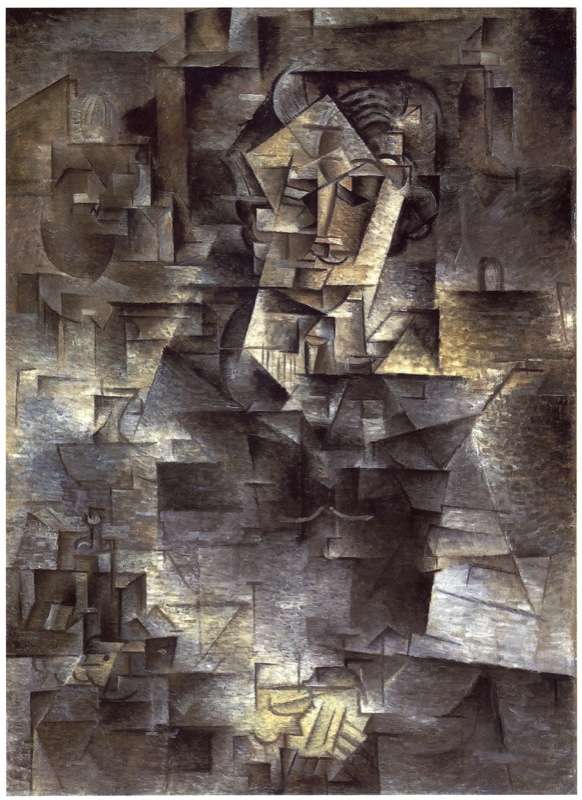
picasso-portrait-of-kahnweiler-1910

Daniel-Henry Kahnweiler

Kahnweiler was a German-born art historian, art collector, and one of the premier French art dealers of the 20th century. He became prominent as an art gallery owner in Paris beginning in 1907 and he was among the first champions of cubism and Picasso.  Picasso wrote of Kahnweiler “What would have become of us if Kahnweiler hadn’t had a business sense?”  The figure in the painting is imposing, the head powerful, the hands relaxed but commanding.  There is light that seems to emanate from the head and the hands.  One has the impression of a dynamic, creative and important person.  When one looks at the painting itself, which must be about a meter and a half tall, one can’t help but be impressed by the intricacy of the brushwork and the hours that Picasso worked on this portrait.  It is certainly a fitting tribute to a very important influence in Picasso’s life.

f_6405600_1

Jacqueline Roque

Jacqueline Roque was Picasso’s second wife whom he married in 1961, and she outlived him.  She was his favorite female subject; in 1963 he painted her portrait 160 times, and continued to paint her, in increasingly abstracted forms, until 1972.  In looking at the portrait, one has a sense of a strong relationship between the subject and the painter.  She is dressed in black but does not seem to be in mourning; in fact her forthright stare and raised eyebrows suggest a positive outlook.  She appears to be about to disclose something important.  The figure expresses confidence and femininity.

old_man

Old Man

This is a self-portrait of Picasso in a posture similar to a Rembrandt self-portrait; Picasso greatly admired Rembrandt.  This was painted in the last year of Picasso’s life, and suggests a powerful figure looking out on the world.  There is little motion in the picture, except for what appears to be heat on the right which dissipates toward the left.  His right hand is clearly shown; the left hand is somehow disabled.  His exposed upper torso conveys a sense of vitality in spite if the stasis.  The face seems prepared to make an announcement.  Overall, one has the impression of a painter who knows what he wants to paint and why and who cares very little for the reaction of his audience.

Picasso was highly skilled in communicating a message along with the image in his paintings, and this is particularly evident in his portraits.  Artists and writers share a challenge: defining a character to the viewer/reader.

New Novel

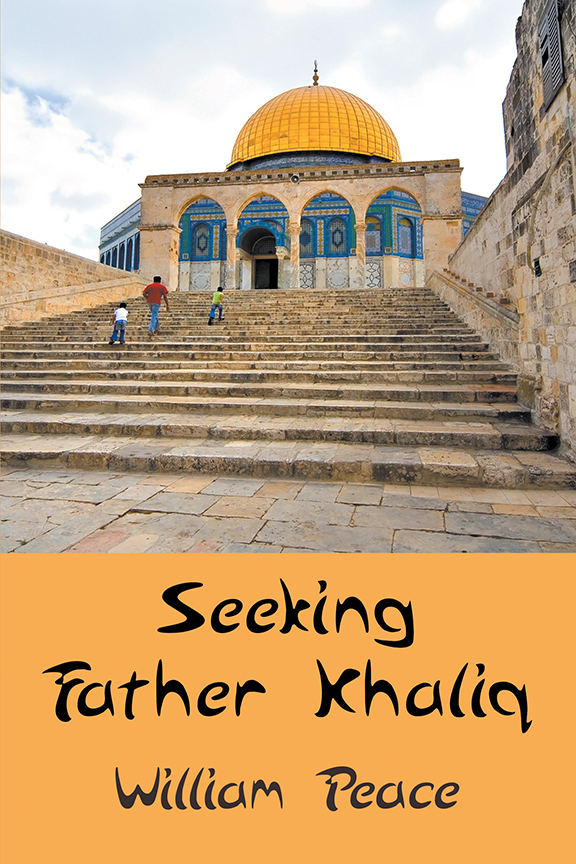
My latest novel, Seeking Father Khaliq, has just been published.

9781681818009-Peace_CV.indd

Seeking Father Khaliq is a modern allegory about one man’s search for spiritual fulfillment. Set in the Middle East, philosophy professor Kareem al-Busiri teaches at a prestigious Egyptian university.
The professor is persuaded by a Princess Basheera to find Father Khaliq for her.  From time-to-time, the professor wonders whether the princess is real or did he imagine her?  In the search, he undertakes important pilgrimages: the Hajj, Arba’een (the huge Shia pilgrimage to Karbala in Iraq), to Medina (the Prophet’s tomb), to Jerusalem and Rome. He falls in love with a colleague who was his late wife’s best friend, and who like his late wife and daughter is a Coptic Christian.  He attempts to manage mortal conflicts of values and ideology between his two sons.  One son is an Egyptian army officer; the other is a lawyer who is secretly providing money and arms to the terrorist insurgency in the Sinai.  Classical Arabic philosophy is woven into the narrative to support certain viewpoints.

The back cover continues:
Carefully researched and constructed, this dynamic story reflects the current religious, political, and social turmoil of the region.
Seeking Father Khaliq is unique in its Middle East setting, and its focus on Islam, as well as elements of Christianity and Judaism. The use of the jihadist conflict in Egypt as a surrogate for larger regional conflicts, the religious pilgrimages, and the resolution of inter-faith marriage issues are also highlighted.

There are two reviews, so far:

E. Lund for Phi Beta Kappa Reviews said, in part:

” . . . Author William Peace has woven a compelling narrative that explores the issues of religion, politics and social change, all while avoiding the pitfalls of becoming a treatise. Instead, “Seeking Father Khaliq” is a moving study of a family caught up in the volatile turmoil of the times, and a father who finds that moving closer to God is a way to navigate forward.  Beautifully written with vivid depictions of religious pilgrimages, the book also delivers three dimensional characters fully realized and equally empathetic. Highly recommended for those who want to know more about this important part of the world, but as much to be enjoyed simply on its narrative merits. “

Deborah Lloyd for Reader’s Favorite said, in part:

“. . . The author’s writing style is clear and concise. The account is thought-provoking and fascinating; the reader will be forever changed. This is a much-needed book during these difficult, challenging times in our modern world.”

I will just add that this book was a great pleasure to write.  I spent at least as much time on the internet researching as I did in the actual writing.  It took two years to write – about half my normal pace.  I also feel that my original idea for the book blossomed very nicely: one man’s search for God, Middle East setting, key character a philosophy professor, told in the first person, two sons on opposite sides of the regional divide.

I hope you enjoy it!

First Amendment Problems

As you may know the first amendment to the US Constitution covers free speech.  There is an article in my alumni magazine which addresses the ‘First Amendment Problem’.  You will know that freedom of speech is, to me as an author, a key issue.  The article says that hate speech isn’t the issue; politics isn’t the issue; the problem, says the dean of Yale Law School, is that nobody knows how to think about free speech.

The article says,” Take Sorrell v. IMS Health.  In 2007, Vermont passed a law restricting the sale of doctors’ prescriptions to drug companies, which were using the records in their marketing.  The drug companies, along with data mining companies sued, saying that the law violated their First Amendment rights. Vermont argued that the law regulated commerce, not speech.  The case reached the US Supreme Court, where Justice Anthony Kennedy delivered the majority opinion in 2011.  Marketing, he reasoned, consists of speech.  Therefore, singling out marketers amounts to government censorship.

Sorrell wasn’t treated like a blockbuster in the press, but it caused a sensation in the legal world.  It’s hard to argue with Kennedy’s declaration that ‘the state cannot engage in content based discrimination to advance its own side of the debate’.  But if that’s true for pharmaceutical marketers, what else does it apply to?  All kinds of commercial and professional regulations restrict speech based on its content.  Under Sorrell, can states still require psychologists to be licensed, considering that therapy is speech?  Can a public school teacher be fired for telling students that the earth is flat?”

images-1

Robert Post

Robert Post, the dean of Yale Law School and an expert on the First Amendment, has been following Supreme Court rulings on freedom of speech for about 30 years.  He has been trying to deduce the criteria that the court uses in making its decisions.  For example, the Supreme Court recently ruled that a newspaper couldn’t publish confidential information it had obtained through the discovery process in a civil lawsuit.  At first, Post disagreed, but he came to the conclusion that the court had made the right decision.  “The legal system, Post realised, isn’t an open forum for public debate; it’s a government institution designed for a specific purpose.  For the courts to function, judges have to have the power to regulate speech in a trial setting’”

Post’s insight is that “the amendment applies differently is different contexts or ‘constitutional domains’.  The most important domain is what he calls ‘public discourse’, because the goal of free speech is self-government.  Only speech relevant to that goal should get the highest level of protection.  Because public opinion shapes laws in a democracy, people need a chance to affect it: otherwise they won’t experience self-government.”

An interesting example is that some dentists believe that the mercury contained in some dental fillings can leach into the body, but they are punished by their professional regulators for malpractice if they advise their patients to remove the fillings.  The same dentists can, without censure, write op-ed pieces setting out their views.  This latter case is ‘public discourse’ and has First Amendment protection, while advice to a patient is not ‘public discourse’.

The question for an author, whose work is clearly ‘public discourse’, is: how far can you go?  If I were to write a piece belittling or making fun of the Prophet Muhammad (which I have no reason to consider), that would probably be OK, based on the Charlie Hebdo cartoons and The Satanic Verses.  But if I were to write a treatise recommending that the readers go and join ISIL, I might well end up in jail (like Anjem Choudary, the UK hate preacher).  What’s the difference, legally?  Professor Post doesn’t say, but I guess the legal differences arise from two subjective factors:

  • Public opinion, and
  • The perceived threat to a democratic form of government

Review: Why the West Rules ~ for Now

I was given this imposing book by a friend who thought highly of it.  I say ‘imposing’ because it is 645 pages long (including one appendix but not counting 100 pages of notes and index).  I’ve had time to read it because I’m on holiday in Sicily.  Not only is it imposing but it is very interesting and thought-provoking.  The book examines 16,000 years of human history (and other forms of data) to explore why the West has more power than the East, and what is likely to happen in the future.

The author, Ian Morris, was born in 1960; he is currently Willard Professor of Classics at Stanford University.  He is an archaeologist as well as an historian, and the interesting aspect of this book is that in relies of archaeological, biological, geological, linguistic, genetic, social as well as historical evidence.  Published in 2010, the book has won many awards and has  been translated into 13 languages.

index

Ian Morris

The book is a ‘brief’ summary of human history beginning at the end of the last ice age (but with with an exposition of the prior evolution of humanity).  Professor Morris uses four indices of human development to quantify the progress of civilisation in the East and the West.  He provides captivating commentary on why the various indices grew or shrank over time.  His indices are social (the size of the largest city in the region); military (the most powerful military force in the region); technological (who had the technological advantage); and who was making the most use of energy.  There are plenty of brief descriptions of the brilliant (or catastrophically stupid) moves of the movers and shakers – eastern and western -in each age, but he demonstrates that it was not their brilliance or stupidity that really changed history.  Nor was it political or cultural or genetic.  It was geography which finally gave the West a major advantage at the end of he eighteenth century.

Looking ahead, Professor Morris concludes that the East will take over the lead in the twenty-first century: largely based on China surpassing the US in financial terms.  But he also says that it may not matter who ‘rules’, because sometime in this century there is more likely to be one world than an east and west.  Looking still further into the future, he postulates two major scenarios: Singularity where human intelligence becomes so well integrated with computers that all intelligence becomes shared, and humanity becomes something altogether different; and Nightfall where humanity is essentially wiped out by a catastrophe such as nuclear war or environmental disaster.  (There are plenty of other undesirable scenarios suggested.)  At the conclusion, he hopes that Singularity will prevail.

This book is very thought-provoking, interesting reading, calling as it does on a wide range of specific data, and events in human history.  I found it interesting that religion had almost no part to play in human development.  Instead, the steadfast theme of human brutality is omnipresent.  War, it seems, was always the preferred option.  Professor Morris attributes human development to fear, greed or laziness, saying that all human innovation arises from one of those three motivations.  Sadly, I’m afraid he is right  So, in addition to giving the reader a fascinating lesson in human history, Professor Morris provides a rather depressing picture of human character.

I must say that I don’t necessarily agree that the East will – via China – rule the world.  Economic, military or political disaster could overtake China (or the US for that matter).  But I do agree that we are converging on One World rather than East vs West.

This is a brilliant book, worth all the time it takes to consume it all!

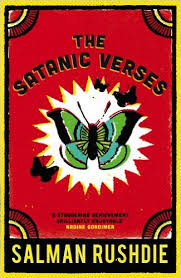
Review: The Satanic Verses

download


I decided to read this novel by Salman Rushdie because I had not read any of his work, because this particular novel is famous, and because of my interest in better understanding Islam.  The novel is famous for the fatwa issued by the Ayatollah Khomeini calling for the death of Rushdie for having committed blasphemy and for mocking the Islamic faith.   There was a bounty of £2.8 million on Rushdie’s head and several failed assassination attempts; others associated with the novel were not as fortunate: Hitoshi Igarashi the Japanese translator, was stabbed to death on 11 July 1991, and a number of attempts were made on the lives of others.  The novel was published in 1988, and it was shortlisted for the Booker Prize, but won the Whitbread Award for novel of the year. The fatwa was issued on 14 February 1989.  In the UK, 13 Muslim barristers drafted an indictment for the High Court attempting to justify a charge of blasphemy.  This attempt failed and blasphemy is no longer an offense under English law. For years, Rushdie lived at no fixed abode under Special Branch protection.  In 1998, Iran issued a conciliatory statement and Rushdie declared he would no longer live in hiding.   The Iranian state news agency reported in 2006 that the fatwa would remain in place permanently since fatwas can only be rescinded by the person who first issued them, and Khomeini had since died.

In the context of blasphemy, it is worth a brief description of the origin of the term ‘satanic verses’.  Muhammad was living in Mecca at the time and he was experiencing difficulty persuading powerful Meccans to accept that he was the prophet of God.  There is a theory – repeated in Rushdie’s novel – that, as a concession to these men, he gave brief permission for prayer to three popular idols.  What is certain is that Muhammad originally recited several verses naming the idols, praising them and indicating that they should not be neglected.  Muhammad then inserted three replacement verses which say that the idols are only ‘names’ and that ‘God revealed no authority for them’.  His explanation for the change was that Satan had managed to slip in the verses without him knowing it.

In the novel, Muhammad (called Mahound) comes across as a weak, indecisive individual who uses religion for his own benefit.  But the sequences in the novel involving Mahound are contained in the dreams of the character, Gibreel Farishta, who is mentally ill and who believes that he has become the archangel Gabriel, so these characterisations cannot be said to represent the author’s personal views.

The central plot of the novel is that two Indian Muslim actors fall from the sky over the English Channel when the flight they are on is blown up.  Miraculously, they both survive, and they take on the personalities of the archangel Gabriel (Gibreel Farista) and the devil (Saladin Chamcha).  Each of them has difficulty being accepted in London, each finds to a prior love, and each returns to his previous occupation.  Chamcha seeks revenge on Farista for having deserted him after their fall from the sky, and he stokes Farista’s pathological jealousy, destroying his love relationship.  Farista realises what his colleague has done and he forgives him.  Nonetheless, Farista kills his lover, Alleluia Cone, and commits suicide.  Chamcha returns to India and is reconciled to his dying father.

The novel – at 547 pages – has a great deal beyond this simple plot, including dream sequences involving the prophet Mahound.  There are also sequences involving relationships of the primary characters with lovers, friends and acquaintances.

This is not an easy book to read.  The sentences are long, sometimes complex, and the references to characters, places and things unfamiliar.  There is one sentence 146 words long.  Being somewhat familiar with Islamic history, I recognised some to the dream characters, but I could have benefited from a working knowledge of Indian mythology.  It is also not easy to follow what is going on: is this part of a dream or reality?  Having said that, I did find much of the writing uniquely engaging.

The feelings one encounters in reading the book are doubt bordering on hopelessness with some offsetting glimpses of humour.  The doubt has to do with the purpose of life, religion, acceptance as an individual, and perception vs reality.


Publishing Success

There is a story in The Daily Telegraph last month about how Andrew Michael Hurley achieved success with his first novel, The Loney which won the Costa Prize for the year’s best first novel.  This May, it won the Book of the Year award at the British Book Industry Awards.   Hurley is a former teacher from Preston (northern England).  He self-published two collections of stories before taking up part-time work as a librarian, so that he would have time to work on a novel.  He spent almost four years working on The Loney before showing it to friends and colleagues.

images

Andrew Michael Hurley

The people who read it, he recalls, “Said it was great – but where would it go in bookstores?”  (The novel is set on a wild stretch of northwest English coast, and mixes captivating descriptions of the landscapes with a mixture of the ridiculous and the terrifying.)  The article says, “It follows the activities of a small group of hardline Catholics – the narrator, his developmentally challenged adult brother, his fervently religious parents and two elderly friends – as they mount an expedition to a holy well in the company of their new parish priest.”

Three years ago, Mr Hurley couldn’t find a publisher anywhere.  “He sent it to agents and small publishers, all of whom responded either with silence or with polite notes of refusal.  Eventually, searching the internet for possible publishers, he came across Tartarus, a small press specialising in ‘literary supernatural/strange/horror fiction’ and run from a house in the Yorkshire Dales by the writers Ray Russell and Rosalie Parker.  ‘It was just one of many books when it arrived,’ says Russell.  ‘Ros read it and loved it, but I was slightly sceptical, mainly because over the years we’d had the impression that our customers preferred short story collections.  But as Ros said, the whole idea of Tartarus was to publish books that we liked – and if we liked then, hopefully other people would as well.’

“In London, the sharp-eyed publisher Mark Richards at John Murray read the book and recognised it, he says, as ‘a first novel of extraordinary assuredness.  It felt like the work of someone who had been writing for 40 years.’  He made contact with Hurley and the proprietors of Tartarus and arranged ‘to bring it to the mass market audience that the book could definitely reach.’

“Hurley says, ‘I’m 41 now, so it’s been a long time coming.  I’m very grateful that I can concentrate on doing something that I love more than anything else.  All the rest is just an added – though very welcome – extra. . . . I’m terrible at giving advise on writing,’ he says, ‘but perseverance has to be the key.  So many times you feel like giving up and thinking, this isn’t going to happen.  But it does.  It absolutely does.'”

Review: A God in Ruins

For the last couple of weeks, I’ve been out of the office: my PC has been neglected, but I’ve done some reading.

A God in Ruins by Kate Atkinson is without a doubt the best book I’ve read in a long time, and it’s easy to see why it won last year’s Costa Book Award.  In fact, the judges called it, “Utterly magnificent and in a class of its own.  A genius book.”

The author has some pretty heavy-weight credentials.  Kate Atkinson won the Whitbread (now Costa) Book of the Year in 1995 with her first novel, Behind the Scenes at the Museum.  Her four bestselling novels featuring former detective Jackson Brodie became the BBC television series.  Her last novel, Life After Life, was the winner of the 2013 Costa Novel Award.  She was appointed MBE in the 2011 Queen’s Birthday Honours.

index

Kate Atkinson

A God in Ruins is the story of Teddy Todd, a would-be poet, lover of the countryside, and heroic bomber pilot during World War II.  The story begins in 1925 and zig-zags back and forth in time until its conclusion in 2012.  As the number of his completed combat missions piles up, Teddy does not expect to see the ‘Afterwards’ in which he will become a husband and a father.  Throughout the story, he faces life as it is without complaints about lost opportunities, heartbreak, or feelings un-expressed.  He is surrounded by the characters of his own family and by some of the family who are neighbours.

The writing is captivating and tight; there is no excess baggage here even though the book runs to over 500 pages.  The characters are distinct, and the story line never lags.  What most impressed me about the novel was the authenticity of the descriptions of flying bombing missions in a Halifax, but then, at the end of the book is a three page bibliography of sources.  Ms Atkinson did a lot of research!  I understand why it too two years to write this novel.  There is an interesting device she used which turns fiction on its head.  Fascinating!  But I’m not going to give it away.  Sometimes I felt slightly put off by the broken chronology, but in reading the book over a period of days, I began to feel that it was building nicely to a conclusion.  This is a novel which fully engages both one’s emotions and one’s beliefs.

Review: The Meursault Investigation

This novel, written by Kamel Daoud, reveals the hidden side of Albert Camus’ novel The Stranger.  In The Stranger, Camus has his principal character, Meursault, shoot and kill a nameless Arab for no apparent reason other than possible disorientation from sunstroke.  In The Meursault Investigation, Daoud names the murdered Arab as ‘Musa’ (Moses), and considers the implications of the murder from the viewpoint of Musa’s brother ‘Harun’ (Aaron).

Camus was a French-Algerian philosopher, an ‘absurdist’ who held that human life is absurd.  He was also regarded as an existentialist (he disagreed) and a pacifist.  He was born in 1913, won the Nobel Prize for Literature in 1957, and died in 1960.  In The Stranger, which was published in 1942, Camus used the murder of the nameless Arab for no reason as an example of the absurdity of human life.

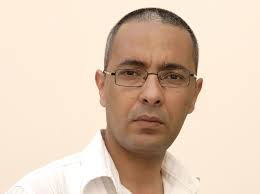
Kamel Daoud is an Algerian journalist based in Oman.  His background is similar to that of Camus: French-speaking, Algerian writer and philosopher. The Mersualt Investigation is Daoud’s first novel, published in 2015, and it has been recognised with several prizes in France.

index

Kamel Daoud

In The Mersault Investigatiom, Harun is in a bar in Oman reflecting morosely on his brother, his mother and the book by the listener’s hero (Camus).  Included in his reflections are thoughts on Algeria, its people and its relationship to France.  The tone of the book is pessimistic and its conclusions are ambiguous (much like the tone and content of The Stranger).  One is left with the impression that there can be no God, and that life itself can have no meaning.

This is not an enjoyable book to read, because of its pessimistic philosophy, and because nothing conclusive arises from its reflective monologue.  No new ‘facts’ emerge about any of the characters, except that Musa was a real person who was loved by his mother and close the the heart of his younger brother.  Still, one has the impression that The Mersault Investigation is a classic in the absurdist philosophical tradition.  If you liked Camus’ writing, you will certainly appreciate Daoud’s.  He has created a well-written philosophical sequel to one of Camus’ great works.