Inside the Writing Life

In the Winter 2015 edition of The Exeter Bulletin, the alumni magazine of Phillips Exeter Academy (the boarding school from which I graduated) there is an article Inside the Writing Life.  It is an interview of Roland Merullo (class of ’71, and quite a bit after my time).  Merullo has written 13 novels and four works of non-fiction.  He has been recognised for a Booklist Editors’ Choice, a Maria Thomas Award and was a finalist for the L. L. Winship/PEN New England Prize.  The interviewer is David Weber, who is Emeritus English Instructor at the Academy.

thSWS7R45G

Roland Merullo

Q: Does the act of writing allow you to enter a space where it’s only yourself you need to please?  Or do thoughts of agents, publishers, other writers, or readers enter in?

Merullo: I think you really have to work to keep agents, publishers and especially critics out of the room where you write.  At the same time, in order to improve, especially in the early going, you have to be open to criticism and suggestion, so it can be a tightrope sometimes.  I support my family only from my writing, so I can’t indulge myself and write a 2,000 page essay on the meaning of life, or golf, or learning to swim, or my love for my daughters.  But I’ve gotten pretty good at going into my interior room and mining my own truth, even if its eventually packaged in a way that will please publishers and bookstore owners.  Before I started on In Revere, In Those Days, I was well into another book, hundreds of pages, and it just felt false to me, as if I were writing to please  some outside critic and not from my center.  One night, I just said, “Screw this” out loud, put all that work aside and wrote 30 pages of In Revere in a couple of hours.  That felt right.

My comments: I agree that one needs to exclude external influences when one is writing, but that one has to be open to critiques at other times.  I, too, have scrapped whole sections of a novel that didn’t ‘feel right’.  I started over with what I felt was good and genuine.

Q: Do you think of writing as existing above all in its own realm, called art?  Or do you want your books to act in some way on the worlds of culture, politics, society – or even on the inner lives of readers?

Merullo: There is art to it, and art is essential to any healthy society, but I take a workmanlike approach to writing books.  It bothers me a great deal to hear writers talk about their work as if they have a special line to God or something, or as if it’s “torture” to face a blank page. People who value words should use that one more carefully.  Writing reminds me very much of carpentry, in both its methodical aspects and in the need to think ahead . . . though my body hurts less after writing a novel than it did after building a deck or a garage.  I’m all about the inner lives of readers, and the interior life in general – an area we tend to ignore as a society.  But I feel that for it to matter, the interior dimension should be linked to our outer lives, to things like politics, for example. . . .

My comments: I like the comparison of writing with carpentry, and I agree that both require methodology and planning.  I’m surprised by his comment, below, that he doesn’t outline.  To me an outline is essential to avoid the unnecessary and to include the essential, just as a carpenter’s drawing assures that the project will be completed as envisioned.  I sometimes feel that I have a muse – some external influence – because, occasionally, I will suddenly think, after I’ve written something: “Where did that come from?  That was brilliant!  I could never have thought of that!” I doubt that it was God, but maybe The Presence spoke up.

Q: By this time do you write intuitively, having internalised the skills you needed?  Or does technique remain a conscious focus?

Merullo: I write almost completely intuitively.  Early on, I’d study the work of other writers, but I’m not particularly analytical or scholarly.  I don’t outline, try not to over analyse.  When I taught in college – 10 years at Bennington and Amherst – it wasn’t especially enjoyable for me to analyse the great works of literary art, to break them down into pieces, and try to explain why they were so good.  Some of that is a teacher’s job, of course, necessary and good, but to me it was too often like eating a delicious piece of pie and having to sit there and talk about the ingredients in elaborate detail.  I just wanted to eat the pie.  And now I just want to bake the pie.  My feeling is that if you go down deep into yourself – beyond the purely intellectual level – you can maybe write something that reaches down deep inside the reader; you can connect with them in the most profound way.  I think about technique very little now.

My comments: I write pretty intuitively, but as I review what I’ve written, I think about details: technique.  I think his comment about reaching down deep inside yourself and thereby being able to reach something deep inside the reader is tremendously important.  I just wish I could do it more often!
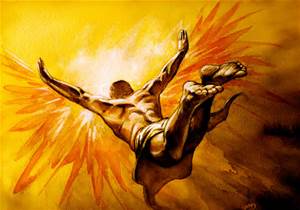
Icarus as an Artist

The myth of Icarus, who, with his father, Daedalus, tried to escape from Crete, using wings that his father made from feathers and wax, is subject to interpretation.  Icarus disobeyed his father’s instructions not to fly too high, because the heat of the sun would melt the wax of his wings.  Icarus flew too high, the wax melted and he fell into the sea.

th

The usual interpretation seems to be that it was hubris – over-ambition – which caused Icarus to fall to his death.  The moral being that we should not fly too low in our lives, as that would not do justice to our capabilities, but we should not try to fly higher than or capabilities.

A few days ago, I heard another interpretation: that Icarus is a symbol of the artist, trying always to stretch and improve his art.  This was suggested by Jorg Widman, clarinettist, composer and conductor.  He was conducting the London Chamber Orchestra and introducing his own piece: Icarus’ Lament.  He said that his piece was inspired by Charles Baudelaire’s poem Lament of an Icarus:

Lovers of whores don’t care,
happy, calm and replete:
But my arms are incomplete,
grasping the empty air.
Thanks to stars, incomparable ones,
that blaze in the depths of the skies,
all my destroyed eyes
see, are the memories of suns.
I look, in vain, for beginning and end
of the heavens’ slow revolve:
Under an unknown eye of fire, I ascend
feeling my wings dissolve.
And, scorched by desire for the beautiful,
I will not know the bliss,
of giving my name to that abyss,
that knows my tomb and funeral.

Jorg Widman’s Icarus Lament was an interesting piece – quite unconventional- played only by the string section of the orchestra.  It began with the violins playing a very high note, pausing momentarily and continuing.  One could visualise a winged creature beating its wings laboriously in very high flight.  Then came the cellos, playing a more sombre melody, as a sort of counter-force to the violins.  Finally, the violas joined in playing a more lively melody.  One definitely had the feeling of the creative force (violins) struggling to assert themselves over the force of gravity (cellos), while the world (violas) looked on.

So I suppose that Icarus could stand as a symbol of the artist who is not content with the safe journey, and who yearns to stretch his talents.

For myself, I see it slightly differently: as a learning and development process.  With each novel, I feel well, I’ve done that; what can I do next that’s a little more challenging?  I suppose what I don’t do is to focus on what my readers would like, because that will tend to be ‘more of the same’.  Rather, I think, if I do this new novel well, my readers will probably like it And if they don’t?  I hope that they’ll tell me what they didn’t like.  But, if they do like it, and I feel I’ve met my challenge, I’m ready to move on to the next challenge!

Television on Books

There was an article in yesterdays Daily Telegraph entitled: “BBC must have a show about books”.

The article went on: “The BBC’s lack of books coverage is  ‘an absolute disgrace’ according to Robert Harris, the novelist and chairman of the Costa Book Awards judging panel.


images0I05FC3F

Robert Harris

Announcing Helen Macdonald’s memoir H is for Hawk as the £30,000 Costa Book of the Year, Harris used his speech to criticise the corporation.  He pointed out that in the 1970’s, when the prize was launched, the BBC had two dedicated book programmes on its main channel.  Now it has none.  ‘It is an absolute disgrace that the BBC, a publicly funded organisation shouldn’t do a bit more to help our books business’, he said, to cheers from authors and publishing industry figures.  ‘Come on, Tony Hall, if you’re watching this on BBC news.  Do a little bit more for the books trade, please.’  He added, ‘In the 1970’s there were two book programmes: The Book Programme with Robert Robertson and Read All About It with Melvyn Bragg.  Both were running at the same time when we only had three channels.  We now have 300 channels, but we don’t have any dedicated book programmes.’

The Book Programme was dedicated to ‘books, authors and the literary life’.  From what I can tell it ran on several BBC regional radio stations, as well as on TV.  My search on Google failed to find a reference to Read All About It as a BBC programme or as a reference under Melvyn Bragg.  Perhaps the BBC’s archive does not go back far enough.  The BBC does, however, give full coverage to Robert Harris’ remarks.

As I think about media coverage of books, I tend to agree that more coverage of books and the literary world would be desirable – provided that the coverage is targeted at the right audience, through the right medium.  It seems to me that television is most effective when it presents changing or moving images.  If the programme were to feature books, the images would mostly be of authors talking, presenters commenting or book covers.  Radio could be nearly as effective as TV in presenting literary subjects.  To justify its cost as a medium, television needs to attract a mass audience, but is there a mass audience for literature? Given the many genres, styles, authors, and critics, it seems to me that attracting a large audience to books, in general, would be difficult.

My conclusion is that a weekly radio show of, say half an hour, in the early afternoon, could be quite interesting.  It would feature trends and developments in literature (including writing, publishing, marketing and distribution) as well as brief, stimulating interviews with authors, publishers and critics.  And, of course, the presenter would have to be both knowledgeable and a good entertainer.

What is your view?

Personification of Evil

Sometimes there are evil characters in novels.  How do we create them and why?

imagesW5BD3VTZ

To get at the answers to these questions, we first have to understand what we mean by ‘evil’.  My Chambers Dictionary defines evil as ‘something which produces unhappiness or misfortune’.  But suppose we are considering a situation where a love affair has ended.  Is the one who ended it evil?  Most of us wouldn’t consider a married person evil if s/he ended an extra-marital affair, but one (or both) parties to the affair may be very unhappy.  Or consider someone who went to Las Vegas and lost £10,000 in a night of gambling.  S/he may consider the event a real misfortune, but I doubt that most of us consider gambling to be ‘evil’.  ‘Foolish’?  Yes.  To be avoided?  Yes.  But not ‘evil’.

For me, ‘evil’ is the creation of sin, and ‘sin’ is the act of intentional harm to another human being.  Notice the use of the word ‘intentional’.  With the use of ‘intentional’, the person who ended the affair did not commit a sin in ending the affair if s/he ended it without intending to hurt the other person.  The other person may indeed be hurt, but causing hurt was not the motivation for ending the affair.  Similarly, the gambler did not intend to hurt himself by continuing to gamble and lose.

I think it is fair to say that I tend to consider ‘evil’ as a semi-religious term, and, as such, it has extra significance.  For me, things and actions which are ‘good’ are God-given, while evil things and actions arise from God’s antithesis – call him the devil, if you wish.  We human beings are in the middle, pulled in both directions, but having free will – the freedom to choose.

Two of my novels deal with these themes.  Sin and Contrition has six characters, three boys and three girls whom we follow from the age of 13 to about 52.   Amongst them, they commit most of the available sins, except such violent sins as rape or murder.  (One of the characters, however, does go to war.)  There is always at least a weak intention to commit the sin, and generally a certain amount of repentance, but the character and his/her motivation is viewed in the unique situation in which they are found, so that I, as the author, try not to judge them.  Rather, I let them judge themselves, with, of course, the input of the world around them.  My expectation is that the reader will judge them.  The point I’m trying to make is that sometimes evil and sin are very clear, but often ‘extenuating circumstances’ make them less clear, and that this is what life is: challenging, a bit foggy and uncertain, even though there may be a beacon – often barely visible – to show the way.

The other novel is Sable Shadow and The Presence, which deals more explicitly with the ‘beacon’.  Sometimes the beacon is a God-send, but often it is not.  Who guides us and why?  Part of the answer is who and what we are as people: our identity, over which we have a great deal more control than we sometimes like to believe. Henry, the principal character in Sable Shadow and The Presence, uses his identity and a particular beacon to achieve a great success.  When multiple tragedies strike, he must change both his identity and his beacon!

Plot vs Theme

I think we all understand what is meant by the plot of a novel.  It is the story line; the summary of what happens.  The theme is the message that the author is trying to get the reader to think about.  It is the philosophical/theological/social/psychological message of the novel.  The theme may not be very clear; it may be quite subtle or implied, because the author wants to present the reader with a puzzle: something important to consider.

It is probably fair to say that every novel has a plot, but not every novel has a theme.  For example, my novel, The Iranian Scorpion, is a thriller, and as such, it has a plot, but I didn’t intend it to have a theme.  I suppose, considering the novel retrospectively, one might say that its theme is the near impossibility of banning addictive drugs such as heroin, but I didn’t intend to write the novel to make that point.

Consider To Kill a Mockingbird, one of the great novels of the 2oth century.  The plot is quite complex.  It involves two young children, Scout and Jem, who live with their widowed father, a lawyer, in a small Alabama town in the 1930’s.  The father, Atticus, is appointed by a judge to defend a black man who is accused of raping a white woman.  In the course of the trial, Atticus establishes that the white woman and her father are lying.  Nonetheless, the black man, Tom Robinson, is convicted by the jury.  Tom is killed in escaping from jail.  What follows is an attack by Bob Ewell, the accused’s father, on the children at night.  Boo, an elusive and mysterious neighbour, intervenes.  Bob Ewell is thought to have fallen on his own knife and died.  The plot itself has elements of uncertainty: the evidence presented at trial, the attack on the children, the motivation of Boo.

The overriding theme of the novel is the racial prejudice which existed in the American South in the ’30’s.  But there is also the idealistic courage of Atticus and his children in the face of prejudice.  In addition, there are issues around social class and gender which are touched on.

I think it is fair to say that the plot, while it reflects some of the author, Harper Lee’s, childhood experiences, is constructed so as to develop the themes for the reader.  Harper Lee took two and a half years to complete the novel, and during that time, she became so frustrated that at one point she threw the manuscript out a window into the snow.  (Her agent made her retrieve it.)  In my view, To Kill a Mockingbird is the best example of compelling plot and themes beautifully integrated.

A lesser example would be my novel, Sable Shadow and The Presence, which has as its themes the overriding importance of identity for us as human beings.  Identity is who, why and what we are.  It is critical in determining how happy we are in the life we lead, and our identity can be changed under certain circumstances.  The plot is the life of a bright, but introverted male character who grows and develops into a ‘great success’, only to see his success evaporate, and having to build a new identity.

Mark Zuckerberg on reading

James Walton has an article in yesterday’s Daily Telegraph which is entitled: ‘Reading Books is not a duty, Mr Zuckerberg’.


thHD0QESRQ

Walton begins by saying:

“Books,” according to the chick-lit author and  former Member of Parliament Louise Mensch, “were what we used to do before the internet.”  Now, though, it seems that these ancient artefacts may be making a comeback.  No less a figure than Mark Zuckerberg, Facebook’s founder, has declared 2015 “A Year of Books” and is inviting his website users to join him in his New Year’s resolution of reading and discussing one a fortnight.  His first choice is Moisés Naim’s The End of Power, which explores the growing power of ‘anti-political’ movements such as the Tea Party and Ukip – thanks, as luck wold have it, to their use of Facebook.  Zuckerberg launched his project by announcing, with what sounds almost like surprise, that books are “intellectually fulfilling” and “allow you too explore a topic . . . in a deeper way than most media today”.  For old school book lovers, the literary reference that springs most readily to mind is “no —-, Sherlock”.

Walton continues: You might also be tempted to imagine a world in which there had been 700 years of internet, before, in the Nineties, somebody invented books.  It would surely seem a miracle that, instead of trawling acres of semi-reliable information, you could have a guaranteed, portable and inexpensive source of knowledge from someone who knows both how to write and what they’re talking about.  But it appears that in his shock discovery of books potential, Zuckerberg is not alone.  A recent article in The Wall Street Journal praised a new campaign of “slow reading”, whose members meet once a week in a café, turn off their phones for a whole hour and read in silence.  Such quiet reading, the headline declared, can “benefit your brain” (again, not a revelation that would have startled Sherlock Holmes.)  While today’s bibliophiles might want to pounce on anything that smacks of good news, I can’t help wondering if using books purely as a means of self improvement – with elements of self-congratulation thrown in – misses the point of reading.

Walton goes on to make the point, via Nick Hornby, that people should read books for enjoyment and should not bother to finish the ones they don’t enjoy.  “Every time we pick up a book from a sense of duty, we’re reinforcing the notion that reading is something you should do, but television (or, presumably, surfing the internet) is something that you want to do.”  He makes the further point that Zuckerberg has fallen into the philistine idea that books should be relevant to your life.

I certainly agree with Walton, but I’m surprised that he doesn’t mention that Goodreads is owned by Facebook.  All the more reason for Zuckerberg to promote reading.  And I agree that it’s good for us to expand our intellectual horizons by reading something entirely new to us.  My wife recently finished reading Do No Harm, a book by neurosurgeon Henry Marsh about his life and practice.  She recommends it, and since I know nothing about the subject, it’s at the top of my To Read list.

The Outlook for Bookstores

The news about the health of bookstores has been pretty downbeat during the last couple of years.  Between 2000 and 2007 about 1,000 independent booksellers closed.  I was therefore pleased to see an article in Independent, the journal of the Independent Book Publishers Association.  The article, by Linda Carlson, was pretty full of good news, but somewhat lacking in statistics.

The one statistic which was reported: according to an article published in Slate, the membership of the American Booksellers Association increased more than 20% from 1,651 in 2009 to 2,094 in 2014.  While 20% is a substantial increase, the average annual increase is about 5%.  Still, this is healthy growth.  To put this increase in perspective, Donna Paz Kaufman, an industry consultant is quoted as saying: “Fewer entrepreneurs are stepping forward to own independent bookstores, even at a time when many communities throughout the country long to replace a Borders or Barnes & Noble store that proved too large to be sustainable.”  She goes on to say that some would-be entrepreneurs have family members who are risk-averse and cannot justify investing the family’s wealth in “something that still seems iffy”.  My impression is that the apparent ‘growth’ in ABA membership is actually the renewal of lapsed membership, rather than new members. Nonetheless, this is a good sign.

So, what is driving the improvement in outlook for independent bookstores?  Shane Gotwalls, of Gotwalls Books in Macon, Georgia says, “Feedback from our customers tell us that they are tired of impersonal on-line shopping. . . . We hear more and more often that there’s nothing like the smell of a bookstore. . . . We try to give the best service possible, and we believe our customers keep returning because we are successful with this goal.”

WinterRiver Books in Oregon has kept its sales from slipping with a policy of discounting hardcover editions of best sellers by 20%.

Mirian Sontz, CEO of Powell’s bookstores in Portland, Oregon says that the store sold almost 10,000 copies, prepublication, of Edan Lepucki’s debut novel, California, after Hatchette authors Stephen Colbert and Sherman Alex recommended, on air, that it be purchased from Powell’s in response to the Amazon-Hachette conflict!  Sontz says, “The conversation about conscious on-line shopping continues, thanks to this increased awareness.”

Flintridge Bookstore & Coffeehouse in La Canada, California reports that they provide core literature for the La Canada school district.  “We work very closely with public school faculty and staff and we stock titles on required reading lists.”  Flintridge also emphasizes local history, geography, and culture of the San Gabriel Mountain foothills.

Espresso Book Machines are a drawing card for several bookstores which have them.  While only a fraction of the inquiries received by the bookstores result in orders, many writers who use the machines return again and again for additional print runs.

Other tactics for drawing people into bookstores include hosting story hours for kids and YA book clubs.  Some bookstores offer tickets to author events.  The ticket may require a book purchase or offer a discount.  Elliott Bay Books now hosts 500 events a year and says that “events keep us in mind as a cool place to visit . . . but having customers buy books in order to attend can backfire by discouraging people from attending.”

In summary, each successful indie bookstore seems to have its own special identity and offerings which appeal to local customers.  It offers personal service to frustrated on-line customers, and the touch, feel and smell of actual books!

Living the characters

How does one, as an author, decide what a given character says or does?

For me, the answer is: I try to get inside the character’s skin.  What this means in practice is that I try to feel what the character is feeling at that particular moment, and I ask myself, ‘what is s/he thinking?’  While I don’t explicitly bring it to mind, I’m aware of the character’s background, his/her values, personality and ambitions.  This process is particularly necessary when a character is suddenly put in an unexpected or difficult position.

Fir example, in Efraim’s Eye, the principal character, Paul, is suddenly asked by Naomi, “Do you love me, Paul?”  By way of background, Paul and Naomi had become lovers two days previously.  She is a very pretty and sweet charity worker, a rootless, lonely, thirty-something.  Paul is a London-based widower in his fifties, a financial consultant who has a girlfriend his own age.  Naomi and Paul are not an obvious match, but Paul finds Naomi enchanting and Naomi sees Paul as a secure, reliable father figure, who, nonetheless, wakens her dormant sensuality.

The story continues:


Unprepared as he was for that question, Paul knew that there could be only one answer. “Yes, yes, of course I love you.”

Naomi’s head tilted, and her gaze fell to the table cloth. Uncertainly, she asked, “Why do you love me?”

Instinctively, Paul knew that his answer must not include the word ‘beautiful’ or one of its synonyms. He said, “You’re a very sweet idealist, Naomi. You are a woman with great talents as a linguist, as a musician, and in dealing with people. But for me, best of all, is your joie de vie. Life is a great, pleasing adventure for you, and it’s delightful to be with you.”

For some moments, Naomi gazed at him, apparently repeating his words in her mind. She asked, “So you think I’m a sweet, talented, adventurous woman?” She pronounced the word ‘woman’ awkwardly, as if it were a term unfamiliar to her.

He smiled. “For a four word summary, that will do.”

Paul knew the answer to the reciprocal question. She loved him as a daughter loves, and he had awakened her latent brilliance as a lover. But, for her part, she had wanted to know whether she, herself, was a person who could be loved.


Paul’s response, ‘Of course I love you’ leaves room for doubt about the depth of the feeling behind it, and in the days ahead, he begins to doubt the durability of the relationship.  His response to the question, ‘why do you love me, Paul?’ manages to avoid the artificiality of a ‘because you’re beautiful’ response.  He recognises that she has a hunger to be valued for more than her looks.  His answer, from his point of view, is both truthful and recognizes as strengths what she may have seen as weaknesses.

So this exchange between Paul and Naomi, while unexpected by the reader, helps to define these two characters, and begins to open a path to the future for each of them.

Amazon vs. Hachette

Regular readers will know that I have been following the dispute between Hachette, the French-owned publishing house and Amazon.  The two companies have now signed a deal to end their long-running price dispute.

According to the Daily Telegraph: the two firms had disagreed about the price of ebooks which can be read on Amazon’s market-leading Kindle device.  Amazon believed most new ebooks should be $9.99, which many in the traditional publishing industry said was not financially sustainable.  It also wanted to restructure the way revenues were split between the publisher, author and  itself.  Hachette refused to back down on lowering prices.  The dispute gained public attention earlier this year when hundreds of authors supported Hachette.  They argued that  Amazon’s pricing tactics were damaging writers and high streets around the world. The online retailer responded by increasing shipping times on Hachette books, blocking pre-orders, and redirecting customers to other publishers.  In August a group of 900 writers paid for a full page advert in The New York Times criticising Amazon’s actions: “These sanctions have driven down Hachette’s authors’ sales on Amazon by at least 50%.  Amazon has other negotiating tools at its disposal; it does not need to inflict harm on some of the very authors who have helped it to become one of the largest retailers in the world.”

Under the agreement which has been reached between the two companies, Hachette will have responsibility for setting prices of its ebooks, and “will benefit from better terms when it delivers lower prices for readers,” according to a joint press release.

Hachette said: “This is great news for writers.  The agreement will benefit Hachette authors for years to come.”

David Naggar, vice president of Kindle, said, “We are pleased with this new agreement as it includes specific financial incentives for Hachette to deliver  lower prices, which we believe will be a great win for readers and authors alike.”

How can all three of the statements in quotation marks, above, be true at the same time?

The short answer is, I don’t know.  But I have a theory.  Suppose under the old deal at $9.99, Amazon got 40% and Hachette got 60%: $4 for Amazon and $6 for Hachette, and suppose that Hachette pays its authors a one third royalty from its revenue: $2 per copy.  And suppose, under the new deal, Hachette prices its ebooks at $15 per copy and gets 55% of the selling price, while Amazon gets 45%.  This would give Hachette income of $8.25 per copy, and the author would get $2.75 per copy: a better deal for all three parties assuming that the volume of the ebook is not price sensitive.  But, if for example, only half as many copies are sold at $15 as at $10, everybody is worse off.  This is where Amazon’s obsession comes in: the lower the price the more you sell!  I’ll bet that the deal is structured so that Hachette’s share of the sale increases as the price is lowered.  In this example, for each dollar reduction in price, Hachette would get one percent more of the selling price.

So:

Statement no. 1 is true: Hachette gets better terms as it lowers its price (not better revenue, but better terms)

Statement no. 2 is true: Hachette authors will benefit ($2.75 vs $2 assuming that the volume of sales are not particularly affected at the higher price)

Statement no. 3 is true: lower prices are a win for authors and readers alike (assuming lower prices mean greater sales volumes)

It seems to me that this dispute boils down to different views on the price elasticity of books.  Amazon believes that price is very elastic: the higher the price, the less you sell and the lower the price the more you sell.  Amazon apparently has some data which supports this theory.

Hachette believes that, within a certain price band, the price is inelastic: volume is largely unaffected by price.

My own view is that Hachette is probably right.  They have experience with their authors and their genres to be able to predict volume, and they have a pretty good idea of where the price band should be.  They will be quite sure that if they price a book at a third of its normal price band, it won’t sell four times as many.

Topics for Novels

How do writers choose a topic to write about?  What factors influence the setting, the characters, the time frame, the key events?

I suspect that every author will have a slightly different answer to these questions.  In my case, there was a different set of criteria which influenced the topic for each of my six (so far) novels.  I often think it would be easier if I had a consistent topic and some repeat characters, as the late P D James had with her detective stories.  The problem for me is that I get restless with repetitive tasks.  I would make a very poor assembly line worker.  I changed my major in college twice – from architecture, to mathematics – before settling on physics.  As a naval officer, every day was different.  As a salesman of heavy electrical equipment, every sale was unique.  As a manager and as a management consultant, every situation one faces is different.

Starting with Fishing in Foreign Seas, I tried to stay within my experience: romance, Sicily, the north-eastern US, raising a family and the sale of heavy electrical equipment.  I added some sex and some intrigue for seasoning.  For me, this worked, but I wanted something grander, more important.

What could be more important than sin?  What could be grander than six life stories entwined?  That was the premise of Sin and Contrition.  With a chapter devoted to each sin, I found that each character developed uniquely, and that my imagination could add interesting – but credible – surprises.

Efraim’s Eye came about because of a charity assignment I had in Mexico, where we suspected the chief executive of the charity of being corrupt.  I felt that a corrupt charity was interesting, but probably not gripping.  But, what if the purpose of the charity’s corruption was the financing of a terrorist attack?  And what if there was an intense love story?

The feedback from readers of Efraim’s Eye was very good: it was an exciting thriller with believable characters.  I decided that I wanted to write another thriller; this time about the drugs trade, and I decided that Afghanistan, with its huge output of opium for heroin, and being in the public eye, was the setting.  But, I also needed an immediate destination for the heroin, as very little of it is consumed in Afghanistan.  Some research convinced me to make Iran the home of the bad guy and the immediate destination of the heroin in The Iranian Scorpion. 

Before I finished Scorpion, I started on a novel in the first person about a bright, self-conscious boy who hears unfamiliar voices, which, over time, he attributes to representatives of God and the devil.  I wanted to write a serious novel which, through the life of Henry, explored psychological, theological, and sociological issues around the choices we make in our lives – for better or worse.  I wrote three chapters of Sable Shadow and The Presence before setting it aside: I had lost my way and needed to take a break.  But with the completion of The Iranian Scorpion, I came back to Sable Shadow with new enthusiasm, and I completed it.

In the back of my mind was another novel, slightly similar to Sable Shadow, but an allegory, told in the first person, set largely in the Middle East, with Middle Eastern characters, and dealing with the search for meaning in life.  I’m working full tilt on it now, but before getting really started, I wrote Hidden Battlefields, another thriller, this one about a huge shipment of cocaine from Peru to the ‘Ndrangheta mafia in southern Italy. Four of the main characters from Scorpion are in Hidden Battlefields.  The theme of Battlefields is how major conflicts in our values and priorities can affect who we really are.

As I look back on the progression of novels, two trends stand out, both of which amount to increasing levels of challenge for me as a writer:

First, my craft as a writer is being challenged on all fronts: character development, thematic subtlety, language, credibility and interest.

Second, I have to do more and more research, to the point now where I spend more time on research than I do on writing.