‘Banned’ books

There were two recent articles in The Daily Telegraph regarding the ‘banning’ of books by Holocaust deniers.  The first article, by Olivia Rudgard, reads:

“A Cambridge college has removed a David Irving book from display in its library after a visiting Jewish academic complained.  Churchill College, Cambridge, said the Irving’s biography of its namesake, Winston Churchill , would now be held in a ‘closed access’ area with borrowers only able to read it on request.

“Dr Irene Lancaster, formerly a teaching fellow in Jewish history at Manchester University, encountered the books written by the Holocaust denier on display.  She said: ‘They certainly weren’t hidden away – they were sticking out like reference books.’

“A spokesman for the university said: ‘Holding banned or challenged books in no way endorses the views or scholarship of the authors.  Rather, they are accessible to scholars to allow them the opportunity to challenge and refute their contents’.  The spokesman added that the library was used by college members and visiting academics and not the general public, and therefore the books had not been on ‘public display’.”

Wikipedia says this about Irving: “Sixteen years after an English court discredited his work and the judge called him ‘antisemitic and racist’, the historian David Irving claims he is inspiring a new generation of ‘Holocaust skeptics. On the eve of a major new Bafta-nominated film about the trial, Irving, who has dismissed what happened at Auschwitz concentration camp during the second world war as ‘Disneyland’, says that a whole new generation of young people have discovered his work via the internet and social media. . . . Irving v Penguin Books Ltd was one of the most infamous libel trials of the past 20 years. An American historian, Deborah Lipstadt, had accused him in her book, Denying the Holocaust, and Irving, then a somewhat respected if maverick historian, sued her and her publisher.”  (And lost.)

I had a look on Amazon where there are plenty of David Irving’s books.  His book, Churchill’s War, The Struggle for Power, has nine five-star reviews and one three-star review.  The 3-star review complains about non-delivery of half of the e-book.  The five-star reviews focus on the depth of research and the quality of historical writing.  Many of the reviews mention Irving’s reputation, but say that this work is not biased.

The second article, by Robert Mendick:

“Amazon has bowed to public pressure and quietly removed from sale dozens of anti-Semitic books that deny the Holocaust.  An outcry followed news it was profiting from titles such as The Myth of the Extermination of the Jews, by Carlo Mattogno, which was available as a download.  Dr Nicholas Terry at the University of Exeter, said Amazon had last week withdrawn form sale more than 30 books.  The expert on contemporary Holocaust denial added: ‘This is a major blow for Holocaust denying authors.  Amazon has been a major outlet for their sales’.  Despite the decision, Amazon still sells anti-Semitic literature through its website, and it is unclear what rules determine what material is acceptable and what is not.  The company refused to comment.”

I would make three points about all of this:

  1. Non governmental organisations should be free to exclude material which they consider objectionable.  The government should not have any such freedom.
  2. Amazon ought to be transparent about it’s policies, which should err in favour of exclusion of objectionable material.
  3. Any policy should be intelligent and selective, leaving ‘on the shelf’ quality, constructive books by objectionable authors.
Review: Days Without End

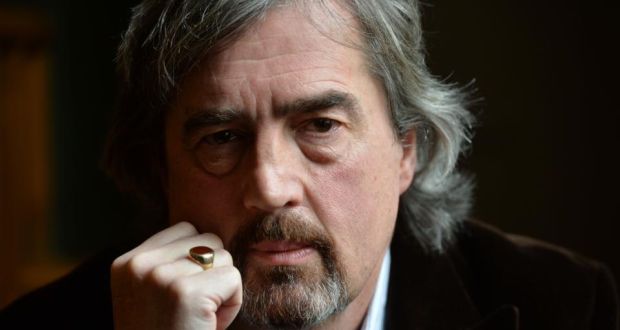
This novel, by Sebastian Barry, was the Costa Book of the Year in 2016.

Wikipedia says: “Sebastian Barry (born 5 July 1955) is an Irish playwright, novelist and poet. He is noted for his dense literary writing style and is considered one of Ireland’s finest writers.

Barry’s literary career began in poetry before he began writing plays and novels. While he was once considered a playwright who wrote occasional novels, in recent years his fiction writing has been more successful than his work in the theatre.

He has twice been shortlisted for the Man Booker Prize for his novels A long Long Way (2005) and The Secret Scripture (2008), the latter of which won the 2008 Costa Book of the Year and the James Tait Black Memorial Prize. His 2011 novel On Canaan’s Side was longlisted for the Booker. In January 2017, Barry was awarded the Costa Book of the Year prize for Days Without End, hence becoming the first novelist to win the prestigious prize twice.”

Sebastian Barry

Days Without End is a poetical, historical novel, set largely on the American frontier in the mid nineteenth century; its themes are love and survival.  The two principal characters are Thomas McNulty, the narrator, an Irish immigrant, aged about 15, initially, and John Cole, a homeless boy of about the same age, from New England.  Their tale begins as dancing girls – yes, boys dressed as girls – in a mining town saloon where they offered the apparent fantasy of women to rough, woman-less men.  They then join the army, which meant growing up with soldiers in hostile geography made all the more dangerous by the presence of Indians, a largely unwilling enemy. Thomas and John face near-constant hardship of savage fighting, bad weather, poor food and non-existent pay, but they find a mission and true comradeship in the army.  An Indian girl is captured, domesticated by the fort commander’s wife and assigned as servant to Thomas and John, who are then drawn into the Civil War, fighting on the Union side through battles which amounted to human slaughter.  At the end of an army enlistments, Thomas, John and Winona, the Indian girl, who is treated as John’s daughter, settle temporarily in Grand Rapids where they are entertainers, but they are drawn back into the Civil War, leaving Winona in Grand Rapids.  They are taken prisoners by the Southern Army, and live through terrible hardship, but eventually find their way back to Grand Rapids, from which the three of them set out to help a homesteader in Tennessee.  But peace is elusive: Winona is wanted in a hostage exchange for the daughter of the fort commander.  Thomas accompanies her, and, after a bloody fight in which he kills an army officer, he returns her to the Tennessee homestead.  But then, Thomas is arrested for having left the army before his papers were signed.  In custody, it is revealed that he killed the officer, and her faces the death penalty.  I won’t reveal the conclusion.

The characters are well drawn, including minor characters: army officers, soldiers, entertainers, Indians and miscellaneous blacks.  From what I remember of my American history, it paints an accurate picture of America 150 years ago.  I’ve called this ‘a poetic, historical novel’  because the narrator, Thomas, speaks in the most picturesque language, which is un-accustomed but very effective.  It does, however, make the process of reading a little more laborious.  Also, Thomas, occasionally draws on vocabulary which in very doubtful for an uneducated immigrant boy.

Having said that, Days Without End is a unique reading experience, and a good story, well-told.

Review: Seeking Father Khaliq

The following review of Seeking Father Khaliq was posted on Amazon.com by amts:

“This is another wonderful book by author William Peace. Fascinating discussions of theology, philosophy and politics all melded in to an intriguing and mysterious plot. Who is Father Khaliq and why does this perhaps Saudi Arabian princess hire Professor Kareem al-Busiri who teaches at the American University in Cairo to find him? An indifferent Muslim, he is intrigued by her offer. Looking for Father Khaliq takes him on a variety of religious pilgrimages from the Muslim Hajj to the Shia Arba’een, to a trip to Israel and to Rome. Not only does one encounter a treasure trove about each of these places and pilgrimages, but one is treated to stimulating discussions about the three major religions and their approaches to essential questions about the meaning of life, about who is God, and what role the divine being plays in each of our lives.
The politics of the Middle East is handled plot wise in the lives of two of the professor’s sons. The elder, Naquib, wants radical change and becomes a member of the Muslim Brotherhood. The younger, Kalifa, chooses to join the army and to work for change within the system. The choices each makes leads to a tragic outcome that is unforeseen. During one of Kareem’s pilgrimages he comes in contact with Daesh and are held hostage. The scenes involving Daesh are not easy to read, but anyone familiar with the work of ISIS, as Americans refer to Daesh, will not be surprised. Their eventual rescue is one of the most exciting scenes.
Kudos to Mr. Peace for providing us with a book full of strong women characters. Although he is a widower, we learn about the strength of his former Peace Corps American wife who stayed in Egypt after her tour ended and later became a Coptic Christian. He is a realist; she an idealist, but they accepted and respected each other and she was able to exert her quiet influence on him in many ways. Naquib’s wife, Anisa, is the wage earner while Naquib is in school and takes care of the children while she is at work. Kalifa is unmarried, but later marries the daughter of another strong character, Adeeba, a friend of his wife’s whose husband had died about eighteen months before Elizabeth. Adeeba is a professor of Egyptian history also at the American University and the author of several books. She has strong opinions and is not shy about expressing them. The romantic relationship that eventually develops between Kareem and Adeeba is one of mutual respect and admiration, but also one with passion. The final strong female character is Wahida, Kareem’s daughter who works for the Red Crescent and presents the viewpoint of a young Moslem woman challenged by life as a Moslem in the modern world and in a Middle Eastern country.
This book has much to offer the reader – a fast moving plot, stimulating ideas to ponder, insight into the contemporary Middle Eastern world, and well developed characters both the main ones and those whose places are more peripheral. I recommend it most highly.”

Seeking Father Khaliq has received an honorable mention in Reader View’s annual literary awards.

Literary Agent, David Miller

I would like to meet a literary agent for a face-to face discussion.  I’ve never met one.  I’ve corresponded with dozens of literary agents, some of whom have even been kind enough to send me brief notes of refusal.  Therefore, when I saw the obituary of David Miller, literary agent, who died, aged 50, on December 30 last year, I had to read it.  What sort of person was he?  Would I have gotten on with him?  More importantly, would he have liked my books?

My pre-conceived notion of the ‘standard personality’ of a literary agent is: a slightly unattractive, introverted, intelligent, sensitive, artistic person with an emotional intelligence approaching zero.  I would expect him or her to look up from a cluttered desk, behind which the shades are drawn, peer at me over half-moon spectacles, and inquire, “Yes?”

Having read the obituary of David Miller that appeared in the Daily Telegraph two days ago, I have concluded that my ‘literary agent standard personality’ is – at least in David Miller’s case, pretty far off target.

download

David Miller

The obituary says: “The son of a chartered surveyor, David Miller was born in Edinburgh on February 6, 1966, and educated at King’s School Canterbury, and at Girton College, Cambridge, where he read theology.  After a short spell at a City recruitment consultancy, where he learned his formidable telephone-bashing skills, Miller joined the literary agency Rogers, Coleridge & White in 1990.  One of the many ways in which the agency bucked tradition was to hire a succession of presentable young men to take calls and occupy the front desk.  Miller, in his slender, younger days, equipped with a matinee-idol forelock and an expression that was somehow both sardonic and guileless, fitted the bill perfectly.

“He quickly became an agent, and set about  building a stable of authors.  His first client was the Booker-shortlisted novelist Nicola Barker.  She later described him as ‘too wayward and funny and complex either for fiction or for real life.  An absolute one-off.’  Some (of his clients) enjoyed considerable sales, notably Victoria Hislop, but Miller had the rare gift of seeming to care about money neither too much, nor too little.  And if this was something of an act – posthumous revelations about him having one phone for his ‘wonga’ clients and one for the rest would have pricked several authors’ amour propre – it was a useful and educational one.

“Business was generally conducted over lunch.  Miller would arrive all of a kerfuffle, like the White Rabbit.  His personal style had evolved into a rather Doctor Who-ish blend of elegance and scruff _ moleskin, swirling scarves, on occasion even a fedora hat – a certain clerical sleekness combined with a tangible air of mischief, he would . . . after a rapid gossip download, produce a book proposal or a chunk of manuscript, marked up with a proper fountain pen.  In the conviviality of what ensued, at the end of which authors would find themselves deposited on a pavement somewhere in west London, the late afternoon sunshine stinging their eyes, it was easy to overlook the rigour that Miller had brought  to the preceding couple of hours.

“Ferdinand Mount writes: ‘David Miller wasn’t just and agent, he was a personal battery charger.  Just to hear his thrilling stage whisper over the phone or to see him bounce round the corner in a huge jersey too heavy for the time of year with a bundle of manuscripts under his arm set you up for the day.  He always knew how to persuade you to write a book you hadn’t particularly thought of writing, or how  to rewrite it when it didn’t work, because he knew more about books than any publisher and himself wrote better than most of his clients.  . . .  He was fearless, unquenchable and the kindest man you could ever hope to meet.'”

I would say that David Miller was attractive, extroverted, intelligent, brash, artistic, with a sky-high emotional intelligence.  I would have loved to have lunch with him even if he turned down my book proposal!

Charlie Smith, Novelist

I’m always interested in other writers: what motivates them to write as they do, and their techniques.  My high school alumni magazine has an interview with Charlie Smith (class of ’65), who has written eight novels, a book of novellas, and eight books of prize-winning poetry.  He has won the Aga Khan Prize, the Levinson prize, the J. Howard and Barbara M.J. Wood prize, a Guggenheim Fellowship, and a grant from the National Endowment for the Arts.  His writing has appeared in magazines and journals such as The New Yorker, The Paris Review, Harper’s, The New Republic, the New York Times, and The Nation. He lives in New York City and Key West.

download

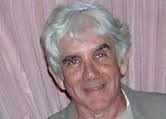
Charlie Smith

His latest novel, Ginny Gall, is the “story of Delvin Walker, and African-American born in Tennessee in 1913.  Young Delvin loses his mother when she flees their home after being accused of murder; is taken in by the kind and literate Cornelius Oliver; has to hightail it out of town after a skirmish with a white boy; and rides the US railroad system in a bid to find a home, a place, his life.  The novel sprawls across the America of Jim Crow and the Great Depression, steeped in segregation, violence and destitution of the era, while vibrantly capturing the making of a man – and a writer.”

Smith is asked about the origins of the story: “Well I’m not really a writer who forecasts his novels; I just start off writing.  But this novel does have a faint template: there are certain skeletal bones that reference the Scottsboro Boys in Alabama in 1931, nine young black men who were pulled off a train, accused of raping a couple of white women and thrown into prison.  Those facts were more than I usually have to go on when I start writing.

“One of the things I wanted to do was write an imagined biography about a young man in peril in the South, the extreme difficulty that someone can find himself in – not of his own making – and how he responds to it.  As far as  the character being a writer, it wasn’t something I thought of before I started the book, but as I moved along, I found myself interested in the side of Delvin that would culminate in someone who was becoming a writer.  So I went along that way, and that’s what followed.”

Smith is asked: “Even the bleakest parts of the book had this sort of light shining on them because of the way you used your language.  Did you maintain that language to show how Delvin’s mind works?”

“Some of that is simply the way I write.  I write pretty dark books – but this one is very light-spattered despite all the trouble and grief – it’s kind  of a square dance compared to the books I usually write.  But the juxtaposition of dark and light is an important part of how I approach a novel, and some of these decisions are intuitive decisions, they’re not something I organize ahead of time.  So the lightness you’re referring to is somewhat characteristic of how I write novels, but it’s also characteristic of this particular person – Delvin Walker – of how he experiences life.”

I must say that I’ve found it beneficial to lay out an rough outline of a novel before I start writing: who the characters are, where and when the action takes place, and the message or point of the story.  It seems to me that Charlie Smith had done exactly this when he says “an imagined biography about a young man in peril in the South, the extreme difficulty that someone can find himself in – not of his own making – and how he responds to it.”  I agree with him that what happens in the story isn’t planned in advance.  It evolves from the characters and the message of the novel.  I usually write a more detailed outline of each chapter before I begin writing it, and this will be a listing of events and reactions to them.  But while I’m writing a novel, the plot and the characters evolve over time.  For example, when I’m about halfway through, I begin to get a sense of how the story will end.  I also agree that the use of language is very important in setting the mood of the story, which changes as events unfold.  Language is also vital in creating distinctive characters.

Review: Silence

The film Silence has been in theaters, lately.  I haven’t seen it yet, but I decided to read the book, Silence, on which it is based. The author, Shusaku Endo (1923 – 1996) was a Japanese author who wrote from the rare perspective of being a Japanese Roman Catholic.  During World Was II, he worked in a munitions factory. After the war, he briefly studied medicine.  He lectured at several universities on the craft of writing, and he took a particular interest in French Catholic authors.  Ill health troubled him for much of his life.  His work was dominated by a single theme: belief in Christianity.  It has been said that Endo was a ‘Japanese Catholic author’ struggling to ‘plant the seeds of his adopted religion’ in the ‘mudswamp’ of Japan.

download

Shusaku Endo

Silence is the story of a Portuguese, Catholic priest, Sebastian Rodrigues, who volunteers to go to Japan in the 17th century to minister to Christian converts and to discover why his colleague, Christovao Ferreira, another Portuguese priest, has reportedly apostatized.  The background of Silence is historically accurate.  Christianity was introduced to Japan in 1549 by the co-founders of the Jesuit Order, and the religion found favour with the Japanese court for the next sixty years.  However, the hostility of English and Dutch Protestant missionaries and the desire of Shugun Icyasu to destroy Christian influence in Japan led to ruthless attacks on Japanese Christians, many of whom were tortured, burned alive, or forced to apostatize – renounce their faith.

Rodrigues makes the long sea voyage from Portugal to Japan in the company of another missionary priest: Father Garrpe.  On arrival, and escorted by a shifty Japanese peasant named Kichijiro, they are placed in a remote hut above a Christian village.  As the story unfolds, Kichijiro becomes a surrogate for Judas Iscariot: admiring Rodrigues and helping him, but also so tempted by the reward in silver for leading the Japanese officials to a priest that he succumbs to the temptation.  Kichijiro goes through repeated episodes to apostatizing and then returning to his Christian faith, claiming that he is too weak to resist torture.  The strategy of the Japanese official who is the chief persecutor, Inoue, is to use the Christian peasants as hostages to wring an apostasy from the priests.  With the priests eliminated, the religion will disappear.  In one scene, watched by Rodrigues, three Christian peasants who have apostatized are wrapped tightly in reed blankets and dropped off a boat.  Father Garrpe tries to swim to their rescue, but all four drown.  Rodrigues had been invited to save all four if he would just put his foot on a plaque on which there is the face of Christ.  The psychological torture continues: Rodrigues is kept in prison, un-harmed on meager rations, but exposed to the suffering of Christian peasants.  Ferreira appears, and advises Rodrigues to take the right way out: simply trample on the image.  Rodrigues spends the rest of his life as a comfortable captive, performing translations and writing anti-Christian essays at the behest of his captors.

Silence is not an enjoyable book, but it makes one question one’s own beliefs and assumptions.  The title refers to the silence of God in the face of so much suffering.  How can that be?  And yet, Rodrigues is frequently confronted with mental images and the words of Christ.  The definition of Christianity seems to be based on the concepts of the Japanese oppressors: a flame of strange faith, driven by priestly ritual, which contradicts the warm, comfortable ‘mudswamp’ of Japan, and that a coerced apostasy extinguishes that faith.  I, personally, am not at all comfortable with this definition, which seems far too limiting.  Moreover, given that one of Endo’s objectives as a writer was to introduce his faith to his country, this definition seems unlikely to attract many adherents.  The central messages of Christianity are obscured in the focus on what is faith and the complex role of Judas, and, by extension, on the roles of Pontius Pilate and Herod.

The Daily Telegraph calls Silence, ‘A masterpiece.  There can be no higher praise.’  I disagree.  I would call it, ‘a fine, and thought-provoking, historical novel’.  Some of this divergence in opinion may be a function of timing.  Silence was first published in 1969 (in Japan), and at that time it may have caused something of a sensation.  But for me, now, it seems a dated classic, but still well worth reading.  I didn’t find the prose to be captivating – more ordinary – though perhaps this is the translation.  But, for example, I cannot blame the translator for the inclusion of the phrase ‘a number of” three times in the space of half a dozen lines.

Interview with Norm Goldman

I have had an e-interview with Norm Goldman, Publisher and Editor of Bookpleasures,com.

download

Norm Goldman

Norm: How did you get started in writing? What keeps you going?

William:  I had taken a writing course at university, and I always enjoyed writing reports in business, but I had never considered myself a writer of fiction.  About eight years ago, I was on holiday in Sicily and I had a series of romantic dreams in which I was involved as a bystander.  I thought: it would be fun to write these down.  I began writing and by the time I got to page 70, I decided to finish it.  That was my first novel.  Since then, I’ve derived an increasing satisfaction from completing novels which are better and better.

Norm:  What do you think most characterizes your writing?

William: There is always at least one character who is facing ethical/moral dilemmas.  I try also to give the reader a strong sense that what she is reading is true and real.

Norm: What did you find most useful in learning to write? What was least useful or most destructive?

William:  What has been most useful is the feedback I have had on my writing.  I am also a fairly avid reader, and I always publish a review of the books I read.  This sharpens my critical skills which are important when I’m writing.  I really can’t think of an experience which has been destructive.

Norm: How many times in your career have you experienced rejection? How did they shape you?

William:  Countless times.  I received several dozen rejections for my first novel, and I was ready to give up on getting it published when Eloquent Books (the predecessor of my current publisher) came to me with a co-op publishing offer.  Since then I have approached about twenty literary agents and publishers for every novel I’ve written; my approaches have been universally rejected (usually politely) or ignored.  I’ve stayed with Strategic Book Publishing.  My impression is that to get a contract with a traditional, main-stream publisher, one must have a third-party intervention or recommendation.  This is an understandable symptom of risk avoidance in the publishing industry, but it also suggests a lack of independent, creative thinking in the industry.  My lack of acceptance by main stream publishers has not deterred me.  I will carry on writing better and better novels.  Someone will almost certainly notice.

Norm:  In your bio you indicated that the spiritual/religious genre is your preferred choice. Could you explain to our readers, why?

William:  I am a religious person, but not evangelical.  The romance and the three thrillers all have religious aspects.  I started writing Sable Shadow & The Presence as a kind of experiment, and I had to re-write large portions of it, but, at the end, I felt particularly good about it.  Several excellent reviews and being awarded seven minor prizes convinced me that I had found my venue.

Norm: How did you become involved with the subject or theme of Seeking Father Khaliq? As a follow up, have you ever lived in Egypt?

William:  Before I started Seeking Father Khaliq, I decided to write about one character’s search for God, but I didn’t want a typically evangelical book. It had to involve a faith other than Christianity and a venue outside the West.  Also, the book had to have more issues than a singular focus on spirituality.  I’ve never lived in Egypt, but I’ve visited the country several times.  In creating Seeking Father Khaliq, I spent as much time on research as I did on writing.

Norm: What were your goals and intentions in this book, and how well do you feel you achieved them?

William: My intention was to leave a gentle message that if one wants to find God, He can be found, and that sometimes He is revealed in the midst of adversity.  I think the message is there and perhaps made a bit more interesting by Egypt, philosophy, Islam (good and bad), and the will-of-the-wisp Princess Basheera.

Norm: Do you worry about the human race?

William:  Not in the long term.  The short term can be a horrendous mess, but somehow we will muddle through.

Norm: How did you go about creating the character of Professor Kareem al-Busiri? (As a passing note,  I am married to someone born in Egypt and who lived there until the age of 18, I am familiar with the male Egyptian mindset and you seemed to have vividly captured it).

William:  My specifications for Kareem were:

  • A respected professor of philosophy at a prominent Egyptian university (I wanted to include philosophy to add richness)
  • He should be a secular Muslim: a sort of agnostic
  • He should be single to introduce a romantic element
  • He should be open-minded and a bit naïve (to believe Princess Basheera)
  • He should have adult children to add complexity

Norm:  What are some of the references that you used while researching this book? As a follow up, can you share some stories about people you met while researching this book?

William:  My principal reference was Classical Arabic Philosophy, an Anthology of Sources, by Jon McGinnis (Translation), David C. Reisman (Editor).  I spent countless hours on the internet to gather facts, opinions and experiences.  I don’t remember their names, but I enjoyed vivid personal accounts by pilgrims on the Hajj and Arba’een.

Norm: What was the most difficult part of writing this book and what did you enjoy most about writing this book?

William: The most difficult part was staying factual in detail, down to the specifications of the Russian-made weapon which killed Kalifa.  Most satisfying and enjoyable was integrating all the pieces of a complex story.

Norm:  Did you learn anything from writing the book and what was it?

William:  While I have read quite a lot about Islam, and I’ve read the Qur’an, I gained a perspective of Islamic culture, and its effect of the values of people.

Norm: Where can our readers find out more about you and Seeking Father Khaliq?

William: I have blog (https://williampeaceblog.com/) which has been going for six years, and which includes my opinions and experiences as a writer.  I’ll let Father Khaliq speak for himself.

Norm: What is next for William Peace?

William:  I’m writing another novel, set in East Africa, with three main young adult characters: a penniless man of traditional tribal faith; a middle class, Christian woman; and a Muslim man from a wealthy, prominent family.  All are black: there is plenty of interaction and clashes in values and beliefs.

Norm: As this interview draws to a close what one question would you have liked me to ask you? Please share your answer.

William:  What else does your ‘day job’ consist of?  Because I write with intensity only three or four hours a day, I need ‘alternative occupations’.  These include pro bono consulting work for London charities, treasurer of a charity which provides psychotherapy, and involvement with two of our daughters and their families who live nearby.


Review: All that Man Is

My wife bought this book for me when I was in the hospital and needed something to read during what would have been periods of utter boredom.  I had asked her to find a book which had been shortlisted for the Booker Prize.

The author is David Szalay, who was born in Canada in 1974, moved to the UK, has lived in Belgium and is now based in Budapest.  He studied at Oxford University, has written dramas for the BBC and his four novels have attracted several prizes including a listing for the Booker Prize in 2016.

4206

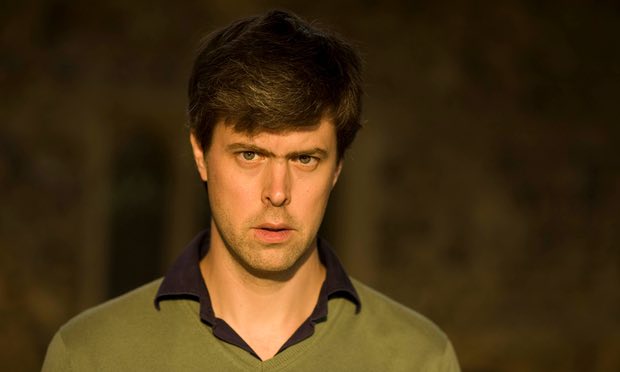
David Szalay

All that Man Is is nine short stories about men, away from home, in different stages of their lives, each of whom tries to come to grips with what it means to be alive.   In the final story a 73 year-old man – knighted for his services in Whitehall twenty years ago, on his own, in a small, old Italian house considers, gloomily, his mortality, and it is this story which – for me – comes closest to establishing a theme for the work.  Before this story, we have: a thoroughly bored 17 year-old university student travelling around Europe with an acquaintance; a university drop-out on a down-market holiday in Cyprus where he meets two willing fat women; a tough guy employed to protect an aloof call girl; a driver delivering a car to his disconnected girlfriend’s father; a journalist involved in a political scandal; a real estate developer who meets an attractive young woman in Switzerland; an English drifter in Croatia is stung by a local con man; a suicidal billionaire on his super yacht.

The stories are well-written except that an occasional detail about setting makes one wish for a similar detail about a character.  The characters are interesting – not least because the reader cannot help but try to understand them. There is an undertow of submerged emotion in the book.  Also,  an air of pessimism in the written tone and in the actions of the characters, so that the reader might ask: ‘what is the point of this?’  With most of the characters, one feels urged to shout: ‘Why don’t you get a grip?  Make an effort for goodness sake!  No one ever promised you a rose garden!’  Is Szalay trying to express a sort of  nihilist philosophy?

For me, this more a collection of short stories than a novel, because there is little to connect the pieces except the tone, European geography and men facing dilemmas.  In summary, this is an interesting, if slightly flawed, book

Review: Selection Day

My wife bought me a copy of this novel – signed by the author!  – while I was briefly in the hospital (nothing very serious) and I wanted something to read.  Hospitals are a great place to read: one is always waiting for the next procedure to take place; one can make oneself comfortable; and it is not particularly noisy!  She bought it because I had asked for a novel by a Man Booker shortlist author.  The author, Aravind Adiga, actually won the Man Booker in 2008 for his first novel, The White Tiger.  Adiga was born in Madras (new Chennai) India in 1974; after achieving his secondary school certificate, he emigrated with his family to Australia, where he graduated from high school in Sydney.  He graduated, next, from Columbia University in 1997 and subsequently studied English literature at Magdelan College, Oxford.  He began his business career as a financial journalist with the Financial Times, Money and Time before becoming freelance.

download

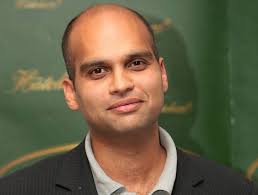
Aravind Adiga

Selection Day is a book focused on Indian cricket and its effect on a Mumbai slum family of two boys and their compulsive father.  Radha, the older brother, expects to fulfill his father’s dream of being selected for a top Indian team.  Tommy Sir, a coach/agent/promoter introduces the boys father, Mohan, to a ‘businessman’, Anand Mehta, who pays Mohan a stipend in return for a large slice of the boy’s earnings when they become famous.  Unexpectedly, Manju, the younger boy, is the better batsman, scoring 497 not out in a crucial contest.  Radha has a ‘weight transfer problem’ which is inhibiting his effectiveness as a batsman.  Enter a rival, Javed, a cocky, rebellious, rich kid who is also a fine batsman, and who happens to be gay.  Manju, at the center of the story, is his older brother’s best friend and rival, and his father’s severest but respectful critic.  The younger batsman is torn between his admiration for Javed, and his reluctance to commit to an intimate relationship; and between careers in cricketing or in science.

Selection Day offers a rich mixture of conflicted, imperfect characters with whom the reader cannot help but empathize.  The setting of Mumbai is drawn with natural clarity; one feels truly present.  And without being a ‘book about cricket’, Selection Day, presents the culture, the mystique, the competitiveness of Indian youth critic captivatingly, without technical fussiness.  The dialogue is credible, but occasionally seems too tangential to lead the reader to any firm conclusions.  Perhaps, this is Mr Adiga’s intention with this novel: to make the point that, try as one might, there can never be the achievement of one’s ultimate dream.

This sense of failure seems to carry over into the two concluding parts of the novel: what happens after selection day and in the epilogue.  One cannot help but be engaged by the beautiful writing, the energy, and the unfolding future in the lead up to selection day.  The writing is as good, but the energy and the future have dissipated after selection day.  Perhaps this novel could feel more whole, more consistent, if dreams could be scaled back rather than dispelled, and the energy and the future modestly re-directed.

Review: The Last Confession of Thomas Hawkins

I bought this book – an historic novel – in a Waterstones bookstore because I had nothing to read at that moment and it looked interesting.  Its author is Antonia Hodgson who grew up in Derby and studied English at the University of Leeds.  Her first novel, The Devil in Marshalsea, won the 2014 Historical Dagger Award.  Ms Hodgson lives in London, where she is an editor.

download

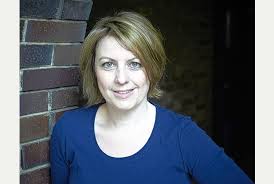
Antonia Hodgson

The Last Confession of Thomas Hawkins is set in a rather down-market section of Georgian London.  Its principal character, Thomas Hawkins is a ‘gentleman’ who killed a man in self-defense in prison, and throughout the story is under threat of being hung for murder.  There are several intertwining plots.  One involves a rather loathsome neighbour who is a member of the Society for the Reformation of Manners (a pathological moralist) and whose own morals permit him to consort with prostitutes and to beat his children.  The neighbour is suddenly dead.  Who killed him?  Thomas, one of the children, the apprentice, the son of a notorious gang?  Another plot involves King George’ mistress who is also a lady in waiting to Queen Charlotte.  This Henrietta Howard (who was a real person) is a pawn in the struggle of her very evil, estranged husband to extort money from the king.  The queen, also a real person, is caught in the middle and manages to capture Thomas as her rook to defeat the black knight, Charles Howard.  To keep things going, there is Kitty, the pretty and libidinous girlfriend of Thomas.

There is plenty of action in this rather engaging tale which moves along at a frenetic pace with many twists and turns along the way.  The characters are well-developed and likable or despicable; the dialogue is terse and credible.  The Covent Garden area of London is well described in physical and moral terms, but it was difficult to picture oneself in the setting.  It is not just a familiarity with the Covent Garden of today that blocked – to some extent – the credibility of the scene; it was more that at a feeling level one is somewhat remote. Having said this, one has to admire the depth of Ms Hodgson’s research into the times, the issues and the characters.  There are plenty of surprises in The Last Confession of Thomas Hawkins – they certainly keep the reader engaged – but sometimes the events seemed a little too contrived.  For example, the events around the ambush of Henrietta’s carriage by her husband, and the conclusion where Thomas is sent on a new mission by the queen.  The cockfight and the duel of the female gladiators, while authentic and interesting, added little to the story line.

For those who like a historical novel with an anchor in truth, one with many fascinating twists and turns, with important, stand-out characters, and a good helping of mystery, The Last Confession of Thomas Hawkins is the novel for you!