Just Jump

Harry Bingham, the Founder and CEO of Jericho Writers, makes a good point about the inertia we sometimes feel as writers.

He says, “Just Jump!”

Harry says, “

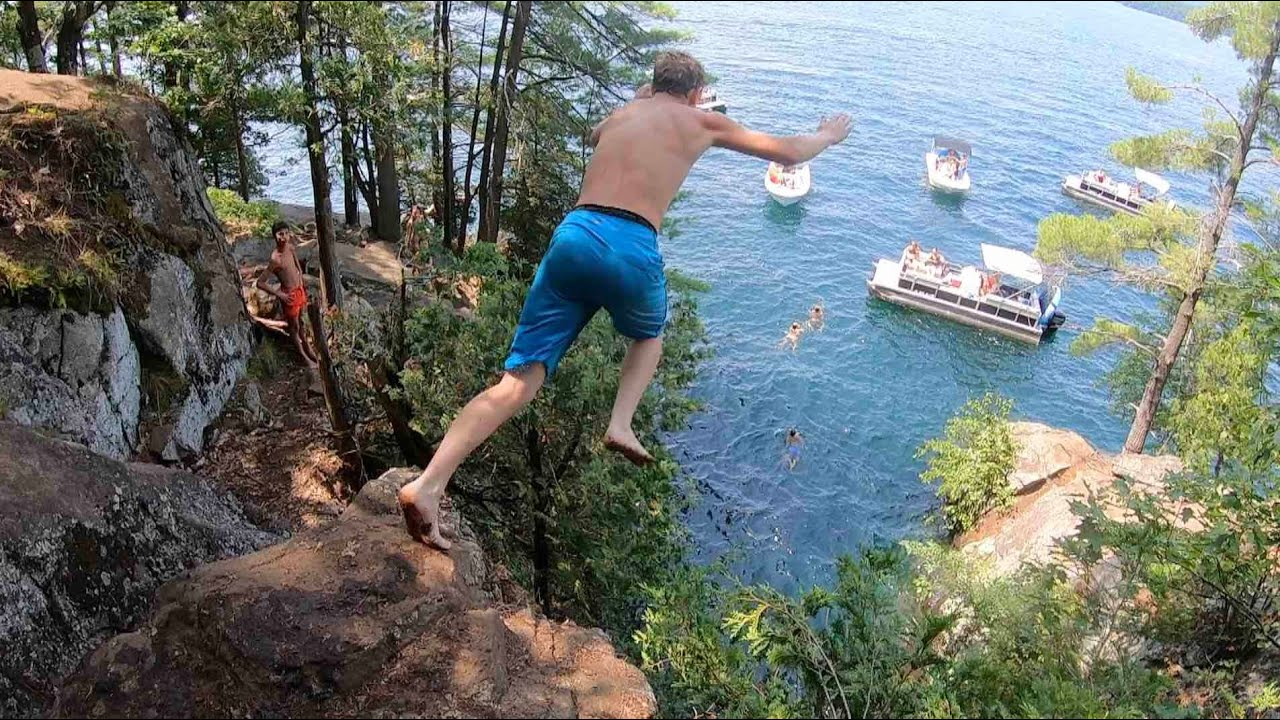
Ray Bradbury, the author of Farenheit 451 and much else, was a fan of the future. A fan of boldness and technological adventure.  In an interview with the New York Times, he said, “If we listened to our intellect, we’d never have a love affair. We’d never have a friendship. We’d never go into business because we’d be cynical: ‘It’s gonna go wrong.’ Or ‘She’s going to hurt me.’ Or ‘I had a couple of bad love affairs so therefore …’ Well, that’s nonsense. You’re going to miss life. You’ve got to jump off the cliff all the time and build your wings on the way down.”  That cliff-jumper is you. It’s me. It’s all of us.  It’s certainly true for any first-time novelist. My first book was a giant 180,000 words long. (And yes, it went to print at that length. And no, it’s not a length that publishers are especially looking for. But if a book is good enough, the length is kinda immaterial.)  I was naïve. I literally had no idea that writing a book and getting it published might be hard. I just assumed I could do it, and would do it. My track record (Oxford University, fancy American bank) was one of achievement. I knew I liked reading. I’d always assumed I’d end up being an author. So: write a book – how hard could it be? I knew how to write a sentence, so just do that over and over, and I’d have a book.  Everyone receiving this email is less naïve. The tone of voice needed for a fast commercial adventure-caper was not the same tone as that had produced success in Oxford philosophy essays. Once I’d written 180,000 words, I looked back at the start and realised it was … ahem, in need of vigorous editing. The kind of editing that involved selecting 60,000 words and hitting Delete. So I deleted the rubbish and rewrote it. Wrote it better.   But:  That wasn’t a failure. It was the second most important step on the road to success. The most important was writing the first word, the first sentence, the first paragraph, the first chapter. The most important step is always the same: it’s jumping off the cliff in the first place.  Deleting 60,000 words was the next crucial step: acknowledging that what I’d done wasn’t good enough; that more work could fix it; that I needed to design and use some better wings.  But you don’t get to the better-wing-design stage until you’ve got to the plummeting-downwards-out-of-control stage. You need them both.  And honestly: the challenges probably get a little bit less as you write more books, get them published, get paid, learn the industry, build a readership. But each book is its own cliff – its own well of uncertainty.  As you know, I’m a huge believer in nailing an elevator pitch before you start writing. I don’t care about pretty formulations – I don’t mind whether you have the kind of phrase that would look good on a book jacket or movie poster. But a list of ingredients that would spark interest in a potential book-buyer? That’s essential.  But oh sweet lord, there is a huge gap between knowing that you have, in theory, a commercially viable novel and actually making it so. I have sometimes written books that flowed, start to finish, with no huge mid-point challenges, but those have been the exception. Mostly, there’s been a hole – a gap – a problem.  I’m not a huge fan of pre-planning novels in vast detail. (But do what you like: it’s whatever works for you.) The only way to find that hole is to leap off the cliff. It’s the flying through the air that tells you what wings you need.  So jump.  Be uncertain.  Jump anyway.  Take the biggest boldest leap you can, knowing that you don’t have the answers.  Just jump.  Jump knowing that your wings aren’t ready. They get born by jumping. Wings that surprise you and delight you and complete you.  So jump.  Good luck. And happy Christmas.     

Could AI Write a War and Peace?

In last Saturday’s Telegraph there was an article by Tom McArdle with the title “Waterstones chief: AI could produce the next War and Peace”.

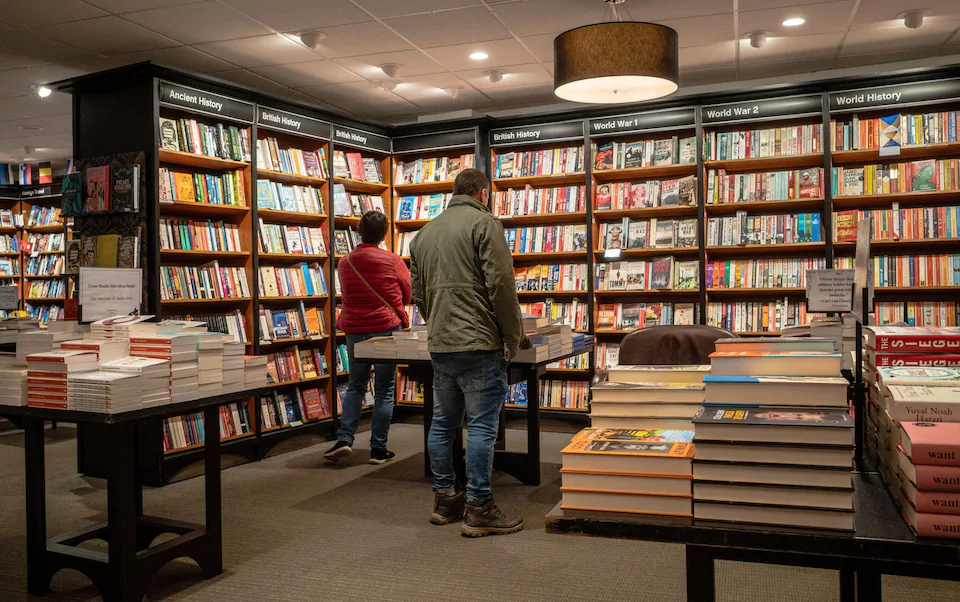
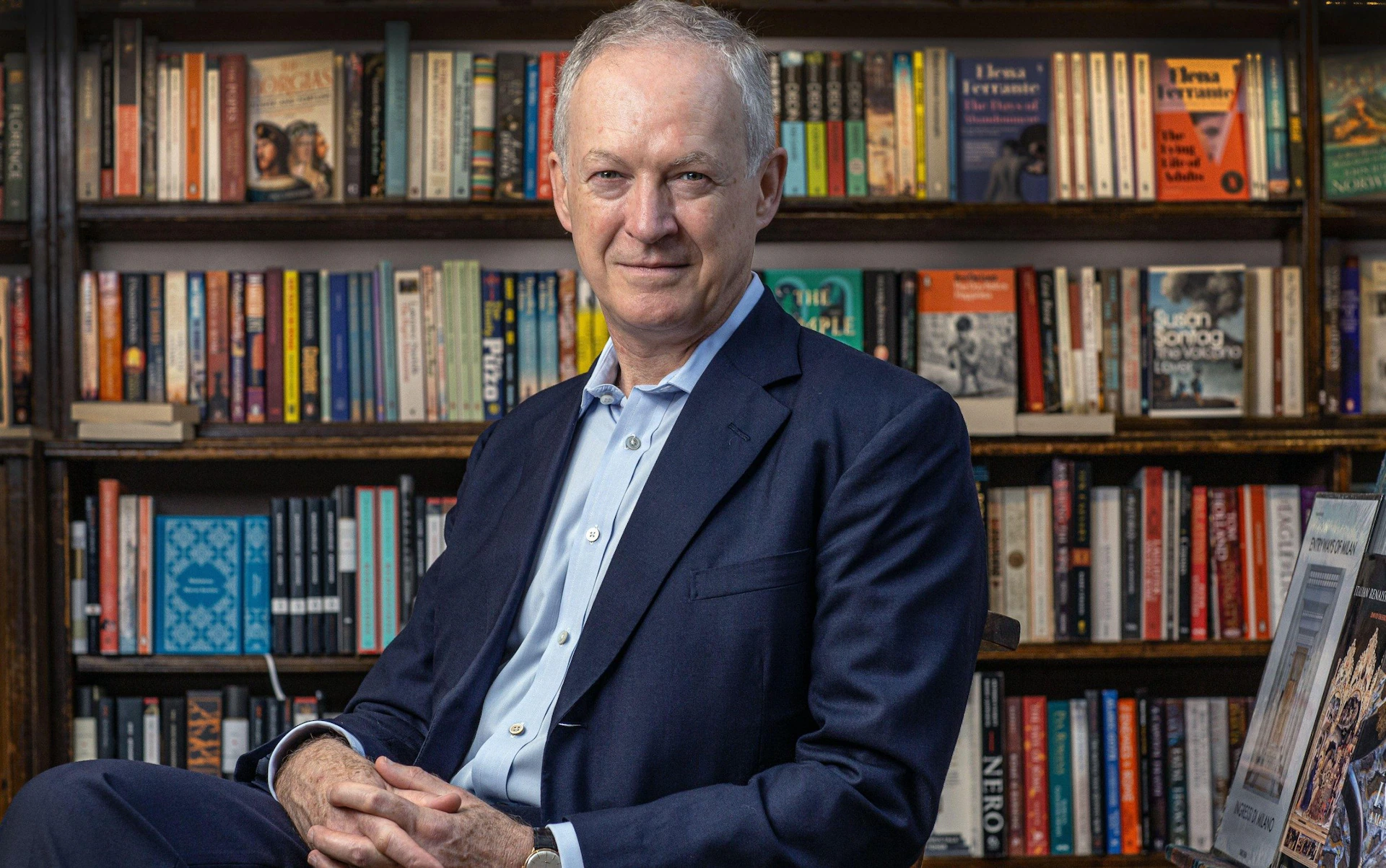
James Daunt, CEO, Waterstones and Barnes & Nobel

THE chief exec­ut­ive of Water­stones has said he is open to the com­pany selling books cre­ated by Arti­fi­cial Intel­li­gence, as long as they are clearly labelled.

James Daunt said it would be “up to the reader” whether to pur­chase them if they end up on his stores’ book­shelves.

There are major con­cerns from authors about the impact AI-gen­er­ated con­tent will have on the book industry, after a recent study found most writers feared their jobs were at risk from the tech­no­logy.

But Mr Daunt, who has been the CEO of Water­stones since 2011, told BBC’s Big Boss pod­cast that AI could pro­duce “the next War and Peace”.

“There’s a huge pro­lif­er­a­tion of AI-gen­er­ated con­tent and most of it is not books that we should be selling,” he said. “Hope­fully, pub­lish­ers avoid it; we as book­sellers would cer­tainly, nat­ur­ally and instinct­ively, dis­dain it.”

A Uni­versity of Cam­bridge study last month found wide­spread con­cerns from nov­el­ists about their jobs being replaced by the tech­no­logy and fears that work writ­ten by humans could become “an expens­ive lux­ury”.

In response, Mr Daunt said: “At the more lit­er­ary end I don’t see that being the case. There is a clear iden­ti­fic­a­tion of read­ers with authors, and book­sellers play an import­ant role in join­ing authors and read­ers.

“That does require a real per­son.

“As a book­seller, we sell what pub­lish­ers pub­lish, but I can say that, instinct­ively, that is something we would recoil [from]. It’s really import­ant that authors earn a liv­ing.”

Asked whether the high-street book­shop would sell AI books, he said: “We would never inten­tion­ally sell an AI-gen­er­ated book that was dis­guising itself as being other than that.”

When pressed on whether he would con­sider it if they were clearly labelled, he respon­ded: “Yeah, if it was clear what it was, then I think it’s up to the reader.

“Do I think that our book­sellers are likely to put those kinds of books front and centre? I would be sur­prised.”

He warned that given the exor­bit­ant sums of money being spent by tech com­pan­ies on AI, it was hard to know its lim­its.

“Who’s to know,” he said. “They are spend­ing tril­lions and tril­lions on AI and maybe it’s going to pro­duce the next War and Peace. If people want to read that book – AI-gen­er­ated or not – we will be selling it. As long as it doesn’t pre­tend to be something that it isn’t.”

Non-AI Novels Will Be a ‘Luxury’

There is an article in today’s Telegraph written by Tom Mc Ardle which reports on a study done by Dr Clementine Collett at Cambridge University on AI’s effects on literary trends.

Dr Clementine Collett is a DPhil student on the ‘Information, Communication and the Social Sciences’ course at the Oxford Internet Institute. Clementine’s doctoral research explores gender bias in artificial intelligence (AI) recruitment technology.

Clementine has worked as lead author on reports such as IA and Gender: Four Proposals for Future Research (2019) with the Leverhulme Centre for the Future of Intelligence at the University of Cambridge and The Effects of AI on the Working Lives 0f Women (2022) with the IDB, OECD and UNESCO.

Dr Clementine Collett

Novels written without artificial intelligence will become an “expensive luxury”, according the report.

Dr Clementine Collett has claimed that the creative market could become “tiered”, with only those who could afford human-written work being able to read it.

“[There] is a real concern from literary creatives that we will have a two-tier market, more so than we have already,” she told BBC Radio 4’s Today programme.

“Where human-written work will be more expensive – a luxury item.Those who can afford it will read human-written novels and AI generated content will be cheap or free and that will potentially have big societal implications as well.”

Dr Collett, who conducted the study at the University of Cambridge’s Minderoo Centre for Technology and Democracy (MCTD), interviewed to nearly 400 literary creatives across the UK about the threat of generative AI.

“There is widespread concern from novelists that generative AI trained on vast amounts of fiction will undermine the value of writing and compete with human novelists,” she said.

Dr Collett called on the Government to weigh up the economic growth it has so far prioritised by developing AI, against the potential impact on the creative industries, including readers and the novel itself.

The study found that almost two thirds (59 per cent) of novelists reported that their work had already been used to train large language models, which power AI tools, without permission or payment.

Such practices have already impacted the livelihoods of those surveyed, with more than a third (39 per cent) reporting their income being negatively affected by AI.

The report found genre fiction, especially romance, thrillers and crime, is more at risk from displacement than more highbrow literary fiction. Dr Collett said this was because of their more “formulaic” make up.

“We don’t know what generative AI is going to be able to do in the future in terms of producing more original content,” she added.

“It’s really important because novels are such a bedrock of our thriving British creative industry and they’re the core part of our humanity.” She called on Government intervention to help protect the industry.

Prof Gina Neff, executive director of the MCTD, said: “Our creative industries are not expendable collateral damage in the race to develop AI. They are national treasures worth defending.”

A spokesman for the Department for Science, Innovation and Technology said: “We’ve always been clear on the need to work with both the creative industries and the AI sector to drive AI innovation and ensure robust protections for creators.”

Review: The Bustamante Story

The subtitle of this book is ‘& Behind the Scenes of Shadow Cell’. The author is ‘Harry Greene’.

After reading an article in the Atlantic about two CIA agents who fell in love on an assignment involving the creation of a shadow cell inside a global competitor of USA, I searched on Amazon for their book.

There appeared to be several, but I couldn’t find one with Shadow Cell in the main title. So I picked this one out as a likely candidate.

This book at 135 pages. The interesting information in it could have been divulged in ten pages. It is repetitious on several subjects: tight security at CIA; the two agents felt under great pressure at CIA for their relationship; the agents were clever, top performers. There were almost no examples backing up these assertions. The author is very careful to speak kindly of the CIA and the agents, and not to mention even a trivial fact which might be classified. He probably wants to be clear of any litigation, should his real name be known.

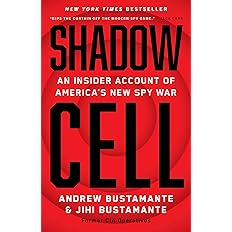
How wrong my choice was! This one is most likely a knock off of the real book (pictured below). A knock-off written by a Joe Bloggs under the pen name of a Harry Green. There is a Harry Green listed on Amazon who has written 16 fiction and non-fiction books on various subjects, none of which include the CIA. This book has an ISBN number (which no longer comes up on Amazon searches). In fact, this book no longer exists according to Amazon. This book doesn’t mention its publisher or its printer. It says only that the book was printed in New Haven, Connecticut on 10 September 2025. There is no author biography or statement of his/her relationship to the agents or the CIA. The narrator starts right in as if he had permission to tell the story.

The real book: a New York Times Bestseller!

Interestingly, I don’t believe the real book was listed on amazon.co.uk when I bought the knock-off. In fact, it still doesn’t seem to be listed. I just bought a real copy on amazon.com. It was published on 9 September 2025.

So what’s all the hubbub about? Well, here’s the publicity from the real thing:

INSTANT NEW YORK TIMES BESTSELLER | A thrilling firsthand account by husband-and-wife CIA operatives who, against all odds, triumphed in a deadly cat-and-mouse game against a mole within the agency—an unprecedented insider account of 21st-century spycraft in the tradition of Argo and Black Ops.
 
Andrew and Jihi Bustamante were a “tandem couple”: married spies who’d dedicated their lives to the CIA. They met as trainees at Langley, and got married while hunting terrorists across the globe. Then, suddenly, they were assigned to a mission so sensitive and explosive that the CIA still has never acknowledged it. The CIA’s source network in a country code-named “Falcon”—one of America’s most formidable rivals—had been compromised by a mole, and the agency needed a new way to collect intelligence there. Young newlyweds, the Bustamantes were considered safe choices for this daunting task precisely because they had no experience in Falcon. They were also loyal, forgettable, and completely disposable—operatives who could help to strengthen the CIA’s position in Falcon while simultaneously serving as bait for the mole.
 
But although their superiors at the CIA didn’t realize it, the Bustamantes also brought another advantage to the table: a granular understanding of how terrorist cells operate, and how the agency could exploit those same tactics to keep America safe. Assembling a rag-tag team of fellow operatives and recruiting new sources from Falcon, the Bustamantes pioneered a new way of spying by building a cell of their own—right at the heart of the CIA.

The propulsive, untold tale of one of history’s greatest intelligence crises and the unlikely band of agents who were sent in to clean up the mess, Shadow Cell allows us to peer behind the curtain to see how today’s spy wars are being fought—and won.”

AI Controversy

There is an article in the Atlantic magazine on 19 September about how the publishing industry views AI. It is written by Boris Kachka, Senior Editor of the Atlantic. He titles the article ‘Publishing’s New Microgenre’

Boris Kachka

“Book publishing has, let’s say, a complicated relationship with artificial intelligence. Earlier this month, Anthropic settled a lawsuit brought by authors and publishers, agreeing to pay $1.5 billion after training its chatbot, Claude, on pirated text; hundreds of such copyright lawsuits against data-scraping tech companies are still making their way through the courts. Many in the culture industries see AI as not just a thief but an existential competitor, ready to replace human writers at every turn. Yet publishers are also fascinated by the technology (and not only because they use it for marketing and other tasks). The major imprints have been churning out a robust collection of books (more than 20 this year, by my count) that explain, extol, deride, fictionalize, and occasionally incorporate AI.

Among these recent releases, one overarching theme is a debate occurring between so-called accelerationists and doomers—those who think superintelligence will hugely benefit humanity and those who suspect it will kill us all. Adam Becker, a journalist and former astrophysicist, disagrees with both groups. Becker, the author of the recent anti-utopian critique More Everything Forever, wrote about his problems with a new dystopian manifesto, If Anyone Builds It, Everyone Dies, by Eliezer Yudkowsky and Nate Soares.

Becker’s main objection to both sides is that they overhype the long-term, world-altering effects of superintelligence while downplaying the “much more immediate and well-founded concerns about the dangers of thoughtlessly deployed technology,” he writes. The kinds of ongoing changes that he would prefer to focus on are well accounted for in 2025’s AI book haul. Readers can find out more about how AI’s processes resemble the workings of our brains (or don’t); how the technology is changing medicine, warfare, education, business, and politics; how it has already profoundly altered society. But to me, the most interesting of the crop (or maybe just the most fun) are the works that explore our individual relationships with AI, through fiction or memoir.

Novels such as Amy Shearn’s Animal Instinct and Jayson Greene’s UnWorld imagine chatbots standing in for boyfriends or dead loved ones; politician-author Stacey Abrams invents a rogue medical-AI company in her latest legal thriller, Coded Justice. Hamid Ismailov’s wildly experimental novel We Computers, translated from Uzbek and longlisted for a 2025 National Book Award, creates an alternate history in which a 1980s computer intelligently generates a new kind of mind-expanding, transnational literature.

Occupying a category all its own is Searches, a fragmented memoir in which Vauhini Vara works through her complex feelings about technology. Vara interweaves the story of the rise of the internet with the narrative of her life and work as a tech reporter. She also includes strange interludes: prose-poetic lists of her Google searches; a collection of her Amazon-purchase reviews; and, most strikingly, a series of long interactions with ChatGPT-3 as she works to revise an essay about a sister who died years ago. As Matteo Wong noted in his Atlantic article about the book, the large language model produced what Vara considered to be the essay’s best lines while also inserting plenty of lies. She wound up employing the bot not to think for her, but to prod her into a different kind of thinking; it forced her, she writes, “to assert my own consciousness by writing against the falsehoods.” I enjoyed the book in part because it was less about what technology is doing to us than what we are doing in response.”

Writing a Novella

Tara Deal has an article on the Writer’s Digest website, dated December 9, 2024 in which she talks about the’Allure’ of the novella for both readers and writers.

Tara Deal is the author of the award-winning novellas That Night Alive (Miami University Press) and Palms Are Not Trees After All (Texas Review Press). Her most recent novel, Life/Insurance, is the winner of the Fugere Prize from Regal House Publishing. She lives in New York City.

Tara Deal

Tara says, “Everyone talks about novellas getting a lot of attention these days because everyone’s attention span is shrinking (a novella is somewhere between 20,000 and 40,000 words), but short books have always been around, enduring, durable, made of quality materials. Stealth Wealth. Novellas are versatile, subtle, changing to suit the times. Metamorphosis. Because think of what a novella represents. The good life! (“Instagram’s Hottest Trend? Flexing Your Favorite Paperback,” according to Nylon magazine.) 

Imagine spotting someone reading a novella from afar, the flash of a bright blue dust jacket across the subway platform, the park, the plaza, or the palazzo. And even though it does take a bit of effort to read a novella, it’s not too much. 

But what if you’re a writer rather than a reader? What if you’re at home, with a computer, rather than out buying paperbacks with abandon, traveling around the world, and enjoying life at night? Is it really worth the effort to invest your time and money and short attention span into crafting a beautifully made, eternally desirable novella? Yes!

Imagine the exhilaration and accomplishment! Mild Vertigo. But how are you going to do it? With something so slim, almost fragile, approaching evanescence, you don’t want any shoddy workmanship to slip in.

How are you going to get a handle on it? I don’t know, but I’ve been working for years on novellas, trying to get it right. Working for years, sometimes giving up and escaping, packing too much into too many suitcases, heavy books for long flights, but always coming home to strip down, pare back, refresh, and rewrite. Back to trying to write a novella that will stand out from the crowd. How?

You want to make a good first impression, ideally on the first page. Your hook doesn’t have to be flashy, but it should be substantial, weighty. Quality at a Glance. So pick out a few essentials that work together, that you can repeat (if necessary), that you can recombine as your write. 

If you focus on one or two characters (rather than a crowd) and one strong story line (rather than trailing subplots), then you need to insert only a scattering of telling details (objects, phrases, names? Who can say.). But it’s always smart to invest in those evocative (provocative?) items that can go from day to evening. 

And this is no time to be frugal. Go all out on a few well-chosen items, as if you’re in Paris. Pretend there’s Never Any End to Paris. But it doesn’t matter where you are, in a city or on an island, in an apartment, An Apartment in Athens or New York, either way, wherever. Make room for what matters.

Strip away things from your text, as if you are a devoted minimalist committed to black and white. You can cut more than you think: description, dialogue, digressions. Think of Chanel, who said to always remove something from your outfit. Think of Hemingway and his iceberg. You need see only a little to imagine the depths. The Torrents of Spring. In a novella, everything is washed away to reveal a vein of gold. Or a vein of blood, depending.

As if you’re running for a plane about to leave for somewhere glamorous (Fez, Lisbon, Osaka? I don’t know. You have your own itinerary.). Keep checking your watch to make sure things are on schedule. Keep checking your novella, rereading as fast as possible, looking for any snags in the fabric. Time is running out. You are losing hours as you travel. Flatland. 

Are there any rough edges in your reading like burrs in the desert that make you look up and think of going somewhere else? Or are you lost in a dream? Does your novella feel like an enduring design that can’t be improved upon? The Time Machine.

Like the clasp on a necklace, with a satisfying click, the end of the story feels solid, satisfying. The Diamond as Big as the Ritz. You’ve strung along some scenes, some thoughts, and although they might have seem unbalanced to the casual reader, a window shopper who wasn’t committed, now everything hangs together, tight or loose, depending on your style. A gift. The Pearl.

Afterward, a moment of luxuriating. Self-Care. Whether you’re a reader or a writer. The Lover. Has the novella transported you? What do you remember? What will you tell people at dinner? Nothing. Quiet Luxury. You’re happy to have avoided the packaged tour through a bloated book that feels like a typical tourist’s itinerary with too much time wasted while waiting for those bits that are tender and delightful. 

With a novella, you always go straight to the heart of the matter, the marrow, the best parts, presented on a platter. As if on a terrace in Venice or looking out over Bangkok. The Stranger. The suburbs are far behind you, beyond you. The night turns purple. Do Not Disturb. Dream Story.

Writing the Book You Want to Rewrite

Beth Kander is interviewed by Robert Lee Brewer Writer’s Digest (published 12 December 2024) on how she entered a competition at the last minute.

Beth Kander is a novelist and playwright with tangled roots in the Midwest and Deep South. The granddaughter of immigrants, her writing explores how worlds old and new intertwine—or collide. Her work has been described as “riveting,” “emotional,” “expertly crafted,” and “habit-forming.” Expect twists, turns, and secrets, with surprising heart and humor. Beth has too many degrees and drinks too much coffee. Her favorite characters are her dashing husband and their two lovely kids.

Beth Kander

What prompted you to write this book?

This book definitely has a non-traditional origin. I was knee deep in another project when a friend texted to let me know that the pop culture site Hey Alma was having a Hanukkah movie pitch competition. Eager to procrastinate on my existing project, I checked the pitch competition deadline—and found out it was the very next day. Long story short (literally), I threw together a pitch for I Made It Out Of Clay, a quirky romcom-with-a-golem concept, submitted it at the 11th hour, and ultimately won the competition.

Industry folks started reaching out to me to inquire about film rights. My literary agent, Alli, passed along some great advice from a film agent colleague: “Write the book first, not the movie.” So, I set aside my other book projects and prioritized writing this novel. The story immediately provided myriad unconventional opportunities to explore big topics: grief and family dynamics and identity and adult friendships and turning 40 … I got to write about these heavy things while laughing and making monsters. What a gift.

How long did it take to go from idea to publication? And did the idea change during the process?

I won the pitch competition in December 2022. I was so inspired, I drafted the novel in two blurry months. My agent took it out on sub in February 2023. It sold at auction in March 2023, and publication was set for December 2024. So all told, a two-year-process from idea to publication. That’s fast—often, the writing alone can take longer than that! I’m grateful that although the acquisition happened fast, I had a great editor and plenty of time to revise the book, several times over. I loved spending the time really developing the story and connecting with each character.

Were there any surprises or learning moments in the publishing process for this title?

I’ve learned so much in the process of publishing this book that it’s honestly hard to even know where to begin, and there have been plenty of surprises along the way. But if I had to pull out the biggest lesson, it’s this: You just never know.

You can spend years working on a story you really believe in, only to have it languish and eventually fade away. You can have an overnight idea that becomes the story everyone’s eager to read. You can’t trust trends or tricks. You just have to keep trying. I think a lot about this two-panel meme, where the first panel is labeled “what people think success looks like” and shows an arrow moving steadily forward and up, and the second panel is labeled “what success actually looks like” and it shows a tangled mess that a forward-facing arrow finally re-emerges from… which feels relevant to the publishing process. But I’ve been over-the-top lucky to work with my agent, Alli, to navigate every detour along the way. And working on I Made It Out Of Clay with my editor, April, and the team at Mira/HarperCollins, has been a delight. Sometimes, gracefully and gratefully, the puzzle pieces slide into place.

You just never know.

Were there any surprises in the writing process for this book?

This was the fastest writing process I’ve ever undertaken. To go from a paragraph-long idea to a 90,000-word novel in two months is… well, not something I’d necessarily recommend, honestly. Thank God for coffee.

But what I realized is that I didn’t speed-write this book in a vacuum; it wasn’t an anomaly, or a fluke. It was a culmination. All those years, all those other stories; that was my training for this manuscript-marathon. I doubt I’ll keep that pace up with many subsequent projects, but I’m definitely holding fast to the lesson that even the projects that don’t pan out help shape the ones that will fly.

What do you hope readers will get out of your book?

There’s so much I hope that readers will get out of this book—catharsis, cackling-laughter, genuine enjoyment, a sense of release. There’s some strange stuff in the story (an actual monster!) but it’s really rooted in characters that I hope are relatable in all their imperfections and deep desires for something better. Most of all, I hope this book gives readers permission to laugh in the midst of sorrow or acknowledge sadness even as they dance for joy; to let complicated, conflicting emotions exist alongside each other on the page and in our lives. The publication of this book intersected with a profound loss in my own life, and I’ve become so grateful for anyone and anything that acknowledges that we can feel many things at once. If readers come away with that affirmation, I’ll be thrilled.

If you could share one piece of advice with other writers, what would it be?

Write the book you want to rewrite—because most of writing is revising! Don’t agonize over every word in a first draft; that will only slow you down. Just write the story. Get it onto the page. Drafting is the stage where you capture the idea. Revising is where you figure out how to really tell the story well.

35 Years Teaching Writing at Columbia

There is an article on the New York Times website by Emma Goldberg, dated 25 May 2025, which is interesting in that it reports on the methods of a high level, successful professor at a prestige university.

Sam Freedman has taught for thirty-five years at Columbia. His students have obtained 113 deals for 95 books.

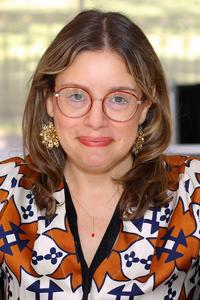
Emma Goldberg is a business features writer for The New York Times. She reports on cultural, societal and economic change.

Sam Freedman leading the course on book writing that he taught for the last time this spring. “This is a big part of my life’s work,” he said.

Ms Goldberg says: “The night before the start of his final semester teaching, after 35 years, Sam Freedman had a dream that he was going to miss class. He woke up with a strange jolt of relief. What comfort, he thought, to know that after three decades he still couldn’t shake his pre-semester agita.

The most difficult work, he has always believed, ought to evoke fear.

“All these years later I’m still anxious the night before, still concerned about getting here at 7:15 in the morning to be ready for all of you,” he said, facing his students on a Monday morning in January, wearing the same dark suit that he purchased in 1989 at Rothmans when he was first starting to teach and realized he needed formal professional attire.

The seminar that Freedman teaches at Columbia Journalism School began in 1991 as something of an experiment, testing whether students could, in the course of a semester, produce a book proposal to sell and hopefully publish. The results have proved his hunch: The class has led to 113 book contracts and 95 published books, out of some 675 people who have taken it.

This spring Freedman taught the course for the last time. He didn’t want to become one of those fading professors he remembers from college, the types who used laminated notes and made students wish they’d been around to take the class in its glory years. The journalism school does not have plans to continue the class in the same form after his departure.

“The course is an institution in itself and you could almost say that about Sam — his retirement is certainly the end of an era,” said Jelani Cobb, the dean of Columbia Journalism School, who regularly meets with Freedman at an Upper West Side diner to trade ideas about books and teaching.

Freedman began his career as a reporter at the Courier-News in Bridgewater, N.J., and later worked on the culture and metro desks at The New York Times. He went on to write 10 books, including one following a New York City public-school teacher for a year. But he realized, at a certain point, that teaching the book-writing seminar for young journalists was one way of creating something that would outlive him.

“This is a big part of my life’s work,” he told the class on their first day of the semester. “Teaching this class, it feels like it’s OK for me to keel over.”

The day had echoes of a religious induction, as Freedman told his students to be “worthy of the ancestors,” his term for class alumni. He projected onto the whiteboard at the front of the room a photo of his office “shelf of honor,” crammed with most of the 95 books that came out of the class. Midway through that first day, four ancestors came to speak.

“If he believes you have a book in you,” said Grace Williams, the author of a 2024 history of a women-owned bank, glancing around the classroom, “you definitely have a book in you.”

The relationship between books and authors is obvious and glorified, but the relationship between books and teachers is less clear. The teachers behind books are often invisible, not the hand stirring the ladle to make the stew but the hand that once wrote the recipe down on some well-worn index card.

When I wrote a book in 2020, about young doctors graduating from medical school early in the pandemic, I reached out for guidance to Freedman, the father of a childhood friend, because I’d heard about his Columbia course. He shared audio clips and met with me, over Zoom, to explain his approach to narrative writing.

What struck me then was the exactitude with which he approached the craft, the lessons he pulled from his own career and then passed around the room: that the reader should never know more than the character, that authors should master methods before trying to subvert them, that narrative is an equation comprised of character, event, place and theme (N = C + E + P + T).

“Nothing in the class is contingent on having a gift, or having the muse speak to you,” said Leah Hager Cohen, who studied with Freedman in 1991, which led her to write Train Go Sorry, about a school for the deaf.

Freedman focuses particularly on demystifying the book proposal, a piece of writing that he likens to the albino alligators which, according to urban legend, once lived in the New York City subways — surviving without exposure to the public world, and therefore evolving to be mysterious and often misunderstood creatures. During the semester, his students draft such proposals. Afterward, he sometimes connects them to agents who he feels might be interested in their reporting topics, though he emphasizes that this won’t always lead to representation.

“He’s been the godfather to an awful lot of publishing over the years,” said George Gibson, the executive editor at Grove Atlantic.

Over the decades that Freedman has taught, the publishing industry has gotten far more corporate. And other mentors who work with aspiring authors noted a recent increase in programs that support young book writers outside of journalism school, which can be costly to attend.

What has stayed consistent, Freedman insists, is the need for an obsessive work ethic, and many of his lectures are paeans to just that.

He emphasizes that there is no such thing as writer’s block, only a failure to have done enough reporting, or an ego that’s getting in the way of putting words on the page. He closes the classroom door at 9 a.m. and those who are late have to wait outside until the first break, at least an hour later. (“Latecomers will be seated at intermission,” read the sign he used to post on the door.) He tracks every grammatical error a student makes, with the expectation it will never be repeated.

Kelly McMasters, who took the class in 2003 and went on to co-teach with Freedman, recalled that when she was his student, he got so fed up with her use of parentheses that he drew her a picture of parentheses, curling up like an old pet near a rug and a bowl of food, and showed it to the whole class. “Your parentheses are fine,” she recalled him saying. “Here’s the rug they can lie down on, here’s their food bowl. You may never use parentheses again.”

“I was so mad and hurt,” McMasters said. “But you know what? He was one hundred percent right.”

If Freedman enters his classroom a bundle of nerves, his students do far more so. One current student, Ally Markovich, 29, was so intent on getting into the class that she flew to Ukraine last summer to begin reporting her book proposal even before she had applied. Another, Carl David Goette-Luciak, 33, made a ritual of meeting his girlfriend for cheap pizza every Monday night so he could share with her the notes he took during Freedman’s lectures. “You can’t go to the bookstore to tell the reader what you meant,” one of them read.

What a great experience to have had a professor like Freedman!

AI-gatha Christie Is a Crime

In response to the article mentioned in my last post about the AI-powered service available from the BBC consisting of digital tutorials by famous writers like Agatha Christie, there is the article below which thoroughly trashes the idea. This article was published on the 3rd of May in the Telegraph and was written by Ruth Dudley Edwards.

Ruth Dudley Edwards (born 24 May 1944) is an Irish Unionist historian and writer, with published work in the fields of history, biography and crime fiction, and a number of awards won. Born in Dublin, Ireland, she has lived in England since 1965, and describes herself as British-Irish. Her revisionist approach to Irish history and her views have sometimes generated controversy or ridicule. She has been a columnist with the Irish Sunday Independent, the Daily Telegraph and Sunday Telegraph, and The News Letter.

Ruth Dudley Edwards

Ms Edwards said, “I try to be positive, so in my frequent Luddite moments I call upon my inner Pollyanna and remind myself of the many blessings of technology. Yet the news that the BBC has added to Maestro, its educational streaming platform, a course of 11 short online videos in which a recreated Agatha Christie tells you how to write crime fiction made me feel appropriately murderous.

Indeed, it’s given me inspiration for another short story deriding and killing publishers. But I won’t be asking AI for help. It’s likely to be the nuclear weapon employed by Big Brother to destroy original thought.

Yes, James Pritchard – who through Agatha Christie Ltd is the custodian of her legacy – has insisted that all writing advice given in 11 videos by his great-grandmother’s recreated voice and face be drawn wholly from her own words.

But after a lifetime of reading crime novels and more than four decades writing them, I think the whole idea of a disembodied voice mouthing the words selected by a team of academics is a horrid and dangerous way to go.

Agatha – which as a fellow member of the Detection Club I feel entitled to call her even though she died 20 years before I was elected – was a genius. She became the world’s best selling author because of her innate gifts when it came to plotting and her rare, unsentimental understanding of human nature and good and evil.

I read all her books in my youth, sneered at her writing in my pretentious years at university and during a bad bout of flu in my early 30s reread her and repented. I imbibed from her and others of her contemporaries like G K Chesterton and Edmund Crispin a love of the genre, especially when humour was added to the pot.

And then, unexpectedly, I was invited to write a crime novel, joined the Crime Writers’ Association and discovered a world of fun and friendship and very varied lives, for our members included cops and ex-convicts, doctors and nurses, musicians, bureaucrats and publicans. We would swap stories of how an episode in our lives had inspired us to have a go at telling a story from an improbable viewpoint. No subject was off-limits.

I’ve had several occupations, including in academia, public service and journalism, and have never come across such a congenial and sociable bunch as crime writers and readers. There’s a humility about them that I love and found rarely among academics and the literati. You couldn’t get from an algorithm or from lectures what I’ve learnt from my lovely, irreverent, self-deprecating and sometimes mad companions in that world.

You learn how to write primarily through reading. I don’t believe it can be taught, though I admit some people benefit from good editing, and there’s nothing wrong with handy hints. Indeed, I was a contributor to the highly entertaining Howdunit – published in honour of the 90th anniversary of the Detection Club – in which 90 of the living and some dead members muse on our trade. We collaborate on books occasionally, our planning meetings are hilarious and we donate the proceeds toward subsidising the next communal dinner.

My passion is free speech, and my blood freezes at the thought of how AI will be used by Big Brother. I bet all the casual racism and other kinds of wrongthink expressed in throwaway lines in the work of Agatha and her generation will not survive the first algorithmic sanitising.

“Who controls the past controls the future; who controls the present controls the past,” Orwell taught us.

AI can see off originality, courage, and truth in no time.”

Are You an Imposter?

Harry Bingham of Jericho Writers sent an email today about how writers are vulnerable to Imposter Syndrome.

Imposter Syndrome

He says: “Writers are hopelessly vulnerable to Impostor Syndrome.

That might be part of our psychological make-up (dreamy, introverted, bookish) – but I don’t think it’s mostly that. Perhaps it isn’t that at all.

If I were a stone-walling guy, I’d drop my tools in the late afternoon and look at my day’s work and think, ‘Yes, I just built that.’

If I were a drainage-contractor or a chimney-sweep, I could count my accomplishment in yards of drain unblocked, or so many vertical feet of chimney cleared. (I once cleaned my own chimneys, then set the house on fire, but it was only a little fire, and the fire brigade came, not once but three times, and the kids were all at home with friends, and got to watch everything, and the firemen let the kids try on their helmets and climb around the fire engine, and everyone had a very nice time.)

And, OK, lots of white-collar jobs can’t be measured by the yard, but there’s still a rhythm of feedback: client meetings, reports, ad campaigns, emails. What’s unusual about the job of novelist is that you have essentially two ways to measure accomplishment, the first of which is phoney and stupid and you know it to be those things. So, novelists can measure accomplishment, via:

  1. Word Counts. Which gives you a sort of feedback, the way a dry stone wall gives you feedback as you build it, but if the words are sh*te, then the feedback is meaningless. And because you know that, you don’t trust the feedback. And because first drafts are first drafty, the words probably are sh*te, so you are right to be suspicious.
  2. Book deals. And yes, a book deal comes with an actual contract, signed by a serious and moneyed counterpart. And there’s money. And there’s the whole hoop-la of publication. So this is serious, meaningful feedback. Same thing with self-pub: you don’t achieve meaningful sales unless your work has been good, so sales is also a metric that matters. But book deals come along once in a blue moon. I mean, if you produce a book a year and work with a standard two-book deal, then you only get confirmation that you’re not an idiot once every two years. That’s a very long time.

So authors get regular meaningless feedback (word counts) and very, very infrequent feedback that matters (book deal, or successful book launch.)

And a lot of what we do involves creating a bad first draft so we can then turn it slowly into a good final draft.

The result? Impostor Syndrome is endemic among writers. It’s endemic among proper published authors too. I know plenty of top 10 bestselling novelists who are pretty much guaranteed to feel like their work is hopeless before they (once again) do what they do and produce an excellent book.

The solution? There ain’t no solution, except to recognise the problem. You will feel that your work is inadequate, because – right now – it is inadequate. And that’s fine. That’s a stage we clamber through to get to adequate and then excellent.

The ladder from rubbish to excellent is editing. It’s self-editing to start with and – even if you’re wise enough to get a professional manuscript assessment – it’s still self-editing after that, because it’s still you that has to choose how to react to your editor’s comments. So. Write, Edit, Publish, Repeat. You may only get meaningful feedback on your output about once a year. That’s just the way it is. Other indicators may not be accurate. You are not an impostor. You’re a writer.”