Famous Books Turned Down by Publishers

There was a column in The Daily Telegraph last month by Charlotte Runcie, who, as far as I can tell, is a poet and freelance journalist.  Her column includes five egregious examples of famous authors whose books were turned down by publishers.

Charlotte_Runcie-small

Charlotte Runcie

Carrie

Stephen King received so many rejection letters for Carrie that he kept them all on a spike in his bedroom.  When it was first published in 1974, it was a runaway success, and the paperback sold more than a million copies in its first year.

Harry Potter and the Philosopher’s Stone

J K Rowling’s first Harry Potter manuscript was snubbed by 12 different publishers.  Eventually, Bloomsbury took a chance on the debut novelist: they offered an advance of £1500 and suggested she get a day job, just in case.

The Spy Who Came in from the Cold

John le Carré’s Cold War classic was brutally rejected by a publisher whose dismissive verdict was that the writer hadn’t ‘got any future’.  Still, it fared better than William Golding’s Lord of the Flies, which was turned down 20 times.

Lolita

This daring novel was rejected by so many American publishers, including one who recommended ‘it be buried under a stone for a thousand years’, that Vladimir Nabokov eventually published it in France – a more enlightened market.

Moby Dick

Herman Melville’s manuscript was dismissed with a despairing note from a publisher who said, ‘First, we must ask, does it have to be a whale?  While this is rather delightful, if somewhat esoteric, plot device, we recommend an antagonist with a more popular visage among the younger readers.  For instance, could not the Captain be struggling with a depravity towards young, perhaps voluptuous maidens?’  The book was eventually published, whale and all, but Melville had to fund the typesetting himself.”

As Andrew Michael Hurley said about the frustrations of writers finding a willing publisher, in a previous post: “So many times you feel like giving up and thinking, this isn’t going to happen.  But it does. It absolutely does.”

Publishing Success

There is a story in The Daily Telegraph last month about how Andrew Michael Hurley achieved success with his first novel, The Loney which won the Costa Prize for the year’s best first novel.  This May, it won the Book of the Year award at the British Book Industry Awards.   Hurley is a former teacher from Preston (northern England).  He self-published two collections of stories before taking up part-time work as a librarian, so that he would have time to work on a novel.  He spent almost four years working on The Loney before showing it to friends and colleagues.

images

Andrew Michael Hurley

The people who read it, he recalls, “Said it was great – but where would it go in bookstores?”  (The novel is set on a wild stretch of northwest English coast, and mixes captivating descriptions of the landscapes with a mixture of the ridiculous and the terrifying.)  The article says, “It follows the activities of a small group of hardline Catholics – the narrator, his developmentally challenged adult brother, his fervently religious parents and two elderly friends – as they mount an expedition to a holy well in the company of their new parish priest.”

Three years ago, Mr Hurley couldn’t find a publisher anywhere.  “He sent it to agents and small publishers, all of whom responded either with silence or with polite notes of refusal.  Eventually, searching the internet for possible publishers, he came across Tartarus, a small press specialising in ‘literary supernatural/strange/horror fiction’ and run from a house in the Yorkshire Dales by the writers Ray Russell and Rosalie Parker.  ‘It was just one of many books when it arrived,’ says Russell.  ‘Ros read it and loved it, but I was slightly sceptical, mainly because over the years we’d had the impression that our customers preferred short story collections.  But as Ros said, the whole idea of Tartarus was to publish books that we liked – and if we liked then, hopefully other people would as well.’

“In London, the sharp-eyed publisher Mark Richards at John Murray read the book and recognised it, he says, as ‘a first novel of extraordinary assuredness.  It felt like the work of someone who had been writing for 40 years.’  He made contact with Hurley and the proprietors of Tartarus and arranged ‘to bring it to the mass market audience that the book could definitely reach.’

“Hurley says, ‘I’m 41 now, so it’s been a long time coming.  I’m very grateful that I can concentrate on doing something that I love more than anything else.  All the rest is just an added – though very welcome – extra. . . . I’m terrible at giving advise on writing,’ he says, ‘but perseverance has to be the key.  So many times you feel like giving up and thinking, this isn’t going to happen.  But it does.  It absolutely does.'”

When Your Book Becomes a Movie: Rewards and Pitfalls

Carol Pinchefsky has an article under the title Wizard Oil on the Intergalactic Medicine Show website about the pros and cons of having your book become a movie. She is a freelance writer of technology, games, and geekery for various publications living in New York.  Extracted below are some of the key points she makes.
index

Carol Pinchefsky

The Lord of the Rings films and the combined Harry Potter films have earned $7.3 billion. Both sets of movies were adapted from books.  Royalties from her adaptations have helped make Harry Potter author J.K. Rowling the second richest woman in entertainment, as well as the richest author in history. This number is higher than the gross domestic product of some small countries, including the Bahamas and Mongolia, enough to keep an author in orchid-scented paper and gold-dusted typewriter ribbon for several lifetimes. Most science fiction and fantasy authors are happy to get by on a fraction of that amount.

“Here’s how it works: a producer or production company ‘options’ a book — that is, buys the rights (typically for several thousand dollars) to adapt the book for a period of time (typically from eighteen months to two years). If the producers have not adapted the book when the agreed-upon the period of time lapses, the rights revert back to the author.  Few books that are optioned are actually produced; some books get optioned more than once. Although most optioned books languish in “development hell,” with promises of big-name stars dangled in front of the author, only to have the project stymied for years on end, sometimes these promises come to life.  . . . For some authors, seeing their books turned into extravagantly funded film is the culmination of a dream.  But is having a book adapted a good experience for the author?

“Financially, yes. The option fee is like free money: thousands of dollars for what amounts to almost no extra work. And if the book gets produced, the author receives royalties–even more free money.  Plus, books adapted for film or television also get an exposure and recognition that other books do not; curious cinephiles often find their ways to original material of a show they’ve enjoyed. This can catapult an author from a position of moderate success into bestsellerdom.

“But adaptation is not without potential hazards: comically bad acting, stupefying dialog, and a complete and utter lack of understanding of the original book have made their way into the cinema and onto the television…all bearing the name of the author.  (This happens with such frequency that fans of a particular book are reluctant to watch adaptations of their favorite books. Even though they would like to share their passion with the world, fans can bitterly resent shoddy or inconsistent portrait.  The author has no recourse, except to divorce him/herself from the production. But by then, her/his name has become linked to a disaster. For some, no amount of money can heal a wounded reputation.

“However, several authors can proudly bear witness to successes, where they’ve sat on set, consulted with the director, and even contributed to the script. More important to them, they have seen the characters and the worlds they’ve created come alive. “I went to visit the set, and my characters are there, only everybody else can see them too,” says Jim Butcher, author of the Dresden Files, now a new series on the SciFi channel.  Butcher’s joy did not end there. ‘I got to be an extra in one of the shots, I get to be one of Butters’ assistants and morgue guys and I help carry out a coffin.’

“Tanya Huff, author of Vicki Nelson Investigates series, says that not only was she treated well by the producers and asked her opinion on casting decisions, ‘I was so incredibly honoured to be asked to write a script for the show.  I’d never written a script…writing for television being very, very different than writing for print.’

“Despite their positive experiences, some authors were not completely unscathed. Although Mike Mignola, author of the Hellboy, was not present during initial talks with producers, he found that part of the process slightly uncomfortable: ‘They’re dissecting and reassembling your child. You don’t want to be in the room for that.’ For Butcher, ‘if anything, the worst thing has been critics. Apparently now that there’s success, the critics feel much more free to whip out the scalpels and go at you to draw blood.’  But those negative experiences pale next to the worst-case scenario that happened to acclaimed author Ursula K. Le Guin.  The adaptation of her Earthsea series had only a passing resemblance to her original material, for example, dark-skinned characters were made white. Le Guin disowned the made-for-TV movie.  ‘Despite lavish ‘promises’ of consultation, I was entirely excluded from the process. Both films were exploitive, using my books merely for the name and some character names and ideas, but arbitrarily changing and ‘stupidifying’ the story,’ says Le Guin.

“Authors find it flattering to know that people with money care enough about their book to spend months of their lives and millions of dollars on it. But this balm to the ego should not replace common sense. The authors whose books have been adapted have advice:

“Butcher says, ‘Make sure you’re working with an agent you can rely on. Make sure you stay in close contact with your agent. Make sure you read all the contracts, because they say things and you think you know what they mean and you don’t.’

“Le Guin says, “When it comes to the actual contract: If they tell you they love your marvelous book and are going to put it straight onto the screen just as it is, if they promise to send you the screenplay and listen to your reactions to it because they know you are greater than Shakespeare, if they give you a fancy title such as Creative Consultant–even if they give you some money to be Creative Consultant–if they tell you they will consult with you on all important points–don’t believe them…. Mostly the rule for the author is ‘Take the money and run.’ And never look back.’

“Huff says, ‘If the process goes off the rails, as sometimes it does, give your readers credit enough to realize that you had nothing to do with it. And if, as in my case, it’s a wonderfully realized extension of your work, smile and say thank you.’

“Authors with a specific vision as to how their works should be portrayed, and are not willing to compromise, should not allow their books to be filmed–no matter how tempting the financial reward (potentially billions of dollars, but more likely in the tens or perhaps hundreds of thousands). Know yourself.  Mignola says, ‘You have to remember film is an entirely different medium…. I think hopefully nobody is so naive that they think their work is going to be preserved as is on screen. And you don’t want them to mess with it, don’t let them have it.’

“But many authors would like to see their books reach a larger audience while concurrently lining their pockets. How does an author get her/his books turned into the next Hollywood blockbuster?  In all cases, my interviewees were approached by a production company, rather than contacting a production company themselves.  Literary agent Joshua A. Bilmes says this is almost always the case. ‘Just about every project that I have sold to Hollywood has been from somebody finding their own way to a property and wanting it.’

“‘You have to contact someone who has contacts in the film industry. There’s not a lot of forums for unsolicited work to get seen by the film industry,’ says Eli Kirschner, who works for Created By, a management company that specializes in adapting popular books into movies.  Kirschner says the best way for an author to get his/her works adapted is ‘getting your books publicized…. If a writer isn’t really well known or doesn’t get an Entertainment Weekly and Publisher’s Weekly review…I’d say that they do kind of have to know someone in the film business.’ Failing that, ‘If an author believes in his work, he can make a trip to LA and get his book in the hands of people who can do something with it,’ says Kirschner.

“Having a novel adapted is an arduous, lengthy process for an author. And for those who create their own universes and tend to work alone, the loss of control can be unsettling.

“But for some authors, the potential rewards outweigh the very real risks. As Huff says, ‘I have had my character, Henry Fitzroy’s, teeth at my throat. It doesn’t get better than that.'”


Publishers Have a Lot to Learn from J K Rowling

Allison Pearson had a column in The Daily Telegraph last Wednesday under the above title.  Ms Pearson is a Welsh author and newspaper columnist. Her novel, I Don’t Know How She Does It, published in 2002, has been made into a movie of the same name  starring Sarah Jessica Parker.   Her second novel, I Think I Love You,  was published in 2010.   A sequel to I Don’t Know How She Does It was announced in 2015.  The column will amuse all of us who struggle to receive a contract from a first line publisher.

index

Allison Pearson

“J K Rowling has shared a rejection letter from a publisher for her first adult crime novel, written under the pseudonym of Robert Galbraith.  The publisher suggests that The Cuckoo’s Calling could not be published ‘with commercial success’, and adds, for good measure, that the author might be helped by a writing course.

“Rowling is to be congratulated for not immediately conjuring a Harry Potter spell, such as Avada Kedavra (Killing Curse) against this dimwit with no literary judgement.  As it happens, I am addicted to Rowling/Galbraith’s novels with their wonderful Caliban-meets-Columbo detective, Cormoran Strike.  The quality, both of writing and observation, is evident from the first page.

“Rejection, alas, is the lot of the new writer.  I am currently judging the Lucy Cavendish College Fiction Prize and am reading the entries with tender  care – so well do I remember the sting of being rejected myself.

“Fourteen years ago, I sent some chapters and a synopsis to a celebrated editor of women’s fiction.  I was quietly confident that the story of a stressed-out working mother would strike a chord.  The editor emailed back and said that the novel was not for her.  Should I seriously wish to become an author, I might like to go away and read a recent novel by one of her writers.  Was I familiar with her work?

“I was, indeed.  Ah, rejection dejection.  The slump lasted a while until I was lucky enough to be snapped up by a couple of brilliant women editors at Chatto and Vintage.  The book they published, the same one rejected by the first editor, was I Don’t Know How She Does It.

“When that novel was number one on Amazon in the Unites States, did I think with quiet satisfaction of the nitwit who had rejected it?  I did, dear reader, I certainly did.  As J K Rowling would probably tell you, revenge is a dish best served cold with an international bestseller.”

Adult Coloring Books

I must live a very sheltered life because until this morning, I never heard of adult coloring books.  If I had to guess, I would have supposed that this was a very minor niche in the publishing business and that it is dedicated to adults with learning disabilities.  To my amazement, it was in part due to the sales of adult coloring books that kept print book publishing out of the red in 2015.  {Print book sales increased in 2015 over 2014, largely due to Big Publishing’s victory over Amazon: it won the right to a larger say in the pricing of ebooks.  As ebook prices increased, readers turned to the print versions.  As a whole, in 2015, the industry experienced a decline in sales (down 4.1% from 5.82 to 5.58 billion dollars)}.

So, adult coloring books are a big thing currently.  Here is what Laura Marsh had to say in an article last December in New Republic:

“In 1962, Barbra Streisand channeled all the emotional turmoil and lyric despair of an abandoned lover into what must be the strangest four minutes of pop music ever written. “Crayons ready?” she croons, “Begin to color me.”  The opening lines of the song, “My Coloring Book,” refer to that year’s fevered interest in coloring books for adults, much like the trend that has taken off recently. “For those who fancy coloring books / As certain people do,” Streisand sings, before asking listeners to fill her sorrowful life with equally sorrowful hues. When the song came out, coloring books for adults permeated pop culture, as Mort Drucker’s JFK Coloring Book spent 14 weeks at the top of the New York Times bestseller list in 1962, and sales of adult coloring books reached $1 million. Today, coloring books are perhaps even more profitable: Johanna Basford’s Secret Garden and Enchanted Forest were the two best-selling books on Amazon in April, responsible for some of the year’s recovery in print sales. (Basford has sold nearly 10 million coloring books since Secret Garden was published in 2013.) But their powerful appeal—enthusiasts say they are a “great way to de-stress” —has very little in common with adult coloring books from the 1960s. Where today’s titles offer consumers a neat package of therapy, escape and nostalgia, 1960s coloring books were both genuinely novel and subversive.

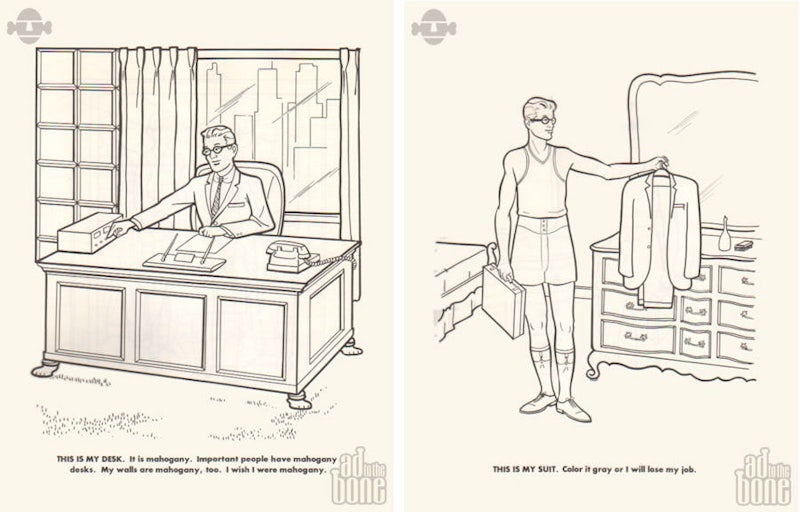
“The first adult coloring book, published in late 1961, mocked the conformism that dominated the post-war corporate workplace. Created by three admen in Chicago, the Executuve Coloring Book showed pictures of a businessman going through each stage in his day, as though teaching a child what daddy does at work. But the captions, which give instructions on how to color the image, are uniformly desolate. “This is my suit. Color it gray or I will lose my job,” reads a caption next to a picture of a man getting dressed for work. Another page shows men in bowler hats boarding their commuter train. “This is my train,” it reads. “It takes me to my office every day. You meet lots of interesting people on the train. Color them all gray.” The rare appearance of a non-gray color is even more disturbing: “This is my pill. It is round. It is pink. It makes me not care.”

From The Executive Coloring Book, 1961.Ad to the Bone

“The coloring books that followed managed to cover, between them, a selection of the decade’s neuroses: national security, the red scare, technology, sex, mental illness. Two popular books took aim at President Kennedy: Drucker’s JFK Coloring Book and Joe B. Nation’s New Frontier Coloring Book. There were coloring books that made fun of communists and coloring books that made fun of people who were scared of communists.  Krushchev’s Top Secret Coloring Book: Your First Red Reader caricatured Soviet leaders and life under communist rule, but was still deemed “objectionable” and banned in the United States Military. Meanwhile, the John Birch Society Coloring Book, which ridiculed conspiracy theorists and extremists, stretched the coloring book concept to its limits with a blank page, captioned: “How many Communists can you find in this picture? I can find 11. It takes practice.” In August 1963, the Washington Post reported on a doctor who proposed using a 12-page coloring booklet “as a diagnostic tool…to classify patients by their types of disorders” from schizophrenia to brain damage. The Post called it the ‘Psychotic’s Coloring Book’.”

Julia Felsenthal writing in the December 2015 issue of Vogue had this to say about more recent interest in adult coloring books:

“But, in spite of the fact that I do on occasion sketch and paint with watercolors, I’ve never once felt moved to pick up a coloring book and go to town. Nor did I imagine that people in my social sphere were doing so. Were those Instagram-famous coloring parties a total anomaly? Or were my other friends also secretly brandishing markers in their spare time?

“I posted the query to Facebook and the response—entirely from women—was surprisingly immediate and enthusiastic. “My aunt-in-law brought coloring books and fancy markers to Thanksgiving and I was all ‘pshhhh, really??’ ” wrote Dean, a designer in Chicago whose funky style I’ve long admired on social media. “Next thing I know, I’m suuuuper chill with a glass of wine, coloring a picture of a flower shop. It’s surprisingly kind of awesome.”

“Other ladies seemed to agree. “I do this,” an old colleague who works in video production admitted with a trace of sheepishness. A writer acquaintance raved about Chat Thérapie, a French, feline-themed coloring book she uses after dinner as a means to avoid screen-induced insomnia. A fashion-school grad explained that coloring-book patterns help her dream up jewelry designs. A mom of two avowed that the hobby keeps her sane. A friend in Austin described how coloring books have begun to appear at packed house parties, psychedelic concerts, and on camping trips. Another friend, a therapist, agreed with Beck that they’re best enjoyed while bingeing on TV.”

OK.  I get it.  But I don’t think I’ll enter the market any time soon.

Payments to Authors

There was an interesting article in The Daily Telegraph two days ago about the payments authors receive from the publishers of e-books, as follows:

“Professional writers could become and ‘endangered species’ unless publishers start paying them properly for e-books, the Society of Authors has warned.  The society said lovers of literature would soon be left with less and less quality content.  In an open letter to publishers, the society called on executives to treat authors more fairly, drawing up less punishing contracts and paying them more.  Research has shown that the median income of British authors is £11,000, which the society argues is far below the ‘level deemed necessary for a socially acceptable living standard’.  Nicola Solomon, the society’s chief executive said: ‘Unless publishers treat their authors more equitably, the decline in the number of full-time writers could have serious implications for the breadth and quality of content that drives the economic success and cultural reputation of our creative industries’.  The society calls on publishers to give authors ‘at least 50%’ of revenue from their e-books, as opposed to a ‘mere 25%’, and not to ‘discriminate’ against writers who do not have powerful agents.”

If I look at the 100 Kindle edition paid best sellers on Amazon, the top price is $14.99 (3 books), and the cheapest books were $0.99 (20 books).  There is another list of the 100 Kindle edition free best sellers.  The books selling at very low prices are there because their authors are trying to promote them into best sellers.  This way the author gets ‘fame’ if not fortune.  But if one looks at the best authors, the prices seem to start at $8.99.  There are five J K Rowling books for sale at $8.99.  So, it’s fair to note that authors have some control over the price at which their books are sold as e-books, and, presumably, also some control over their level of royalties.

The problem, it seems to me, is for the relatively unknown author who is trying to make a living from writing good, serious literature.  Let’s say s/he can persuade the publisher to sell his/her e-book at $6.99, with a 25% commission.  If so, s/he will earn $1.75 a copy, and to make £11,000 per year,  s/he has to sell 9,400 copies per year.  This will put his/her book on somebody’s best seller list.  The point is that it is very difficult for a good, serious writer to make a living selling e-books, unless s/he has a best seller.  So, I think the Society of Authors has a point.

What can be done by whom?  I think it’s pretty unlikely that the publishers will all agree to raise their prices enough to give their authors 50% of the price.  They’ll be afraid of losing volume.  Besides, there’s plenty of margin for the publisher in an $8.99 e-book.  Production costs are far less than a dollar, so their major expenses are corporate overheads, author royalties, and advertising, over which they have control.  It’s even less likely that an ‘author’s union’ will be able to force through price increases.

But I think that once an author and a publisher have reached a basic deal to publish hard copies, there’s room for negotiation on the price of the e-book.  This negotiation would recognise the author’s per copy royalty on hard copies, the publishers costs, volume assumptions, and the sensible price differential between hard copies and e-copies from a user’s point of view.  For example, if the hard copy is selling for $17.50, and a Kindle fanatic wants the book, why wouldn’t s/he pay $12 for it, so that the author gets $4 per copy and the publisher gets $8?

Authors Prohibited from Writing Blurbs

Brooke Warner, of hybrid publisher She Writes Press, recently posted a blog on the HuffPost Books US website in which she was very critical of traditional publishers.  What happened was that a traditionally published author agreed to write a blurb for a book that was to be published by She Writes Press.  The author checked with her editor at one of the big five publishing houses and the blurb was pulled.

untitled

Brooke Warner

The reason for the decision is that there is a difference in ‘values’ between traditional publishers and other publishers: traditional publishers believe that “publishers should invest in authors, but authors should not invest in themselves”.

My reaction: this makes no sense at all!  Why should authors be prohibited from investing in themselves?

Ms Warner said: “What should matter about a book is how well written it is–not the author platform or brand or how many followers a would-be author has. And yet, from a business perspective, of course it makes sense that this is what publishers today must focus on–or risk decimation. I left traditional publishing after a particularly symbolic experience, when I was actively discouraged from acquiring a book I believed in wholeheartedly but then met with excessive enthusiasm (and a large advance to back it) for a proposal propelled by a fancy agent, celebrity endorsements, and a whole lotta hot air. It wasn’t cannon fodder, and it ended up doing well for the company, but I’d compromised. I left three months later.”

She continues: “If you are asked to blurb a book, what should matter is whether you believe in it. If you don’t, you don’t blurb it. If you care enough about the author or the book, you offer your endorsement. End of story. It’s your choice. A blurb is a gift to the author. Authors do not pay for blurbs. They work hard to get them because the industry tells authors that they matter, that they sell books. She Writes Press authors have scored amazing blurbs–blurbs from New York Times best-selling authors and champions of people’s dreams. A publishing company, in my opinion, does not have the right to mandate whom its authors advocate in an attempt to control its reputation or to distance itself from “the other.” To do so smacks of elitism, one of traditional publishing’s lasting and detrimental flaws. We’ve already arrived at a place where people judge books on the writing, not on how those books make it into the marketplace. It’s time for traditional publishing to catch up, to pull its head out of the sand. That it’s lost sight of publishing’s mandate–to champion good books–speaks to its values. And those are values I certainly don’t share.”

Ms Warner – she was apparently quite angry when she wrote the blog – then mentioned a specific example of the ‘values’ of the big five: “Simon & Schuster has a self-publishing imprint called Archway, run by Author Solutions (of very questionable ethics who’ve been sued by authors and whose track record you can Google), which, awkwardly and oddly, is owned by Random House/Penguin. (Apparently Simon & Schuster has no qualms about the self-publishing arm of their business being owned by their biggest and direct traditional competitor.) One of the great promises of Archway is that you might get published by Simon & Schuster–if your book sells well enough. But their traditionally published authors apparently can’t and won’t blurb you. So there you go–you’re the pissed-upon little sibling. They happily run a self-publishing imprint, but they do whatever they can to distance that “subset” from the preferred children.

The war between the traditional press and the ‘upstarts’ is heating up!

The Guilty Secretes of E-book Readers

There was an article in The Daily Telegraph last week which reported on the popularity of titles of e-books vs titles of physical books.

“A newly published list of Amazon.co.uk’s biggest selling e-books of the year features psychological thrillers, misery memoirs, Mills and Boon and a book by the Tory MP Nadine Dorries, whose first work was memorably described by a Telegraph reviewer as “the worst novel I’ve read in 10 years”.  Notably, 18 of the top 20 authors were women, including thriller writers Angela Marsons, Fiona Neill and Rachel Abbott.

“However a parallel list  of physical books compiled by Waterstones to cover the same period is significantly more highbrow, and features four times as many male authors.  They include Richard Flanagan, author of the Man-Booker Prize-winning The Narrows Road to the Deep North, and Anthony Doerr, with his All the Light We Cannot See.  There were also books by Colm Toibin, Ian McEwan and Victoria Hislop.  The print list is topped by Harper Lee’s Go Set a Watchman, which does not make the Amazon e-books list.

“There is some overlap.  Paula Hawkin’s runaway bestseller The Girl on the Train, and the latest risqué offering form E L James appear in the top three of both lists. But the disparity between the books we put on show and those we download suggests that e-book reads can be ‘guilty pleasures’.

“Benedict Page of The Bookseller said: ‘There are certain kinds of books that people like to own.  If they have a favourite heavyweight literary author who they have followed for many years, they are likely to want to possess the printed book because it’s beautiful and durable and represents a readerly commitment.'”

I think that Page’s analysis is probably correct in that we tend to regard e-books as disposable, and printed books something to be retained. The high proportion of female writers on the e-book list is interesting.  My theory would be that at least some of the female authors on the e-book list write primarily for women, and are more interested in achieving volume than literary recognition.  I’m also guessing that more women than men own e-book readers.  These two theories seem to converge on the supply and demand sides.

What’s your view?

Review: Writing with the Master

This is the true story of a retired businessman who’s been writing novels and having them rejected by publishers/agents.  The businessman’s friend John Grisham (the best-selling author) offers to coach him in the writing of a new novel. The book sets out, in detail, all of the coaching provided over two years.

511C2LhqQFL__UX250_imagesT0ZHRO92

Tony Vanderwarker                               John Grisham

Tony Vanderwarker is a retired advertising executive who had his own, very successful, ad agency, sold it and moved from Chicago to Charlottesville, Virginia with his family.  John Grisham, also a Charlottesville resident, is a friend of Tony’s, and one day, over lunch, John offers to ‘mentor’ Tony in writing a new novel.  Grisham had previously referred one of Tony’s works to an agent whose review was positive, but not quite good enough to be published.

The process started with John asking Tony what he wanted to write about.  Tony’s first two ideas were rejected out of hand.  His third idea was a thriller about nuclear weapons lost by the US Air Force in air crashes where the weapon was not recovered.  There are nearly a dozen such weapons, dating back to the 1950’s.  Tony prepared a three sentence description of the plot and then a full, multi-page outline.  At each stage we see portions of what Tony has written and John’s written critiques.  The critiques are blunt and to the point.  After three and a half months of trial and error, Tony revises his plot outline, and is ready to start chapter outlines.  During this process, we see a reflection of the way John Grisham writes his novels.  First, a one paragraph outline: is it interesting enough, strong enough?  Then the three page outline, complete with characters: do the subplots support the main plot or are they extraneous?  Are the events credible?  Are the characters interesting and likeable?  Then comes the first draft of the manuscript.  In Tony’s case, John tears into the manuscript and points out a number of problems:

  • the writing is sloppy: there are repeated words and phrases and factual inconsistencies.
  • there are too many distractions to the basic plot
  • the actions of a key character don’t make sense
  • too many bad guys
  • minor character isn’t fully credible
  • inserting the author’s political views into the story
  • make the dialogue real: repeat it out loud.
  • Show! Don’t Tell!

Tony is absolutely gutted by this critique!  He turns his attention to the notes John has written on individual pages of the manuscript.  Here, again, we see the text and the comment.  Tony divides the manuscript into seven piles and begins the task of rewriting, which takes a year.  Once again Grisham responds with a cover letter describing his principal concerns and returns the manuscript with page-by-page comments, including:

  • too many detours; too much backfilling
  • don’t be afraid to cut
  • not allowing the suspense to build

Tony makes the suggested changes and submits the manuscript to John’s agent, who likes it and refers it to another agent because it doesn’t fit for him.  The agent to whom it is referred is very complimentary but declines. Tony goes back to the default mode of mass submissions, without success.

When Tony has essentially given up on getting his novel published, he gets a great idea.  Why not write a book about the process that he and John Grisham have been through.  Grisham agrees, and the book is published by Skyhorse Publishing, who also agree to publish the mentored novel: Sleeping Dogs.

For anyone who is interested in the process of writing fiction, this book is a must read.  And for those with only a passing interest in the creative effort, there is enough of the rest of Tony’s life fitted neatly in to make to book a good read: his life as an advertising executive, his work for an environmental charity, his relationship with his wife and the Charlottesville area.

Personally, I’m not surprised that Sleeping Dogs didn’t get published on the first attempt.  From my point of view, there’s too much that stretches credibility.  But, I’m not surprised that Skyhorse decided to take it up.  Writing with the Master is a great promotion for Sleeping Dogs.

As for John Grisham’s advice, I think that ninety percent is spot on.  Two quibbles: I believe in outlining, but not to the extent that John does.  I think that detailed outlines can stifle creativity, and I notice that Tony has reached a similar conclusion.  There’s not much in John’s advice about the use of creative language, which I think is important to differentiate the writer and his/her text from the mundane.

Tony writes well, and I’m glad that he decided to follow-up on his brainstorm: why not write a book about the mentoring process?

Dealing with Pirates

The July issue of IBPA Independent magazine has an article entitled “My Battle with Pirates” by Rhonda Rees.

untitled

Rhonda Rees

The article begins:

Late one evening, shortly after I had self-published Profit and Profit with Public Relations: Insider Secrets to Make You a Success, I decided to run a Google search for it – and there it was, staring me right in the face.  My book, along with hundreds of others, was being given away free with the simple click of a button.  By the time I had discovered this, one website had already given away 600 copies of my book, and another one, which had the nerve to say that it had my blessing, had given away 1,500 copies.  As you can imagine, I was shocked.  And as I now know, you may find yourself in this very same unwanted position.  Any book can be pirated online.  It’s not just the famous writers and recording artists who are being ripped off.  Even the fact that I trademarked and registered my title here in the United States didn’t keep my book safe, since many pirates are located overseas.

I decided to take her advice and run a Google search: “<title of book> free download”.  Three of my six novels produced results of commercial websites that had my copyright material on them.  Two of the three promise “free downloads”.  All three referred me to the website http://www.donnaplay.com, where I had to register to be eligible for the free downloads.  It turned out that I had to provide my credit card information, because after a five day free trial, there is a monthly fee.  So the downloads aren’t really free.

The two websites that initially came up promising free downloads had contact forms where I could request that the page be deleted from their site.  The third had a similar request form, but it was not live, and the telephone and email information was obviously false.

So what does Ms Rees recommend?

  • Run a Whois search to find information such as who owns the domain names, where and when they were registered, and when they expire.
  • Send out emails to find out what company is hosting the site so that a DMCA (Digital Millennium Copyright Act) notice can be sent out.  The notice has to be correctly worded and DMCA.com can help with that task.  There is also a free sample DMCA letter posted by Gene Quinn, a patent attorney and the founder of IPWatchdog.com (ipwatchdog.com/2009/07/06/sample-dmca-take-down-letter/id-4501)
  • Send the DMCA takedown notice by email to the web hosting company which is obligated to notify its clients (the culprits) within 24 hours to have them remove all the information.

I, also, was rather shocked that half of my novels are being pirated.  I think my next step will be to get my publisher involved with http://www.donnaplay.com.  If that illegal site has three of my novels, they must have at least one hundred of the publishers other titles.

I’ll keep you posted!