Review: The Bestseller Code

I mentioned The Best Seller Code in my recent post of August 4th, where I commented on a review by Sandra Elliot for The Florida Writer.  Now, having read the book, I can give you my own reactions.

First, let me say that it is a ‘must read’ for aspiring novelists, not because it reveals all the secrets of creating a bestseller (which it doesn’t), but because it will give you insights into your own writing’s weaker points.  (Assuming that there are a few.)

One aspect of the book that I found frustrating at the outset was that there was no discussion about how the ‘almost five thousand ‘ novels which were read by computer were selected.  Five hundred to these (10%) were best sellers.  Presumably all genres were represented, but in what sort of distribution?  Equal balance of male and female writers?  How about the age and background of the authors?  (There are comments on the back grounds of best-selling authors.)  What about the authors’ nationalities?  (Although all are presumably English-speaking.)  There was no mention of the age distribution of the novels, although all of the bestsellers mentioned are recent novels.  To what extent do readers’ tastes change over time?  How about the type of publisher (traditional vs indie) and the marketing budget?

There are a number of examples of the characteristics of books which tend to make them best sellers, or not, and these, of course are helpful.  But the authors admit that their computer model is only 80% accurate in predicting whether a novel will be a bestseller.  The methodology of the authors’ research used three different mapping algorithms to compare hundreds of dimensions in ‘space’.  One dimension, for example, is the use of the word ‘very’.  It turns our that authors who use ‘very’ frequently in their text are less likely to produce bestsellers.  Particular dimensions may be quite influential in predicting bestsellers.  An example is ‘human closeness’.  The computer reads the text looking for words and arrangement of words which mean that the author is writing about human closeness.  It turns out that Fifty Shades of Grey was not a best seller because of its sexual content, but because of its human closeness.

The computer was 71% accurate in identifying the gender of the author.  Three genres that have difficulty achieving bestseller status are romance, science fiction and fantasy.

Some of the dimensions which contribute to good public acceptance include: emotional cycles; active, rather than passive characters; characters who need rather than wish for; author’s distinctive style (J K Rowling’s first incognito novel was recognised not by its subject but by her style).

Topics that readers like include: marriage, death, taxes (really), modern technology, funerals, guns, school, work, doctors, presidents, kids, moms, and the media.  Less popular subjects are: sex (except in a small erotic genre), big emotions, wheeling and dealing, existential or philosophical sojourns, dinner parties.

For me, the chapter on style was particularly interesting as it included a number of specific examples and commentary on why a particular style is effective.  I also believe that I need to work harder at bringing life to what my characters are feeling in subtle but effective ways.

Having said all this, I think it’s important to keep one vital point in perspective.  There are many award-winning novels which are clearly labours of love by their authors, memorable for their readers, and which never make the bestseller list.


Publishing Industry Standard

Angela Bole, CEO of the Independent Book Publishing Association, has introduced an Industry Standard for a Professionally Published Book in the July issue of  IBPA Independent magazine.

Angela Bole

In the article, she says: “IBPA has been championing independent publishers, big and small, self and otherwise, since 1983.  That’s over 30 years of advocating for indie voices in the traditional publishing industry.  Over this time, we’ve seen a thing or two.

“Recent changes in the publishing industry have created enormous opportunities for self-published authors.  It’s now possible to produce a professional-quality book outside of the Big Five conglomerates.  Unfortunately, this opportunity has come at the cost of a deepening divide between how traditionally-published and self-published authors are treated.  Too often, IBPA has noticed a bias against self-published authors, independent publishers and hybrid presses when it comes to choosing titles or authors for review consideration, book award contests, association memberships, and inclusion of independent bookstore shelves.

“There is no reason for this bias.  While it is true that not all books are created equal, when they are, it’s important that the industry treats them as such.  That’s why the IBPA’s Advocacy Committee recently published an Industry Standard for a Professionally Published Book – a two-page document developed to support independent publishers and self-published authors, but also to urge an industry in flux to acknowledge that books ought to be judged on their substance ranter than their business model.  If used appropriately, the checklist gives both authors and book industry professionals an at-a-glance method by which to gauge the professional presentation of a book.  The goal is that the checklist becomes a future guide that reviewers, contests, membership associations and bookstores turn to when deciding which authors merit consideration.

“You can download the checklist at: ibpa-online.org/standardschecklist .

“During BookExpo last June, I had the privilege of discussing the checklist with other industry organisations.  I met with the American Booksellers Association, the Authors Guild, Publishers Weekly, Foreword Reviews and many more.  I’m glad to say that the reception was warm.  Those industry professionals paying attention know they’re missing quality books be using gatekeeping tactics attached to business models; they just haven’t figured out how to consider books without opening the floodgate to unprofessionally produced content, as well.  They seemed to appreciate that the checklist is a needed first step toward figuring this all out.

“Today’s independent publishers and self-published authors represent a diverse array of voices and backgrounds, often speaking about specialised issues that are marginalised by larger presses, often because their books are being judged on the business model and not on what matters, which is the content of the books.  Just as publishers, self, or otherwise, are responsible for producing books that adhere to industry standards, the book industry as a whole is responsible for creating an environment that allows for equal evaluation of all published works.”

Amen!

Is Amazon Helping Pirates ?

Angela Bole, chief executive officer, Independent Book Publisher’s Association, implies as much in the lead article of the June issue of the IBPA Independent magazine.  She takes issue with Amazon’s change in policy on its book buy box.

Amazon’s Buy Box

This is the method which Amazon has used in the past to say that the book in question is new and is supplied by the publisher.  Now, Amazon is offering a priority spot in the buy box the third party suppliers who offer the same book as new, but at a price significantly below the publisher’s list and Amazon’s Prime price.

For example, a hard cover version of The Bestseller Code has a publishers list of $25.99.  Amazon is offering it at $14.29 Prime.  There are eight third-party sellers offering the book at prices lower than Amazon’s.  The worry, of course, is that publishers and authors are not receiving their due compensation on these cheap books.

In the article, Ms Bole asks: “Where might these third-party sellers be getting the books that they sell that don’t result in any author compensation?  Any number of ways, including donated books, closeout sales, sidewalk sellers, remainder and overstock dealers, ‘hurts’ from distributor stock, promo copies and ARC’s” (advanced reader copies –  f0r reviewers).  An Amazon spokesperson wrote to Publishers Weekly to say that books obtained in one of the preceding ways wouldn’t qualify, because the books must be ‘new”.  Amazon defines ‘new’ as ‘brand-new, unused, unread copy in perfect condition.  The dust cover and original protective wrapping, if any, is intact’.

“The problem is that Amazon does nothing to enforce the ‘new’ policy.”  The third-party seller gets to declare that the book is ‘new’ by simply choosing the ‘new’ option. . . . .

“Karla Olson, director of Pantagonia Books, said, ‘We received a comment on one of our books that it was riddled with typos, and the captions were all the same for the second half of the book.  It took us a few reads to figure out that the customer had bought an ARC, from Amazon. . . .

“And Cynthia Frank, president at Cypress House pointed out another problem. ‘We’ve learned that some of the third-party sellers who have won our Buy Boxes are actually fly-by-night sellers who have only been in the business a few months.  Some likely don’t have even a single copy.  On various listservs and forums, including LinkedIn, I’ve read that some customers pay for a book, but it never arrives.  Amazon, because they take good care of their customers (as opposed to their vendors), ends up holding the bag and has to pay a refund.”

“According to Ian Lamont, founder at 130 Media, in a written statement, ‘Even before the policy change, there were several recent cases of counterfeit paperbacks being co-mingled with legitimate inventory at an Amazon warehouse (as reported by No Starch Press) and taking over the Buy Box (which happened to Author Dave Burgess).  Knock-offs taking over the Buy Box has been a massive issue for manufacturers for several years (as reported by Forbes).  And it’s clear that Amazon can’t control this new policy if they can’t solve the counterfeit problem.'”

Why would Amazon want to introduce a policy like this?  I don’t know, but I suspect that it is driven by Amazon’s commitment to offering goods at the lowest possible price.  What Amazon has apparently failed to consider is that the goods are different at the lowest price from the ‘same’ goods at the more reasonable price.  They have also failed to consider the interests of the people who try to earn a living from the goods Amazon sells.

If you would like to reach a wider audience with your comments, you may want to add a comment on the IPBA website:

http://www.ibpa-online.org/news/349854/An-Amazon-Buy-Button-Call-to-Action.htm


Review: The Rover

My blog of April 17, Review: Today, concerned a novel by David Miller on the death of Joseph Conrad.  Since I had never read any of Conrad’s work, I bought Selected Short Stories and The Rover, by Conrad.  As well as The Rover.  the book includes eleven of Conrad’s twenty-six short stories, selected and commented on by Dr Keith Carabine of the University of Kent.  In his introduction to the stories, Dr Carabine says that Conrad’s great distinction “lies in his ingenious and rigorous exploration of the undiscovered possibilities latent in one of the genre’s most familiar forms, namely the framed short story in which a first-person narrator (who is sometimes a member of the group) introduces, comments on and encloses another’s tale.”  As Dr Carabine says, the theme of most of the stories is man’s fate, and they are often “teasing and enigmatic”.  The framed construction of these stories introduces uncertainty in that the main narrator and the teller of the tale may have different interpretations of the events, leaving the reader to draw his own conclusions.

Two other general points I would make about Conrad’s writing.  First, he does not take great pains to capture the interest and attention of the reader at the beginning of a story.  The beginning may be a page of detailed description of the opening scene, with little information about the character who is present, and a considerable, almost poetic word picture of the setting.  In fact, Conrad’s word pictures of scenes are remarkable in their shaping of the mood of the story: mysterious, uncertain, uncommon, unusual.  Moreover, Conrad is lavish in the extent of his descriptions throughout a piece.  Some of this may be attributable to his writing for commercial publication in up-market magazines, where his compensation would be based, at least partially, on the word count.  Each of these stories has at least one principal character who is confronted with some sort of existential challenge and has defects in his character which contribute to his downfall.  Nonetheless, the reader is drawn into his predicament, hoping all the while, that the right solution will be found.

The principal character in The Rover, which is set in the immediate aftermath of the French Revolution, is an ageing, sea-faring, privateer who has come ashore in the south of France to take his ease.  There is also a dim-witted and committed old revolutionary, a young woman who has been psychologically damaged be the horrors of the revolution, a royalist French naval officer, and an aspiring young British naval officer, each of whom seeks his/her own solutions in the world. Who will succeed?  The ingredients in the story include a plan to deceive the British fleet, as well as a search for love, and a re-ordering of the world between revolutionary-royalist lines, and a rough but beautiful Mediterranean sea coast backed up against a traditional rural society.

One comes to have sympathy for the dilemmas of each of the flawed but real characters, and one can sense the tensions between them, as well as having a sensation of being on the rough bucolic scene, or on board one of the ships.  The Rover is an engrossing tale.  The one aspect which I found annoying was the slow pace of the conclusion.  One cold feel it coming, but Conrad was in no hurry to jump into it.  There was much detailed scene setting and character back-story telling.  We were familiar with the scenes, and the character enhancements should – I think – have come earlier.  Nonetheless, The Rover is a satisfying and interesting tale.

Backwards Books

Qualifying for an obscure facts about books award, is an article in The Daily Telegraph with the title ‘How Book Lovers Turned Things Around’ by Anita Singh.  Appearing on 19/4/17, it said:

“If you want to display books on shelves the traditional way, try turning your books back to front.  Placing books on shelves with the spines facing outwards is a relatively recent phenomenon, according to Mark Purcell, former libraries curator for the National Trust who now oversees the research collections at Cambridge University Library.

Mark Purcell

“‘Until fashions changed in the 18th century, book titles and authors were not printed on the spine but written in ink on the edge of pages.  The turnaround happened when the wealthy decided having titles embossed in gold leaf would add a certain cachet.  If you’d gone to almost any library in England, Wales or Scotland until 300 years ago the books were kept backwards,’ Purcell said at the Hay Festival.  ‘In those days the cultural supposition was that books had the title printed on the edges of the pages in ink.’

“The first known English book with a title gilded on the spine was printed in 1604, he said, and that was considered ‘cutting edge’.  Then followed, in the 17th and 18th centuries, what historians call ‘the great turnaround’, where the method of display was reversed.”

I suspect that a change in binding technology may also have been partially responsible for this change.  It may have simply been more difficult to print the author’s name and the title of the book on spine of the book.  But, judging by the picture above, it is easy to see why book owners preferred to display their possessions with the title and author’s name on the spine.


The new ‘Parthenon of Books’

There is an article in Architectural Digest, posted on July 11 by Nick Mafi , the title  – 100,000 Banned Books Have Been Formed into a ‘Parthenon of Books –  of which caught my eye.

“In the 1930s and 1940s, the Nazis banned books that were written by authors who were of Jewish descent, or had pacifist or communist sympathies.  The list included such luminaries as Marcel Proust, Ernest Hemingway, and Jack London.  Now, some eight decades later, a monument is being constructed in honour of these censored books.

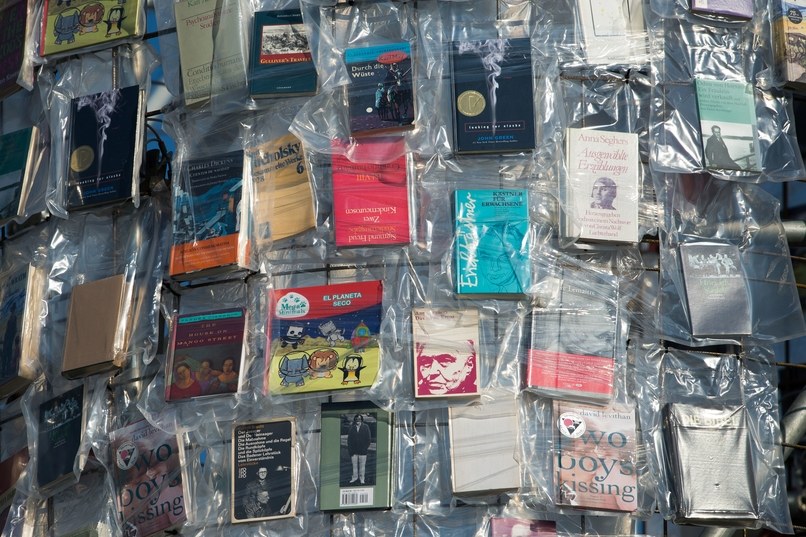
Argentine artist Marta Minujín has created a full-scale replica of one of the world’s most famous structures, the Parthenon in Athens, constructed entirely from censored books. The symbolism is striking, as the Parthenon is the very antithesis of political repression. Indeed, the artist went on to add in a statement that the original Parthenon is “the aesthetic and political ideals of the world’s first democracy.”

The display is part of the Documenta 14 art festival in Kassel, Germany. Now in its 14th iteration, the Documenta was first established in 1955 an attempt to bring Germany up to speed with modern art, after the horrific years of Nazism. For the current exhibition, Minujín created the structure by sourcing 100,000 donated books from around the world. The novels were then secured to the steel structure with plastic sheeting, protecting them from the natural elements while allowing sunlight to filter through the building. The site of the exhibition is noteworthy as well, as the city of Kassel (located in central Germany) was where several thousand books were burned during the Nazi-led campaign to rid the country of books deemed un-German.

The temporary exhibition will run through September 17, 2017. When it ends, the books will be taken down and recirculated around the world.”

Pretty cool, don’t you think?

Review: My Name is Lucy Barton

A friend of my wife’s gave me this book to read with assurances that I would certainly enjoy it.  One night, when I was about half way through the book, there was an interview of the author, Elizabeth Strout, by George Alagiah on the BBC World News channel.  The interview was recorded at the last Hay Festival.  I warmed to Ms Strout – in part – because two nights previously there was another interview from Hay of a poet, whose name I don’t recall, and whom I found unintelligible.  In her interview at the Hay festival,  Ms Strout said that her writing is shaped by the ordinary people she knew in Maine.

Elizabeth Strout was born in 1956 in Portland, Maine,  She attended Bates College and the University of Syracuse.  She waitressed before writing her first novel, Amy and Isabelle (1998). Her debut was met with widespread critical acclaim, became a national bestseller, and was adapted into a movie.  She has since written five novels, My Name is Lucy Barton  being her fifth.  Her third book, Oliver Kitteridge, was published in 2008. The book features a collection of connected short stories about a woman and her immediate family and friends on the coast of Maine.  It won the Pulitzer Prize for fiction.   Louisa Thomas of the New York Times said: “The pleasure in reading Olive Kitteridge comes from an intense identification with complicated, not always admirable, characters. And there are moments in which slipping into a character’s viewpoint seems to involve the revelation of an emotion more powerful and interesting than simple fellow feeling—a complex, sometimes dark, sometimes life-sustaining dependency on others. There’s nothing mawkish or cheap here. There’s simply the honest recognition that we need to try to understand people, even if we can’t stand them.”

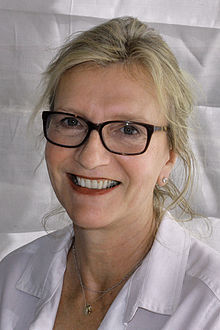
Elizabeth Strout

My Name is Lucy Barton is centered on the unexpected interaction between Lucy Barton, who is in hospital suffering from complications following surgery, and her estranged mother, who has flown east to be with her.  Throughout the book, Lucy has recollections about her childhood in rural Illinois with an impoverished family: distant father and mother, a sister and brother.  Lucy, herself, has gained an education, a marriage, two small daughters, and a career as a writer in New York City, thus estranging herself from her family.  The dialogue between the two women is both limited in the sense that there are unspoken words, and informative in revealing something of their respective characters.  Ms Strout strikes this balance in her writing very well.  She also uses the descriptive recollections of people of the past to elucidate some of the values of the principal characters.  She uses unique voices which shed light on the characters, and her writing style flows simply.  Characterisation is clearly Ms Strout’s strength.

My Name is Lucy Barton is, at 188 pages, short enough to be considered a novella, rather than a novel.  For me, while the writing flows beautifully and the characters are very much alive and their circumstances unique, what was missing was how and why the current circumstances arose.  Why, for example, did Lucy’s father lock her in his pickup for hours – on one occasion with a large brown snake?  We are told that is was a frequent occurrence, but we don’t know why, and knowing why and how it came about would shed further light on the characters.  All of the characters are certainly interesting, but I feel like a hungry diner who was served only an appetizer.

“Writers Are Wrong to Make Historical Women Strong”

This is the title of an article by Hannah Furness, arts correspondent for The Daily Telegraph, on 1 June 2017.  The quotation is from Dame Hillary Mantel speaking in the second of her five Reith Lectures at the Middle Temple in London.

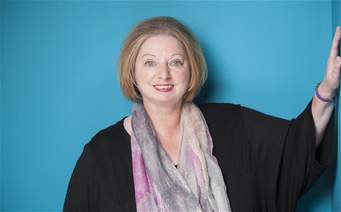
Hilary Mantel

The article said: “Women writers must stop rewriting history to make their female characters falsely ’empowered’, Dame Hilary Mantel has said.  Dame Hilary, the Man Booker Prize winning novelist, said writing about women in history has ‘persistent difficulties’ for her contemporaries who ‘can’t resist’ retrospectively making them strong and independent.  Anyone ‘squeamish’ about the difference in male and female roles in certain historic periods should, she suggested, try a different job.  Dame Hilary, author of Wolf Hall, singled out her own gender for criticism, questioning whether writers should ‘rework history so victims are the winners’.  She said, ‘Many writers of historical fiction feel drawn to the untold tale.  They want to give a voice to those who have been silenced.  Fiction can do that, because it concentrates on what is not on the record.  But we must be careful when we speak for others.  If we write about the victims of history, are we reinforcing their status by detailing it? Or shall we rework history so victims are the winners?  This is a persistent difficulty for women writers, who want to write about women in the past, but can’t resist retrospectively empowering them.  Which is false.  If you are squeamish – if you are affronted by difference – then you should try some other trade.  She added, ‘A good novelist will have her characters operate within the framework of their day – even if it shocks her readers.’

“Dame Hilary did not single out any particular author, but Philippa Gregory, who has written best sellers including The Other Boleyn Girl and The White Queen, has been praised for her strong characters.  Gregory has previously said: ‘The more research I do, the more I think there is an untold history of women.'”

The article goes on: “A ‘feminist ideology’ could have the unintended consequence of making endings too predictable because the woman would always come out on top, warns Gerard Lee, who co-wrote Top of the Lake (a BBC2 crime serial).  Fellow writer and Palme d’Or winner Jane Campion called his view ‘complete rubbish’.  She said film could change for the better overnight if 50% pf all public funding went to female filmmakers.”

My view is that Dame Hilary has a point: women in Tudor England had very little power or voice over their own affairs.  I haven’t read Philippa Gregory’s novels yet, but I think that giving a real female character, in a historical novel, more voice and power than she actually had is simply misleading.

As to the Lee-Campion disagreement, it’s not clear to me that strong female characters make an ending too predictable, but maybe Mr Lee means something more that strong female characters when he speaks of ‘feminist ideology’.  Ms Campion’s remark strikes me as self-serving, and I would ask her ‘in what way would films be so much better if they were made by females?’  She might be right, but what is the evidence?

Review: Song of Solomon

A couple of months ago, in this blog, there was a post about the 100 greatest novels, and how many of them had been read by the average reader.  In order to improve my score, I said I would read Song of Solomon, by Toni Morrison.  I’m very glad I volunteered: it’s a wonderful novel.

Toni Morrison

Wikipedia says this about Toni Morrison: “(born Chloe Ardelia Wofford; February 18, 1931) is an American novelist, editor, teacher, and Professor Emeritus at Princeton University.  Morrison won the Pulitzer Prize and the American Book Award in 1988 for Beloved. The novel was adapted into a film of the same name (starring Oprah Winfrey and Danny Glover) in 1998. Morrison was awarded the Nobel Prize in Literature in 1993. In 1996, the National Endowment for the Humanities selected her for the Jefferson Lecture, the U.S. federal government’s highest honor for achievement in the humanities. She was honored with the 1996 National Book Foundation’s Medal of Distinguished Contribution to American Letters. Morrison wrote the libretto for a new opera, Margaret Garner, first performed in 2005. On May 29, 2012, President Barack Obama presented Morrison with the Presidential Medal of Freedom. In 2016 she received the PEN/Saul Bellow Award for Achievement in American Fiction.”

The paragraph in Wikipedia on the early years in Toni Morrison’s life helps me understand her great facility as a black writer: “Morrison’s parents instilled in her a sense of heritage and language through telling traditional African American folktales and ghost stories and singing songs.”  Song of Solomon is full of children’s songs, traditional folktales, ghosts, and – in today’s terms – unthinkable racism.  All the principle characters have names one would never think of: Milkman, Guitar, Pilate, First Corinthians, Hagar and eccentric, engaging personalities.  The novel is set in a small, poor black community in Michigan, beginning in the 1930’s; it progresses through Pennsylvania into Virginia, but always in black territory.  It is the story of the development of Milkman against the background of a family whose origins are slaves and Native Americans, and whose strange history make them what they are.  There are numerous tensions within the family with various historic causes; and external tensions of being well off vs having nothing; sexual tensions; and tensions arising from differing circumstances and values. Milkman’s development as a person is facilitated by his dissatisfaction with his comfortable, but pointless situation, and by his search for identity in the personalities of his fore bearers.  He must learn, figuratively and mythologically, to fly.

For me, Song of Solomon was the best kind of reading experience.  One learns, or perhaps in my case re-learns, the savage history of racism in America, set against a background of ‘real’ people who are flawed but nonetheless our friends.  One admires their unique coping skills: songs, love, stories and tradition.  One is carried from one set of circumstances, expecting the outcome, to a new, more interesting situation.  The author’s inventiveness is breath-taking, and enjoyable.  The writing is voluble or terse as the situation demands, and the language is appropriately unique but always descriptive.  Most of all, I admire Toni Morrison as a great story-teller.

Child Readers

There was an article in the June 2 issue of The Daily Telegraph regarding a study by the National Literacy Trust which found that black and Asian children enjoy reading more than white children.

According to the NLT, 25% of white children involved in the survey of 42,406 pupils aged eight to eighteen said that they enjoyed reading ‘very much’.  This is compared to 27.8% of black respondents and 28.2% of Asian children.

At the other end of the scale 9% of white children said that they liked books ‘not at all’, compared with 6.7% of black children and 5.3% of Asian children.

The annual survey also showed that the number of primary school children who enjoy reading a book has reached record levels.  Nearly 78% of youngsters aged eight to eleven said they enjoy reading while 55.4% of pupils aged eleven to fourteen also enjoy doing so.

However, the study shows a continuing gender gap with boys less likely to enjoy reading than girls.

Jonathan Douglas, of the Literacy Trust, said: “When children enjoy reading and have books of their own, they do better at school and later in life, so we must do everything we can to inspire children to fall in love with reading for a lifetime.”

I certainly agree with Mr Douglas: motivating children to read is very important to the development of a child, but also becomes a lifelong pleasure that can be passed on to their children.

For me the statistics of black and Asian vs. white children are not sufficiently significantly different to be a cause of concern.  What is worrying for me is the apparent decline in reading for enjoyment among older children.  I can accept that older children have busier lives and perhaps less time to read for enjoyment, but I would hope that their enjoyment of reading does not lessen.

The article in the Telegraph did not publish statistics on the ‘gender gap’, but I’m not surprised that there is one.  Unfortunately, for many boys, reading is not enough of an ‘action activity’.