Erudite Writing

A friend was telling me about a book she was having trouble reading and enjoying.  She (a well-educated woman) said the “writing is over the top; I have to stop now and then to look up word.  Why can’t authors simplify their writing?  Why do they have to make it so complicated?”  He husband added, “There seems to be a trend for authors to try to position themselves above their readers, and to win the admiration of critics.”  I agreed with both points, and I said that, “It seems to me that writers who are aiming for big prizes use extraordinary language to express themselves: not only in vocabulary, but in sentence structure, grammar and imagery.  Prose is becoming poetry for the benefit of the critics.”

As evidence of this trend, there are three passages below.  The first is from Salman Rushdie’s The Satanic Verses.  The second is how I think I would have tried to write the same passage, and the third is in ordinary English.
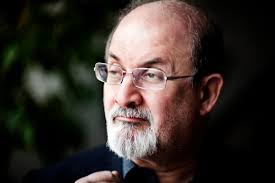
Salman Rushdie

Salman Rushdie

After the news of his death in the plane crash reached her, she had tormented herself by inventing him: by speculating, that is to say, about her lost lover.  He had been the first man she had slept with in more than five years: no small figure in her life.  She had turned away from her sexuality, her instincts having warned her that to do otherwise might be to be absorbed by it; that it was for her, would always be, a big subject, a whole dark continent to map and she wasn’t prepared to go that way, be that explorer, chart those shores: not any more, or, maybe, not yet.  But she’d never shaken off the feeling of being damaged by her ignorance of love, of what it might be like to be wholly possessed by that archetypal, capitalised jinn, the yearning towards, the blurring of the boundaries of the self, the unbuttoning, until you were open from your adam’s apple to your crotch: just words, because she didn’t know the thing.  Suppose he had come to me, she dreamed.  I could have learned him, step by step, climbed him to the very summit.  Denied mountains by my weak-boned feet, I’d have looked for the mountain in him: establishing base camp, sussing out routes, negotiating ice-falls, crevasses, overhangs.  I’d have assaulted the peak and seen the angels dance.  O, but he’s dead and at the bottom of the sea.

William Peace

When she learned of his death in the plane crash, she agonised over day dreams of her perished lover.  As the first man she had slept with in over five years, he represented a kind of icon.  In his absence, she had repressed her sexuality out of a fear that to live and examine it would somehow frighten and diminish her.  Her ignorance of the bright spectrum of love, was a source of insecurity, and sometimes she longed to know the feeling – whatever it was – of merging one’s consciousness with that of a lover.  But, if her lover had been there she would have eschewed any leap into the heavens of love; rather she would establish a safe and slow process to advance into the heights until, in her glory, she saw the angels dance.  But, alas, her lover lay at the bottom of the sea, dead.

Plain English

Ever since the news of his death reached her, she thought of him, the first man – remarkably – she had slept with in five years.  She set aside her interest in sex out of fear of stepping into the unknown.  Nonetheless, her ignorance of love bothered her, and she wondered what it would be like to experience true and selfless love.  If her lover had been present, she would not have thrown herself into an unlimited relationship; she would have approached the situation gradually, learning and advancing slowly so that eventually she would have found true bliss.  But, of course, her lover was dead.

I’m not, by any means, suggesting that my text is in any way better that Rushdie’s.  I rather like his use of off-the-wall phrases like ‘archetypal, capitalised jinn’, but I would never think of it; and I like some of his images, which border on the poetic.  However, one has to be pretty well educated to read Rushdie.  So who is he writing for?  Critics and academics, or Mrs Smith, book reader?

Suppression of Freedom of Speech

Camilla Turner wrote an article for The Daily Telegraph in late April on the topic “Student ban on free speech ‘blight of our age’.”  She said:

“Suppression of freedom of speech in universities is ‘one of the greatest problems of our time’, a former chancellor has warned.  (A chancellor in the UK government is the finance minister.) Lord Lawson, who led the Conservative campaign for Brexit, said that political correctness was a ‘great blight of our age’, adding that students often have their way because of ‘totally supine’ university authorities.

Lord Lawson

“‘Safe space’ and ‘no platform’ movements have swept across campuses, including campaigns to ban speakers deemed offensive.  But Lord Lawson, who served as chancellor in Margaret Thatcher’s government in the Eighties, said it was crucial that universities were independent from government.  He went on: ‘But now we have a new problem in the university sector, which is not the problem of government control – though that always needs to be watched – but the problem of the suppression of free speech.  The problem comes from political correctness to some extent, which is the great blight of this age.  A view is either politically correct or not, and if it is not, then it should not  be heard.’

“At an event to celebrate the 40th anniversary of the University of Buckingham, the UK’s first  private university, he added, ‘This is happening throughout the universities today, where it is pushed by students.  They may not be the majority of students, but they are very vocal and they have their way because of totally supine university authorities.  The suppression of freedom of speech in the universities is now one of the great problems of our time’.  A new higher education bill has been criticized by academics, who say universities will be forced to pander to the demands of ‘snowflake’ students.

I agree with Lord Lawson.  There is entirely too much exclusion of what for some is painful dialogue on university campuses.  One example is at my alma mater where the name of a college (my particular college, in fact) was changed because of student protests.  The name of the college was Calhoun College, named for John C Calhoun (March 18, 1782 – March 31, 1850) who was an American statesman and political theorist from South Carolina and the seventh Viced President of the US  from 1825 to 1832.  He was also a two-term US Senator and US Secretary of State.He is remembered for strongly defending slavery and for advancing the concept of minority rights in politics, which he did in the context of defending Southern values from perceived Northern threats.

Wikipedia says this about Calhoun: “In Calhoun’s defense, Clyde Wilson, editor of the multi-volume The Papers of John C. Calhoun and a Distinguished Chair of the Abbeville Institute, argued: ‘Your ordinary run-of-the mill historian will tell you that John C. Calhoun, having defended the bad and lost causes of state rights and slavery, deserves to rest forever in the dustbin of history. Nothing could be further from the truth. No American public figure after the generation of the Founding Fathers has more to say to later times than Calhoun.’

While I can appreciate that Calhoun is an objectionable figure for many, is it necessary to expunge him from history?  It seems to me that particularly at university level, one needs to reflect on the good and the bad.  One needs to ask, “Why did they name this college after John C Calhoun?  Would we do the same today? Why not?  How have we changed?”  It seems to me that there are some learning experiences in such a dialogue.

Besides, when one starts cleaning up names, where does one stop?  Calhoun College (now called Grace Murray Hopper College) is part of Yale University.  Founded in 1701, it was originally the Collegiate School of Connecticut, but it became Yale College after the gift of Elihu Yale, a slave trader.

Plotting Problems

There is an interesting article on the Writer’s Digest website, 11 Plot Pitfalls – And How To Rescue Your Story From Them, by Laura Whitcomb (born December 19, 1958), an American writer and teacher.  Whitcomb grew up in Pasadena, California. She received a degree in English from California State University in 1993.  She is best known for her book A Certain Slant of Light, which has been optioned for a film by Summit Entertainment. Whitcomb has won three Kay Snow awards and was runner-up in the Bulwer-Lytton Writing Contest.

Laura Whitcomb

Ms Whitcomb lists the pitfalls as follows:

1. THE PLOT ISN’T ORIGINAL ENOUGH.  It may be very similar to another story, play or movie.  When I write, I have an issue or two,  the setting, and the characters in mind before I start.  I also define the direction that the novel will take, but my novels tend not to be driven by a pre-conceived plot.

2. READERS ALWAYS KNOW EXACTLY WHAT’S GOING TO HAPPEN.  This can definitely be a problem is one is working with stereotypical characters and a familiar plot.  When I start a novel, I don’t know what’s going to happen.  It depends on how the characters (who have to be pretty unique) react to the issue(s) in their particular setting.  And often, I’ll take pains to shape the story so that the character goes down an unexpected path.

3. THE PLOT IS BORING.  “Often, after thinking of wild ideas to make the story more interesting, you begin to come up with workable ones that are just as stimulating, but better suited to your book.”  I agree.

4. THE PLOT IS ALL ACTION AND THE FRENZIED PACE NUMBS READERS. Ms Whitcomb makes the point that it is important to give the characters an opportunity to reflect on what has happened, consider what might happen, and express their feelings.  Real life isn’t all action.

5. THE PLOT IS TOO COMPLEX.  “Does your protagonist have to visit her father in the hospital twice—once to bring him flowers and talk about Mom, and then again to find he has taken a turn for the worse? Couldn’t he take a turn for the worse while she’s still there the first time? Does your villain need to have three motives for revenge? Would one or two be interesting enough?”

6. THE PLOT IS TOO SHALLOW.  “Ask yourself these questions: Why am I bothering to write this story? Why does the outcome matter to the characters? How do the characters change? How did my favorite book affect me the first time I read it?”

7. SUSPENSION OF DISBELIEF IS DESTROYED.  “Readers need to buy into the reality put forward by what they’re reading. You may go too far with a plot point or not far enough with preparing your audience for that plot point.”  I think this is a very good point.  As a writer, one constantly has to ask, ‘is this believable?’  If not, something has to change.

8. TOO MANY SUBPLOTS MAKE THE PLOT OVERLY COMPLEX.  Only Agatha Christie could get away with this.

9. THE SEQUENCE IS ILLOGICAL. “If you feel the order of scenes or events in your story is off, list each scene on a separate index card and, in red ink, write a question mark on every card that doesn’t feel right where it is in the story. Shuffle the cards. I’m not kidding. Mix them up completely. Lay them out again in the order you think they might work best, giving special attention to those with red question marks.”  It’s important to feel the reaction of the reader at every point in the story.

10. THE PREMISE ISN’T COMPELLING.  “See where you might make the stakes higher, the characters more emotional, the setting more a part of the overall plot. Remember: The premise should make your readers curious.”

11. THE CONCLUSION IS UNSATISFYING.  “Do you have to create more suspense before you give the readers what they’ve been craving? Do you need to make the answer to the mystery clearer? Does the villain need to be angrier, or perhaps show remorse?”

I would add one more point: keep the suspense coming in waves.  This solves several of the problems mentioned above.

Writing Advice

On their website, The Writer’s Workshop say: “When you send your stuff off to an agent, 9 times out of 10 your work won’t actually be read. It’ll be ‘looked at’.  What does that mean? It means that an agent (or junior reader) will simply glance at the first page or two of your submission. In a large majority of cases, authors will give themselves away as amateurish in the opening chapter.  If you’re one of them, then the agent will read no further. Sure, the agent doesn’t know about your story, your characters, or your brilliant ideas. The fact is that if your writing style is poor, then those things are irrelevant.”  The website goes on to give lots of advice about writing style and techniques.  This makes sense: after all The Writer’ Workshop is selling their editorial services.  Their message is, ‘use our service and agents will read your manuscript’.

On the iUniverse website, there are tips from fiction authors, and I found it somewhat surprising that there were only two tips that mentioned writing style or technique.  These are:

“Interesting verbs are seldom very interesting.” — Jonathan Franzen, and

“Keep your exclamation points under control. You are allowed no more than two or three per 100,000 words of prose. If you have the knack of playing with exclaimers the way Tom Wolfe does, you can throw them in by the handful.” — Elmore Leonard

I wonder what Franzen means by ‘interesting verbs’.   If he means ‘unusual verbs’, why not say “Unusual verbs are seldom very effective”.  In which case, I agree.  I’m not sure Leonard’s advice is actually helpful.  What is ‘the knack of playing with exclaimers’?  And if there is a knack, why have a quota?

iUniverse is a self-publishing company, so maybe they want to be associated with important authors.  Anyway, here are some of the tips that caught my eye:

“In the planning stage of a book, don’t plan the ending. It has to be earned by all that will go before it.” — Rose Tremain  I agree!

“Always carry a note-book. And I mean always. The short-term memory only retains information for three minutes; unless it is committed to paper you can lose an idea for ever.” — Will Self   Maybe I should start carrying a notebook, but I doubt I would use it.

“It’s doubtful that anyone with an internet connection at his workplace is writing good fiction.” — Jonathan Franzen; and “Work on a computer that is disconnected from the internet.” — Zadie Smith  I disagree.  If one is writing fiction that is intended to be’real’ in time and space, how can you do it without Google?  Unless, of course, ‘good fiction’ is not real in time and space.

“Read it aloud to yourself because that’s the only way to be sure the rhythms of the sentences are OK (prose rhythms are too complex and subtle to be thought out—they can be got right only by ear).” — Diana Athill  I’ve got to do more of this.

“Don’t tell me the moon is shining; show me the glint of light on broken glass.” – Anton Chekhov  Beautiful.

“The writing life is essentially one of solitary confinement – if you can’t deal with this you needn’t apply.” — Will Self   Very true.

“Be your own editor/critic. Sympathetic but merciless!” — Joyce Carol Oates   A necessity.

“Remember: when people tell you something’s wrong or doesn’t work for them, they are almost always right. When they tell you exactly what they think is wrong and how to fix it, they are almost always wrong.” — Neil Gaiman   True, except for publishers’ editors.

“The main rule of writing is that if you do it with enough assurance and confidence, you’re allowed to do whatever you like. (That may be a rule for life as well as for writing. But it’s definitely true for writing.) So write your story as it needs to be written. Write it honestly, and tell it as best you can. I’m not sure that there are any other rules. Not ones that matter.” — Neil Gaiman  This sums it up.


Review: Today

In my post of 3 March 2017 on the obituary of David Miller, literary agent, I mentioned that he wrote one novel: Today.  I have now read it, and share the consensus of other readers that it is a little gem of a novel.  Today concerns the gathering of friends and family of  Joseph Conrad on a bank holiday weekend in 1924.  Jessie, Joseph’s wife had recently been discharged from a nursing home.  During the weekend, Joseph dies unexpectedly.

Joseph Conrad was born into a Polish family in what is now Ukraine in 1857.  He traveled around Europe, and eventually settled in England, where he learned English.  He applied for and was granted English citizenship in 1886, but he remained a subject of Russia until he was granted a release from obligation to Tsar Alexander III in 1889.  Conrad had a nineteen year career in the merchant navies of France and England, rising from apprentice to captain. But in 1894, he gave up the sea, partly because of ill health, partly because of the lack of ships, and partly because he had become fascinated with writing.  Almost all of Conrad’s writing was first published in influential magazines and newspapers: The North American Review, The Saturday Evening Post, and The Illustrated London News, for example.  Nonetheless, financial success eluded him for much of his career, although a government grant of an annuity of £100 per annum greatly eased his situation.  His fame increased greatly with the publication of Chance in 1913, which is, ironically, thought to be one of his weaker novels.  Many of his novels include a maritime theme, and he is believed to be a writer who sailed rather than a sailor who wrote.  His writing style is thought of as poetic prose; his work is marked by exotic style, complex narration, profound themes, and pessimistic ideas.  He suffered from gout, malaria and depression.  Conrad wrote some twenty novels and a long list of stories.  His best known novels include: Lord Jim, Heart of Darkness, Nostromo, The Nigger of the ‘Narcissis’, The Secret Agent, and Under Western Eyes.

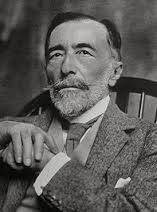
Joseph Conrad

Coming back to the novel, Today, it is written by a man who clearly admired Conrad and his work.  But Joseph Conrad, as a living character, never appears in Today.  Nonetheless, one feels his remote greatness by the way other characters react to him.  Today is a short, historical novel (160 pages) about the passing of a great author in 1924.  The setting and the culture of the time are accurately reflected.  The writing is fittingly oblique but engaging.  The characters, many of whom were real people – including Conrad’s son’s Borys (a disappointment to his father) and the younger, John; his wife Jessie, an ordinary, working-class, English girl, who was 16 years Conrad’s junior, and who was looked down upon by his friends, but was probably the supportive companion he needed.  And there is the middle-aged Miss Lillian Hallowes, Conrad’s loyal secretary.  At the end, Lillian receives not the typewriter on which she transcribed most of Conrad’s work, but, secretly, from John, the fountain pen by which the original manuscripts were written.  Did it really happen?  We don’t know: this is fiction.

I would certainly recommend Today.  Though it’s subject is death, it is largely about life.

‘Banned’ books

There were two recent articles in The Daily Telegraph regarding the ‘banning’ of books by Holocaust deniers.  The first article, by Olivia Rudgard, reads:

“A Cambridge college has removed a David Irving book from display in its library after a visiting Jewish academic complained.  Churchill College, Cambridge, said the Irving’s biography of its namesake, Winston Churchill , would now be held in a ‘closed access’ area with borrowers only able to read it on request.

“Dr Irene Lancaster, formerly a teaching fellow in Jewish history at Manchester University, encountered the books written by the Holocaust denier on display.  She said: ‘They certainly weren’t hidden away – they were sticking out like reference books.’

“A spokesman for the university said: ‘Holding banned or challenged books in no way endorses the views or scholarship of the authors.  Rather, they are accessible to scholars to allow them the opportunity to challenge and refute their contents’.  The spokesman added that the library was used by college members and visiting academics and not the general public, and therefore the books had not been on ‘public display’.”

Wikipedia says this about Irving: “Sixteen years after an English court discredited his work and the judge called him ‘antisemitic and racist’, the historian David Irving claims he is inspiring a new generation of ‘Holocaust skeptics. On the eve of a major new Bafta-nominated film about the trial, Irving, who has dismissed what happened at Auschwitz concentration camp during the second world war as ‘Disneyland’, says that a whole new generation of young people have discovered his work via the internet and social media. . . . Irving v Penguin Books Ltd was one of the most infamous libel trials of the past 20 years. An American historian, Deborah Lipstadt, had accused him in her book, Denying the Holocaust, and Irving, then a somewhat respected if maverick historian, sued her and her publisher.”  (And lost.)

I had a look on Amazon where there are plenty of David Irving’s books.  His book, Churchill’s War, The Struggle for Power, has nine five-star reviews and one three-star review.  The 3-star review complains about non-delivery of half of the e-book.  The five-star reviews focus on the depth of research and the quality of historical writing.  Many of the reviews mention Irving’s reputation, but say that this work is not biased.

The second article, by Robert Mendick:

“Amazon has bowed to public pressure and quietly removed from sale dozens of anti-Semitic books that deny the Holocaust.  An outcry followed news it was profiting from titles such as The Myth of the Extermination of the Jews, by Carlo Mattogno, which was available as a download.  Dr Nicholas Terry at the University of Exeter, said Amazon had last week withdrawn form sale more than 30 books.  The expert on contemporary Holocaust denial added: ‘This is a major blow for Holocaust denying authors.  Amazon has been a major outlet for their sales’.  Despite the decision, Amazon still sells anti-Semitic literature through its website, and it is unclear what rules determine what material is acceptable and what is not.  The company refused to comment.”

I would make three points about all of this:

  1. Non governmental organisations should be free to exclude material which they consider objectionable.  The government should not have any such freedom.
  2. Amazon ought to be transparent about it’s policies, which should err in favour of exclusion of objectionable material.
  3. Any policy should be intelligent and selective, leaving ‘on the shelf’ quality, constructive books by objectionable authors.

Review: Days Without End

This novel, by Sebastian Barry, was the Costa Book of the Year in 2016.

Wikipedia says: “Sebastian Barry (born 5 July 1955) is an Irish playwright, novelist and poet. He is noted for his dense literary writing style and is considered one of Ireland’s finest writers.

Barry’s literary career began in poetry before he began writing plays and novels. While he was once considered a playwright who wrote occasional novels, in recent years his fiction writing has been more successful than his work in the theatre.

He has twice been shortlisted for the Man Booker Prize for his novels A long Long Way (2005) and The Secret Scripture (2008), the latter of which won the 2008 Costa Book of the Year and the James Tait Black Memorial Prize. His 2011 novel On Canaan’s Side was longlisted for the Booker. In January 2017, Barry was awarded the Costa Book of the Year prize for Days Without End, hence becoming the first novelist to win the prestigious prize twice.”

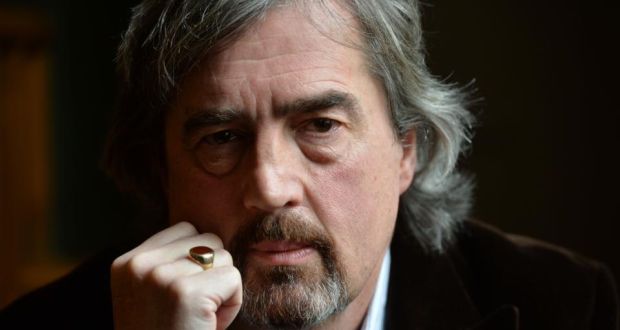
Sebastian Barry

Days Without End is a poetical, historical novel, set largely on the American frontier in the mid nineteenth century; its themes are love and survival.  The two principal characters are Thomas McNulty, the narrator, an Irish immigrant, aged about 15, initially, and John Cole, a homeless boy of about the same age, from New England.  Their tale begins as dancing girls – yes, boys dressed as girls – in a mining town saloon where they offered the apparent fantasy of women to rough, woman-less men.  They then join the army, which meant growing up with soldiers in hostile geography made all the more dangerous by the presence of Indians, a largely unwilling enemy. Thomas and John face near-constant hardship of savage fighting, bad weather, poor food and non-existent pay, but they find a mission and true comradeship in the army.  An Indian girl is captured, domesticated by the fort commander’s wife and assigned as servant to Thomas and John, who are then drawn into the Civil War, fighting on the Union side through battles which amounted to human slaughter.  At the end of an army enlistments, Thomas, John and Winona, the Indian girl, who is treated as John’s daughter, settle temporarily in Grand Rapids where they are entertainers, but they are drawn back into the Civil War, leaving Winona in Grand Rapids.  They are taken prisoners by the Southern Army, and live through terrible hardship, but eventually find their way back to Grand Rapids, from which the three of them set out to help a homesteader in Tennessee.  But peace is elusive: Winona is wanted in a hostage exchange for the daughter of the fort commander.  Thomas accompanies her, and, after a bloody fight in which he kills an army officer, he returns her to the Tennessee homestead.  But then, Thomas is arrested for having left the army before his papers were signed.  In custody, it is revealed that he killed the officer, and her faces the death penalty.  I won’t reveal the conclusion.

The characters are well drawn, including minor characters: army officers, soldiers, entertainers, Indians and miscellaneous blacks.  From what I remember of my American history, it paints an accurate picture of America 150 years ago.  I’ve called this ‘a poetic, historical novel’  because the narrator, Thomas, speaks in the most picturesque language, which is un-accustomed but very effective.  It does, however, make the process of reading a little more laborious.  Also, Thomas, occasionally draws on vocabulary which in very doubtful for an uneducated immigrant boy.

Having said that, Days Without End is a unique reading experience, and a good story, well-told.

National Book Foundation

There was an interview in Time magazine a couple of months ago with the first black female to be named executive director of the National Book Foundation.

By way of background, the National Book Foundation website says:

“The mission of the National Book Foundation and the National Book Awards is to celebrate the best of American literature, to expand its audience, and to enhance the cultural value of great writing in America.

“History: On March 16, 1950, publishers, editors, writers, and critics gathered at the Waldorf-Astoria Hotel in New York City to celebrate the first annual National Book Awards, an award given to writers by writers. The American Book Publisher’s Council, The Book Manufacturers’ Institute, and The American Booksellers’ Association jointly sponsored the Awards, bringing together the American literary community for the first time to honor the year’s best work in fiction, nonfiction, and poetry.

“In 1986, the publishing community established The National Book Foundation, a not-for-profit organization to oversee the Awards, diversify their base of philanthropic support and expand their mission. The Foundation board then hired Neil Baldwin—an author, and Manager of The Annual Fund at The New York Public Library—to become the Founding Executive Director of The National Book Foundation and help determine its agenda for the future. ”

Wikipedia says this about Lisa Lucas: “Lucas was born in New York City and grew up in New Jersey.  Lucas attended the University of Chicago, where she studied English.  Reporting on Lucas’s 2016 appointment to executive director of the National Book Foundation, NBC said: ‘With Lucas at the forefront of the National Book Foundation and Awards, the future of publishing looks very bright.’  The Los Angeles Times said Lucas ‘is clearly poised to bring the organization to a new level…ideally suited’ to promote the foundation. She is the third director in the history of the foundation, ‘one of America’s key literary institutions,’ and the first woman and the first African-American to lead the organization.”

Lisa Lucas

In the Time interview, Lucas was asked: “What’s going to be the role of American literature in the new political era?”

Lucas: “People keep saying we’re postfact, and I think that books are the special place where we can go to understand the world we live in.”

Time: “In 2014, 27% of Americans didn’t read a single book.  How can we change that?”

Lucas: “People who make and market books probably assume that 27% of people aren’t going to bother with our product.  That’s the place where you first start correcting.  Assume everyone reads.  Lately, people have been talking a lot about book deserts, places where there isn’t access – how do we encourage people to open bookstores in these communities?”

Time: “What book would you recommend to our President?”

Lucas: “We were so lucky to have such a wonderful reader in President Obama, who said that reading novels helped make him a better citizen.  I can only hope that President Trump is as interested in our stories, lives and literature.  I’d recommend some books that have recently been celebrated by the foundation: Claudia Rankine’s Citizen; John Lewis, Andrew Aydin and Nate Powell’s March; Arlie Russell Hochschild’s Strangers in Their Own Land; and Ibram X. Kendi’s Stamped from the Beginning.

The full interview is on page 48 of the January 30, 2017 issue.

Review: Seeking Father Khaliq

The following review of Seeking Father Khaliq was posted on Amazon.com by amts:

“This is another wonderful book by author William Peace. Fascinating discussions of theology, philosophy and politics all melded in to an intriguing and mysterious plot. Who is Father Khaliq and why does this perhaps Saudi Arabian princess hire Professor Kareem al-Busiri who teaches at the American University in Cairo to find him? An indifferent Muslim, he is intrigued by her offer. Looking for Father Khaliq takes him on a variety of religious pilgrimages from the Muslim Hajj to the Shia Arba’een, to a trip to Israel and to Rome. Not only does one encounter a treasure trove about each of these places and pilgrimages, but one is treated to stimulating discussions about the three major religions and their approaches to essential questions about the meaning of life, about who is God, and what role the divine being plays in each of our lives.
The politics of the Middle East is handled plot wise in the lives of two of the professor’s sons. The elder, Naquib, wants radical change and becomes a member of the Muslim Brotherhood. The younger, Kalifa, chooses to join the army and to work for change within the system. The choices each makes leads to a tragic outcome that is unforeseen. During one of Kareem’s pilgrimages he comes in contact with Daesh and are held hostage. The scenes involving Daesh are not easy to read, but anyone familiar with the work of ISIS, as Americans refer to Daesh, will not be surprised. Their eventual rescue is one of the most exciting scenes.
Kudos to Mr. Peace for providing us with a book full of strong women characters. Although he is a widower, we learn about the strength of his former Peace Corps American wife who stayed in Egypt after her tour ended and later became a Coptic Christian. He is a realist; she an idealist, but they accepted and respected each other and she was able to exert her quiet influence on him in many ways. Naquib’s wife, Anisa, is the wage earner while Naquib is in school and takes care of the children while she is at work. Kalifa is unmarried, but later marries the daughter of another strong character, Adeeba, a friend of his wife’s whose husband had died about eighteen months before Elizabeth. Adeeba is a professor of Egyptian history also at the American University and the author of several books. She has strong opinions and is not shy about expressing them. The romantic relationship that eventually develops between Kareem and Adeeba is one of mutual respect and admiration, but also one with passion. The final strong female character is Wahida, Kareem’s daughter who works for the Red Crescent and presents the viewpoint of a young Moslem woman challenged by life as a Moslem in the modern world and in a Middle Eastern country.
This book has much to offer the reader – a fast moving plot, stimulating ideas to ponder, insight into the contemporary Middle Eastern world, and well developed characters both the main ones and those whose places are more peripheral. I recommend it most highly.”

Seeking Father Khaliq has received an honorable mention in Reader View’s annual literary awards.

Rape & Freedom of Speech

On Tuesday evening, my wife and I went to a piano concert at Southbank Centre.  As we approached the entrance, staff diverted us to another entrance around the corner.  When we turned the corner, we found we were in the midst of a demonstration, complete with portable loudspeakers, signs and angry people – mostly women.  We hurried through and found an entrance at the far end of the building.  I couldn’t help wondering what in the world a demonstration at Southbank Centre would be about.  On the way home that night, I picked up a copy of the Evening Standard, and found what was the issue: Tom Stranger and his ex-girlfriend, Thordis Elva were going to tell their story of rape and reconciliation.

The story is this: at the time of the rape, 20 years ago, Stranger, who is Australian, now married and a youth counsellor, was on an exchange trip to Iceland.  There, he met Elva, an Icelander who was 16 at the time (he was 18), and he became her first teenage romance.  The Evening Standard article continues: “The pair went to a Christmas party, and, wanting to impress him, Elva tried rum for the first time.  She became very drunk and spent the night being sick in the toilets – staff at the venue wanted to call an ambulance to get her home but Tom volunteered.  She was incapacitated and remembers how grateful she was to him for removing her vomit-stained dress and high heels, and how alarmed she suddenly felt when he started to go further.  He raped her.   She remembers it being painful.  She never reported what happened because it didn’t fit with her idea of what rape was.  Or his, he says: ‘I presumed that after a night out with your girlfriend, a boy is deserving of sex.  I sanctioned my own perceived needs and sexual urges, and had no regard for Thordis’ well-being.  I did not have an intent to hurt Thordis, but that is what I did.’

“Nine years after the rape, Stranger, long since back in Australia, all thoughts of Elva buried, received an email. ‘It was detailed and clear.  Her words took me back to that room nearly a decade earlier.  They told me what really happened and revealed the effects my actions had on her. . . . But I also felt I was being offered something really rare, something that needed to be understood, respected and not questioned. . . . He wrote back and they spent the next two years corresponding in long emails, unpicking the events and repercussions of that night.”  She proposed that  ‘in six months time we meet up with the intention of reaching forgiveness, once and for all.  In person.’

“They met on neutral ground – a hotel in Cape Town.  Talking was difficult.  At one point Stranger broke down. ‘I’ve come to understand the damage that I caused.  It’s been a long journey for me to be totally able to acknowledge that it was rape, and to comprehend how Thordis has had to live with the effects of my actions.’

The two have written a book: South of Forgiveness, published by Scribe.

Tom Stranger & Thordis Elva

Their appearance at the Women of the World festival at Southbank Centre last Saturday was cancelled.  2364 people objected to his appearance, but it was rescheduled for last Tuesday.  The petition to cancel said: “By giving the rapist in question a platform to relay their narrative the event will inevitably encourage the normalisation of sexual violence, instead of focusing on accountability and root causes.”  Those who opposed the appearance said it would set a precedent in which rapists can be applauded simply of admitting their crime, “and may even encourage rapists to contact survivors, an action that would severely disrupt their process of healing.”

Stranger says he disagrees with the female judge who warned that drunk women put themselves at higher risk of rape.  “I would say that’s a continuation of victim-blaming.  Once again the scrutiny is on the actions of women. . . . I would not speak about the choice of women in that way.  I want the focus to be on the young men making their choices and why they do what they’re doing. . . . It’s about time we started looking at sexual violence as a men’s issue.  It’s very clear – unless it’s a mutual thing, unless there’s consent, then it’s wrong.”

In reading the Evening Standard article (which covers two entire pages), the writer, Stefanie Marsh, leaves one with the impression not only that Stranger is contrite, but he understands why he is a hate figure, and is willing to suffer abuse to get his point across: It’s a Men’s Issue.

As to whether the Women of the World appearance should have been cancelled, I take a neutral view: it’s up to the management of the festival, and more generally, I think it depends on the time and place.  What I would object to is if the government were to interfere in the decision.  Having said that, I have an issue with the protest petition.  My issue is not about freedom of speech but about willingness to listen.  It seems to me that there is an increasing tendency in our society today when a subject is introduced to say: we don’t want to hear about that!  There are three words in the petition to cancel that make me believe this is an example of refusal to listen.  Narrative: have the petitioners considered what Stranger’s narrative might be instead of assuming what it is?  Accountability: the petitioners want to focus on accountability; that’s exactly what Stranger does: his own.  Root causes: Stranger identifies the root cause as being a men’s problem.  Is that not correct?