Man Booker Protest

Today’s Daily Telegraph has an article captioned Man Booker rule change has lost us sales , say publishes, and the caption reads: US dominance has hit Commonwealth writers who are falling off shortlists.  

Not that my opinion had an iota of influence, I was opposed to the rule change in 2014, which opened the prize to writers from any nationality, who publish in English, on the basis that there are a large number of US literary prizes, so there was no need to open another prize to American writers.  I also felt that the Man Booker was a unique prize open to Commonwealth authors.  Finally, given the quirky judging standards of the Man Booker Prize Committer (see my most recent post), it seemed inappropriate to me that the Booker should be positioning itself as the top global prize in English literature.
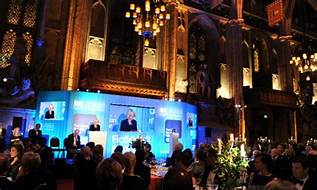
Now the publishers have weighed in with their own arguments regarding the effect of the rule change on the volume of books sold, and, by extension, on their bottom lines.

“About 30 publishers are understood to have signed a letter urging the trustees to the Booker Prize Foundation to reverse the decision, saying the change risked creating ‘a homogenised literary future’ dominated by American culture.  ‘The rule change, which presumably had the intention of making the prize more global, has in fact made it less so by allowing the dominance of Anglo-American writers at the expense of others; it risks turning the prize, once a brilliant mechanism for bringing the world’s English-language writers to the attention of the world’s biggest English-language market, into one that is no longer serving the readers in that market’ it says.

“It claims that diversity of the prize has been ‘significantly reduced’, noting that this year’s shortlist consists of three Americans, two Britons, and one British-Pakistani as opposed to 2013’s shortlist which featured a New Zealander, a Zimbabwean, an Irishman, an American-Canadian and a British-American. ‘We already live in a world that is dominated by American culture’, the letter says. ‘The Man Booker Prize was one significant way to allow other voices to be heard.’

“Johnny Geller, of the Curtis Brown literary agency, said the letter was ‘a long time coming’ and that ‘widening the entry requirements to include US writers has resulted in weakened sales on both sides of the Atlantic’.

“Denying that diversity had been reduced, the Booker foundation said the rule change was not created specifically to included US writers but to allow entries from authors of any nationality, regardless of geography.”

Clearly, the rule change has reduced diversity, and one is prompted to ask why the rule change was felt to be necessary: was it to raise the profile of the foundation at the expense of sacrificing its unique position?

The point about the impact on sales is interesting, and the article does not mention whether it was addressed in the foundation’s response.  Presumably, the cause of this sales decline is that Man Booker prize recognition does little to increase the sales of winning American authors: they already have recognition through other awards and bestseller lists.  But, non-recognition of Commonwealth authors impacts their sales on both sides of the Atlantic.

It will be interesting to see how much power the publishers have in this situation!

Review: Istanbul: Memories and the City

I wanted to read a book by Orhan Pamuk, who won the Noble Prize for Literature in 2006, but when I looked at his recent novels, I was put off.  My Name is Red is 688 pages; A Strangeness in my Mind is 764 pages.  To me, this seems a disproportionate amount to time to devote to one author.  (Perhaps, I’m like a teenage boy: so many girls, so little time.)  So, I chose Istanbul: Memories and the City (336 pages), which was written in 2005, and appealed to me because I visited Istanbul, briefly, on my honeymoon.

Orhan Pamuk is a Turkish writer, screenwriter and academic, born in Istanbul in 1952; he has sold 13 million books in 63 languages.  He is a Professor of Humanities at Columbia University, where he teaches courses in writing and comparative literature.

In 2005, Pamuk made a statement regarding the Armenian Genocide that  “Thirty thousand Kurds have been killed here, and a million Armenians. And almost nobody dares to mention that. So I do.”  An ultra-nationalist lawyer brought a law suit based on Article 301 of the Turkish Penal Code which makes it a crime to insult Turkey or the Turkish Grand National Assembly.  The suit resulted in a lengthy battle with the Turkish legals system in which the European Union took an interest because of its implications for the freedom of speech in Turkey.  The Turkish Justice Ministry finally declined to back the trial on a technicality, but gave no support to Pamuk, who said that he mentioned the genocide not to call attention to specific numbers of deaths but to demonstrate the lack of freedom to discuss taboo subjects in Turkey.

Orhan Pamuk

Istanbul, translated by Maureen Freely, is one of five non-fiction works by Pamuk in English.  It is, as the subtitle suggests, a reflection on the Istanbul the author knew as a child together with his family memories.  There are black-and-white photographs on every couple of pages, some dating back to the mid-nineteenth century, and some as recent at the 1960’s; most are of ‘old Istanbul’ but there are family photographs, as well.  The ‘old Istanbul’ photographs are a vehicle for commentary on the writings of European and Turkish literati regarding the culture, style, history, art and visual perspectives of the city.  Clearly, Istanbul was (and is) a unique city: its rapid growth, its human crossroads of East and West, its unique wooden architecture (which frequently went up in smoke), the presence of the Bosporus with all its maritime energy, and the air of melancholy (húzún) arising from the dissolution of the Ottoman Empire, the subsequent economic decline, and the cultural ambivalence between East and West.

Perhaps what is surprising about this book – part travelogue, history, autobiography, artistic and cultural commentary – is that it is an integral whole, seamlessly shifting themes without confusing the reader.  This, I think, is all down to Pamuk’s fondness for his city and his skill as a commentator and a writer.  One can set the book aside for a day or two, but one is drawn back into its dream-like flow.  The attraction is, in large measure, due to the characterisation of the boy, Orhan, his brother, his mother and father, the larger family and their declining circumstances.  The one criticism I have is that a map of the city should have been included.  There are frequent references to districts in Istanbul by their Turkish names, but one has no idea of the geography which is an omission for a piece of writing which is otherwise so visual.

Istambul is a very pleasant reading experience.

Rules for Writing Fiction

On the Guardian website, February 20, 2010, there is an article, Ten Rules for Writing Fiction Parts 1 & 2, which caught my eye, mainly because of the writers who were offering their opinions.  In this post I’ve picked out some that haven’t been covered before in this blog, and with which I agree or disagree.

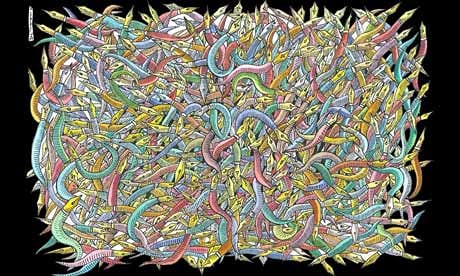
Illustration: Andrzej Krauze from the article

Is this a metaphor for writing fiction or for the opinions about it?

  • Hilary Mantel: “Description must work for its place. It can’t be simply ornamental. It ­usually works best if it has a human element; it is more effective if it comes from an implied viewpoint, rather than from the eye of God. If description is coloured by the viewpoint of the character who is doing the noticing, it becomes, in effect, part of character definition and part of the action.”      I agree!
  • Michael Moorcock: “If possible have something going on while you have your characters delivering exposition or philosophising. This helps retain dramatic tension.” and “Carrot and stick – have protagonists pursued (by an obsession or a villain) and pursuing (idea, object, person, mystery)”   Good point.
  • Will Self: ” You know that sickening feeling of inadequacy and over-exposure you feel when you look upon your own empurpled prose? Relax into the awareness that this ghastly sensation will never, ever leave you, no matter how successful and publicly lauded you become. It is intrinsic to the real business of writing and should be cherished.”    I find this quite interesting; I had only feelings of pride for my first book when completed.  More recently, with my eighth, I do feel that sense of inadequacy.
  • Zacie Smith: “Tell the truth through whichever veil comes to hand – but tell it. Resign yourself to the lifelong sadness that comes from never ­being satisfied.”     This is very similar to Will Self’s comment.
  • Rose Tremain: “Forget the boring old dictum “write about what you know”. Instead, seek out an unknown yet knowable area of experience that’s going to enhance your understanding of the world and write about that.”    I did just this with my last two novels.   By the way, when one does this, one has to be connected to the Internet – contrary to the advice of several authors.
  • Sarah Waters: “Writing fiction is not “self-­expression” or “therapy”. Novels are for readers, and writing them means the crafty, patient, selfless construction of effects. I think of my novels as being something like fairground rides: my job is to strap the reader into their car at the start of chapter one, then trundle and whizz them through scenes and surprises, on a carefully planned route, and at a finely engineered pace.”     I like the analogy.
  • Jonathan Franzen: “Write in the third person unless a ­really distinctive first-person voice ­offers itself irresistibly.”    I think this is probably good advice.  Luckily the two novels I’ve written in the first person are distinctive.
  • Esther Freud: “Cut out the metaphors and similes. In my first book I promised myself I wouldn’t use any and I slipped up ­during a sunset in chapter 11. I still blush when I come across it.”   I don’t agree with this; I think that a whimsical, unexpected metaphor can be very enlightening.
  • Neil Gaiman: “Fix it. Remember that, sooner or later, before it ever reaches perfection, you will have to let it go and move on and start to write the next thing. Perfection is like chasing the horizon. Keep moving.”  I thought it was jut my compulsive self: noticing a problem in an earlier chapter and immediately rushing to find and fix it.
  • P D James: “Increase your word power. Words are the raw material of our craft. The greater your vocabulary the more ­effective your writing. We who write in English are fortunate to have the richest and most versatile language in the world. Respect it.”   I think this is an excellent point and it is contrary to some who encourage the use of common words or discourage the use of a thesaurus.

Artistic Ladder

A good friend of my wife’s and mine is an only child and when her father died, he left her a large industrial site on the outskirts of a major city.  For some years, she thought to sell it to a developer, but the area is not ideal for a residential – or commercial – development.  She is an art lover and gradually, she began to put on exhibitions by two or three eclectic artists in the buildings.  The site became known as an art venue and she developed a mailing list of ten thousand ‘members’ who pay a small fee to be advised of events and are admitted for free.  Recently, she put on an exhibition by three prominent artists in different disciplines from three different countries.  One of them is thinking of establishing a studio on the site.

I asked her what she could do with a grant of one million euros.  Her face lit up and the ideas came tumbling out, but then she stopped and said, “But I haven’t any idea how to raise one million euros.”  We talked about it further, and she agreed that grants in that size can be obtained with the right connections and a persuasive proposal.  She certainly has connections in the art world, if not the actual fund-raising skills.

She also said that her surname will die out with her and she wants to somehow leave her name attached to whatever she does in the art world.  We talked about a way to do that, and then she was back on the subject of the kind of exhibitions she might put on.

I asked her to give serious thought to providing same ‘ladders’ for aspiring, but unknown artists with talent.  I pointed out that in every art discipline (including my own – literature, and including sports) there tends to be an enormous gap between the well-known, well-paid, big names and the skilled but unknown, and unpaid beginners.  I suggested two possible ladders for her to consider when possible.  The first was to put on an aspiring artists exhibition, at least once a year, with exhibitors selected by a panel of experts, and prizes being awarded to those judged to be ‘the best’ by another expert committee.  Perhaps provision could be made for the public to buy individual pieces, or for a gallery to pick artists to carry.  The second ladder was to establish an artist’s workshop space in the premises where young artists could come and paint or sculpt, where they could exchange ideas, and minimise the loneliness of their trade.  Maybe a small coffee shop would be opened to serve them, and perhaps interesting events could be organised.

As those of you who have been following this blog know, I feel that there are not enough ladders to success for aspiring artists of all disciplines.  In fact, in literature there are structural disincentives for the advancement of new talent: the tight grip of the traditional publishers on whom to select and promote.

Review: Absalom, Absalom!

William Faulkner is a novelist I had never read until now – perhaps because I grew up and was educated in the northeastern US.  Now that I have read Absalom, Absalom! I can understand why Faulkner is considered one of the greatest American writers of the 19th century.

Faulkner was born in Mississippi in 1897, was raised by a black nanny, lived most of his life in Oxford, Mississippi, and attended the University of Mississipi (Ol’e Miss).  His family, upper-middle class; his mother was a literature buff who read to him and introduced him to the classics.  Friends and extended family often told tales of the Old South, the Civil War, slavery, and the Ku Klux Klan.  Faulkner received the Nobel Prize for Literature in 1949 and his last novel, The Reivers (1962) was awarded the Pulitzer Prize for Fiction in 1998.  Faulkner died in 1962 after the fall from a horse.

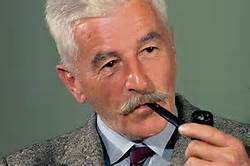
William Faulkner

Absalom, Absalom! (the title relates to the return of the central character’s son, Charles; Absalom, according to the Jewish bible, was the third son of King David.  A handsome, high-living man, Absalom killed his older half-brother for the rape of their sister) is set in the early to middle 19th century, mostly in Mississippi.  The central character, Thomas Sutpen, a rough, ungentlemanly fellow, appears in a small Mississippi town with 20 slaves and considerable funds of suspect origin.  He acquires 100 square miles of property 12 miles outside the town, builds an enormous mansion, grows cotton, marries the town shopkeeper’s daughter, and has a son, Henry, and a daughter, Judith.  Sutpen had married the daughter of a Haitian sugar planter, who bore him a son whom he named, Charles Bon.  When Sutpen discovered that his new wife has negro blood, he pays to have the marriage annulled under obscure circumstances.  In his mid-twenties, Charles Bon suddenly appears at the U of Miss. where Henry is attending and the two become friends, though Henry does not learn Charles’ identity until later, when Charles begins to realise who his father is.  Henry and his mother begin to promote the marriage of Judith to Charles.  Sutpen travels to New Orleans (where Charles first appeared) and learns who he is.  On his return, he tells Henry that Charles is his half-brother and the marriage will not be permitted.  Henry refuses to believe that Charles is his brother.  The Civil War intervenes.  Charles decides to break the impasse by marrying Judith, and Henry kills him.  Other deaths follow until there is no mansion and no living heirs to the Sutpen name.

This is an intriguing story, deeply coloured with the culture of the Old South.  Falkner’s story-telling technique is quite oblique: he makes use of different narrators to illuminate parts of the story that they know first-hand, have heard from others, or suspect, so that the reader is able to gradually pick up the thread.  This technique creates a sense of mystery, uncertainty and ambiguity about a story which was nearly a century old.  Faulkner’s writing is a poetic, erudite, stream of consciousness by the narrator, particularly when the subject is what a character is thinking or feeling; not infrequently, these dissections of a character’s motives can go on for two pages or more, and they are not easy to read, because they lack fluency and are full of parenthetical statements.  Sentences can go on for half a page.  Nonetheless, a careful reader will, at thinking and feeling levels, understand the character.  There is almost no dialogue in the novel; nearlyh all is revealed by the narrators.  Interestingly, the narrators never set the scenes: what the town, the battlefield, the mansion looked like.

The characters are all clearly drawn.  I found it somewhat surprising that all of the female characters were presented as passive.  One gets a clear sense of what life was like in the Old South, particularly before the Civil War, from the point of view of the wealthy few, the middle class and the slaves and poor whites. The slaves themselves had various classes.  As a literally minded person, I found it difficult to accept that Thomas Sutpen could have acquired the wealth he had as the overseer of a Haitian sugar plantation: something is missing.  Similarly, it is doubtful that Sutpen, 20 unskilled slaves and a French architect could have built the huge, elaborate mansion ‘Sutpen’s Hundred’.

Absalom,Absalom! is not an easy read, but it should not be overlooked if one is interested in distinctive American writing – particularly about the Old South.

Review: One Hundred Years of Soliude

Having never read of any of Gabriel Garcia Marquez’ writing, I decided to start with One Hundred Years of Solitude, which is thought to be his greatest novel, a classic, and one of the best by a Latin American author.

Gabriel García Márquez was born on 6 March 1927 in Aracataca, Colombia.  García Márquez’s grandmother, Doña Tranquilina Iguarán Cotes, played an influential role in his upbringing. He was inspired by the way she “treated the extraordinary as something perfectly natural.”   The house was filled with stories of ghosts and premonitions, omens and portents, all of which were studiously ignored by her husband.   According to García Márquez she was “the source of the magical, superstitious and supernatural view of reality”.  He enjoyed his grandmother’s unique way of telling stories. No matter how fantastic or improbable her statements, she always delivered them as if they were the irrefutable truth. It was a deadpan style that, some thirty years later, heavily influenced her grandson’s writing.  Marquez began his career as a journalist while studying law.  Throughout his life, he was left-leaning politically, adopting socialist thinking, and he held that socialism and democracy are mutually dependent.   García Márquez said, “my grandfather the Colonel was a Liberal. My political ideas probably came from him to begin with because, instead of telling me fairy tales when I was young, he would regale me with horrifying accounts of the last civil war that free-thinkers and anti-clerics waged against the Conservative government.”   In 1955, Marquez published fourteen articles in the El Spectador newspaper based in his interviews of the lone survivor of a shipwreck.  In the articles he made the case that the ship wreck of a Colombian Navy vessel was the result of improperly stowed contraband, rather than the government’s story that the tragedy was due to a storm.

García Márquez received the Nobel Prize in Literature on 8 December 1982 “for his novels and short stories, in which the fantastic and the realistic are combined in a richly composed world of imagination, reflecting a continent’s life and conflicts”.  Marquez wrote 6 novels (Solitude is his second), 5 novellas, 6 collections of short stories, 8 pieces  of non-fiction, and 26 films.  He once remarked: “Most critics don’t realize that a novel like One Hundred Years of Solitude is a bit of a joke, full of signals to close friends; and so, with some pre-ordained right to pontificate they take on the responsibility of decoding the book and risk making terrible fools of themselves.”  Due to his newfound fame and his outspoken views on US imperialism Garcia Márquez was labeled as a subversive and for many years was denied visas by U.S. immigration authorities.  After Bill Clinton was elected U.S. president, he lifted the travel ban and cited One Hundred Years of Solitude as his favorite novel.  García Márquez died of pneumonia at the age of 87 on 17 April 2014 in Mexico City.

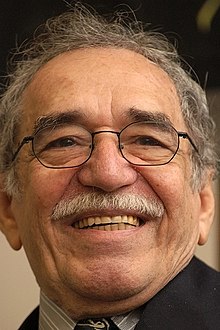
Gabriel Garcia Marquez

One Hundred Years of Solitude is the story of seven generations of a prominent Colombian family living in the fictional town of  Macondo which was founded by the family patriarch, José Arcadio Buendía.  Initially, the town is isolated from the rest of the world, but with the arrival of the railroad, it becomes connected.  Among the many family characters, there are themes of inherited traits, incest, selfishness and licentiousness.  In keeping with the style of magical realism, there are some startling events: five years of non-stop rain and one year of contagious insomnia, for example, which are presented as unremarkable in a laconic tone.  There are many references to real events in Colombian history: a long-drawn-out civil war, colonization by an American fruit company and the cover-up of the massacre of workers.  Each of the characters is distinctive and memorable, principally for their actions, which, in some cases, are outrageous, rather than their beliefs.  Life is not presented as a happy, constructive experience, and memory in not to be trusted.

This is clearly a great classic in its innovative style, its extraordinary imagination, fluid writing, and in the complexity of the human issues on which it touches.  Paradoxically, while I found it difficult to read – to follow the thread of the author’s imagination, I could not put the book down: I had to find the conclusion.  (The family and the town die out.)  At over 400 pages, it is not a short book, but it is also intense and dense.  Often, the novel is written in stream-of-consciousness style, with breathless transitions from one event to the next.  There is very little dialogue to relieve the narrative, and the narrative itself can be quite complicated.  There is one sentence in the book which goes on for a page and a half.  To do One Hundred Years of Solitude its due, one needs to be in a position to read it deliberately, without distraction, so that the dots – or at least most of them – are connected.

Five Types of Readers

On the Goodreads Blog last June, Cynthia (no last name published) posted comments about five types of readers she has encountered.

She said, “As an author, you will encounter many different types of readers over the course of your career.  Some will turn into adoring fans; others might remain a mystery.  Here are five types of readers you’ll probably come across:

1 The Early Buzzer: This type of reader takes pride in reading books many months before they are published, reading books by authors you’ve never heard of, and leaving thoughtful book reviews most likely including quotes from the book.  On their bookshelf: titles without final covers, debut authors.

2 The Casual Reader: Considering that the typical American reads about 5 books a year, you’ll most likely encounter the Casual Reader.  This person leans toward popular bestsellers or classics.  On their bookshelf: The Girl on the Train,  The Catcher in the Rye, and something by Stephen King.

3 The Want-to-Reader: This person has every intention of reading your book, has heard so many good things about it and definitely will eventually read your book.  There are just 300 books on the want-to-read shelf.  (So many books, so little time.)

4 The Dedicated Reader: This reader will be meticulous in writing down every last detail of their reading experience, including where they purchased the book, how long it took them to read the book, where they read the book and what they were wearing that day.  Most likely to point out any factual errors or inconsistencies your editor might have missed.  On their bookshelf: You’ll likely find multiple bookshelves organised by date, season and genre.

5 The Follower: This is the best kind of reader.  Once they’ve read the book, they’ll fall in love with your writing and want to hear about everything you do.  They’ll likely follow you on Goodreads and ask when you’ll be coming to their town on book tour.  Expect lots of ‘likes’ on your content. On their bookshelf: Other books in your genre.  Books you’ve read and loved yourself.”

I suppose this is all well and good, but what I really liked was the first comment on Cynthia’s post published by Peter, who said: “‘Publishing career’ is a bit of a misnomer in my case, but, as far as it goes, here it is:

1 The Secret Reader: This is someone who has bought the book and you are aware from the limited details you have been given that they know you.  But they haven’t told you that they bought it.

2 The Not-So-Secret Reader: This is one of your friends who has bought the book and has let you know that they bought it.  You would have given them a free copy if you’d thought of it.

3 The Window Cleaner: The window cleaner hasn’t read your book (in fact, he probably isn’t aware that you have written one), but he whistles a jolly tune as he wipes the foam from your panes.

4 The Doorman: The doorman snickers as you walk past.  If you knew that you had written a book, he would probably snicker louder.

5 The Reluctant Discussers: These are your friends to whom you have given free copies of the book.  They haven’t mentioned anything about it, possibly because they are overwhelmed or have better things to talk about.”

As for me, if anyone cleans my window it is I, and we don’t have a doorman, so I am spared the attention of these two.  I think all authors wish for more Readers, secret or not-so-secret, and we have to put up with Reluctant Discussers.

How do they decide? Booker shortlist.

In my last post, I argued that critics tend to look for innovation in writing, rather than ‘quality’.  This argument appears to be validated (at least in part) by the shortlist selections for the 2017 Man Booker Prize.

There was a commentary in the Evening Standard on September 13 written by the Literary Editor, David Sexton, from which I quote.

“This year’s Man Booker shortlist is a total surprise.  The two most obvious contenders from the longlist failed to make the cut,  Colson Whitehead’s vivid, inventive novel about slavery, The Underground Railroad. has already won the Pulitzer Prize for Fiction, and the National Book Award in the United States, and been warmly endorsed by Barack Obama and Oprah Winfrey.  Now it has been discarded by the Booker.

“Sebastian Barry’s lyrical ballad about a young Irishman and  his partner fighting through the Civil War in America, Days Without End, won him the Costa Book Award last year – but it doesn’t figure either.  Booksellers will be clasping their heads today.

“Could the judges, chaired by Baroness Young of Hornsey, have possibly been influenced by a desire not to be seen to be following the other big prizes and so seem behind the pace?  Surely not, because the prize’s one criterion is to find ‘the best novel of the year’. regardless.  The problem is that the five judges change every year, so there is no consistency and rarely any clear agreement, producing the erratic decisions that the Booker is famous for – including many terrible eventual winners.  When Julian Barnes dismissed the prize (before he won it) as ‘posh bingo’, he did it too much honour.

“The committee system is simply not a good way of determining ultimate literary value.  If you rope together five individuals and they charge off eagerly in different directions, they are likely all to end up flat on their faces – as I know from my own experience.  Camels are animals designed by committee, and Booker shortlists are compromises.

“Lola Young emphasises that the judges have discovered ‘six unique and intrepid books that collectively push against the borders of convention’.  Perhaps that is all convention ever deserves, to be intrepidly but collectively pushed against?

“The shortlist is certainly great news for the debut novelists, Emily Fridlund. 38, and Fiona Mozley, 29.  Our reviewer called the latter’s novel, Ehmet, ‘a wonder to behold’ and hoped this David would conquer the Goliaths of the Booker.  However, of the novels that have survived this eccentric winnowing, the favourite to win, if it is determined on merit, must surely be Lincoln in the Bardo, by George Saunders, a writer who first came to prominence here through being awarded the Booker’s rival, the Folio Prize, for his short stories.  It’s and extraordinary invention: voices from limbo, counsel from the afterlife, heard as President Lincoln grieves his 11-year-old son, Willie, in 1862.  ‘A dark imagination in service of a tender heart’, said our reviewer Johanna Thomas-Corr.  Properly unique.”

The shortlist for this years Man Booker Prize is:

  • Elmet, by Fiona Mozley
  • Autumn, by Ali Smith
  • 4321, by Paul Auster
  • History of Wolves, by Emily Fridlund
  • East West, by Mohsin Hamid
  • Lincoln in the Bardo, by George Saunders

Critique of Criticism

“There are many differences between critics and sensible human beings, but the main one is this.  Critics are fixated, above all else, with novelty.”

This was how Michael Deacon began his review of the Magpie restaurant on Heddon Street on London.  The Telegraph  lists him as a ‘Parliamentary Sketchwriter’; Wikipedia says he is a British author and political satirist.  In any event, I thought, ‘this guy knows what he’s talking about’.  The review appeared in The Telegraph Magazine on the 2nd of September.  If you’re interested in food, he gave the Magpie four stars and said, “With no menus, adventurous taste buds and an acute sense of smell are required.  Most of the food was terrific.  Essentially, it was dim sum, but with all kinds of influences”

Michael Deacon

He went on to say, “It’s the same in every field of creativity: books, music, film, theatre, painting.  In the eyes of critics, the highest accolade they can bestow is to call a work original – or groundbreaking, bold, radical, seminal, revolutionary.  To them, it’s more important for a book to be original than readable.  More important for music to be original than tuneful.  More important for a play to be original than enjoyable.  Novelty trumps all.  Pleasure is a lesser concern.

“There are two reasons for this.  First, insecurity.  A critic is anxious about dismissing a work that is experimental for fear of how he’ll look to his fellow critics.  He’ll look stuffy, provincial, dim.  He’ll look as if he doesn’t get it.  He has to show them that he’s intelligent enough to understand and appreciate what the artist, this subversive innovator, this trailblazing auteur, is doing.

“The second reason is just as crucial.  Boredom. Think of a teacher marking a stack of essays from an exam in English literature.  In essay after essay, the same topics recur.  An exhausting majority of students have written about the set texts.  Read in isolation, their essays might be perfectly well-written – but read one after the other, they start to seem drainingly uninspired.  So a student who writes about an unusual topic – about novels, plays or poems that weren’t even taught  on the course may get a higher mark than those who wrote about the set texts, even if his essay is inferior.  The marker is simply relieved by the change in scene.  That’s what critics are like.  Sooner or later they run out of things to say about the conventional.  Hey ho, another romantic comedy.  Yawn, another detective thriller.  So when something unusual turns up, they embrace it with desperate gratitude.  What the paying customer is likely to make of it is irrelevant.  What matters is, it’s given the critic something new to write about.  The artist has done the critic a favour – and, more often than not, can expect to be rewarded.

“But of course, the above doesn’t apply only to critics of books, music and the rest.  It applies to restaurant critics, too.  And so when I go out to review a restaurant that’s in some way out of the ordinary, and decide that I like it, I have to ask myself: do I, though?  Am I genuinely enjoying myself?  Honestly?  Or am I just grateful to the chef because he’s just made  my job easier?”

Five stars to Michael Deacon!

Review: The Bestseller Code

I mentioned The Best Seller Code in my recent post of August 4th, where I commented on a review by Sandra Elliot for The Florida Writer.  Now, having read the book, I can give you my own reactions.

First, let me say that it is a ‘must read’ for aspiring novelists, not because it reveals all the secrets of creating a bestseller (which it doesn’t), but because it will give you insights into your own writing’s weaker points.  (Assuming that there are a few.)

One aspect of the book that I found frustrating at the outset was that there was no discussion about how the ‘almost five thousand ‘ novels which were read by computer were selected.  Five hundred to these (10%) were best sellers.  Presumably all genres were represented, but in what sort of distribution?  Equal balance of male and female writers?  How about the age and background of the authors?  (There are comments on the back grounds of best-selling authors.)  What about the authors’ nationalities?  (Although all are presumably English-speaking.)  There was no mention of the age distribution of the novels, although all of the bestsellers mentioned are recent novels.  To what extent do readers’ tastes change over time?  How about the type of publisher (traditional vs indie) and the marketing budget?

There are a number of examples of the characteristics of books which tend to make them best sellers, or not, and these, of course are helpful.  But the authors admit that their computer model is only 80% accurate in predicting whether a novel will be a bestseller.  The methodology of the authors’ research used three different mapping algorithms to compare hundreds of dimensions in ‘space’.  One dimension, for example, is the use of the word ‘very’.  It turns our that authors who use ‘very’ frequently in their text are less likely to produce bestsellers.  Particular dimensions may be quite influential in predicting bestsellers.  An example is ‘human closeness’.  The computer reads the text looking for words and arrangement of words which mean that the author is writing about human closeness.  It turns out that Fifty Shades of Grey was not a best seller because of its sexual content, but because of its human closeness.

The computer was 71% accurate in identifying the gender of the author.  Three genres that have difficulty achieving bestseller status are romance, science fiction and fantasy.

Some of the dimensions which contribute to good public acceptance include: emotional cycles; active, rather than passive characters; characters who need rather than wish for; author’s distinctive style (J K Rowling’s first incognito novel was recognised not by its subject but by her style).

Topics that readers like include: marriage, death, taxes (really), modern technology, funerals, guns, school, work, doctors, presidents, kids, moms, and the media.  Less popular subjects are: sex (except in a small erotic genre), big emotions, wheeling and dealing, existential or philosophical sojourns, dinner parties.

For me, the chapter on style was particularly interesting as it included a number of specific examples and commentary on why a particular style is effective.  I also believe that I need to work harder at bringing life to what my characters are feeling in subtle but effective ways.

Having said all this, I think it’s important to keep one vital point in perspective.  There are many award-winning novels which are clearly labours of love by their authors, memorable for their readers, and which never make the bestseller list.