Author’s Mood

In several posts, I have mentioned writer’s block.  I have said that when I have it (which is occasionally) it is usually an indication that my writing has slipped off the track, and that I should rethink my recent work, or ask myself searching questions about the direction that the novel is taking.

I will say that another important blockage for me is either being tired or in a strong mood.  If I’m tired, I can’t focus properly, and my creativity is numbed.  I don’t write when I’m tired.  If I’m in a negative mood or preoccupied with a personal  issue, I have difficulty getting  myself into the mood that the character(s) is feeling.  If I’m angry about something, I find it more difficult to feel the joy that a female character is feeling.  If I’m worried about someone, how can I fully empathize with a protagonist who is experiencing a different relationship problem?  For me, forcing myself into the mood of a character is possible only when I’m not preoccupied.

images

In fact, I find it difficult to write well about a character who is depressed if I’m in a low mood.  The empathy is there, but, if I’m in a low mood, it’s difficult to find just the right words to fully express the feelings of the character.  For me, it seems to work best if I’m in a ‘neutral mood’, empathize with the character, and then find to words to express what the character is feeling.

Let me give you an example from Sable Shadow & The Presence.  The central character is on a business trip to a Mexican oil refinery when his wife calls and tells him that his much-loved son – a military officer – has just been killed in the Somali area.

I was numb and senseless, but the pain was inescapable.  I could not really function.  I could walk, but my destination was unclear.  I could hear voices, but I had to turn toward the voice I heard and try to understand if it was addressing me.  My mind had great difficulty processing.  It was as if a powerful ray had struck my head and turned my brain to mush.  I knew David.  He helped me pack, and he rounded up the pilots.  He fastened my seat belt.  He gave me a glass of something cold, and sometimes he would reach across and hold my hand.

I had no sense of time.  I was drifting in a remote, timeless space.  Then I recognised the front door of my house.  Inside, there was Suzanne.  She was pale, years older, in that familiar blue quilted bathrobe.  We sat on the living room sofa, and she talked to me.  I don’t remember what she said.  She was very sad.  She led me to the bedroom and took off my clothes.  She removed her bathrobe.  In bed, she pulled the covers over us, and we wrapped our arms around each other.  We lay like that, weeping and dozing through the night.

There were dreams: of William trying to master a skateboard, of William holding up a small trout, of William wearing a muddied jersey number 24.

There was no mistaking the voice:  You loved William and he loved you.  Remember this.

What did you say?

But I knew what was said, and I knew the voice even though I had not heard it often for ten years or more.

Interview with Norm Goldman

I have had an e-interview with Norm Goldman, Publisher and Editor of Bookpleasures,com.

download

Norm Goldman

Norm: How did you get started in writing? What keeps you going?

William:  I had taken a writing course at university, and I always enjoyed writing reports in business, but I had never considered myself a writer of fiction.  About eight years ago, I was on holiday in Sicily and I had a series of romantic dreams in which I was involved as a bystander.  I thought: it would be fun to write these down.  I began writing and by the time I got to page 70, I decided to finish it.  That was my first novel.  Since then, I’ve derived an increasing satisfaction from completing novels which are better and better.

Norm:  What do you think most characterizes your writing?

William: There is always at least one character who is facing ethical/moral dilemmas.  I try also to give the reader a strong sense that what she is reading is true and real.

Norm: What did you find most useful in learning to write? What was least useful or most destructive?

William:  What has been most useful is the feedback I have had on my writing.  I am also a fairly avid reader, and I always publish a review of the books I read.  This sharpens my critical skills which are important when I’m writing.  I really can’t think of an experience which has been destructive.

Norm: How many times in your career have you experienced rejection? How did they shape you?

William:  Countless times.  I received several dozen rejections for my first novel, and I was ready to give up on getting it published when Eloquent Books (the predecessor of my current publisher) came to me with a co-op publishing offer.  Since then I have approached about twenty literary agents and publishers for every novel I’ve written; my approaches have been universally rejected (usually politely) or ignored.  I’ve stayed with Strategic Book Publishing.  My impression is that to get a contract with a traditional, main-stream publisher, one must have a third-party intervention or recommendation.  This is an understandable symptom of risk avoidance in the publishing industry, but it also suggests a lack of independent, creative thinking in the industry.  My lack of acceptance by main stream publishers has not deterred me.  I will carry on writing better and better novels.  Someone will almost certainly notice.

Norm:  In your bio you indicated that the spiritual/religious genre is your preferred choice. Could you explain to our readers, why?

William:  I am a religious person, but not evangelical.  The romance and the three thrillers all have religious aspects.  I started writing Sable Shadow & The Presence as a kind of experiment, and I had to re-write large portions of it, but, at the end, I felt particularly good about it.  Several excellent reviews and being awarded seven minor prizes convinced me that I had found my venue.

Norm: How did you become involved with the subject or theme of Seeking Father Khaliq? As a follow up, have you ever lived in Egypt?

William:  Before I started Seeking Father Khaliq, I decided to write about one character’s search for God, but I didn’t want a typically evangelical book. It had to involve a faith other than Christianity and a venue outside the West.  Also, the book had to have more issues than a singular focus on spirituality.  I’ve never lived in Egypt, but I’ve visited the country several times.  In creating Seeking Father Khaliq, I spent as much time on research as I did on writing.

Norm: What were your goals and intentions in this book, and how well do you feel you achieved them?

William: My intention was to leave a gentle message that if one wants to find God, He can be found, and that sometimes He is revealed in the midst of adversity.  I think the message is there and perhaps made a bit more interesting by Egypt, philosophy, Islam (good and bad), and the will-of-the-wisp Princess Basheera.

Norm: Do you worry about the human race?

William:  Not in the long term.  The short term can be a horrendous mess, but somehow we will muddle through.

Norm: How did you go about creating the character of Professor Kareem al-Busiri? (As a passing note,  I am married to someone born in Egypt and who lived there until the age of 18, I am familiar with the male Egyptian mindset and you seemed to have vividly captured it).

William:  My specifications for Kareem were:

  • A respected professor of philosophy at a prominent Egyptian university (I wanted to include philosophy to add richness)
  • He should be a secular Muslim: a sort of agnostic
  • He should be single to introduce a romantic element
  • He should be open-minded and a bit naïve (to believe Princess Basheera)
  • He should have adult children to add complexity

Norm:  What are some of the references that you used while researching this book? As a follow up, can you share some stories about people you met while researching this book?

William:  My principal reference was Classical Arabic Philosophy, an Anthology of Sources, by Jon McGinnis (Translation), David C. Reisman (Editor).  I spent countless hours on the internet to gather facts, opinions and experiences.  I don’t remember their names, but I enjoyed vivid personal accounts by pilgrims on the Hajj and Arba’een.

Norm: What was the most difficult part of writing this book and what did you enjoy most about writing this book?

William: The most difficult part was staying factual in detail, down to the specifications of the Russian-made weapon which killed Kalifa.  Most satisfying and enjoyable was integrating all the pieces of a complex story.

Norm:  Did you learn anything from writing the book and what was it?

William:  While I have read quite a lot about Islam, and I’ve read the Qur’an, I gained a perspective of Islamic culture, and its effect of the values of people.

Norm: Where can our readers find out more about you and Seeking Father Khaliq?

William: I have blog (https://williampeaceblog.com/) which has been going for six years, and which includes my opinions and experiences as a writer.  I’ll let Father Khaliq speak for himself.

Norm: What is next for William Peace?

William:  I’m writing another novel, set in East Africa, with three main young adult characters: a penniless man of traditional tribal faith; a middle class, Christian woman; and a Muslim man from a wealthy, prominent family.  All are black: there is plenty of interaction and clashes in values and beliefs.

Norm: As this interview draws to a close what one question would you have liked me to ask you? Please share your answer.

William:  What else does your ‘day job’ consist of?  Because I write with intensity only three or four hours a day, I need ‘alternative occupations’.  These include pro bono consulting work for London charities, treasurer of a charity which provides psychotherapy, and involvement with two of our daughters and their families who live nearby.



Books as Therapy

The November 7th issue of Time Magazine has an article Read a Novel: it’s just what the doctor ordered, written by Sarah Begley.   Ms Begley is a staff writer for Time; she writes book reviews and culture stories for the magazine.  She has worked at Newsweek, The Daily Beast and Hearst Magazines.  She lives in the New York City area and is a graduate of Vassar College.

download

Sarah Begley

She says, “the latest round of research on the benefits of literature focuses on how it improves not our IQ but our EQ.”  Researchers at the New School for Social Research found a link between ‘theory of mind’ (the ability to know what a person is thinking or feeling) and reading a passage of literary fiction (as distinguished from popular fiction).  Ms Begley continues, “Maria Eugenia Panero of Boston College says it is ‘hard to know whether reading literary fiction increases theory of mind or if people who naturally have a higher theory of mind are more drawn to literary fiction'”.

Ms Begley reports that a 2012 study at Ohio State University had undergraduates read different versions of a story in which a protagonist overcomes challenges (car trouble, bad weather, long lines, etc.) in order to vote.  Those who read a version of the story which led them to identify strongly with the character were more likely to vote in a real election a few days later: 65% reported having voted as compared to 29% of those who read a less relatable version of the story.  The story did affect the behaviour of some readers.

Bibliotherapy, which involves the prescription of novels to ‘cure life’s ailments’, is practices at the School of Life in London.  Ella Berthoud, an artist, and Susan Elderkin, a novelist, are friends from their Cambridge days when they left books for each other to deal with the crisis of the week: be it romance, work stress, or whatever.  Now, while they are not trained at therapists, their clients pay £100 to spend 50 minutes with them, in person or via Skype.  The clients fill out a questionnaire about what they like to read and what is going on in their lives.  “The bibliotherapist makes an ‘instant prescription’ at the end of the session and then sends a list of six to eight books and the reasons for the recommendation a few days later.  They say the feedback is 99% positive.”

Ms Begley concludes: “The science behind reading for mental health is limited, but researchers like Panero are eager to continue exploring the benefits.  ‘I think we all have some intuitive sense that we get something from fiction’, Panero says.  ‘So in our field we’re interested in saying – well, what is it that we’re getting?’  Even the greatest novel cannot cure clinical depression, erase post-traumatic stress or turn an egomaniac into a self-denying saint.  But it might ease a midlife crisis or provide comfort in a time of grief.  As Elderkin says, it’s natural for readers to find it’satisfying when people come up with ‘proof’ of something which they’ve always felt to be true.'”

As for me, I certainly subscribe to the theories presented by Ms Begley in her article.  That is why I write novels like Seeking Father Khaliq.

Promotion

Now that I have a new novel out, it’s time to think about promoting it, right?

Actually, one has to think about promoting a novel before one starts writing it.  Probably, the first question to ask is: who’s going to read it?

Let me give you a summary of my experience using various promotion channels.  And I should confess that while I have a marketing background, I would much rather write than promote (because I think I’m better at writing than at selling and I enjoy writing more)

images

Press Release: My publisher writes a draft press release which I edit and it goes out to ‘thousands of libraries, book shops, media outlets’.  Fortunately, it’s in an electronic form, so that no trees are actually killed (not even from recipients printing it out, which, as far as I know, has never happened).

Website:  I have a website (www.williampeace.net), which I share with the publisher.  At the moment, I’m waiting for the publisher’s IT guru to add Seeking Father Khaliq.  Then, I’ll ask my IT handyman to add some real content.  Essential?  Yes.  Has it sold any books?  Doubtful.

Blog:  Here we are!  For me the main value of a blog is the work I have to do each week – other than writing – to prepare something which might be stimulating.  And, I very much enjoy it when someone responds!

Twitter:  Pass.  Unless you’re a big name author and people want to know what you had for breakfast, I doubt that 140 characters per day sells many books.

Goodreads & Amazon Author Pages:  Yes.  They even run my blog down the side – as does my website.

Facebook Pages:  Yes.  I have a personal page, an author’s page and there’s a page for each of my books.

Advertising:  Yes.  Five of my books have regular advertisements on Goodreads.  What I’ve got to do now is to revisit the advertising copy on some of the ads because the click-through-rate is too low.  There have been quite a few books added to readers’ lists.  Currently, I’m running a Facebook ad which covers the commuter homebase north of Manhattan.  Lots and lots of ‘Likes’.  Sales?  Hard to say.  The Facebook ads are expensive.

Giveaways:  I ran a giveaway on Goodreads last year.  Over one hundred people applied for ten books.  After I sent the books out, I got one semi-literate review, instead of the ten I should have received.  Don’t they do book reports in school any more?

Brick & Mortar Bookshops:  Bookshops will carry books only if they are bought on a sale or return basis.  That way, they get left with zero unsold stock.  My publisher offers a ‘deal’ where the author underwrites the cost of returns from bookshops.  When I pointed out that since they had something to gain from sales to bookshops, they ought to participate in the underwriting.  Their response was to put a cap on my potential exposure.  I signed up to that for a while, but there was no evidence that any bookshops bought copies.  I’ve offered to carry the stock for several independent bookshops in London, but there was no interest in even a sample book. I approached Barnes & Noble about carrying one or two of my books in selected stores.  No interest.  With (very) rare exceptions brick and mortar bookshops buy from traditional publishers.  Period.

Book Signings: A few years ago, my publisher would arrange book signings.  In fact I was offered a signing at a rural bookshop in Maine, but I had to buy and carry 50 books with me.  This service has since been discontinued.  In fact, I have the impression that book signings work only for non-fiction accounts of a juicy scandal written by one of the perpetrators.

Awards:  This is a semi-major project area for me. I’ve stopped submitting to the outfits that run multiple contests with unidentified judges.  That still leaves about one contest per month, and I’m getting recognition about half the time.  (No serious money yet.)

Reviews:  You may know that Amazon has cracked down on pay-for-review outfits: they won’t let them post reviews.  This makes some sense in that the money might be trying to buy a good review.  The problem is that there isn’t enough review capacity in the industry.  Willing and educated reviewers tend to flock to the best sellers.  Bloggers who offer  reviews typically have a very long waiting list.  Reciprocal reviewing services are an option, but, to be fair, one has to reading some marginally interesting stuff to win a hasty review.  Recently, I tried a different approach to the literary editors of large newspapers.  I had previously sent a few of them samples of my latest book.  No response.  I identified about fifteen literary editors of major newspapers in the UK, US and Canada, and I sent them carefully crafted messages about Seeking Father Khaliq, inviting them to review it.  There were two polite ‘no thank you’s.

So let me end with a fantastic offer!  If any of my readers would like to receive a free copy of Seeking Father Khaliq with an obligation to publish a brief, learned review, please email me at  bill(at)williampeace(dot)net!

New Novel

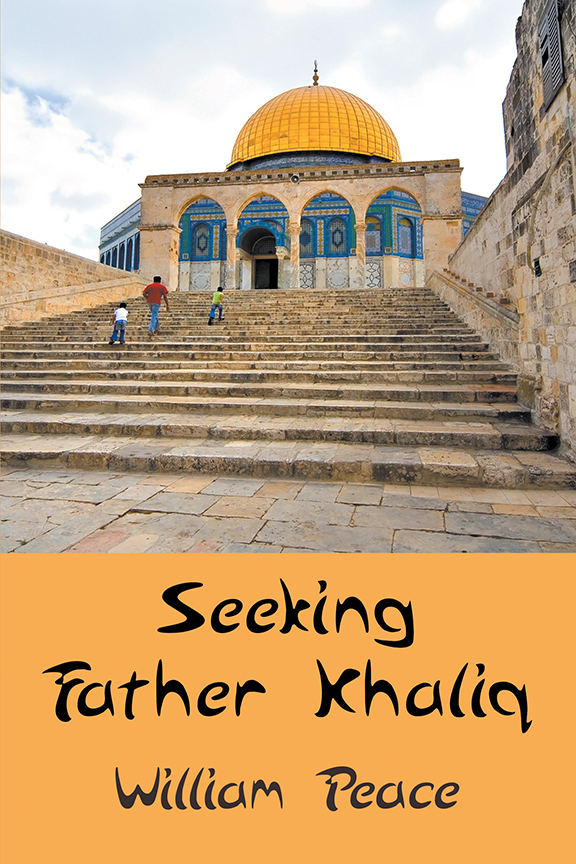
My latest novel, Seeking Father Khaliq, has just been published.

9781681818009-Peace_CV.indd

Seeking Father Khaliq is a modern allegory about one man’s search for spiritual fulfillment. Set in the Middle East, philosophy professor Kareem al-Busiri teaches at a prestigious Egyptian university.
The professor is persuaded by a Princess Basheera to find Father Khaliq for her.  From time-to-time, the professor wonders whether the princess is real or did he imagine her?  In the search, he undertakes important pilgrimages: the Hajj, Arba’een (the huge Shia pilgrimage to Karbala in Iraq), to Medina (the Prophet’s tomb), to Jerusalem and Rome. He falls in love with a colleague who was his late wife’s best friend, and who like his late wife and daughter is a Coptic Christian.  He attempts to manage mortal conflicts of values and ideology between his two sons.  One son is an Egyptian army officer; the other is a lawyer who is secretly providing money and arms to the terrorist insurgency in the Sinai.  Classical Arabic philosophy is woven into the narrative to support certain viewpoints.

The back cover continues:
Carefully researched and constructed, this dynamic story reflects the current religious, political, and social turmoil of the region.
Seeking Father Khaliq is unique in its Middle East setting, and its focus on Islam, as well as elements of Christianity and Judaism. The use of the jihadist conflict in Egypt as a surrogate for larger regional conflicts, the religious pilgrimages, and the resolution of inter-faith marriage issues are also highlighted.

There are two reviews, so far:

E. Lund for Phi Beta Kappa Reviews said, in part:

” . . . Author William Peace has woven a compelling narrative that explores the issues of religion, politics and social change, all while avoiding the pitfalls of becoming a treatise. Instead, “Seeking Father Khaliq” is a moving study of a family caught up in the volatile turmoil of the times, and a father who finds that moving closer to God is a way to navigate forward.  Beautifully written with vivid depictions of religious pilgrimages, the book also delivers three dimensional characters fully realized and equally empathetic. Highly recommended for those who want to know more about this important part of the world, but as much to be enjoyed simply on its narrative merits. “

Deborah Lloyd for Reader’s Favorite said, in part:

“. . . The author’s writing style is clear and concise. The account is thought-provoking and fascinating; the reader will be forever changed. This is a much-needed book during these difficult, challenging times in our modern world.”

I will just add that this book was a great pleasure to write.  I spent at least as much time on the internet researching as I did in the actual writing.  It took two years to write – about half my normal pace.  I also feel that my original idea for the book blossomed very nicely: one man’s search for God, Middle East setting, key character a philosophy professor, told in the first person, two sons on opposite sides of the regional divide.

I hope you enjoy it!

Designing a Cover

I probably wrote about this subject quite a while ago, but it’s close enough to my heart that it warrants a re-exploration.

My publisher will produce two cover designs, and the author can have his/her choice.  To facilitate the process, there is a questionnaire for the author to fill out.  It includes such questions as:

  • what is the book about?
  • what ideas do you have for the cover?

I usually respond with a fairly detailed cover idea.  In the case of my second novel, Sin & Contrition, I didn’t have an idea, and I probably told the cover designer that the cover should reflect sin and repentance.  What came back was amazing, and I liked it immediately:

413rtvescwl-_sx328_bo1204203200_

But with the five novels that have followed since, I have had to make more of a personal effort.

My latest novel, Seeking Father Khaliq, is a modern allegory about one man’s search for spiritual fulfillment.  It is set almost entirely in the Middle East, and many of the issues involve Islam.  As the title implies a difficult search, I told the designer that I wanted a Middle Eastern maze with the Dome of the Rock (the famous mosque in Jerusalem) positioned at the end of the maze.  What came back was a modern, three-dimensional maze with the Dome of the Rock floating on the horizon.  It just didn’t work.  Next, I found two, antique two-dimensional mazes to choose from, and I suggested that the Dome of the Rock (in miniature) be positioned at the success point in the center.  This also didn’t work; I gave up on the maze.

While browsing dreamstimes.com’s collection of mosque photos, I came across a single photo of some people ascending a long flight of stairs toward the Dome of the Rock.  That’s it.  But meanwhile, my wife, who has a much better eye for things artistic than I, had objected to the font proposed by the designer for the cover: “It’s a dated Western font; there’s nothing Arabic about it!”  So, on a page offering ‘free Arabic fonts’, we found one we liked.

What came back from the designer was a lot better, but I asked that the photo be enlarged and positioned at the top of the cover, and that the white highlights be eliminated from the font.  We’ll see what comes back, and I expect to introduce the book and its cover to you when it goes to press within a month.

It is true that one can’t judge a book by its cover, but the cover can play an important role in introducing the book to the reader!

Manuscript Editing

editor

Yesterday, I received the edited copy of my seventh novel back from the editor.  For me, the way it works is that I – as the author – am responsible for professional editing of my books.  The publisher will arrange for editing, but the author has to pay for it as a part of the co-operative publishing  deal.  On one occasion, I used the publisher’s editor, but never again.  It was a less expensive fee than my usual editor, but a lot more costly in my time and aggravation.  That editor didn’t understand that her job was just to check the grammar, spelling, punctuation and syntax of the manuscript.  She did that (sloppily), and many of the changes she made were incorrect, and had to be reversed.  This made me wonder how competent she was at finding the real errors I made.  But what really irritated me was that she made changes to the text so that the meaning I had intended was lost.  Clearly, she didn’t like the characters or my plot.

Vonda works for a large editing company and she has edited the other six of my novels, including my latest, which is 108,000 words.  (That will work out to be about 250 pages, and her company’s fees were just under $1000.)

To give you a sense of what she wanted me to change:

  • too many commas
  • too many colons
  • English English to American English spellings (my publisher is American)
  • removing the hyphens from compound noun; for example hang-dog becomes hangdog
  • catching instances where two-letter words were wrong; for example: ‘in’ appeared in place of ‘it’ or ‘is’

The above changes were made after I had read through the manuscript at least three times and my wife had read it once!  Sometimes we see only what we think should be there!

And then there were her really useful comments:

  • there were two cases where I misspelt the name of the Egyptian president as ‘Al-Sisi’ when I had previously spelt it correctly as ‘el-Sisi’.
  • Similarly, in later paragraphs, I had misspelt the Anglicized version of an Arabic surname.
  • In one case she questioned the identity of the speaker (it could have been either of two characters).
  • And one case where she questioned my translation of an Arabic word.  (She was right.)

She made the following general comment: “This is somewhat of a departure from your previous works — more philosophical and thought-provoking.  The characters are, as usual, well-drawn, believable and sympathetic, and your descriptions of all the places Kareem visits made me feel as if I were right there with him.”

There is another step of editing: when the manuscript is laid out for printing, there are inevitably new errors – particularly in format – which creep in, and I will have to read it again carefully.

I haven’t told you much about this latest novel, because it hasn’t been formally copyrighted yet, but please ‘stay tuned’!

Trends in Novel Genres

Chip MacGregor is a “book guy” by his own admission, and he runs the MacGregor Literary Agency.  He was asked recently: “Can you tell us the latest trends you’re seeing in fiction?”  Here is the (abbreviated) answer from his blog:

index

Chip MacGregor

The continued growth of romance — particularly historical romance. Let’s face it, last year the publisher who saw the biggest growth was Harlequin, and they did it in a down year for most publishers. Readers in a bad economy like to escape by reading romance novels. You can roll your eyes if you want to, but it’s the truth.

Thrillers aren’t selling like they used to.  James Patterson and other bestselling novelists can still move large quantities, but once you move away from the bestselling authors, it’s much slower (and, frankly, much harder to place a new novelist). 

There is a renewed interest in Americana, particularly during sunnier days. We’re seeing interest in the Victorian and Edwardian periods, for example (assuming it’s fair to use British terms for American history). That seems to be a trend away from seeing so many wartime sagas — perhaps a reflection on our fatigue with the never-ending war in Iraq. 

We’ve seen a lot of growth with fiction that surrounds historical events. Not a retelling of the events, but of stories that touch on history. So, for example, we’re not seeing novels that re-tell the assassination of President Lincoln, but we ARE seeing novels that have to do with people who were in the vicinity, or who knew John Wilkes Booth, or who were at Ford’s Theater, or who were part of the chase to catch the conspirators, etc. Again, not so much focused on the event itself, but on characters who were influenced by the event. 

Literary fiction is definitely a growth category in American publishing. Take a look at any bestseller list, and you’ll see a lot of literary fiction. Not only that, but many of the books have a clear spiritual thread — something I don’t see many people recognizing or reporting on. 

One of the most-reported growth trends has been in paranormal fiction.

 I see mixed signals in the horror category. Some think it’s up; others think it has run its course. I don’t have a firm opinion one way or the other. 

Of course there has been huge growth in the Christian/inspirational category over the past 7 or 8 years. The incredible growth has slowed, making some think religious fiction is hurting, but that’s just not true. Christian fiction is still a HUGE category, and there is still growing interest from those houses who were late to jump on board during the heyday. So while, yes, we’re not seeing the big growth in titles that we did a couple years ago, compare the number of titles and the number of genres and sub-genres to what we saw just three years ago. 

One of the most visible areas of growth in the inspirational category has been Amish fiction (or “bonnet novels”). Some people have said that it’s going to fade out, but I don’t believe it. I think it has established itself as its own sub-genre. What Bev Lewis started and Cindy Woodsmall followed has turned into its own category of fiction. That sort of thing happens sometimes — consider Louis L’Amour creating the giant interest in westerns, or Edgar Allan Poe basically establishing horror fiction. People are still buying it, so it has clearly found its audience. 

He goes on the mention the growth of small presses (including those who specialise only in the production of e-books) and the growth of e-books themselves.  He continues: “I don’t think ink-and-paper books are going away any time soon — most every reader still loves printed books. But I’ve got three kids in their 20’s, and all of them are comfortable reading a book on a screen — even an iPhone screen. That tells me when their generation is in charge, the e-book will be a core business, not a side business. It will be a major part of every publishing decision, not simply a sub-rights discussion. 

I can comment on two genres mentioned above: thrillers, and spiritual literary fiction.  Five of the soon to be seven books I’ve published are in these two categories.  The three thrillers I’ve written are all pretty gripping, and realistic.  But, I’m beginning to feel ‘been there, done that.  Sable Shadow & The Presence is spiritual literary fiction, and it has won eight (minor) awards to date.  Writing it and the reaction I’ve had to it have motivated me to (nearly) complete my seventh novel, which has a definite spiritual dimension, and is set in the Middle East.  In spite of the fact a tremendous amount to research was required, I greatly enjoyed the experience.  I’ll tell you more about it as soon as the publishing contract is signed.

Editing by the Author

I used to believe that the only editing I, as an author, had to do was to scan each piece of text five times: check for typos, punctuation, spelling, and was it saying what I wanted to say

  1. When I had finished a sentence
  2. When I had finished a paragraph
  3. When I had finished writing for the day – usually 2-3 pages
  4. Re-read the entire chapter
  5. Re-read the entire novel

At the end of step five, I would turn the completed text over to a professional editor who would spot additional typos, spelling and punctuation errors, and who might also raise some questions about characters or events.

index

But with my latest novel, I find that these five steps are not enough.  After completing the final chapter and before step five, I have found it necessary to review each chapter, from the beginning, in detail, again.  Why is this necessary?  When I finished the last chapter, I had some concerns about what I had written before:

  • Was each character developed consistently, and in keeping with his/her role in the story?  For example, the credibility of one character depends on the reader believing that he has a high level of curiosity.  Was this curiosity trait well enough developed?
  • Was the setting described so that it was both clear and credible without being be-labored?  This was important because the entire novel (except for part of one chapter) is set in the Middle East, and all the characters speak Arabic as their mother tongue.  Would a Western reader lose sight of the setting, and therefore miss the cultural dimension of the story?
  • Were the events in the novel supportive of the themes – the messages – which I’m trying to convey?  I have to check both the events and the characters’ reactions to them to be sure that what was happening wasn’t superfluous and was leaving the reader with the right impression.

The way I am going about this chapter-by-chapter review is to begin with a critical re-read.  I’ve made mental notes to add a paragraph here to include a piece of history about a character, or to change an event so that it contributes more effectively to the message.  As I read, I find typos, and language that is too ordinary, or does not leave a clear unique impression.  I find unnecessary phrases and pieces of dialogue. I also find mistakes.  For example, in chapter 2, a peripheral character has three children, but in chapter twelve she has two.  I’ll go through each chapter at least three times before I have taken care of all the big issues and the little ‘niggles’ I’ve found.  As I re-read and re-write, I’m constantly asking: does this feel like the Middle East?  This detailed  review has to be done with all pride of authorship set aside.  I have to pretend that I am a very senior, experienced editor working with a red pencil on the work of a talented young author.  It is a time-consuming process, and it can take two or three days to complete a twelve page (single-spaced) chapter.  But it is also challenging, mostly enjoyable and ultimately satisfying.

Review: Classical Arabic Philosophy

I bought this book as a resource. My latest novel has, as its principle character, a professor of philosophy at a prestigious Egyptian university. I wanted to be able to refer to actual teachings of classical Arabic philosophy in his interactions with students and to use some of the philosophical discussions to help make some of the conclusions in the novel. In these two respects, the book was an excellent resource. I could have the professor discuss the teachings of a particular ancient philosopher with a student, quoting the philosopher by name, dates of birth and death, place of origin, philosophical interests, and exactly what he had written. I could also use what a philosopher had written to establish a point I wanted to make in the novel.

index

The book has a useful index of key words, both in English and Arabic. The text, however is largely in English. It also has, for the serious reader, clarifying footnotes, and an extensive bibliography. The preface will acquaint the reader with the methodology used by the authors in the selection and translation of the material. The introduction gives the background of the classical Arabic philosophy, which is – to a large extent – derived from Greek, particularly Aristolean, philosophy. What I found of particular interest was that the first prominent Arabic philosophers appeared barely two hundred years after the founding of Islam in 622 AD – well before their Western counterparts. While Greek philosophy provided a foundation, there were philosophical debates within Islam which also provided grist for the mill.

The book includes translations of selected, verbatum writings of a dozen philosophers who lived between the 9th and 13th centuries AD. Subjects of discussion for the Arabic philosophers included physics (motion, force, change, etc.); metaphysics (being, knowing, identity, time and space); theology (God, the soul, eternity). The language used by the Arabic philosophers can be quite turgid and difficult to follow. I suspect this was more the convention of the era than a fault in the translation. Also, the use of logical conventions, which appeared in the West later, were not available at the time to structure a clear proof of a theory.

This is not a book that one would want to read for pleasure unless one were a practicing philosopher. It could serve as a text book in the teaching of philosophy. And it is an excellent reference work.