Review: Achieving Superpersonhood

6705 HWY 290 W, Suite 502-255
Austin, Texas 78735
512.280.2001
http://www.readerviews.com
admin@readerviews.com


Achieving Superpersonhood: Three East African Lives
William Peace
Strategic Book Publishing and Rights Co. (2018)
ISBN 9781948858892
Reviewed by Robert Leon Davis for Readers Views (1/19)
“Achieving Superpersonhood: Three East African Lives” by author William Peace is a novel set on the Continent of Africa, involving the personal lives of three East Africans. Each is exposed to various decisions and choices they make involving their lives, with either dire consequences or happy outcomes. The intertwining relationships between the friends is just plain awesome.
“Achieving Superpersonhood” is sort of written in the third person, which eloquently dictates the pace of the characters’ lives. There is also what I call a “footnote,” or another person speaking in the third person, which reminds one of God or Satan, (or good or bad), immediately questioning each person’s decisions. This “footnote” is the brilliancy of the author and the plot! I really don’t know how he imagined this stupendous plot or “footnote.” It’s a novel that can’t be explained but actually has to be read.
I’ve read hundreds of novels, but this is top on my list. It’s the crème de la crème of novels that I’ve read. I personally place this work in the vein of a Charles Dickens. Huh, you say? Yes, in my humble opinion. As I’ve stated and must repeat it again; the plot is beautifully set, with surprisingly contrasting differences between each character and a “can’t wait to read what’s next” feeling.
“Achieving Superpersonhood: Three East African Lives” by William Peace is an excellent, well-written novel, thought provoking on a serious level, and a beautiful flow from one incident to another. The characters also seem real, not imaginative. I thank the author for sharing this “work” not book, with me, and recommend it to the many readers who enjoy and love reading a good novel. Well done, sir. 5 stars plus!

Doing Whatever It Takes

There is an article by Sandra Wendel which appeared in the December 2017 issue of the IBPA Independent magazine.  Ms Wendel is an experienced book editor who specializes in helping authors write, polish, and publish their manuscripts; she gives the following example of “doing whatever it takes” as an editor.  Her website is https://www.sandrawendel.com/.


Sandra - headshot 082918.JPG

Sandra Wendel

“After working his way up through the ranks in narcotics and homicide, putting plenty of bad guys in prison, and retiring from exemplary work on the Omaha Police Department, detective Brian Bogdanoff sat down to write a story.”  (A true story of two bad guys who stole tons of marijuana from three Mexican drug minions, shot the three and burned their bodies along the roadside near Omaha.)

“Brian and I met in a book-writing class I was teaching at the community college. The manuscript he brought me read like a police report with words like “vehicles,” “perpetrators,” and “victims.” So I invited him to my home office, sat him down, and we began.

“He had written:

As I spoke with each of them separately, I could see nobody wanted to talk yet, so I made it very clear to Preston and Gaylan that I was a homicide detective, not a narcotics officer, and this case that brought me to them was just getting started.

As if he were on the hot seat in an interrogation room, I grilled him: “What did Gaylan look like?” “What was he doing?” “What exactly did he say?” “And then what did you say?” “Describe the room—how big, furniture, what?”


Here’s the revision of the same passage:


Gaylan was first. If someone was going to talk, I thought it would be Gaylan.

I walked into a fourth-floor interview room of the Criminal Investigation Bureau at downtown police headquarters. Gaylan was sitting at the same table where he’d been sitting for nine hours while we were searching his house, the recording studio, the lawn service, the remaining storage units, and his secondary houses.

His head was down, he looked up at me and said, “What’s up, man?”

He’s a big guy, twenty-four years old, and was tired from sitting in a ten-by-ten room all day. He wasn’t handcuffed, but there was a guard outside the door.

“You got big problems.” I opened the conversation. “I got a receipt and inventory of all the stuff we recovered today, and it doesn’t look good.” I handed him a list of the property seized.

“I’m a homicide cop, and that’s what this is all about, so you might be in your best position right now to tell me what you know,” I said. “If someone else wants to talk first, they’ll get all the good things that come with it.” And he chose not to talk.

I gave the same spiel to Preston. He had the same attitude. He wasn’t talking.

Roscoe and I then walked Gaylan to the jail elevator and rode it to the basement of the police station. We put our guns in the gun locker and walked him into jail. He was booked in for his marijuana charges and taken to his concrete ten-by-ten cell in solitary confinement, which on the street has earned the name Bedrock.

We did the same procedure for Preston.

“And the story came out, excruciating detail by detail, so readers could go inside the mind of this talented detective and follow his story from crime scene to courtroom, gasping when blood was found under the carpet of a home, unbeknownst even to the current residents. Readers followed the thread of a note found in the pocket of one of the burned bodies to the hotel where the cartel guys stayed.

“We described more key scenes with fresh detail and dialogue. And then we went to the crime scenes themselves where I took photos of the roadside burn site where religious artifacts had still been left presumably by grieving family five years later; to the yellow house where the gangbangers shot the Mexicans and loaded their bodies into a pickup that left a dripping blood trail down the street; to the neighborhood where the bangers lived that didn’t feel safe even at two in the afternoon with an armed police officer giving the guided tour.

“We gathered yet more detail, so I could add pertinent facts and observations. That’s what an editor does.”

Three Bodies Burning by Brian Bogdanoff

The moral of this article is that it takes a different mentality to be a good homicide detective, than the mentality of a writer who can make the detective’s story come alive in the mind of the reader.

Review: Achieving Superpersonhood

The following review has been posted on the Indie Reader website:

ACHIEVING SUPERPERSONHOOD: Three East African Lives

by William Peace

Verdict: With ACHIEVING SUPERPERSONHOOD: Three East African Lives, author William Peace delivers a beautiful, if sometimes gritty story, functioning as a contemporary and outstanding example of narrative form.

IR Rating   5.0  IR Rating

Three coming-of-age tales set against the dramatic backdrop of East Africa make up this compelling novel from William Peace. Each young person comes from a distinctly different background: Kamiri, a poor migrant from a tribal culture, Dorothy, an earnest college graduate, and Hassan, the youngest son of a wealthy Muslim family. Their lives intersect as they experience the real world and learn more about who they are and what they want to become.

Told by an observer narrator, each person’s story is in the present tense, so the reader will feel like an insider, experiencing stirring and sometimes sensational highs and lows. Peace paints a stunning picture of each character and what they endure, whether on the road with Kamiri as he makes his way from “Village” to “City”, or in the thick of a mining scandal with Dorothy, as she attempts to expose the truth and save poor diamond miners from an evil corporation. As for Hassan, his struggle with identity delivers him from university into the hands of an Islamic extremist group, whose violent practices repulse him. Readers will sense Kamiri’s sweet innocence, Dorothy’s sincerity, and Hassan’s confusion and self-doubt. Readers will root for these characters, none of which are unlikable, despite their flaws and naivete.

But perhaps what is most fascinating about this book’s narrative form is the interjections by the “One” and the “Other.” Both of these “characters” speak in the first person, commenting on Kamiri’s, Dorothy’s, and Hassan’s choices, as well as human nature in general. Readers can interpret these “characters” as God and the Devil, with the latter often dismissing the former, due to the deity’s disinterest in the seedier side of humanity. The One and the Other also occasionally drop in to influence the characters in various ways, some of which gets ignored, much to the Other’s disgust.

What could have been another loss of innocence story or journey of the spiritual self is a truly magnificent example of narrative form. As readers experience what happens to characters in between comments from the One and the Other, they will find themselves increasingly unable to wait to turn the page.

With ACHIEVING SUPERPERSONHOOD: Three East African Lives, author William Peace delivers a beautiful, if sometimes gritty story, functioning as a contemporary and outstanding example of narrative form.

~Kent Page McGroarty for IndieReader

Bookshops: A Retail Bright Spot

Margareta Pagano’s article in the December 12th issue of the Evening Standard contained welcome news, ending with this: “But the best news of all is that people are buying books again in physical book shops, rather than on line with Amazon.  It’s difficult to get accurate figures, but there is a definite shift back to bricks and mortar: Waterstones, which bought Foyles earlier this year, is making excellent profits and opening new stores again.  And, for the first time in years, there are more new opening of book shops this year than closures.”

ResPublica says about Ms Pagano. “(She) is a columnist and the Independent and the Independent on Sunday. She is one of the UK’s leading financial journalists and has worked for the Daily Telegraph and the Sunday Telegraph, the Times and the Sunday Times. A founding editor of the Financial News, Margareta helped turn this specialist newspaper into one of the City’s premier online news services which is now part of Dow Jones. She also writes for the Spectator and the First Post and appears on TV as a financial commentator.”

Margareta Pagano

The article begins: ” . . . here’s as safe bet; you are going to buy or receive from someone in your family either Michelle Obama’s autobiography, Becoming, or The Ice Monster, by David Williams and Illustrated by Tony Ross. . . . To date, Obama’s Becoming is the fastest-selling, hardback, non-fiction title in the UK since Alex Ferguson’s My Autobiography published five ears ago. . . . It is being gobbled up by women of all ages around the country to give to their female friends and relatives.  They also reckon that with two million copies of Obama’s book having been sold worldwide more or less at the full price, Penguin Random House may be close to raking back much of the enormous $65 million (£50 million) advance paid to the Obama couple for their books- the former president, whose biography is out next year, has a job on his hands to beat his wife’s record.

“Like in the jewellery business, December is the Holy Grail for the book trade with u to 40% of all fiction and non-fiction books sold in the Christmas month.

“The latest figures from Nielsen BookScan show that sales for the year up to December 1 are 1.3% up on the year before at £1.3 billion, although volume sales are down a smidgen.  This is still along way off its pre-crash heyday, when sales between 2006 and 2007 hit a record £1.9 billion.  But Tom Tivnan of The Bookseller says the industry is going through a renaissance and reckons that sales this year could be a\s high as £1.6 billion after Christmas is taken into account.

“What is driving this revival? Fewer retailers are discounting prices, digital has opened up new markets and book shops have woken up to the need to host live events with authors and other experiences to attract readers.  Growth is most marked in the childrens’ books market and in audiobooks.  Audiobook sales are up 20% year on year and have created a new market, notably among men aged between 25 and 45, a demographic that traditionally reads the least.  In an era when time is short and the mood troubled, readers are also pouncing on ‘smart thinking’ books and authors who stir debate. That’s quite a contrast to the Ladybird books and adult colouring books which did so well after the crash.”

On a personal note, I should mention that Achieving Superpersonhood: Three East African Lives has been named winner in the Novel category, Pinnacle Book Achievement Awards, 2018.

Review: Washington Black

I went through the short list of candidates for this year’s Man Booker prize, and I selected Washington Black by Esi Edugyan as one I wanted to read.

Esi Edugyan was born in 1978 to immigrants from Ghana and raised in Calgary, Alberta.  She studied creative writing at the University of Victoria and received a master’s degree from Johns Hopkins Writing Seminars.  Her debut novel, The Second Life of Samuel Tyne was published at the age of 24, and despite favourable reviews of it, she had difficulty finding a publisher for her second manuscript.  She was a writer-in-residence in Stuttgart, Germany, where she found inspiration for Half Blood Blues, which was published in 2011 and short listed for the Man Booker.  She has since written a book of non-fiction, Dreaming of Elsewhere: Observations on Home, and Washington Black, which was published in September 2018.  She currently lives in Victoria, British Columbia with her husband, the novelist and poet, Steven Price and their two children.

Esi Edugyan

Washington Black is set initially on a sugar plantation in Barbados in the 1830’s.  An eleven-year-old field slave, Washington Black, is selected by the younger brother of the plantation manager,, Erasmus Wilde, to be the younger man, Titch’s servant.  While Erasmus is the irascible slave driver, Titch is a scientist with abolitionist sentiments, and he needs Washington to help him launch a prototypical lighter than air ship, the Cloud-cutter.   While preparations for the launch are underway, the Wilde brothers’ cousin, Philip, arrives on the plantation.  Philip brings news that his cousins’ father has died, and that their mother requires Erasmus to return to England, while Titch should take over the plantation, an assignment which he definitely does not want.  Philip commits suicide in the presence of Washington, so that the boy becomes a suspect of murder.  Titch and Washington depart hastily in the Cloud-cutter, but the craft is downed in a storm at sea and they are rescued by a ship which takes them to Norfolk, Virginia, where they find passage into Hudson’s Bay, Canada, where Titch’s father, an arctic explorer is supposed to have died.  But he hasn’t died, until later.  Titch disappears and Washington travels to Nova Scotia where he finds work and a Mr Goff, a marine biologist and his daughter Tanna, who becomes his love interest.  Washington travels to London to help the Goffs set up a pioneering aquarium.  Washington has Titch on his mind and he tracks him down in Morocco.

There is something surreal about this tale of achieving adulthood in the midst of tenuous relationships while travelling through a strange and hostile world.  All of the characters, with the possible exceptions of Washington and Tanna, are lost souls: people who have no chance of realising their human potential.   It is not clear to me what Ms Edugyan is hoping I will take away from her novel, except that being black is a life handicap and a being a slave is intolerable.  While the story in intriguing, I found my credibility being stretched now and then.  For example, Washington is uneducated except for some reading lessons from Titch, yet he designs a grand, state of the art aquarium, and aspires to have his name mentioned by the Royal Academy. Ms Edugyan’s writing is interesting, but occasionally it slips away from her as when she describes one character: “His was a small, square face in which the bones sat high and prominent, and the gesture seemed to thrust his skull to the very surface of his brow.”  I had the impression that the skull is just below the surface of the brow in any case.

Washington Black will appeal to those who enjoy the rousing adventures of an ex-slave.

Why Are Book Editors So Expensive?

There is an article with the above title in the IBPA Independent magazine, December 2017, written by Belinda Pollard which is of interest because I often wonder about the size of the bills I receive from editors, both structural and copy.  Belinda Pollard is a writer, editor, and publishing consultant based in Brisbane, Australia .

Belinda Pollard

She says: “In all my years as a book editor and chatting with other editors and authors, I’ve noticed two key misunderstandings about the whole process. First, editing a book takes longer than most people think. Second, an editor’s fee covers much more than their salary.

Good Editing Is Time-Consuming

Wikipedia tells us: “The average adult reads prose text at 250 to 300 words per minute. While proofreading materials, people are able to read at 200 wpm on paper, and 180 wpm on a monitor.”

So, let’s say someone is going to read carefully (not just skim) your 100,000-word crime novel at 200 wpm. That adds up to about 8.5 hours just to read your book once. A quality edit usually involves two readings, at least. At the 200 wpm rate for careful reading, we’re up to 17 hours for two passes through the manuscript.

Editors are not just reading, however. They’re writing, as well—jotting down changes as they make their way through the draft. Editors need to take the time to express themselves clearly in their notes to ensure the author will be able to understand the logic of their comments and have enough information to make well-informed decisions about the recommendations. A good editor will also take the time to express themselves graciously, present options, and show respect for the author. It takes much longer to write thoughtful, sensitive, useful feedback than to say, “I hated this part.”

A content/developmental/structural editor needs to read and think creatively, evaluating the book in terms of where it’s heading and where it could go to make it a stronger book. They can often read quickly because they are looking at the big picture rather than the small details, but the creative side needs some time to breathe.

A copy/mechanical editor needs to read every letter of every word on every page, along with every punctuation mark—no skimming. They might be required to check sources, depending on the brief. While they do all this, they need to think analytically, weighing not only correct versus incorrect, but also OK versus better. This applies to a range of areas, including spelling, grammar, punctuation, and expression.

About how many hours is that? The Chicago Manual of Style (16th Edition, p. 71) says: “A 100,000-word book manuscript, edited by an experienced editor, might take seventy-five to one hundred hours of work before being sent to the author, plus ten to twenty additional hours after the author’s review.”

So that’s averaging around one hour per 1,000 words of manuscript! Has CMOS gone mad? Let’s double-check against the Editorial Freelancers Association. They’re saying 500 to 1,250 words per hour for heavy copy editing. For basic copy editing, they suggest 1,250 to 2,500 words per hour, and 250 to 1,250 words per hour for developmental editing. Seems like they are in the same ballpark.

An Editor’s Fee Is Not Their Salary

The second misunderstanding I encounter is that people often compare editing fees to the hourly rate of their own wage or salary. Only a small portion of a freelance editor’s fee goes to pay their salary. It also has to cover a range of business expenses, and many unpaid tasks that are needed to run a business.

When I first started freelancing back in the late 1990s, I didn’t understand this. I worried that the rates recommended by my national association seemed too high, and that no one would pay them. I charged too little, and ended up working 60 to 80 hours a week for less than minimum wage, even though I had two university degrees and a significant amount of experience.

I burnt out, got cranky and depressed, and got a job at a company. They used to charge out my services to clients for $110 an hour (and this was about 10 years ago, so adjust for inflation). I was astonished. It seemed like a king’s ransom. Of course, they didn’t pay me $110 an hour. I finally grasped that the hourly rate they charged to the client needed to cover the whole cost of employing me.

Freelance editors need to do something similar. A freelance editor doesn’t have the large overhead of a big company, but they also don’t have lots of people to share the costs, or the tasks. Just one person has to bear all those financial burdens, and either do those tasks themselves or pay someone else to do it.”

(She gives a long list)

“For many freelancers this can easily add up to $20,000 a year or more, for someone working at a highly professional level. And if that isn’t bad enough, on average, freelance editors find that they can only spend half of the hours in the week actually doing what are known as “billable hours.” Those are the hours that are charged out to clients. The other half of the week is spent running the business, doing administrative tasks, interacting with clients and potential clients, and building the business.

I’ve had times when it’s taken me up to eight hours just to prepare a detailed proposal for a potential client—without any guarantee of income from it. So, out of only perhaps 20 to 25 “billable hours” per week, a freelancer has to pay their own salary plus many expenses.

If you find yourself thinking, “I shouldn’t have to pay for all those things,” the follow-up question is, “Well, then, who should?” It has to be shared around the freelancer’s clients; that’s the only way.

I’m not going to lie to you—I’d love to get someone to do a great edit on my books for a tiny price. Who wouldn’t? And I have found it a financial burden to come up with the editor’s fees on my own indie books. But, having been on the other side of the fence, I have to show integrity, and try not to be one of those people pressuring an editor to live in poverty. Editors are expensive, yes, but very few of them are overpriced. It’s just an expensive and necessary part of the publishing process.”

On reflection, I think the best solution for me is to find the right freelance editor who will do a more thorough and less expensive job than the workmanship I’ve experienced with agencies.

Judge’s Commentary

I have received the following email form Nicole with Writers Digest Competitions, in which I entered Seeking Father Khaliq.

A few quick notes~

  • Books are evaluated on a scale of 1 to 5, with 1 meaning “needs improvement” and 5 meaning “outstanding”.
  • The 1-5 scale is strictly to provide a point of reference; the scores are meant only to be a gauge, and are not a cumulative score, nor are they tallied or used in ranking. 

Entry Title: Seeking Father Khaliq

Author: William Peace

Judge Number: 33

Entry Category: Inspirational

Structure, Organization, and Pacing: 5

Spelling, Punctuation, and Grammar: 5

Production Quality and Cover Design: 5

Plot and Story Appeal: 5

Character Appeal and Development: 5

Voice and Writing Style: 5

Judge’s Commentary*:

Author has a gorgeous writing voice, varying in formality as needed by the narrative and establishing position for Professor al-Basiri with language and inner thought. We get fine characterization throughout, especially impressive given the long list of supporting characters. Author has done well to differentiate their speaking voices, and engage us with their movement styles (regal for Princess Basheera and cautious for those he encounters on his journey, etc.) Author consistently builds a fine sense of setting for each scene, with sensory details that enliven the action and allow us to feel present in the scenes. The story is finely structured with gripping intrigue moving the story forward, and author doesn’t shy away from gory moments. Well done. Very well-layered. Dialogue shines with natural language, movement, inner dialogue, gestures and physical contact. At many times during this book, the scenes were so visual and so richly realistic, I saw them as a movie playing out. Well done. That’s the essence of good narrative. Some gorgeous phrasing here, such as young people being caught up ‘in immediacy and perceived wisdom.’ There’s a lot to digest there. Author never misses an opportunity to allow us a scenic view, such as from the bus, especially serving to the reader since the journey and the land is a character in itself. The search is well-paced, and well-written transitions carry us from chapter to chapter. With his concern for his son, we get a very strong subplot that invites additional layers of his character. The telegram announcing the death of Naquib, and the cold manner of invitation to collect his body, feels like a kick to the reader’s gut in its delivery, and tears flow at the scene of the professor washing his son’s body. Devastating. Elizabeth and God existing, and being needed, are revelations that tie the book’s soul together for us at the end. Beautifully done.

Creating An Author Persona for Interviews and Live Events

A post with the above title appeared on The Creative Penn blog back in September, and it caught my eye.  The Creative Penn is a business started by Joanna Penn, author, speaker and creative entrepreneur.  Her website says she is a New York Times and USA Today bestselling author of thrillers and non-fiction, and an international professional speaker and entrepreneur voted as one of The Guardian UK’s Top 100 Creative Professionals in 2013.

Joanna Penn with some of her books

“First let go of your belief that writers get to simply clack away at the keyboard, spinning tales and immersing themselves in story.  Most successful authors have social media accounts and go on blog tours, but they also complete interviews, participate in panels, set up book signings, and maybe even deliver keynote speeches.  These are great ways to build an audience, but a far cry for the reality most of us imagined when we dreamed of becoming authors.

“Shannon Baker has published seven books and says she still finds it difficult to network at conferences and meetings ‘Often, I’m hovering around the outskirts of conversation groups, feeling awkward and dull-witted.  Then, I get tongue-tied or flat-out say the wrong thing,’ Shannon says.

“Fortunately, there is a way for an introvert to navigate this situation and maintain her sanity: create an author persona.  Jess Lourey, an author of sixteen books says she received some of the best writing advice early in her career.  She says, ‘It came from Carl Brookins, a gruff, Minnesota mystery author with a background in television.  He said that to survive, I should create an author persona.  I told him I was no actor.  He said it’s not acting: it’s taking that gregarious, unique person we all have somewhere in us, and shoving her on stage,’

“The steps:

  1. When creating your author persona, try to keep your mask as close to your real face as possible, but make the public one more cheerier and more upbeat.
  2. Make a conscious decision about whether your public persona will discuss (online and in person) politics, religion, civil rights. i.e. important polarising issues. Shannon avoids these areas, Jess does not.  You have to decide what your comfort level is, but make the decision consciously and early so your audience knows what to expect.
  3. Choose one quality that you like about the real you, and amp that up in your author persona.  For Jess, it’s humour; for Shannon, it’s being an excellent listener.  Deciding what organic quality of yours you’ll rely on in public situations keeps it authentic while also giving you comfort.
  4. Finally, have a special wardrobe that  you save for author events.  Don’t go out and buy something new and expensive.  Rather, use your regular wardrobe, but make it a little more fun.  Some authors are know for wearing hats, or a scarf, or blue shoes.  The item/wardrobe signals to you that you’re about to perform.”

I think this is good advice, and I’ll welcome the opportunity to putting it into practice.

Yesterday, I received notification that my latest novel, Achieving Superpersonhood: Three East African Lives, was the winner, Inspirational, in the Beverly Hills Book Awards, 2018.


Why a Book Tour Is More Brutal Than a Political Campaign

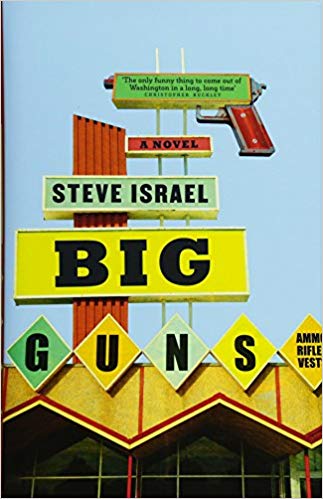
There was an article written by Steve Israel in the New York Times on this past Tuesday with the above title.  I had to find out how this could possibly be the case, so I read it.  Steve Israel represented New York in Congress from 2001 to 2017. His most recent novel is Big Guns, published last April.  The Amazon website for Big Guns calls it, “a hilarious indictment of American politics, whose author knows from bitter experience how sensible laws almost never get passed by Congress.”

Steve Israel and his novel

He said, “During the course of eight successful campaigns for Congress in my Long Island district, I was called every imaginable name by unhappy voters, including, but not limited to, idiot, Communist, socialist, liberal (what’s worse than that?), Pelosi puppet, Obama lackey and Bush sellout. I was criticized as too progressive, too conservative, too middle-of-the-road. In 2010, when Tea Party fever swept through congressional districts, I sat in a slow-moving convertible, waving to crowds at a Memorial Day parade. People waved back, many with one particular finger.  I didn’t let any of it get to me. I brushed it off. In a swing district with about as many Democrats as Republicans — but all opinionated New Yorkers — dealing with voter rejection had become second nature.

So you’d think that I’d be inoculated against the indifference of some readers during the recent book tour for my novel.

Wrong.

In politics, one’s skin must be impenetrable to insult and even the occasional knife in the back. But sitting behind a pile of books at an Authors Night, watching people pick up your book as if it’s a piece of spongy fruit at the market, is sheer torture. Often, they frown sceptically, weigh the book in their hands, glance at a few pages and toss it back on the pile. All right in front of you.

In August, I participated in a signing to benefit a historic public library in Connecticut. I was one of only a few novelists in a tent filled with nonfiction authors. My book, a political satire on the National Rifle Association, sat in a pile that actually seemed to grow higher as the evening progressed. Among the questions I received were:

1: “Is this a novel?” (The words “A Novel” appear on the cover.)

2: “Are you pro-gun or anti-gun?”

And my favourite: “I shoot bear. Will this book help?”

Each question was deflating. I remember receiving a letter when I was in Congress telling me that my support for Obamacare was so odious that the writer was voting for my opponent, then asking who, exactly, my opponent was. I laughed. But in that tent in Connecticut, I had to restrain myself when a reader asked me if my passion for exposing the insanity of the N.R.A.’s influence in a novel (written in 90,000 words and taking over two years of my life) might improve his bear-hunting skills. “Dude, this book’s not for you,” I replied.

Then I sat down, jiggling my signing pen, watching the line get longer at Simon Winchester’s table.

There’s some solace in knowing that I’m not alone. The producer and writer Alan Zweibel recently shared with me his favourite story about the occasional solitude of the book-signing tour earlier in his career. Zweibel was one of the original writers on “Saturday Night Live,” and the author of numerous books. He’d been invited to promote his book at the Barnes & Noble in Paramus, N.J. The night before, he had appeared on “Late Show With David Letterman,” the kind of visibility an author or publicist craves. Anticipating a large crowd, the Barnes & Noble staff put out about 200 folding chairs. There was a crowd, Zweibel said — only they were rushing to the multiplex on the other side of the mall for the opening of a new movie. Zweibel made the best of it, gracefully taking his audience of five to dinner at the local Legal Sea Foods.

My presence at authors nights usually draws folks I call “political leaners.” They don’t lean to the ideological left or right. They lean forward. On my books. Blocking people who might actually buy my work while they fulminate about Mueller, Putin, impeachment, climate change, the obscure member of Congress whom they hate/love, the granddaughter who wants to go into politics or the president’s latest kooky tweet. Sometimes they want a handshake and a selfie. Then they move on. But so have the people behind them.

So how is it that rejection in politics rolled off my back while even one person’s rejection of my book sticks in my craw? For me, there’s a big difference between being snubbed in an election and being ignored on a book tour.

The maxim in politics is that “it’s not personal, it’s just business.” Maybe that’s the psychological armour every politician wears against insults and indignities. Someone’s going to run against you, lie about you, spend millions of dollars vilifying you — but it’s not personal. If angry voters spew, it’s not about you, it’s about that unpopular vote that you cast, or the tough political environment for your party or because they’re uninformed. Writing a book, on the other hand, is deeply personal. Politicians put on protective gear, fiction writers take it off — fully exposing their creativity, emotions, fantasies. It’s like unburdening oneself on a therapist’s couch, only every reader on earth is your therapist.

Plus, there’s the issue of space. At elections, people reject you in the privacy of a voting booth. It stings, but it’s distant and anonymous. At a book signing, the judgements are cast from a distance of a few feet and in real time. The response to you is immediate.

Thankfully, at each signing I somehow manage to sell a fair share of books. And although I left politics (undefeated and unindicted), political skill hasn’t completely left me. For instance, I’ve figured a way to rationalise setback. In an election, anything over 50 percent is a win. At a book signing, I’ve decided that selling over 50 percent of my book pile is also a win.

So I’ll continue, skin thin, signing-pen sharp. And the next time someone asks me if my novel will help him shoot a bear, I’ll let my political instincts take over. I’ll say “Yes!” Then I’ll suggest he take extra copies for other bear hunters.

After all, it’s not personal. It’s business.”


“Don’t Call It ‘Chick Lit'”

There was an article in the 20th October issue of The Daily Telegraph, written by Camilla Tominey, titled: Don’t refer to women’s fiction as chic lit, says author’.  “Books should not be referred to as ‘chick lit’ because more women than men read novels – and it should be men’s fiction that is the ‘sub-category’, the author of Big Little Lies has said.  Liane Moriarty, who sold the rights to the book to Nicole Kidman and Reese Witherspoon for a blockbuster TV series, said women’s fiction should never be treated as a sub-genre because women read more than men.”

Ms Moriarty’s page on Goodreads says: “Liane Moriarty is the Australian author of six internationally best-selling novels, Three Wishes, The Last Anniversary, What Alice Forgot, The Hypnotist’s Love Story and the number 1 New York Times bestsellers, The Husband’s Secret and Big Little Lies.  Her breakout novel The Husband’s Secret sold over three million copies worldwide, was a number 1 UK bestseller, an Amazon Best Book of 2013 and has been translated into over 40 languages. It spent over a year on the New York Times bestseller list. CBS Films has acquired the film rights.  With the launch of Big Little Lies, Liane became the first Australian author to have a novel debut at number one on the New York Times bestseller list. An HBO series based on Big Little Lies is currently in production, starring Nicole Kidman and Reese Witherspoon. . . . Liane lives in Sydney with her husband, son and daughter. Her new novel, Truly Madly Guilty, will be released in July 2016.”

Actually, the first series of Big Little Lies completed in April of last year, and a second series was announced in December. Ms Moriarty has since written Three Perfect Strangers.

Liane Moriarty

Most of the rest of the Telegraph article deals with Ms Moriarty’s excitement in meeting Nicole Kidman, reaching an agreement on the sale of rights, and of her creation a a character to be played by Meryl Streep, whose real name is Mary-Louise, we are informed.

But to return to the main point of the article, I certainly have some sympathy for the name given to what Wikipedia calls ‘genre fiction which consists of heroine-centered narratives that focus on the trials and tribulations of their individual protagonists”, because ‘chick lit’ has become a somewhat pejorative term.  Wikipedia goes on to say, “While chick lit has been very popular with readers, critics largely disapproved of the genre. Reviewer Alex Kuczynski, writing for The New York Times condemned Helen Fielding’s novel, in particular, writing ‘Bridget is such a sorry spectacle, wallowing in her man-crazed helplessness, that her foolishness cannot be excused.’ Writer Doris Lessing deemed the genre “instantly forgettable” while Beryl Bainbridge called the genre ‘a froth sort of thing’.

As I mentioned in an earlier blog, there are literary agencies which specialise in chick lit, though they don’t specifically say so; their focus is immediately clear from the covers and titles of their authors.  Chick lit is big business!

It seems to me that if Ms Moriarty doesn’t like her work to be called chick lit, she should change her subject matter and style or she should invent a new name for her genre – something like ‘Good Women’s’.   It certainly doesn’t classify at Literary Fiction.

To argue, in effect, that the chick lit genre should be deleted because women read more fiction than men – while it is true that women read more – doesn’t make sense.  How are we going to distinguish serious female writers like Kate Atkinson from writers like Helen Fielding?