A Civil Engineer’s View of Literature

I recently joined the Royal Society of Literature, and I’ve found that on their website (www.rsliterature.org) there are interesting pieces on topics related to reading and writing.  One piece which caught my eye is ‘Literature Matters: A Civil Engineer’s View’ by Gyan Shrivastava, who received his civil engineering education in India, Britain and the West Indies. He is a Chartered Civil Engineer.  After several years in the construction industry, he joined academia. In 2015, he retired as a Professor of Civil Engineering at the University of the West Indies in Trinidad.

Gyan Shrivastava

In his article, he says: “I am a retired civil engineer. I worked in practice and in academia. In sum, I belong to the world of concrete and steel. At age thirty, however, I entered into the world of literature: a book, found in an aircraft’s seat-pocket, became a turning point.

“The daytime flight, over an endless blue ocean, was nondescript. I read the book A Christmas Carol by Charles Dickens. By the time I landed, I saw the world, and my life, through a different lens – a lens which showed me the outcome of self-absorption. Inspired, I read more. In time, the words of Virginia Woolf (‘How Should One Read A Book?’) became a beacon:

“‘—- I have sometimes dreamt, at least, that when the Day of Judgment dawns and the great conquerors and lawyers and statesmen come to receive their awards – their crowns, their laurels, their names carved indelibly upon imperishable marble – the Almighty will turn to Peter and will say, not without certain envy when He sees us coming with our books under our arms – Look, these need no reward. We have nothing to give them here. They have loved reading.’

“Not long ago, I came across The Examined Life by Stephen Grosz, Professor of Psychoanalysis at University College in London. His words are telling: ‘Experience has taught me that our childhoods leave in us stories – stories we never found a way to voice, because no one helped us find the words. When we cannot find a way of telling our story, our story tells us – we dream these stories, we develop symptoms, or we find ourselves acting in ways we don’t understand.’

“Needless to say, literature gave me a purpose in my twilight years: I am writing my own story. Unexpectedly, I find that it is not different from constructing bridges and buildings. Put simply, words become concrete and steel, sentences span words as beams, paragraphs support sentences as columns, and punctuation marks connect as bolts and nuts. Moreover, a civil engineer may even have an inbuilt advantage in the world of thoughts and emotions. That is to say, an economy in the use of building materials can translate into an economy of words!”

I particularly like his quotation from Virginia Wolf that reading is its own great reward.

I haven’t read The Examined Life, but the excerpt above resonates for me – more as a writer than a reader.  As a child, our experiences leave indelible impressions on us, and they are important enough that we keep returning to them, to understand their meaning for us as malleable individuals.  So, in this sense they are stories – stories which we need to tell – not necessarily in their entirety or all at once, but in pieces that can be laid out on a table like a grand jigsaw to be savoured and tested for relationships.  I have found that, as a writer, there are pieces of me scattered about and to which I attach a new meaning.

‘Swiping Left’ on Books

Camilla Turner, Education Editor at The Daily Telegraph, had an article on the April 2 issue of the Telegraph, which was titled: ‘Time to turn over a new leaf as infants ‘swipe left’ on books’.

“Children are swiping on books in an attempt to turn pages, teachers have said, as they are confusing them with mobile phones and iPads,” the article began.

“There is a ‘disturbing’ trend of children in reception and at nursery school picking up library books and trying to ‘swipe left’, delegates at the National Union of Teachers (NUT) annual conference in Brighton were told.  During a debate about libraries, Jennifer Bhambri-Lyte, a delegate from North Somerset, told of “happy childhood memories” of “running into a library, snuggling in a corner with a book, cuddling up to mum, turning the pages, gazing at the pictures”.  She told the conference: “Kindles and iPads are wonderful things, but many of my friends talked about the smell of a book, finding tickets and receipts that someone had left as a bookmark, echoes of all the people that had been there before.”  Ms Bhambri-Lyte went on: “I’ve taught both nursery and reception and I personally still find it disturbing to see a child pick up a book and try to swipe left.” She said that books are a now luxury that many struggling families cannot afford, and that libraries can act as a “pair of armbands”.

“A previous report by the National Literacy Trust (NLT) advised parents to turn to iPads and Kindles to get boys interested in reading, amid fears that large numbers of children are shunning books at a young age.   Their research found that children aged three to five often read for longer and had a better grasp of vocabulary when accessing touch-screen technology. Tablet computers had a particular impact on groups that are traditionally most resistant to reading – particularly boys and infants from poor families, the study added.”

The article went on to complain about the reduction in the number of public libraries in the UK, due to budget cuts.  Quite what the relationship might be between ‘swiping left’ and library budget cuts is not clear.  For some reason, children swiping left in their library reminds teachers and librarians that budgets are being cut.  If one disentangles this strange logic, it seems to me that there is nothing particularly ‘disturbing’ about children swiping left.  They will soon learn that this is not the most effective way to turn the pages of a book.  On the other hand, reducing the number of public libraries is certainly a very poor idea.

Kids Books Should be a Little Sad

In my post on March 12, 2018, I covered a story from Time Magazine about Matt de la Pena, a writer of children’s books, arguing that it’s OK for there to be a dark aspect to children’s books.  In a follow-up to that article, there is another on the Time website by Kate Dicamillo, an award-winning author of sixteen children’s books.

Kate Dicamillo

The connection between the two authors is this: Matt asked Kate whether it is the job of a children’s author to tell the truth or to preserve innocence.

Kate answered with a question: “Have you ever asked an auditorium full of kids if they know and love Charlotte’s Web?  In my experience, almost all the hands go up.  And if you ask them how many of them cried when they read it, most of the hands remain unabashedly aloft.”

(Charlotte’ Web is by E B White with illustrations by Garth Williams.  Its Amazon site says, “This is the story of a little girl named Fern who loved a little pig named Wilbur and of Wilbur’s dear friend, Charlotte A. Cavatica, a beautiful large grey spider. With the unlikely help of Templeton the rat, and a wonderfully clever plan of her own, Charlotte saves the life of Wilbur, who by this time has grown up to be quite a pig.”)

Kate says she asked her best childhood friend, “What was it made you read and re-read that book? Did you think that if you read it again, things would turn our differently, better?  That Charlotte wouldn’t die?”

“No,” she said, “It wasn’t that.  I kept reading it not because I wanted it to turn out differently . . . but because I knew for a fact that it wasn’t going to turn out differently.  I knew that a terrible thing was going to happen, and I also knew it was going to be OK somehow.  I thought that I couldn’t bear it, but then when I read it again, it was all so beautiful.  And I found out that I could bear it.   That was what the story told me.  That was what I needed to hear.  That I could bear it somehow.”

Kate told another auditorium story: “A boy asked me if I thought I would have been a writer if I hadn’t been sick all the time as a kid and if my father hadn’t left.  And I said something along the lines of I think that there is a very good chance that I wouldn’t be standing in front of you today if those things hadn’t happened to me.  A girl raised her hand and said, ‘It turns out that you were stronger than you thought you were.”

“When the kids left the auditorium, I stood at the door and talked with them as they walked past. One boy – skinny legged and blonde haired – grabbed my hand and said, “I’m here in South Dakota, and my dad is in California.  He’s there and I’m here with my mom.  And I thought I might not be OK.  But you said today that you’re OK.  And so I think that I will be OK, too.”

Kate continued, “E B White loved the world.  And in loving the world, he told the truth about it – its sorrow, its heartbreak, its devastating beauty.  He trusted his readers enough to tell them the truth, and with that truth come comfort and a feeling that we are not alone.”

What Do Bookshelves Reveal About You?

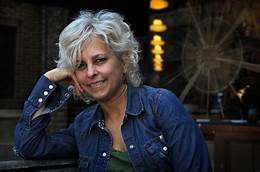
Last month there was an article in The Daily Telegraph written by Shane Watson on the subject of our bookshelves as an important personality indicator.  This Shane Watson is not to be confused with the other Shane Watson, the Australian cricketer, and who may not know much about bookshelves, or books, for that matter.  This Shane Watson looks like this:

Her Penguin Books biography says: “Shane Watson writes regular columns for the Sunday Times Style magazine and is a contributing editor to Easy Living magazine. She is also the author of two novels, The One to Watch and Other People’s Marriages.”  There is also a third book: How to Meet a Man After Forty and Other Midlife Dilemmas Solved.  Presumably, this is non-fiction.

Turning now to her column in the Telegraph, she said: “This week a lifestyle blogger called Laura Coleman, whose house was featured in the latest issue of Ideal Home magazine, has been wishing she never revealed her tastes to the world.  Ms Coleman has bee vilified on social media, not because she has a stuffed bear in her front hall, or the world’s largest collection of framed butterflies, or a walk-in wardrobe that could accommodate six families.  No, Coleman’s crime is having arranged her books on her shelves, with their spines facing the wall, so as to keep the colour palette of the room a creamy, book page neutral.

“The incident of the backward books, apparently a decorative trend, has evidently struck a nerve – and the haters are out in force.  What kind of person arranges books in this way?

“The kind of person who doesn’t read books, that’s who.  The kind of person for whom books are just shelf fillers!  Shelf Candy!  A bad person who sees more value in the parchment colour of a page end than in the printed word!  How low is that?!

“This shelf hate seems to be driven by two impulses: one, outrage at disrespecting books and reducing them to shelf padding; and, two, contempt for the sort of people whose homes are pristine, neutral environments, all about the surface with nothing genuine behind the facade.  Poor Laura Coleman has found her shelves being held up as the epitome of style over substance and the shallowness of ‘lifestyle’ trends. . .

“Still, singling out these shelves and their owner for death by social media seems rather unfair.  It is true that unless Ms Coleman cunningly photographed all the books in situ before reversing them, she would have a job locating a specific title.  We can safely assume that these backwards books were never intended to be read again.  But in her defence, she says these are all chick lit sorts of paperbacks which (my observation not hers) you might otherwise leave on the train, or throw away to make room for others.   Books with loud covers and title like Maisie’s Fat Day Out, which don’t have much of a shelf life anyway, not to mention typically being bound in garish covers that clash with anyone’s colour scheme.

“But more to the point, who among us is not guilty of shelf rigging?  Who doesn’t have a guilty book presentation habit?  If the books on your shelves were slammed up there with no thought whatsoever for the impression they were going to give . . . then we would be very surprised indeed.”

Ms Watson then goes on to mention several ‘shelf stuffing’ techniques:

  • Hiding books that might put the owner in an unfavourable light
  • Substituting a prominent author or title for one less fashionable
  • Arranging books according to size or colour
  • Displaying books with beautiful covers at the top of a coffee table pile
  • Treating books as decorative objects  (Is this bad?)

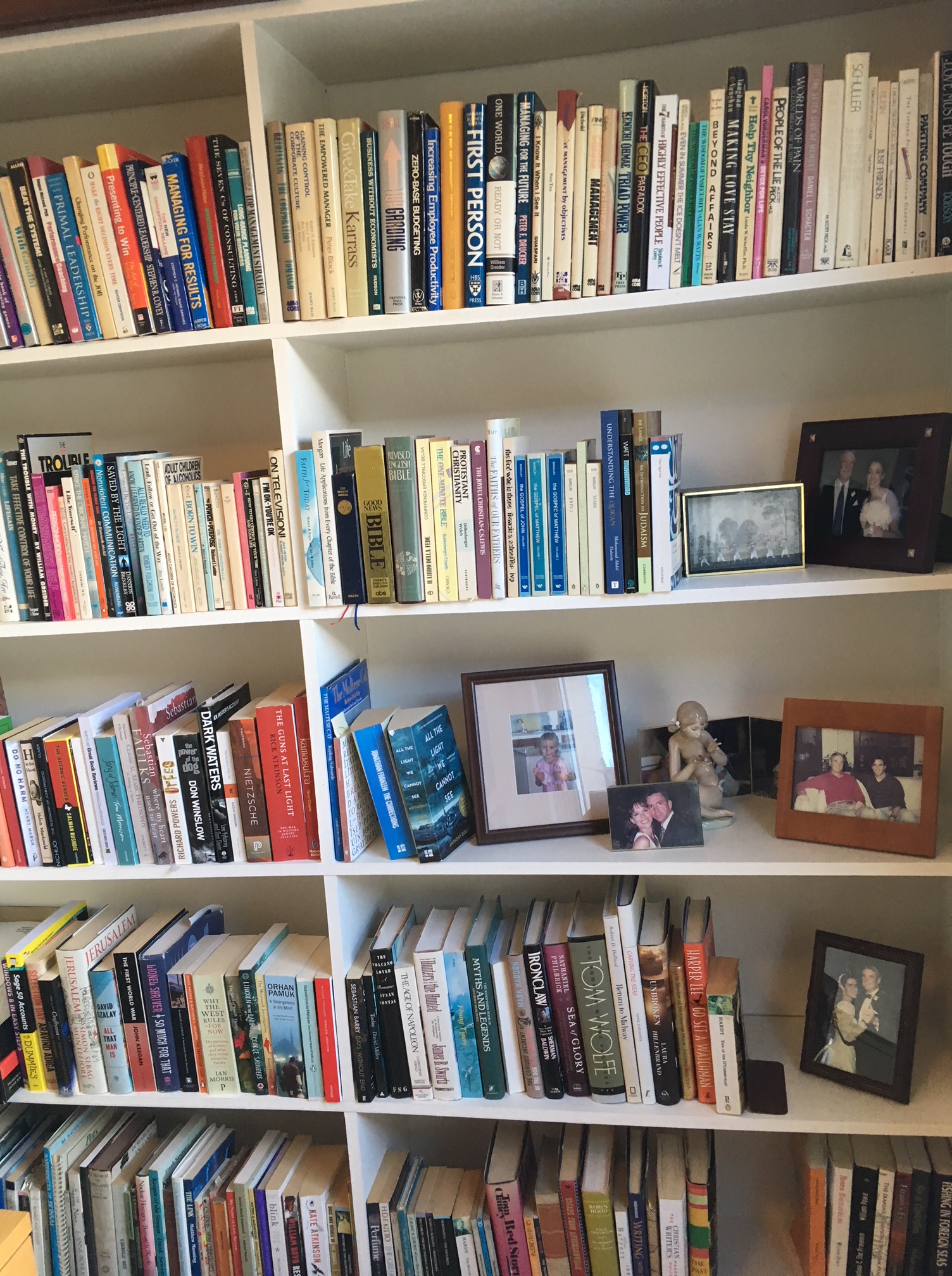
As for me, one wall of my office has floor to ceiling book shelves, and I have to admit that most of the books are arranged pretty randomly, so I have to search for a particular book.  However, there are two shelves full of business reference books (from a prior life), one shelf of religious books, and three shelves of novels.  One of my problems is how to dispose of business books to make space for new novels.  Libraries don’t want them, and it seems wrong to just throw them away.

My bookshelves: partial view


Real Editing

Many of you may like to know what it’s like to work with a real editor.  Until very recently, I never have.  Of course, I’ve had my manuscripts checked by a professional editor before publication, but that was copy editing: editing of grammar, spelling, punctuation and consistency in presentation.  With my latest novel, I decided it was time to ignore – for the time being – my grammar, spelling and punctuation, and focus on my presentation skills as a writer.   The editor I worked with is a published author, and she took two months to review my 529 page, double spaced manuscript.  What I got back from her was my edited manuscript with one or two comments on nearly every page (none of them related to grammar, spelling or punctuation) and a one-page summary of areas where I could improve the manuscript.

This isn’t mine, but you get the idea

For me, the experience was very good: I learned a lot.  It also meant that I have a major re-write underway.  The current re-write is in addition to the revisions I undertook after completing the manuscript and having some reservations of my own about it.  The areas for attention she mentioned included:

  • Character development: she noted that, while they were all well-defined, there is much that happens to the three main characters, and one of them changes his identity.  What about identify changes for the other two characters?
  • The novel would benefit from more tension for the characters in some of the events
  • I am too kind to some of the characters
  • Some of the dialogue and description does not really add to the story
  • More attention to the time line; there are gaps in the time line
  • The ending needs to be punchier
  • The point of the novel needs to be defined earlier and often
  • Point of view is an issue

Regarding point of view, with three main characters, I decided to use an omniscient point of view, rather that the point of view of one of the characters.  The editor pointed out that the omniscient point of view is not ‘fashionable’.  Perhaps she writes from a singular point of view.  In any case, I complicated things by permitting God and Satan to interrupt the story occasionally, to reveal their views and their covert involvement.  This, she found very confusing.  I think I have now eliminated any confusion.

For me, one problem was that she apparently didn’t read the manuscript through before beginning her editing; this could have clarified what seemed to me to be her early misunderstandings.  Having said that, her comments were generally very helpful and thorough, and as I went through the manuscript, I tried to eliminate opportunities for misunderstanding

In my current re-write, I have cut out about ten percent of the manuscript which, while mildly interesting, is not essential to the advancement of the plot.  I have also focused on how the characters are feeling about the events and the changes in their values.  Tension is also increased, and I’m planning changes to address her other comments.

The real test of all this will be when I submit it to literary agents/publishers.

Darkness in Kids Books

Last month, there was an essay in Time Magazine by Matt de la Pena, author of the childrens’ books, in which he discussed the importance of writing about painful experiences in the books he writes.

Matt de la Pena

He says, “A few weeks ago, illustrator Loren Long and I learned that a major gatekeeper would not support our forthcoming picture book, Love, an exploration of love in a child’s life, unless we “softened” a certain illustration. In the scene, a despondent young boy hides beneath a piano with his dog, while his parents argue across the living room. There is an empty old fashioned glass resting on top of the piano. The feedback our publisher received was that the moment was a little too heavy for children. And it might make parents uncomfortable. This discouraging news led me to really examine, maybe for the first time in my career, the purpose of my picture book manuscripts. What was I trying to accomplish with these stories? What thoughts and feelings did I hope to evoke in children?”

“This particular project began innocently enough. Finding myself overwhelmed by the current divisiveness in our country, I set out to write a comforting poem about love. It was going to be something I could share with my own young daughter as well as every kid I met in every state I visited, red or blue. But when I read over one of the early drafts, something didn’t ring true. It was reassuring, uplifting even, but I had failed to acknowledge any notion of adversity.

“So I started over.

“A few weeks into the revision process, my wife and I received some bad news, and my daughter saw my wife openly cry for the first time. This rocked her little world and she began sobbing and clinging to my wife’s leg, begging to know what was happening. We settled her down and talked to her and eventually got her ready for bed. And as my wife read her a story about two turtles who stumble across a single hat, I studied my daughter’s tear-stained face. I couldn’t help thinking a fraction of her innocence had been lost that day. But maybe these minor episodes of loss are just as vital to the well-adjusted child’s development as moments of joy. Maybe instead of anxiously trying to protect our children from every little hurt and heartache, our job is to simply support them through such experiences. To talk to them. To hold them.”

He went on to say that he was in Rome, Georgia, reading to some school children, when “I decided, on a whim, to read Love to them, too, even though it wasn’t out yet. I projected Loren’s illustrations as I recited the poem from memory, and after I finished, something remarkable happened. A boy immediately raised his hand, and I called on him, and he told me in front of the entire group, “When you just read that to us I got this feeling. In my heart. And I thought of my ancestors. Mostly my grandma, though … because she always gave us so much love. And she’s gone now.”

“And then he started quietly crying.

“And a handful of the teachers started crying, too.

“I nearly lost it myself. Right there in front of 150 third graders. It took me several minutes to compose myself and thank him for his comment.  On the way back to my hotel, I was still thinking about that boy, and his raw emotional response. I felt so lucky to have been there to witness it. I thought of all the boys growing up in working-class neighborhoods around the country who are terrified to show any emotion. Because that’s how I grew up, too — terrified. Yet this young guy was brave enough to raise his hand, in front of everyone, and share how he felt after listening to me read a book. And when he began to cry a few of his classmates patted his little shoulders in a show of support. I don’t know if I’ve ever been so moved inside the walls of a school.  That’s why I write books. Because the little story I’m working on alone in a room, day after day, might one day give some kid out there an opportunity to “feel.” And if I’m ever there to see it in person again, next time hopefully I’ll be brave enough to let myself cry, too.”

I have to add that the illustration Matt is talking about is evocative.  Unfortunately, I couldn’t find it on line, but is it focused on a grand piano with a small boy, hugging his legs, head down, sheltered beneath it.  His dog is cuddled up next to him.  On the left is a woman, covering her face with her hands, and on the right is a man, leaving the room.  The text says: “But it’s not only stars that flame out, you discover.  And friendships.  And people.”

Review: Tess of the D’Urbervilles

I was searching my bookshelves for something to read on holiday and I found an old, paperback copy of Hardy’s Tess of the D’Urbervilles – I have no idea where it came from.  I remember reading Far from the Madding Crowd in high school, and I thought it was time to get in touch with Hardy again.

Thomas Hardy was born in 1840 in a rural community in Dorset, England to a working-class family which did not have the means to send him to university.  He trained as an architect in Dorchester, and moved to London to pursue a career, but he was never comfortable in London, where he was acutely conscious of his class and social inferiority.  Returning to Dorset in 1867, he began his first novel, The Poor Man and the Lady, which was rejected for publication; he subsequently destroyed the manuscript, but subsequently wrote three novels: two published anonymously and one, A Pair of Blue Eyes, in his own name.   This latter novel concerns his courtship of Emma Gifford, who became his wife and encouraged him to write full time.  In 1874, Far from the Madding Crowd was published and was followed be ten novels, which attracted an increasingly hostile reception for ‘pessimism’ and ‘immorality’.  In fact, Jude the Obscure, Hardy’s last novel (1895), was burned by the Bishop or Wakefield.  In his memoir, Hardy said: “After these [hostile] verdicts from the press, its next misfortune was to be burnt by a bishop – probably in his despair at not being able to burn me.”  Hardy then turned his attention to writing poetry and short stories until hes death in 1928.  Tess was also criticised for its immorality and its implied criticism of social and religious culture, which, viewed from a 21st century perspective, is difficult to understand.

Hardy’s themes include the examination of social themes in Victorian England: marriage, education and religion, that limited people’s lives and caused unhappiness.  Hardy’s religious beliefs seem to have been a combination of agnosticism and spiritualism; he rejected the religious doctrine of his time.  For him, education was an unfair badge of social status, and the sexual mores of Victorian England were often a millstone around people’s necks.


Thomas Hardy

Tess, the lead character in Tess of the D’Urbervilles, is a beautiful farm girl whose lower class status is denied by her father who fancies that his family are descendants of the old, aristocratic, D’Urberville family.  She is sent to work for an old,  matriarch and her ne’er-do-well son, Alec, of the D’Urberville family.  She dislikes the son for his arrogance and his bothersome attentions, but she is taken advantage of by him and becomes pregnant.  How this happens is left to the reader’s imagination.  Her baby dies and she goes to work on a distant farm where she meets a middle class man, Angel Clare, with whom she falls in love.  When he asks her to marry him she is distraught, as his expectation must be that she is a virgin.  Finally, she accepts Angel’s proposal and commits to revealing her sin to him, which she does on their wedding night.  He, a man of strict morals, rejects her and emigrates to Brazil.  She is heartbroken, and goes to work on a hard-scrabble farm, where, once again, she meets Alec.  Separated by thousands of miles, Tess and Angel pine for one another, and he comes back to England to find her.  But, owing to dire financial circumstances, she has been taken by Alec as his mistress.  Angel follows her trail and finds her with Alec in a smart hotel.  The story ends tragically.

The first two thirds of the novel is beautifully written at a leisurely, captivating pace.  Hardy’s love of Tess, the English countryside and its culture shines through. At the same time there is a sense of impending disaster which pulls the reader along.

It seemed to me that the last third of the novel was written in a hurry by an author who wanted to get to the conclusion.  Character development in the first two thirds was measured and complete, but the changes in Alec and Tess toward the end seem somewhat dubious.  Alec’s transformation from scoundrel to preacher and back to a scoundrel seems barely plausible – as does Tess’ out of character change in the last few pages to pliant mistress with a hidden fury.  Strangely, Hardy has Tess swear an oath on an ancient stone monument, and one is braced for a repercussion, but none appears.  Then there is the character Lisa-Lu, Tess’s sister, who comes on stage at the last minute in an important role, without previous introduction.

I enjoyed reading Tess, and I also enjoyed finding what I think are errors by a great author.

Review: Fire and Fury

I have to admit that I bought a copy of Fire and Fury inside the Trump White House.  I’m not  a Trump fan and I wanted to see how bad it really is.  The book is written by Michael Wolff, based on over two hundred interviews and and two hundred days in the White House, ending with the appointment of General John Kelly as chief of staff and the departure of Steve Bannon..  Mr Wolff claims that he had the agreement of the President to be a sort of fly on the wall, beginning during the campaign, though the President has denied ever speaking to Wolff.

Michael Wolff does not have a gold-plated reputation as a journalist.  The Independent said : “He became well-known for writing that explored the lives of the rich and powerful, often written with colourful and bombastic language. His New York Magazine column, “This Media Life”, explored a world of which he was very much a part – he has surfaced periodically in the New York Post’s Page Six, a gossip hub for the city. . . While he achieved prominence and visibility with his work, Mr Wolff is not necessarily beloved by his compatriots in the media world. And he has embraced that, as shown by a past book featuring blurbs that excoriated him as toxic. “Far less circumspect – and sometimes more vicious – than the other journalists,” The New York Times is quoted as saying. “Possibly the bitchiest media bigfoot writing today,” suggested The New Republic.  “This Wolff excerpt (the book) has a 500-word-long chunk of recreated verbatim dialogue between Bannon and Ailes,” The New York Time’s Nick Confessore wrote. “Come on”.  But it turns out that Wolff hosted the dinner for six at this Manhattan town house.  “I was one of the 6 guests at the Bannon-Ailes dinner party in January 2017 and every word I’ve seen from the book about it is absolutely accurate. It was an astonishing night,” Janice Min said.”

Michael Wolff

The reader has to decide for herself whether every word in the book is the unvarnished truth.  There are relatively few direct quotations from named individuals.  Further, there are almost no kind words for anyone in the book: can everyone in the White House be that bad?  However, the preponderance of hear-say evidence in the book points overwhelmingly to the President’s short-comings in the vital learn-analyse-act-review cycle that leaders must master to be fully effective.  In particular, the Learn and Analyse stages are almost void.  He does not read memoranda longer than two pages (and those, reluctantly).  His preferred style of information gathering is watching television and speaking on the telephone with friends.  Reportedly, he has an aversion to ‘experts’, and tends to be swayed by the last person he spoke with on the subject.  Analysis is also a weakness (though to put it in context, perhaps Obama sometimes seemed to engage in analysis-paralysis), as numerous examples were cited of the President referring decisions to others.  Act, unlike Obama, is one of Trump’s strengths (though this is not mentioned in the book); one has to only count the record number of presidential orders that he has signed.  And, as to Review, no examples are given but, in fairness, it may be too early to review many of the actions taken.  Overall, one has the impression of a man with an enormous, but very fragile ego.

If one has been reading the daily newspapers and watching the evening news, there isn’t much in the way of surprises in this book.  However, until reading it, I did not appreciate the extent to which Trump did not expect to win (nor did he want to win) the 2016 election.   The win he wanted was all the publicity with no follow-on consequences.

Man Booker Protest

Today’s Daily Telegraph has an article captioned Man Booker rule change has lost us sales , say publishes, and the caption reads: US dominance has hit Commonwealth writers who are falling off shortlists.  

Not that my opinion had an iota of influence, I was opposed to the rule change in 2014, which opened the prize to writers from any nationality, who publish in English, on the basis that there are a large number of US literary prizes, so there was no need to open another prize to American writers.  I also felt that the Man Booker was a unique prize open to Commonwealth authors.  Finally, given the quirky judging standards of the Man Booker Prize Committer (see my most recent post), it seemed inappropriate to me that the Booker should be positioning itself as the top global prize in English literature.

Now the publishers have weighed in with their own arguments regarding the effect of the rule change on the volume of books sold, and, by extension, on their bottom lines.

“About 30 publishers are understood to have signed a letter urging the trustees to the Booker Prize Foundation to reverse the decision, saying the change risked creating ‘a homogenised literary future’ dominated by American culture.  ‘The rule change, which presumably had the intention of making the prize more global, has in fact made it less so by allowing the dominance of Anglo-American writers at the expense of others; it risks turning the prize, once a brilliant mechanism for bringing the world’s English-language writers to the attention of the world’s biggest English-language market, into one that is no longer serving the readers in that market’ it says.

“It claims that diversity of the prize has been ‘significantly reduced’, noting that this year’s shortlist consists of three Americans, two Britons, and one British-Pakistani as opposed to 2013’s shortlist which featured a New Zealander, a Zimbabwean, an Irishman, an American-Canadian and a British-American. ‘We already live in a world that is dominated by American culture’, the letter says. ‘The Man Booker Prize was one significant way to allow other voices to be heard.’

“Johnny Geller, of the Curtis Brown literary agency, said the letter was ‘a long time coming’ and that ‘widening the entry requirements to include US writers has resulted in weakened sales on both sides of the Atlantic’.

“Denying that diversity had been reduced, the Booker foundation said the rule change was not created specifically to included US writers but to allow entries from authors of any nationality, regardless of geography.”

Clearly, the rule change has reduced diversity, and one is prompted to ask why the rule change was felt to be necessary: was it to raise the profile of the foundation at the expense of sacrificing its unique position?

The point about the impact on sales is interesting, and the article does not mention whether it was addressed in the foundation’s response.  Presumably, the cause of this sales decline is that Man Booker prize recognition does little to increase the sales of winning American authors: they already have recognition through other awards and bestseller lists.  But, non-recognition of Commonwealth authors impacts their sales on both sides of the Atlantic.

It will be interesting to see how much power the publishers have in this situation!

Review: Lincoln in the Bardo

This novel, by George Saunders, won the Man Booker Prize in 2017, and I felt obliged to read it.

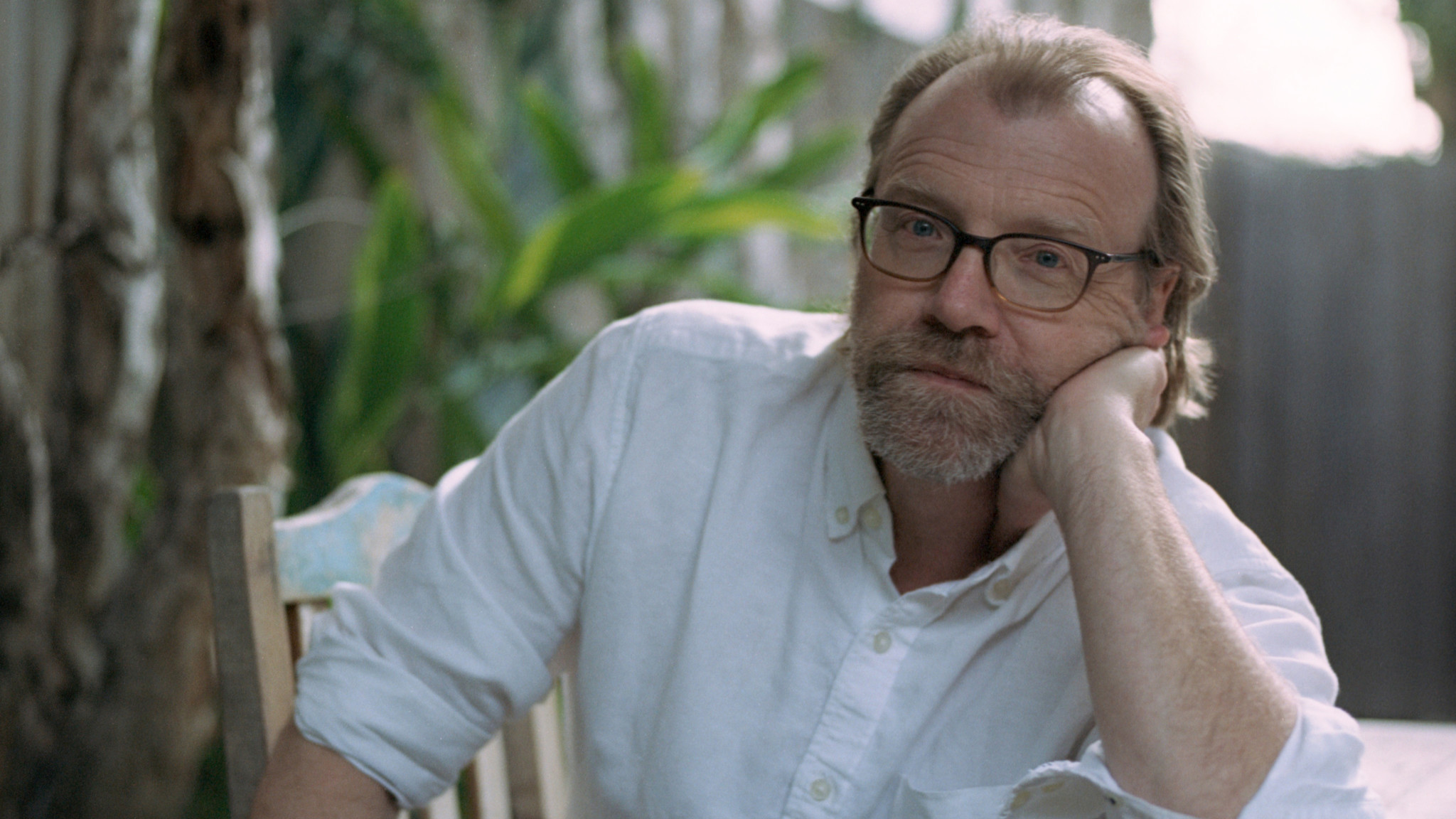
George Saunders – according to the bio included in the book – is the author of nine books, including Tenth of December, which was a finalist for the National Book Award and won the inaugural Folio Prize (for the best work of fiction in English) and the Story Prize (best short story collection).  He has received MacArthur and Guggenheim fellowships and the PEN/Malamud Prize for excellence in the short story and was recently elected to the American Academy of Arts and Sciences.  In 2013, he was named one of the world’s 100 most influential people by Time magazine.  He teaches in the creative writing program at Syracuse University.

George Saunders

Lincoln in the Bardo concerns the death of Willie, President Lincoln’s younger son, his burial and the President’s intense grief over his death.  This major theme in bound up in a collection of ghost stories in which a state of bardo is conceived and in which the ghosts provide a commentary on racial, social, financial, sexual and religious mores at that time.  There is no central narrator; rather, the stories are told by several dozen fictional ghost characters (two of whom are prominent) and by quotations from contemporary news articles and other sources.  These quotations lend a sense of reality, even though the viewpoints represented (of the President, himself, for example) are conflicting.  The style of the book is oblique, particularly as to the individual ghost stories, so that the reader is left to exercise some deduction and imagination.  The writing is innovative, but faultless. The author’s central question is: “how do we live and love when everything we love must end?”

For me, Lincoln in the Bardo was not an easy or a captivating read.  This was due, in part to the author’s technique of presenting the ghost’s dialogue frequently as fragmented hints (which is fine for ‘ghost speak’ but doesn’t make easy reading).  I also felt that the ghost stories did not always mesh well with the Lincoln tragedy. In my opinion, the author was trying to do too much in one novel.  Interestingly, I don’t recall seeing the word ‘bardo’ mentioned in the novel itself.  Bardo is a Buddhist concept of a transitional state between death and rebirth.  Two other minor comments.  I think the title of this novel should have been: Willie Lincoln in Limbo.  As a Buddhist concept, ‘bardo’ does not fit well in a Christian setting; bardo is a state, so the definite article ‘the’ is unnecessary – one wouldn’t say ‘in the coma’; and Lincoln (the President) was not in bardo – his son was.  But my suggested title is not as intriguing.  At the conclusion of the book, there are 11 ‘Reading Group Questions and Topics for Discussion’.  This says to me: ‘ I am not only the author, I am a distinguished academic’: hubris.

For me, this is another example of the Man Booker Prize Committee selecting works which are intriguing, different, innovative, rather than lucid, beautiful and memorable.