Man Booker Protest

Today’s Daily Telegraph has an article captioned Man Booker rule change has lost us sales , say publishes, and the caption reads: US dominance has hit Commonwealth writers who are falling off shortlists.  

Not that my opinion had an iota of influence, I was opposed to the rule change in 2014, which opened the prize to writers from any nationality, who publish in English, on the basis that there are a large number of US literary prizes, so there was no need to open another prize to American writers.  I also felt that the Man Booker was a unique prize open to Commonwealth authors.  Finally, given the quirky judging standards of the Man Booker Prize Committer (see my most recent post), it seemed inappropriate to me that the Booker should be positioning itself as the top global prize in English literature.
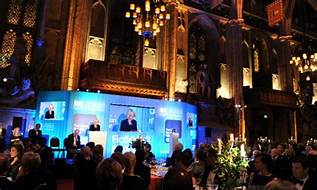
Now the publishers have weighed in with their own arguments regarding the effect of the rule change on the volume of books sold, and, by extension, on their bottom lines.

“About 30 publishers are understood to have signed a letter urging the trustees to the Booker Prize Foundation to reverse the decision, saying the change risked creating ‘a homogenised literary future’ dominated by American culture.  ‘The rule change, which presumably had the intention of making the prize more global, has in fact made it less so by allowing the dominance of Anglo-American writers at the expense of others; it risks turning the prize, once a brilliant mechanism for bringing the world’s English-language writers to the attention of the world’s biggest English-language market, into one that is no longer serving the readers in that market’ it says.

“It claims that diversity of the prize has been ‘significantly reduced’, noting that this year’s shortlist consists of three Americans, two Britons, and one British-Pakistani as opposed to 2013’s shortlist which featured a New Zealander, a Zimbabwean, an Irishman, an American-Canadian and a British-American. ‘We already live in a world that is dominated by American culture’, the letter says. ‘The Man Booker Prize was one significant way to allow other voices to be heard.’

“Johnny Geller, of the Curtis Brown literary agency, said the letter was ‘a long time coming’ and that ‘widening the entry requirements to include US writers has resulted in weakened sales on both sides of the Atlantic’.

“Denying that diversity had been reduced, the Booker foundation said the rule change was not created specifically to included US writers but to allow entries from authors of any nationality, regardless of geography.”

Clearly, the rule change has reduced diversity, and one is prompted to ask why the rule change was felt to be necessary: was it to raise the profile of the foundation at the expense of sacrificing its unique position?

The point about the impact on sales is interesting, and the article does not mention whether it was addressed in the foundation’s response.  Presumably, the cause of this sales decline is that Man Booker prize recognition does little to increase the sales of winning American authors: they already have recognition through other awards and bestseller lists.  But, non-recognition of Commonwealth authors impacts their sales on both sides of the Atlantic.

It will be interesting to see how much power the publishers have in this situation!
Review: Lincoln in the Bardo

This novel, by George Saunders, won the Man Booker Prize in 2017, and I felt obliged to read it.

George Saunders – according to the bio included in the book – is the author of nine books, including Tenth of December, which was a finalist for the National Book Award and won the inaugural Folio Prize (for the best work of fiction in English) and the Story Prize (best short story collection).  He has received MacArthur and Guggenheim fellowships and the PEN/Malamud Prize for excellence in the short story and was recently elected to the American Academy of Arts and Sciences.  In 2013, he was named one of the world’s 100 most influential people by Time magazine.  He teaches in the creative writing program at Syracuse University.

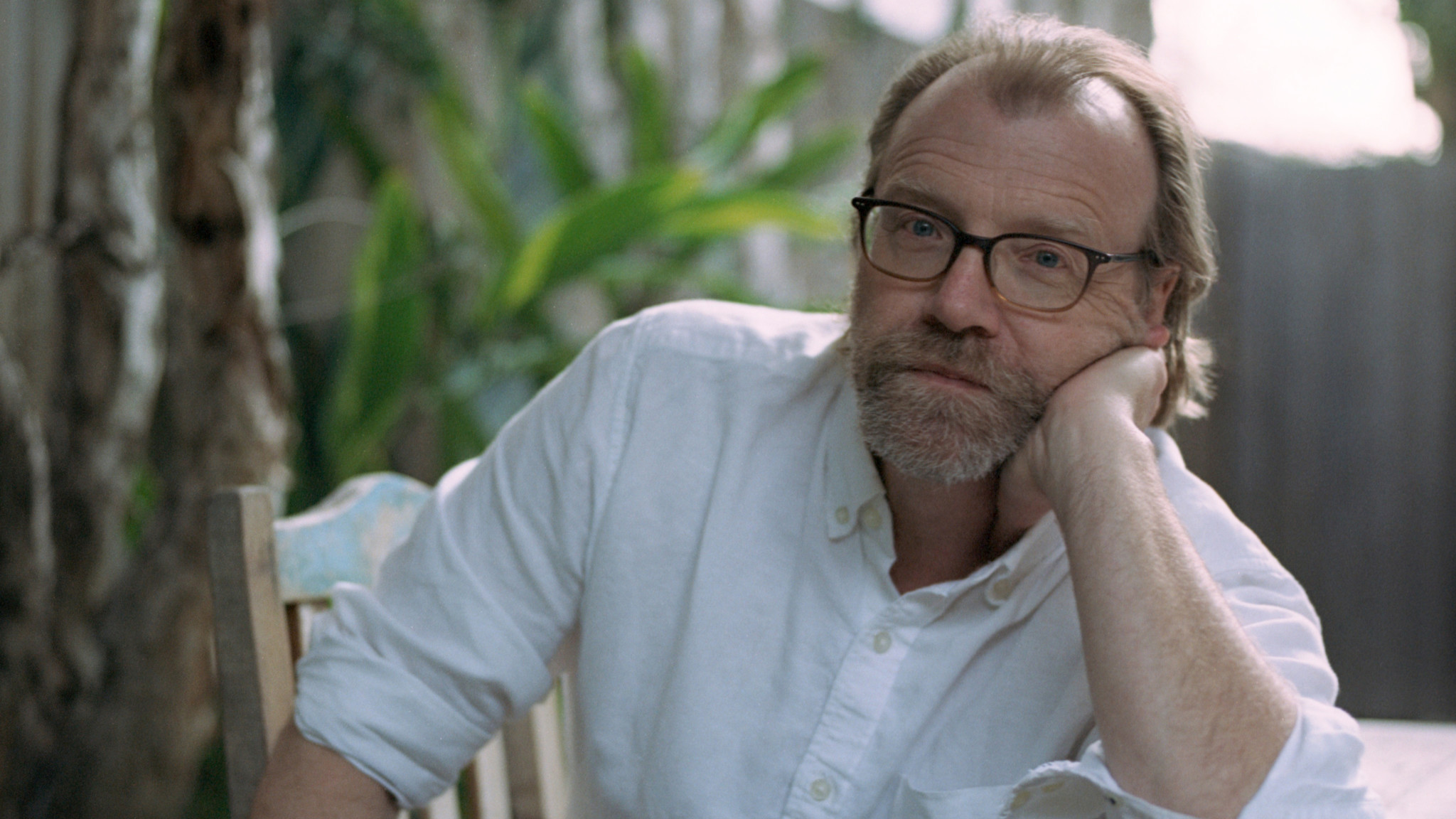
George Saunders

Lincoln in the Bardo concerns the death of Willie, President Lincoln’s younger son, his burial and the President’s intense grief over his death.  This major theme in bound up in a collection of ghost stories in which a state of bardo is conceived and in which the ghosts provide a commentary on racial, social, financial, sexual and religious mores at that time.  There is no central narrator; rather, the stories are told by several dozen fictional ghost characters (two of whom are prominent) and by quotations from contemporary news articles and other sources.  These quotations lend a sense of reality, even though the viewpoints represented (of the President, himself, for example) are conflicting.  The style of the book is oblique, particularly as to the individual ghost stories, so that the reader is left to exercise some deduction and imagination.  The writing is innovative, but faultless. The author’s central question is: “how do we live and love when everything we love must end?”

For me, Lincoln in the Bardo was not an easy or a captivating read.  This was due, in part to the author’s technique of presenting the ghost’s dialogue frequently as fragmented hints (which is fine for ‘ghost speak’ but doesn’t make easy reading).  I also felt that the ghost stories did not always mesh well with the Lincoln tragedy. In my opinion, the author was trying to do too much in one novel.  Interestingly, I don’t recall seeing the word ‘bardo’ mentioned in the novel itself.  Bardo is a Buddhist concept of a transitional state between death and rebirth.  Two other minor comments.  I think the title of this novel should have been: Willie Lincoln in Limbo.  As a Buddhist concept, ‘bardo’ does not fit well in a Christian setting; bardo is a state, so the definite article ‘the’ is unnecessary – one wouldn’t say ‘in the coma’; and Lincoln (the President) was not in bardo – his son was.  But my suggested title is not as intriguing.  At the conclusion of the book, there are 11 ‘Reading Group Questions and Topics for Discussion’.  This says to me: ‘ I am not only the author, I am a distinguished academic’: hubris.

For me, this is another example of the Man Booker Prize Committee selecting works which are intriguing, different, innovative, rather than lucid, beautiful and memorable.

Why Children Need to Read

This was the title of the cover story in the Review section of The Daily Telegraph on 20 January 2018.  The author is Katherine Rundell, author of The Explorer, which won the 2017 Costa Children’s Book Award. She begins the article by talking about a “state of consciousness that comes without calling.  It is as if the clamorous world has quietened and thinned. . . The other times I have experienced it were as a child, while I read.  It would take perhaps three pages, then the world became mute.  Its urgency vanished and its demands fell silent.  I could sit waiting outside a ballet class, music vibrating through the walls, and hear nothing.

“Children’s fiction accounts for 39 of the 100 bestselling books of 2017, and for about 24% of the UK book market.  There’s a lot of it about.  Still, the question I get asked most, when people hear that I write for children, is: why?  Why not write real, serious books for adults?  Because, I think, only for a child, can fiction crowbar open the world.

“The intricacies of reading evade description in the same way that dreams and music evade it, but there is, I think, something unique about the way stories colour the imagination of a child.  What do you see as an adult, when you read?  Do you deck out the characters in shoes, buttons, fingernails.  I think I don’t.  I read ‘Emma Woodhouse, handsome, clever and rich’, and I conjure up, in the space behind my eyes, an atmosphere rather than a distinct picture, colour, nose or lip. But children are doing something different when they read.  They have sometimes described to me in painstaking detail, scenes from books of mine which do not exist.  It happens relatively often: a child will tell me she loves the dance across the Paris rooftops in my book Roofhoppers, or the moment when a girl jumps from a tree onto the back of a wolf in The Wolf Wilder –  scenes I never wrote, although I wish I had.  Children, as they read, paint bright colours in the margins that fiction leaves open.  Their imaginations are snowballs.  When, as an adult, I read some of  my favourite childhood books, I was startled to see how slight some of them were, how many of the details I thought I knew by heart never even appeared; houses I had furnished myself, clothes I had embroidered, journeys  had added.  This is part of why I write for young people: children read the world into largeness.  When you write for a child, you build them a house; when they read, they expand it into a castle.

Ms Rundell tells about the illness of an older sister who died.  “I read through long periods of being alone, in hospital waiting rooms, and car journeys and friends’ houses.  Afraid, I took The Jungle Book or What Katy Did into bed with me alongside my bear, so that if my own fear overwhelmed me, there would be an exit door; I would fall asleep with an escape hatch clutched in one hand. . . . the stories I read then allowed me to believe that my sister didn’t only lose; she also won.  To fight with such gallantry and love is to win.

“The value of children’s books cannot, of course, be predicated on pain – books aren’t only valuable when we have something to escape – but, in fact, I am not sure that escapism is a large enough word for what those books did.  They taught me through the medium of wizards and lions and spies and talking spiders that this world I was newly inhabiting was one of wit and endurance.  Children’s books say: the stories of the world are infinite and various and unpredictable.  They say: you will count for something. They say: bravery will matter, love will matter.”

I was fortunate in having a mother and a grandmother who liked to read aloud.  They were probably motivated, in part, by the rapt attention I paid to stories by Rudyard Kipling, Robert Louis Stevenson and J Howard Pyle.

Review: Istanbul: Memories and the City

I wanted to read a book by Orhan Pamuk, who won the Noble Prize for Literature in 2006, but when I looked at his recent novels, I was put off.  My Name is Red is 688 pages; A Strangeness in my Mind is 764 pages.  To me, this seems a disproportionate amount to time to devote to one author.  (Perhaps, I’m like a teenage boy: so many girls, so little time.)  So, I chose Istanbul: Memories and the City (336 pages), which was written in 2005, and appealed to me because I visited Istanbul, briefly, on my honeymoon.

Orhan Pamuk is a Turkish writer, screenwriter and academic, born in Istanbul in 1952; he has sold 13 million books in 63 languages.  He is a Professor of Humanities at Columbia University, where he teaches courses in writing and comparative literature.

In 2005, Pamuk made a statement regarding the Armenian Genocide that  “Thirty thousand Kurds have been killed here, and a million Armenians. And almost nobody dares to mention that. So I do.”  An ultra-nationalist lawyer brought a law suit based on Article 301 of the Turkish Penal Code which makes it a crime to insult Turkey or the Turkish Grand National Assembly.  The suit resulted in a lengthy battle with the Turkish legals system in which the European Union took an interest because of its implications for the freedom of speech in Turkey.  The Turkish Justice Ministry finally declined to back the trial on a technicality, but gave no support to Pamuk, who said that he mentioned the genocide not to call attention to specific numbers of deaths but to demonstrate the lack of freedom to discuss taboo subjects in Turkey.

Orhan Pamuk

Istanbul, translated by Maureen Freely, is one of five non-fiction works by Pamuk in English.  It is, as the subtitle suggests, a reflection on the Istanbul the author knew as a child together with his family memories.  There are black-and-white photographs on every couple of pages, some dating back to the mid-nineteenth century, and some as recent at the 1960’s; most are of ‘old Istanbul’ but there are family photographs, as well.  The ‘old Istanbul’ photographs are a vehicle for commentary on the writings of European and Turkish literati regarding the culture, style, history, art and visual perspectives of the city.  Clearly, Istanbul was (and is) a unique city: its rapid growth, its human crossroads of East and West, its unique wooden architecture (which frequently went up in smoke), the presence of the Bosporus with all its maritime energy, and the air of melancholy (húzún) arising from the dissolution of the Ottoman Empire, the subsequent economic decline, and the cultural ambivalence between East and West.

Perhaps what is surprising about this book – part travelogue, history, autobiography, artistic and cultural commentary – is that it is an integral whole, seamlessly shifting themes without confusing the reader.  This, I think, is all down to Pamuk’s fondness for his city and his skill as a commentator and a writer.  One can set the book aside for a day or two, but one is drawn back into its dream-like flow.  The attraction is, in large measure, due to the characterisation of the boy, Orhan, his brother, his mother and father, the larger family and their declining circumstances.  The one criticism I have is that a map of the city should have been included.  There are frequent references to districts in Istanbul by their Turkish names, but one has no idea of the geography which is an omission for a piece of writing which is otherwise so visual.

Istambul is a very pleasant reading experience.

America, the Ugly

As an American living in Europe, I am often asked whether I miss the States and whether I will return there.  The answer I give is that I miss my family and friends living there, but that I have no plans to return to the States.  In fact, in the current environment, I would find America a disagreeable place to live.

Those of you who visit this blog on the expectation of stimulating thoughts from an author’s point of view I ask your indulgence that I might – just this once? – enlarge the topic.

My impression of America today, based in the voices I hear from across the Atlantic – the formal media, social media, politicians, commentators, activists and private individuals – is that it has become a violent, racist, and un-educated country, and my impression is that this is a view shared by many non-Americans.  To be clear, I’m not focusing on the President; to my mind, he is only the cheerleader of a violent, racist, un-educated minority, a minority that is attempting to dominate the discourse on issues with a stridency which seems to seek a change in the culture of America.  The desired culture appears to be more fragmented, more ‘them-and-us’, less orderly, and more beneficial to the loudest.

When I mention an ‘un-educated minority’, I am not speaking of Americans who have only a high school or secondary school education.  For me, it’s not about the number of years of education one has; rather it’s about how one behaves.  There are Americans with graduate degrees who are behaving like cretins and high school drop-outs who display considerable wisdom.

I believe that there are two vital behaviours which the ‘un-educated’  are neglecting: the systematic collection of reliable, non-business-related information, and the deliberate, dispassionate analysis of this information.  These two behaviours, taken together, are the foundations of good citizenship.  What kind of information am I talking about?  General, wide-ranging information on subjects including history, social science, physical science, theology, sports, finance, psychology, art and politics.  If one doesn’t have at least an understanding of the trends in these areas, how can can one call oneself a knowledgeable citizen?  And it isn’t just a question of having ‘facts’ at one’s disposal: the ‘facts’ can be wrong or misleading.  Trust only sources of information that are reliable and have no incentive to bend the truth.  It takes time, attention and effort to become half-educated.

And the other half of being ‘educated’ is perhaps more difficult: it involves setting aside one’s personal agenda and biases (my, particular religion/political beliefs/economic circumstances/social standing/etc.) in order to understand alternative viewpoints and to analyse dispassionately the pros and cons.  (Nothing other than arithmetic is always right.)

It seems to me that the ‘uneducatedness’ of some Americans, who have insufficient or wrong information and analyze it superficially, is what leads to racism and violence.  Racism (and other forms of intolerance) cannot stand up to the ‘educated citizenship’ approach.

By ‘violence’, I’m not just referring to gun violence, but to abuse of all kinds, and to the desire to disrupt the status quo just to ‘punish the system’.  The latter two forms of violence are invalidated by informed analysis.

Gun violence is a particular issue for me, as a resident of England, where reliable adults can have rifles and shotguns, subject to certification and safe storage, and where handguns and automatic weapons are proscribed.  Does this handicap the British population, many of whom are keen hunters?  No.  Gun violence is a tiny fraction of what it is in the US.  Apart from this, the major difference between the two countries is that there is no ‘constitutional right’ in the UK to bear arms.  But, the Second Amendment was based partially on the right to keep and bear arms in English common law and was influenced by the English Bill of Rights of 1689.  Yet, there is no ‘constitutional right’ in the UK.

As I think about the causes of ‘uneducatedness’, two things come to mind: laziness – unwillingness to take the time and effort to inform oneself and to think clearly – and discontentment with one’s situation in life, which, while sometimes justified, can lead to the the blaming of others or the ‘system’.  Laziness is, of course, self-inflicted, and if one is discontented, the best remedy is action, not blame.


The Espresso Book Machine

There is an article in the September, 2017 issue of the IBPA Independent magazine, ‘Can the Espresso Book Machine Save the Indie Publisher?’  It is written by Peter Goodman, the publisher of Stone Bridge Press in Berkeley, California, and a member of the IBPA Independent Editorial Advisory Committee.

The article tells us that “the EBM is a self-contained, on-demand printing and binding machine that can produce a single perfect-bound book from a digital file in 5-8 minutes.  A product of On Demand Books in New York City, the EBM promises ‘Books Printed in Minutes at Point of Sale for immediate Pick-up and Delivery’.

“Currently there are about a hundred EBM’s installed in stores and libraries, mostly in the US and Canada, but in other countries, as well.  Through On Demand Books’ own servers and tie-ups with other publishers and with Google and Lightning Source, over 7 million titles are currently available in multiple languages for on-demand printing at these locations. ”

The article also mentions that the machine can be promoted to anyone who simply wants to get unpublished written material into a printed and bound format: family cookbooks, memoirs, school projects first novels, etc.

“An EBM prints books – perfectly bound only – one at a time on an integrated Xerox D95 toner-based printer.  Available formats range from 4.5″ x 5.0″ to 8.25″ x 10.75″ with page counts from 40 to 830 pages.   Covers are produced on heavier tabloid-size stock using four-colour digital printing.  As the book pages print, the cover is output and positioned below the book block.  The EBM then scrapes and applies glue to the spine of the block and presses the  block down onto the back surface of the cover.  The book is finished as soon as the block and its attached cover are turned and trimmed on the side and front edges.”

Espresso Book Machine

“Publishers contract with On Demand to make books available through the EBM network database.  The finances are straight forward: the EBM operator arranges with On Demand  for leasing and maintenance, and then pays a licensing fee for each book printed.  The publisher receives 25% of the price of the book to the customer; the publisher sets the price, as long as it exceeds a calculated amount to cover production costs, licensing and profit to the bookseller.”

Turning now to an article from Publishers Weekly, On Demand Books emphasize that the EBM is “not a POD ( print on demand) solution: it is a sales solution”

“Another reason that book machines have started to come into their own is that publishers are looking for ways to support bricks-and-mortar stores. Publishers cannot afford to lose retail distribution. So they also see this as a mechanism for the distribution model.  The desire to keep indies in business is translating to a new willingness to make content available. To date, most of the books that the machine can print have come from deep backlists.  Most frontlist titles are from smaller presses and open source publishers.

“A question put to attendees at Xerox’s first Thought Leadership Workshop about the EBM in Rochester, N.Y., last month indicates another possibility for the machine’s growing popularity: Amazon. “We need to compete with Amazon,” says Linda Gregory, who handles Web site and order fulfillment for Colgate Bookstore in Hamilton, N.Y.

“Statistics from On Demand are tantalizing: within the first three months of having a machine McNally Jackson Books in New York City has gone from zero to 1,000 books a month. At Harvard Book Store in Cambridge, Mass., which added a machine in October 2009, owner Jeffrey Mayersohn expects to surpass 2,000 books a month this summer. “Digitalization is the salvation of the neighborhood bookstore,” he declares. He regards Amazon’s infrastructure as “20th-century” and believes that the key competitive issue is inventory, not price. With the EMB, Mayersohn says, “The store becomes a well-curated showroom with books published to specification—and a manufacturing operation in the backroom.”

In doing some research for this post, I found that the price of an EBM is $185,000, but I feel sure that On Demand’s preference is to enter into lease and maintenance agreements.

Lessons from a 20-Year Career

In the IBPA Independent magazine, December 2017, there is an article by Ron W Mumford about the lessons he has learned on his 20-year path through the industry.  He certainly has a sense of humour and some good advice to offer, so I’ve quoted excerpts below.  Ron has written a non-fiction book, Finding Your Soulmate, God’s Way, a thriller, Gray Justice, and a fantasy trilogy: Wayne’s Angel, Betwixt, and Z-Gen.  As a businessman, before his started writing books,  he had taken a company public on NASDAQ, become a licensed financial consultant with two of the largest brokerage firms in the US.

Ron W Mumford

He says, ” During the 1990’s I wrote my first novel: 800 pages double spaced, 200,000 words.  I was so proud of myself.  The work was sure to win the Pulitzer Prize!  Sound familiar?  After my first edit by a professional editor, the work was cut in half with a notation from the editor, ‘Ron, you have written two books in one and you ramble.’

As regards the publishing industry, he says, “What a new and different industry full of well-wishers, scammers and instant-success gurus, all looking to take your money while promising the bestseller list and delivering nothing.  I queried literary agents for two years, finally found a couple, and, again, got nothing.  Finally I decided I would become a literary agent and go to New York and Hollywood to learn first hand how this crazy industry worked. I picked up several writer clients and headed to New York City with client manuscripts in hand.  All the Big Five publishing companies rolled out the red carpet to a new literary agent from Texas.  I spent half a day at Simon & Schuster and even met Stephen King’s editor.  I asked each editor, ‘What are yo looking for?’  They all replied, ‘Great writing.’  I asked, ‘Define ‘great writing.’  Again, each editor replied similarly, ‘We’ll know it when we see it’.

‘”What a cop out!  What they should have said in complete honesty was, ‘We are looking for well-known authors and celebrities with a huge following so we can sell hundreds of thousands of books.  Your chance of being published by us are about 100,000 to one.’

“My last stop in lower Manhattan was at Warner Books, where I was granted an appointment with a vice president/editor.  When I entered his office and gave him my card, he snapped, ‘What gives you the audacity to think you can be a literary agent?’  This guy did not know Texas audacity.  I took a deep breath, leaned on his desk and replied, ‘The same audacity that told me I could swim with the sharks on Wall Street.  Do you want to talk books or what?’  Needless to say, Warner and my literary agency didn’t do any business.”

Ron says that he sent out 100 client manuscripts a month to small and medium sized publishers and he managed to get 12 books published.  He mentions that he got one client a seven-book deal, and that the client later got a five-book deal with HarperCollins.  “After my money and my passion hit new levels of low, I passed her (the client) on to a great literary agency.  There are good lit agents out there.

“I sent emails to every IT/social media guru that I personally knew, asking them, ‘How do you mass market books?’  I got no replies.  I talked to one guy that guaranteed a best seller.   I asked him how he does his marketing and how much he charges.  Answer, ‘For 30 days, I send out tweets on Twitter, I charge $3000.’  I passed on that offer, even for a ‘guaranteed bestseller.”

Unfortunately, Ron does not offer any sure-fire solutions to the achievement of mass book marketing at an affordable price.


Rules for Writing Fiction

On the Guardian website, February 20, 2010, there is an article, Ten Rules for Writing Fiction Parts 1 & 2, which caught my eye, mainly because of the writers who were offering their opinions.  In this post I’ve picked out some that haven’t been covered before in this blog, and with which I agree or disagree.

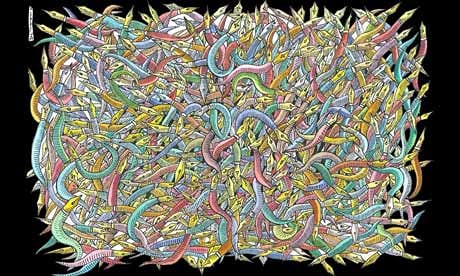
Illustration: Andrzej Krauze from the article

Is this a metaphor for writing fiction or for the opinions about it?

  • Hilary Mantel: “Description must work for its place. It can’t be simply ornamental. It ­usually works best if it has a human element; it is more effective if it comes from an implied viewpoint, rather than from the eye of God. If description is coloured by the viewpoint of the character who is doing the noticing, it becomes, in effect, part of character definition and part of the action.”      I agree!
  • Michael Moorcock: “If possible have something going on while you have your characters delivering exposition or philosophising. This helps retain dramatic tension.” and “Carrot and stick – have protagonists pursued (by an obsession or a villain) and pursuing (idea, object, person, mystery)”   Good point.
  • Will Self: ” You know that sickening feeling of inadequacy and over-exposure you feel when you look upon your own empurpled prose? Relax into the awareness that this ghastly sensation will never, ever leave you, no matter how successful and publicly lauded you become. It is intrinsic to the real business of writing and should be cherished.”    I find this quite interesting; I had only feelings of pride for my first book when completed.  More recently, with my eighth, I do feel that sense of inadequacy.
  • Zacie Smith: “Tell the truth through whichever veil comes to hand – but tell it. Resign yourself to the lifelong sadness that comes from never ­being satisfied.”     This is very similar to Will Self’s comment.
  • Rose Tremain: “Forget the boring old dictum “write about what you know”. Instead, seek out an unknown yet knowable area of experience that’s going to enhance your understanding of the world and write about that.”    I did just this with my last two novels.   By the way, when one does this, one has to be connected to the Internet – contrary to the advice of several authors.
  • Sarah Waters: “Writing fiction is not “self-­expression” or “therapy”. Novels are for readers, and writing them means the crafty, patient, selfless construction of effects. I think of my novels as being something like fairground rides: my job is to strap the reader into their car at the start of chapter one, then trundle and whizz them through scenes and surprises, on a carefully planned route, and at a finely engineered pace.”     I like the analogy.
  • Jonathan Franzen: “Write in the third person unless a ­really distinctive first-person voice ­offers itself irresistibly.”    I think this is probably good advice.  Luckily the two novels I’ve written in the first person are distinctive.
  • Esther Freud: “Cut out the metaphors and similes. In my first book I promised myself I wouldn’t use any and I slipped up ­during a sunset in chapter 11. I still blush when I come across it.”   I don’t agree with this; I think that a whimsical, unexpected metaphor can be very enlightening.
  • Neil Gaiman: “Fix it. Remember that, sooner or later, before it ever reaches perfection, you will have to let it go and move on and start to write the next thing. Perfection is like chasing the horizon. Keep moving.”  I thought it was jut my compulsive self: noticing a problem in an earlier chapter and immediately rushing to find and fix it.
  • P D James: “Increase your word power. Words are the raw material of our craft. The greater your vocabulary the more ­effective your writing. We who write in English are fortunate to have the richest and most versatile language in the world. Respect it.”   I think this is an excellent point and it is contrary to some who encourage the use of common words or discourage the use of a thesaurus.

Award

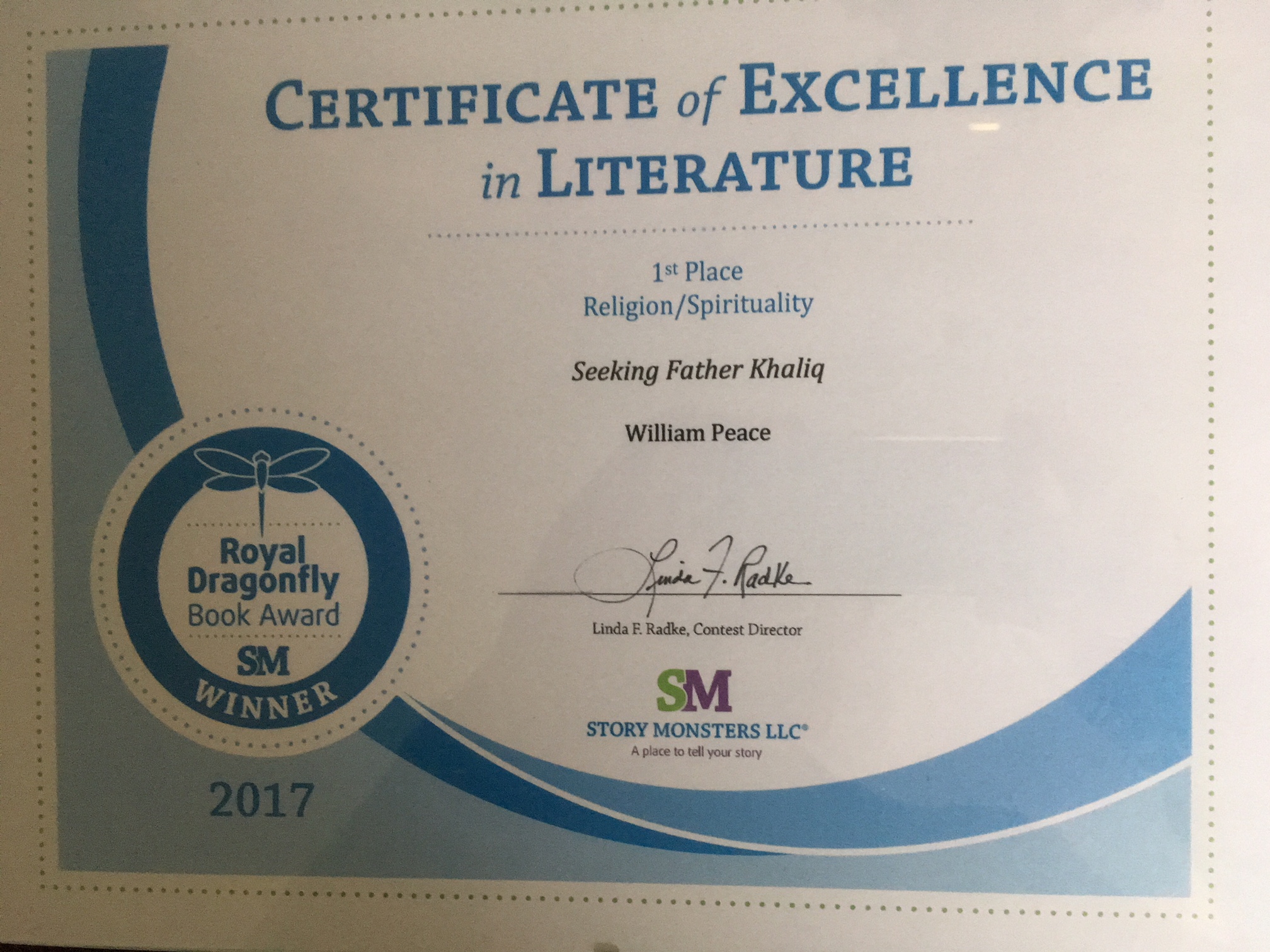
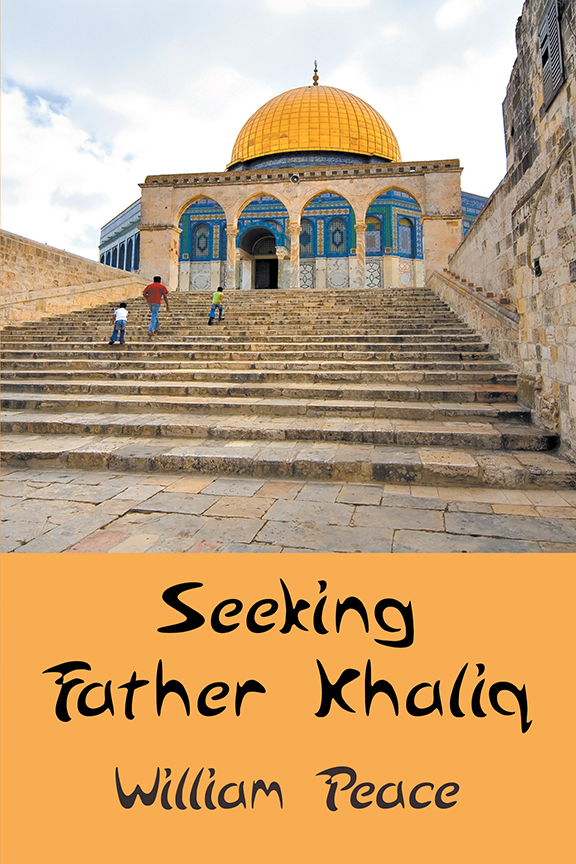
Seeking Father Khaliq has been awarded first place, Religion/Spirituality in the Royal Dragonfly Literary Awards, 2017

The synopsis of Seeking Father Khaliq is as follows:

Kareem al-Busiri is a tenured professor of philosophy at a prestigious Egyptian university.  A woman whose eyes alone are visible, invites him to meet a Princess Basheera.  After doubt and discussion, he agrees.  Princess Basheera asks al-Busiri to find Father Khaliq, who is apparently her very old father, and she suggest that he find him on the Hajj.

Kareem is a secular Sunni Muslim, a widower, with three children: Naqib, the oldest is a leftist lawyer and secret member of the Muslim Brotherhood; Wahida, like her late mother is a Copt, working for the Red Crescent; Kalifa, a handsome, principled conservative plans to be an army infantry officer.  Adeeba is a winsome widowed Copt, Kareem’s late wife’s best friend, professor of archaeology, and an expert in ancient Coptic history, culture and language.  Adeeba’s younger adult daughter, Sagira, has a romantic interest in Kalifa.

On the Hajj, which Kareem undertakes with Hafez, a busy-body, agnostic colleague, there are near encounters with Father Khaliq.  The religious fervour of two million pilgrims, and the mystery of the Hajj make an indelible impression on al-Busiri.

Princess Basheera encounters Kareem on several occasions, appearing unexpectedly, wearing casual clothing, but always a niqab, exposing only her eyes.  She discusses his findings, she suggests new pilgrimages, and there is often an exchange of views on the ideas of important Arabic philosophers.  Kareem wonders: Is she real, or do I imagine her?

On a trip to Medina, al-Busiri visits the Prophet’s tomb and finds that, next to the Prophet is a vacant tomb reserved  for the second coming of Jesus.  He narrowly escapes a suicide bombing in the Date Market, and hears a woman crying out for Father Khaliq.

Persuaded to go on Arba’een, the pilgrimage of over twenty million to the Shia shrines in Karbala, Iraq, Kareem joins eleven Shia scholars from the University of Bagdad.  He becomes caught up in the intensity of the emotion at the tomb of Ali, the Prophet’s grandson and Shia icon.  During the return to Bagdad, the professors are taken hostage by a violent ISIS cadre and held for ransom.  Locked in an abandoned house in Ramadi, they are rescued by a Shia militia in a bloody shoot-out during which four of the Iraqi professors are killed.

On his return to Cairo, Kareem finds that Kalifa has been posted to north-eastern Sinai, where the army is engaged in almost daily skirmishes with Wilayat Sinai (the ISIS affiliate in Egypt).  Wahida suspects that her older brother’s law firm is providing material support to the terrorists.  Kareem reports the law firm, anonymously, to Egyptian intelligence, and meets with his son in an attempt to moderate his increasingly strident views.

With Hafez, on a trip to Jerusalem, the great mosques on the Noble Sanctuary, the Western Wall, the Jewish Quarter, and a Druze settlement on the Golan Heights are visited.  Again, there is the illusive Father Khaliq.  Kareem walks the Via Dolorosa with a Christian guide.

Kalifa and Sagira are married in jubilant Coptic and Islamic ceremonies.

Adeeba takes Kareem on a trip to Rome where he is impressed with the splendour of Christian pageantry, music and art, and the two become lovers.  She tells him she has found that ‘Khaliq’ is one of the lesser-known of Allah’s ninety-nine names.

Kalifa is killed in an attack on his base with a rocket which Wilayat Sinai was not known to have.  Wahida suspects that Naqib was involved in the supply chain.  Kareem washes his son’s body for burial; a grieving Naqib appears at the burial.  Wahida finds damning circumstantial evidence, which she passes to an intelligence officer, of Naqib’s involvement with the terrorists.  Naqib, and his law firm partners, are arrested, tried in secret, sentenced to death, and hung.  Again, Kareem washes the body of his son.

Kareem is grief-stricken, and visits his mosque for prayer.  He hears a voice offering reassurance.  Is it Allah?  Adeeba, whom he has now married, suggests that he must seek a new identity in his remaining family and his profession.  In a vacant classroom, Princess Basheera appears once again.  She debates with him the meaning and relevance if an idea of the philosopher Ibn Sina.  Kareem understands her message; she disappears.

Seeking Father Khaiiq  have recently won another award: the Pinnacle Book Achievement Award, Spiritual Fiction, 2017:


What Is a Novel?

When I first started writing, and someone asked me the question, “What is a novel?”, I would have replied, “A good story.”  But frequently, brief replies don’t really enlighten the questioner, and the more I write, the more I understand that a ‘good story’ is actually very complicated indeed – at least when it is written down, printed, publicised, sold to the general public, and liked by its readers well enough to earn its writer more than a trivial income.

So what does a ‘good story’ consist of?  There are a number of qualities of a ‘good story’, and while some may not be directly measurable, they are all, at least scrutinisable and subject to opinion:

  • The Plot:  A plan of what happens in the story.  Is it interesting?  Is it predictable or unpredictable?
  • The Characters:  The fictional people who populate the story.  Do they come alive?  Do we care about (like or despise) them?  Are they active or passive? Are their relationships to one another interesting?  Do the characters’ beginnings and end points support the Message?
  • The Setting:  The time(s) and place(s) in which the story takes place.  Is the particular setting of interest to the particular reader?  Is it easy to place oneself as the reader comfortably into the setting?
  • The Message:  What, in an overall sense, is the author trying to say to the reader? If nothing, do we care?  If something, is it clear?  Does it make us think?
  • The Tone:  The kind of emotion which is inherent in the language the author uses.  Is it sad? angry? melancholy?  matter-of fact?  Does the tone seem to support the Message?
  • The Narrator;  Who’s telling the story?  Is the choice of narrator supportive of the above five characteristics?
  • The Tense:  Is the story told in the present or the past tense?  Is the story supported by the choice of tense?
  • The Action:  Exactly what happens.  Is it credible?  Is it attention grabbing?  Is there too much or too little action?  Is the action relevant to the Message?

And then, there are the variables which define how the story is told:

  • The Language:  At what educational level is the story pitched (toddler vs college grad)?
  • The Words:  Do the words convey an exact (vs approximate) meaning?  Are there cliches?  Are there too many or too few words?  Do they convey appropriate feelings as well as facts.
  • The Sentences:  Does the author use correct grammar and punctuaton?  Do the sentence structures facilitate understanding?   Are they readable without difficulty: not too complex; not too simple?
  • Realism vs Fantasy:  Is the author’s choice of realism vs fantasy supportive of the story overall.  If there are elements of fantasy, does the reader automatically suspend disbelief?
  • Dialogue vs Backstory vs Narrative:  Is there a balanced use of these techniques?  Does their use support the story?
  • Tension:  How much tension does the author build into the story?  Does it support the plot? is there too much or too little tension?

Perhaps there are some variables I’ve overlooked.  Please don’t hesitate to mention them.