When Your Book Becomes a Movie: Rewards and Pitfalls

Carol Pinchefsky has an article under the title Wizard Oil on the Intergalactic Medicine Show website about the pros and cons of having your book become a movie. She is a freelance writer of technology, games, and geekery for various publications living in New York.  Extracted below are some of the key points she makes.
index

Carol Pinchefsky

The Lord of the Rings films and the combined Harry Potter films have earned $7.3 billion. Both sets of movies were adapted from books.  Royalties from her adaptations have helped make Harry Potter author J.K. Rowling the second richest woman in entertainment, as well as the richest author in history. This number is higher than the gross domestic product of some small countries, including the Bahamas and Mongolia, enough to keep an author in orchid-scented paper and gold-dusted typewriter ribbon for several lifetimes. Most science fiction and fantasy authors are happy to get by on a fraction of that amount.

“Here’s how it works: a producer or production company ‘options’ a book — that is, buys the rights (typically for several thousand dollars) to adapt the book for a period of time (typically from eighteen months to two years). If the producers have not adapted the book when the agreed-upon the period of time lapses, the rights revert back to the author.  Few books that are optioned are actually produced; some books get optioned more than once. Although most optioned books languish in “development hell,” with promises of big-name stars dangled in front of the author, only to have the project stymied for years on end, sometimes these promises come to life.  . . . For some authors, seeing their books turned into extravagantly funded film is the culmination of a dream.  But is having a book adapted a good experience for the author?

“Financially, yes. The option fee is like free money: thousands of dollars for what amounts to almost no extra work. And if the book gets produced, the author receives royalties–even more free money.  Plus, books adapted for film or television also get an exposure and recognition that other books do not; curious cinephiles often find their ways to original material of a show they’ve enjoyed. This can catapult an author from a position of moderate success into bestsellerdom.

“But adaptation is not without potential hazards: comically bad acting, stupefying dialog, and a complete and utter lack of understanding of the original book have made their way into the cinema and onto the television…all bearing the name of the author.  (This happens with such frequency that fans of a particular book are reluctant to watch adaptations of their favorite books. Even though they would like to share their passion with the world, fans can bitterly resent shoddy or inconsistent portrait.  The author has no recourse, except to divorce him/herself from the production. But by then, her/his name has become linked to a disaster. For some, no amount of money can heal a wounded reputation.

“However, several authors can proudly bear witness to successes, where they’ve sat on set, consulted with the director, and even contributed to the script. More important to them, they have seen the characters and the worlds they’ve created come alive. “I went to visit the set, and my characters are there, only everybody else can see them too,” says Jim Butcher, author of the Dresden Files, now a new series on the SciFi channel.  Butcher’s joy did not end there. ‘I got to be an extra in one of the shots, I get to be one of Butters’ assistants and morgue guys and I help carry out a coffin.’

“Tanya Huff, author of Vicki Nelson Investigates series, says that not only was she treated well by the producers and asked her opinion on casting decisions, ‘I was so incredibly honoured to be asked to write a script for the show.  I’d never written a script…writing for television being very, very different than writing for print.’

“Despite their positive experiences, some authors were not completely unscathed. Although Mike Mignola, author of the Hellboy, was not present during initial talks with producers, he found that part of the process slightly uncomfortable: ‘They’re dissecting and reassembling your child. You don’t want to be in the room for that.’ For Butcher, ‘if anything, the worst thing has been critics. Apparently now that there’s success, the critics feel much more free to whip out the scalpels and go at you to draw blood.’  But those negative experiences pale next to the worst-case scenario that happened to acclaimed author Ursula K. Le Guin.  The adaptation of her Earthsea series had only a passing resemblance to her original material, for example, dark-skinned characters were made white. Le Guin disowned the made-for-TV movie.  ‘Despite lavish ‘promises’ of consultation, I was entirely excluded from the process. Both films were exploitive, using my books merely for the name and some character names and ideas, but arbitrarily changing and ‘stupidifying’ the story,’ says Le Guin.

“Authors find it flattering to know that people with money care enough about their book to spend months of their lives and millions of dollars on it. But this balm to the ego should not replace common sense. The authors whose books have been adapted have advice:

“Butcher says, ‘Make sure you’re working with an agent you can rely on. Make sure you stay in close contact with your agent. Make sure you read all the contracts, because they say things and you think you know what they mean and you don’t.’

“Le Guin says, “When it comes to the actual contract: If they tell you they love your marvelous book and are going to put it straight onto the screen just as it is, if they promise to send you the screenplay and listen to your reactions to it because they know you are greater than Shakespeare, if they give you a fancy title such as Creative Consultant–even if they give you some money to be Creative Consultant–if they tell you they will consult with you on all important points–don’t believe them…. Mostly the rule for the author is ‘Take the money and run.’ And never look back.’

“Huff says, ‘If the process goes off the rails, as sometimes it does, give your readers credit enough to realize that you had nothing to do with it. And if, as in my case, it’s a wonderfully realized extension of your work, smile and say thank you.’

“Authors with a specific vision as to how their works should be portrayed, and are not willing to compromise, should not allow their books to be filmed–no matter how tempting the financial reward (potentially billions of dollars, but more likely in the tens or perhaps hundreds of thousands). Know yourself.  Mignola says, ‘You have to remember film is an entirely different medium…. I think hopefully nobody is so naive that they think their work is going to be preserved as is on screen. And you don’t want them to mess with it, don’t let them have it.’

“But many authors would like to see their books reach a larger audience while concurrently lining their pockets. How does an author get her/his books turned into the next Hollywood blockbuster?  In all cases, my interviewees were approached by a production company, rather than contacting a production company themselves.  Literary agent Joshua A. Bilmes says this is almost always the case. ‘Just about every project that I have sold to Hollywood has been from somebody finding their own way to a property and wanting it.’

“‘You have to contact someone who has contacts in the film industry. There’s not a lot of forums for unsolicited work to get seen by the film industry,’ says Eli Kirschner, who works for Created By, a management company that specializes in adapting popular books into movies.  Kirschner says the best way for an author to get his/her works adapted is ‘getting your books publicized…. If a writer isn’t really well known or doesn’t get an Entertainment Weekly and Publisher’s Weekly review…I’d say that they do kind of have to know someone in the film business.’ Failing that, ‘If an author believes in his work, he can make a trip to LA and get his book in the hands of people who can do something with it,’ says Kirschner.

“Having a novel adapted is an arduous, lengthy process for an author. And for those who create their own universes and tend to work alone, the loss of control can be unsettling.

“But for some authors, the potential rewards outweigh the very real risks. As Huff says, ‘I have had my character, Henry Fitzroy’s, teeth at my throat. It doesn’t get better than that.'”

 

Writing Contests: A Cautionary Tale

Warren Adler published the following article, extracted below, on the Huffington Post Books page in June of last year.  Until I read it, I hadn’t realised there was such explosive growth of on-line writing contests.

Warren Adler is best known for The War of the Roses, his masterpiece fictionalization of a macabre divorce turned into the Golden Globe and BAFTA nominated dark comedy hit starring Michael Douglas, Kathleen Turner and Danny DeVito. Adler’s international hit stage adaptation of the novel will premiere on Broadway in 2016. Adler has also optioned and sold film rights for a number of his works including Random Hearts, The Sunset Gang, The War of the Roses – The Children,Target Churchill, Residue, Mourning Glory, and Capitol Crimes.

index

Warren Adler

“When I started the Warren Adler Short Story Contest in 2006 I had rather lofty ideas about integrity and fidelity to the goal of resurrecting the popularity of the short story which was in decline. I appointed qualified people, meaning people who were either authors themselves or teachers of literature or creative writing with the taste and experience to judge the submissions honestly.

“It was a difficult chore at best and I wanted to guarantee that those who were the chosen winners were the very best of those who submitted their work. I offered cash prizes out of my own pocket. The first Prize Winner received $1000 and prizes were offered for our second and third choices. The submissions were free of charge.

“In addition to the cash prizes I promised that the prizewinning stories would be published as an e-book anthology on Amazon and offered for sale with royalties given to the authors of the stories. My hope, of course, was to give a boost not only to the short story format but also to the writing careers of the talented writers who participated. The book, as promised, is available on Amazon.

“The digital publishing revolution was in its infancy and I believe I was the first novelist to ever create such a contest on the Internet. As the cyber world grew so did the submissions. It became difficult and time consuming to read all of the offerings and finding enough quality judges to devote the time to honest assessment was becoming exceedingly burdensome to administer. The last thing I wanted to do was jeopardize the integrity of the contest.

“Eventually I had no choice but to begin charging a small submission fee designed to perhaps curb the number of submissions as well as to provide judges with a stipend that would make it worth their time. Above all, the goal was to maintain the integrity of the contest and further the original goals of the enterprise.

“After seven years of sponsoring the contest, I opted for a hiatus. It was a victim of its own success. To do it right required time, personnel and resources. I finally suspended the contest. I had no desire to create a startup and it was interfering with my own busy writing career.

“What I didn’t imagine was the tsunami of writing contests that it inspired. Worse, I never suspected that it would serve as a business model for entrepreneurs to get into the game just for profit.

“I am somewhat suspect of the value these contests hold for participants.

“Self-publishing requires self-promotion. It is an absolute necessity and comes with the territory, requiring time, effort and funding. The goal is “discoverability.” Most never achieve it, regardless of the quality of their work.

“The rise of self-published fiction authors has been spectacular. Unfortunately the glut has made it difficult for them to stand out from the crowd however excellent their writing is. Genre writers with promotional skills along with lots of money and time might find a niche, although the odds of making enough money to give up their day job is long.

“These writing contests, with their prestigious sounding names, offer the impression of quality promotion for the winners and, of course, bragging rights which can be dubious and of suspect value. One wonders who the judges are that are taking on such a massive amount of submissions. Few of these contest sponsors reveal their methods or the people who read this mass of material and make their judgments. It is often true of the most prestigious awards like the Pulitzer and the Nobel and I often wonder how some of the winners have reached the attention of the judges and who makes the screening decisions.

“By and large, internet-based contests tend to always charge a submission fee, which accounts for the sponsor’s profits as well as its proliferation. Considering that these contests are expanding they must be profitable for the sponsors and are inspiring others to create mirror image money-making opportunities using a similar business plan. Their targets are vulnerable, aspiring writers desperate for recognition and the realization of their dreams.

“Most of these contests are based upon dreams of literary glory, popularity, riches and movie adaptations on the part of authors. All truly believe that their work is deserving of recognition, popularity and prestige. Many probably fit that description. Indeed the sponsors know this and exploit it. It is the key to their monetary success.

“There is a great deal of literary talent out there who go unrecognized and do not attract the traditional publishers. Of course it works both ways. The traditional publishers sometimes gamble on first novels and often lose their bets in the sales arena. Such is the nature of the beast.

“This is not meant to be a blanket condemnation of writing contests. But since the Internet is a vast swamp of snake oil salesman hawking worthless schemes, products and ideas, consider this a cautionary tale.”

My experience of writing contests is very similar to the picture Mr Adler paints.  I have entered a number of contests with most of my books, and I have won some ‘awards’ – but no money.  Even winning first place in a genre did not merit a financial award.  So, I have a wall covered with award certificates.  Invariably, I had to pay an entry fee.  To me, this doesn’t seem unreasonable: there are administrative costs and (presumably) judges fees to be paid.  But, I have never learned how the judging would take place, let alone the identity of a single judge.  I attended one award ceremony in London, at which I expected a journalist or two to be present: there were none.  Attendees consisted of some of the authors who won awards and two low-ranking admin people representing the contest.

Having said this, I still try out new contests that appear to offer more value, particularly those that offer a critique of the work submitted.

Publishers Have a Lot to Learn from J K Rowling

Allison Pearson had a column in The Daily Telegraph last Wednesday under the above title.  Ms Pearson is a Welsh author and newspaper columnist. Her novel, I Don’t Know How She Does It, published in 2002, has been made into a movie of the same name  starring Sarah Jessica Parker.   Her second novel, I Think I Love You,  was published in 2010.   A sequel to I Don’t Know How She Does It was announced in 2015.  The column will amuse all of us who struggle to receive a contract from a first line publisher.

index

Allison Pearson

“J K Rowling has shared a rejection letter from a publisher for her first adult crime novel, written under the pseudonym of Robert Galbraith.  The publisher suggests that The Cuckoo’s Calling could not be published ‘with commercial success’, and adds, for good measure, that the author might be helped by a writing course.

“Rowling is to be congratulated for not immediately conjuring a Harry Potter spell, such as Avada Kedavra (Killing Curse) against this dimwit with no literary judgement.  As it happens, I am addicted to Rowling/Galbraith’s novels with their wonderful Caliban-meets-Columbo detective, Cormoran Strike.  The quality, both of writing and observation, is evident from the first page.

“Rejection, alas, is the lot of the new writer.  I am currently judging the Lucy Cavendish College Fiction Prize and am reading the entries with tender  care – so well do I remember the sting of being rejected myself.

“Fourteen years ago, I sent some chapters and a synopsis to a celebrated editor of women’s fiction.  I was quietly confident that the story of a stressed-out working mother would strike a chord.  The editor emailed back and said that the novel was not for her.  Should I seriously wish to become an author, I might like to go away and read a recent novel by one of her writers.  Was I familiar with her work?

“I was, indeed.  Ah, rejection dejection.  The slump lasted a while until I was lucky enough to be snapped up by a couple of brilliant women editors at Chatto and Vintage.  The book they published, the same one rejected by the first editor, was I Don’t Know How She Does It.

“When that novel was number one on Amazon in the Unites States, did I think with quiet satisfaction of the nitwit who had rejected it?  I did, dear reader, I certainly did.  As J K Rowling would probably tell you, revenge is a dish best served cold with an international bestseller.”

Review: The Past

I bought Tessa Hadley’s latest novel, The Past, because of a very favourable review in Time Magazine.  Ms Hadley is the author of five previous novels which have achieved recognition.  She has also produced two short story collections, and her writing appears regularly in The New Yorker.

index

Tessa Hadley

The Past is about the journey of three sisters and a brother, all adult, to their grandparents’ run-down, abandoned, old home in the Somerset countryside.  They meet there for three weeks of holiday in the summer to decide what to do with the house, now that their parents are dead.  The house is filled with memories; their mother took them there as children when she left her husband.  Conflicts, jealousies and attachments emerge during the three weeks.  Fran’s two young children, Ivy and Arthur; Molly, Roland’s sixteen-year-old daughter; his third wife, Pilar; and Kasim, the twenty-year-old son of Alice’s ex-boyfriend, add interest and complexity.

Ms Hadley’s writing is beautiful.  The descriptions of the Somerset country are almost poetic: her fondness for rural England is unmistakable.  The characters are real and well-drawn, with the possible exceptions of Kasim, who often seems petulantly distant for a man of college age, and Ivy, whose behaviour seems unaccountably contrarian.

The only problem I had with The Past is that nothing of real significance happens.  There is plenty of interaction among the characters which sheds light on their personalities and values.  Personal histories emerge.  The most significant events are the children finding a dead dog, Kasim and Molly making love, Harriet making a pass at Pilar, and one of the sisters estranged husbands’ being sent away.  The inside of the dust jacket says, “small disturbances build into familial crises”, but the crises are neither grand, nor ultimately meaningful.

However, if one is seeking a comfortable, quintessential British story about family, The Past would be a very good choice.

Social Media

I would really like your comments on this post, because while I’m engaged with social media – as I’ll tell you below – I’m not sure I’m making the most efficient/effective use of the various social media.

index

First of all, let me tell you what I have.  I have a website: http://www.williampeace.net, which is actually put in place by my publisher, but I update it from time to time.  The website has a page for each of my books with a sample chapter, synopsis, information about awards, links to Amazon, etc., and a little bit about me.  This blog runs down the margin of the website.  I have an author’s page on Amazon.  On Facebook, in addition to my personal page, I have an author’s page and a page for each of my books.  I have recently started to advertise Sable Shadow & the Presence on Facebook, and I’m getting about 10 Likes per day.  I have an author’s page on Goodreads, where this blog also runs.  I am currently advertising four of my books on Goodreads, but I’m only getting one or two clicks a week: I’ve set a pretty low budget.  When I review a book I’ve read (about once a month), in addition to posting the review here, I post it on Amazon and Goodreads.  When I review a book on Goodreads, the review appears on my personal Facebook page.

Then, there is this blog.  This will be my two hundred and fourteenth post over the course of four and a half years.  Generally, I try to post once a week, and I aim the blog at people like me who are trying to make their way as writers, or who are interested in what writers think and do.  Last year, I paid about £250 for SEO – by my internet service provider – but I haven’t seen a major increase in hits: I’m up from about two per day to four per day – average.

I haven’t done Twitter, although I have registered.  My view is that Twitter isn’t a good vehicle for a busy writer (what could I say every day about writing in less than 140 characters?)  I haven’t done UTube, again because I don’t think it’s the right medium for me.  I looked into Pinterest, but again, I felt that it didn’t fit.

One thing I’m planning to do is to start answering reader’s questions on Goodreads.  That would seem to be a good investment of my time.

What else would you suggest?  I have only two constraints:

  1.   I haven’t got much free time, and what free time I have, I would rather write than promote.
  2.   I’m willing to spend some money, but I’d like to know that I’m getting a return on my investment.  So far, the return has been only what I’ve learned about social media.

What Literary Agents Dislike

Chuck Sambuchino contributed an interesting  post to the Writer UnBoxed blog, excerpts of which appear below.  Chuck is a freelance editor of query letters, synopses, book proposals, and manuscripts. As an editor for Writer’s Digest Books, he edits the Guide to Literary Agents.

img_1970

Chuck Sambuchino

“No one reads more prospective novel beginnings than literary agents. They’re the ones on the front lines — sifting through inboxes and slush piles. And they’re the ones who can tell us which Chapter 1 approaches are overused and cliche, as well as which techniques just plain don’t work. Below find a smattering of feedback from experienced literary agents on what they hate to see the first pages of a writer’s submission. Avoid these problems and tighten your submission!

FALSE BEGINNINGS

“I don’t like it when the main character dies at the end of Chapter 1. Why did I just spend all this time with this character? I feel cheated.”
– Cricket Freeman, The August Agency

“I dislike opening scenes that you think are real, then the protagonist wakes up. It makes me feel cheated.”
– Laurie McLean, Foreword Literary

PROLOGUES

“I’m not a fan of prologues, preferring to find myself in the midst of a moving plot on page 1 rather than being kept outside of it, or eased into it.”
– Michelle Andelman, Regal Agency

“Most agents hate prologues. Just make the first chapter relevant and well written.”
– Andrea Brown, Andrea Brown Literary Agency

“Prologues are usually a lazy way to give back-story chunks to the reader and can be handled with more finesse throughout the story. Damn the prologue, full speed ahead!”
– Laurie McLean, Foreword Literary

EXPOSITION/DESCRIPTION

“Perhaps my biggest pet peeve with an opening chapter is when an author features too much exposition – when they go beyond what is necessary for simply ‘setting the scene.’ I want to feel as if I’m in the hands of a master storyteller, and starting a story with long, flowery, overly-descriptive sentences (kind of like this one) makes the writer seem amateurish and the story contrived. Of course, an equally jarring beginning can be nearly as off-putting, and I hesitate to read on if I’m feeling disoriented by the fifth page. I enjoy when writers can find a good balance between exposition and mystery. Too much accounting always ruins the mystery of a novel, and the unknown is what propels us to read further.”
– Peter Miller, PMA Literary and Film Management

“I dislike endless ‘laundry list’ character descriptions. For example: ‘She had eyes the color of a summer sky and long blonde hair that fell in ringlets past her shoulders. Her petite nose was the perfect size for her heart-shaped face. Her azure dress—with the empire waist and long, tight sleeves—sported tiny pearl buttons down the bodice. Ivory lace peeked out of the hem in front, blah, blah.’ Who cares! Work it into the story.”
– Laurie McLean, Foreword Literary

STARTING TOO SLOW

“Characters that are moving around doing little things, but essentially nothing. Washing dishes & thinking, staring out the window & thinking, tying shoes, thinking.”
– Dan Lazaar, Writers House

“I don’t really like ‘first day of school’ beginnings, ‘from the beginning of time,’ or ‘once upon a time.’ Specifically, I dislike a Chapter 1 in which nothing happens.”
– Jessica Regel, Jean V. Naggar Literary Agency

VOICE

“I know this may sound obvious, but too much ‘telling’ vs. ‘showing’ in the first chapter is a definite warning sign for me. The first chapter should present a compelling scene, not a road map for the rest of the book. The goal is to make the reader curious about your characters, fill their heads with questions that must be answered, not fill them in on exactly where, when, who and how.”
– Emily Sylvan Kim, Prospect Agency

“I hate reading purple prose – describing something so beautifully that has nothing to do with the actual story.”
– Cherry Weiner, Cherry Weiner Literary

“A cheesy hook drives me nuts. They say ‘Open with a hook!’ to grab the reader. That’s true, but there’s a fine line between an intriguing hook and one that’s just silly. An example of a silly hook would be opening with a line of overtly sexual dialogue.”
– Daniel Lazaar, Writers House

“I don’t like an opening line that’s ‘My name is…,’ introducing the narrator to the reader so blatantly. There are far better ways in Chapter 1 to establish an instant connection between narrator and reader.”
– Michelle Andelman, Regal Literary

“Sometimes a reasonably good writer will create an interesting character and describe him in a compelling way, but then he’ll turn out to be some unimportant bit player.”
– Ellen Pepus, Signature Literary Agency

CHARACTERS AND BACKSTORY

“I don’t like descriptions of the characters where writers make them too perfect. Heroines (and heroes) who are described physically as being virtually unflawed come across as unrelatable and boring. No ‘flowing, wind-swept golden locks’; no ‘eyes as blue as the sky’; no ‘willowy, perfect figures.’ ”
– Laura Bradford, Bradford Literary Agency

“Many writers express the character’s backstory before they get to the plot. Good writers will go back and cut that stuff out and get right to the plot. The character’s backstory stays with them—it’s in their DNA.”
– Adam Chromy, Movable Type Management

“I’m turned off when a writer feels the need to fill in all the backstory before starting the story; a story that opens on the protagonist’s mental reflection of their situation is a red flag.”
– Stephany Evans, FinePrint Literary Management

“One of the biggest problems is the ‘information dump’ in the first few pages, where the author is trying to tell us everything we supposedly need to know to understand the story. Getting to know characters in a story is like getting to know people in real life. You find out their personality and details of their life over time.”
– Rachelle Gardner, Books & Such Literary

I agree with all of these points except ‘Prologue’ (in some cases).  I have a prologue in two of my novels.  The first novel has a prologue and an epilogue, set in a later time frame, to help the reader understand that the narrator is an adult who was a child in the story.  If I had it to do over again, I would do it differently.

Sable Shadow & The Presence has a prologue and an epilogue.  In this case, the prologue has no back story; rather, it jumps ahead and establishes a central theme of the novel.  The epilogue tells the reader what happened after that.  So, I think there situations where a prologue can be useful.

Authors’ Earnings

I was looking for information on authors’ earnings, and I spotted the post below on the UK edition of the Huff Post.  It was written by Sara Sheridan, a Scottish writer who works in several genres, but primarily historical fiction.  She is the creator of the Mirabelle Bevan mysteries.

index

Sara Sheridan

“I write historical fiction. I’ve been a full-time professional writer for almost 20 years. I realized early on that being an author is a hugely misunderstood job. Because there are no pay grades and very little structure, people make interesting assumptions about the profession. The writer is a mysterious figure, wandering lonely as a cloud, fired by inspiration, or perhaps a cocktail or two. Writers have it easy. If you write a bestseller or have your book made into a movie, you’ll never have to work again, or so the myth goes.

“When my first novel was optioned for film in 1999 the common response was “Off to Barbados?” The option was for £3,000 – this remains a fairly average figure for that kind of deal. In fact, the perception at the Society of Authors (which acts as a union for writers) is that in real terms, writers’ incomes have gone down over the last 10 years. The industry values publishers, editors and publicists (who are paid reliable salaries) but when it comes to writers, there are so many people who want the job, that conditions are tough. At publishing houses writers aren’t even treated as part of the team. It was interesting last year when Random House made record profits from 50 Shades of Grey, that it decided to award a bonus of $5,000 (just over £3,000) to everyone working in the US arm of the company. They did not include their writers.

“This decision stems from the underlying belief that writers are artists and artists should be doing whatever they do for love alone. Money sullies art and damn you for having bills. From figures compiled by the Authors Licensing and Collecting Society it is easy to see that for every JK Rowling or Ian Rankin there is a huge swathe of scribblers whose sales don’t merit even a living wage. Conversely, the top 10% of writers earn over 50% of the total income. Like all the creative industries, it’s a winner take all game.

“For publishers, the hunt is on to find those high earners so they commission more books than can possibly make it – and see what sticks. In the UK something just under quarter of a million traditionally printed books are published annually. Set that against the fact that the average first novel sells something in the order of 1,000 copies and you can see what writers are up against. Although given a (usually) small advance by a publisher, a writer still has to earn that money from sales.

“So how much does a writer have to sell to make it?

“Average earnings in the UK were around £26,500 in 2012. To make this amount on a book contract for a paperback edition selling at £7.99 that pays 10% a writer would need to sell 33,166 copies a year. And that’s if the book isn’t discounted as part of a 3 for 2 promotion, for example. That is a lot of books! To put it in perspective to get to number one in the UK paperback chart last month you’d have needed to sell almost 20,000 copies a week. This means that going to number 1 doesn’t even earn you the national average wage (and that book may have taken the writer months or even years to produce). The odds of making a mint are very long – writing is a risky profession. And like most jobs in the UK there is a glass ceiling. Female writers on average earn only 77.5% as much as their male counterparts. Their books are also less likely to get reviewed in the traditional press or for that matter win awards (apart from the prestigious Women’s Prize for Fiction, set up expressly to try to redress that balance).

“In 2005 (the latest figures available) the mean (average) figure that a professional writer-of-books in the UK earned was £28,340 but because there is such a huge bias at the top of the table, the median figure is far more telling. £12,330. Well below subsistence levels. As I said, it is the view of the Society of Authors that figure has now gone down in real terms. All this, I suppose, sounds like a complaint. The truth is that in the last several years although I haven’t reached the dizzying heights of that top 10%, I have done better than the mean. My books get reviewed in the national press. I love my job and it’s exciting to see the popularity of my books growing. Like all writers I live in hope that perhaps one day I’ll make it big and at least on the way I’m enjoying what I do. After all, it can take several books to get your break.

“There’s a larger issue though, than simply one writer (even if that writer is, well, me). Books have a vital place in our culture. They are the source of ideas, of stories that engage and stretch the imagination and most importantly, inspire. The digital revolution has wrest a little control away from corporate publishers and white, male, middle-aged critics, but the financial value put on the job of the writer and the misconceptions around that make it extremely difficult to enter the profession. If we don’t value the people who inspire us (and money is one mark of that) then what kind of culture are we building?”

The above may be a bit depressing if you’re an author trying to write for a living.  But for those of us who love to write, who have other sources of income, but are hoping one day to reach the number one position in sales, it can be at least a little annoying that one’s labour of love achieves so little remuneration.

Adult Coloring Books

I must live a very sheltered life because until this morning, I never heard of adult coloring books.  If I had to guess, I would have supposed that this was a very minor niche in the publishing business and that it is dedicated to adults with learning disabilities.  To my amazement, it was in part due to the sales of adult coloring books that kept print book publishing out of the red in 2015.  {Print book sales increased in 2015 over 2014, largely due to Big Publishing’s victory over Amazon: it won the right to a larger say in the pricing of ebooks.  As ebook prices increased, readers turned to the print versions.  As a whole, in 2015, the industry experienced a decline in sales (down 4.1% from 5.82 to 5.58 billion dollars)}.

So, adult coloring books are a big thing currently.  Here is what Laura Marsh had to say in an article last December in New Republic:

“In 1962, Barbra Streisand channeled all the emotional turmoil and lyric despair of an abandoned lover into what must be the strangest four minutes of pop music ever written. “Crayons ready?” she croons, “Begin to color me.”  The opening lines of the song, “My Coloring Book,” refer to that year’s fevered interest in coloring books for adults, much like the trend that has taken off recently. “For those who fancy coloring books / As certain people do,” Streisand sings, before asking listeners to fill her sorrowful life with equally sorrowful hues. When the song came out, coloring books for adults permeated pop culture, as Mort Drucker’s JFK Coloring Book spent 14 weeks at the top of the New York Times bestseller list in 1962, and sales of adult coloring books reached $1 million. Today, coloring books are perhaps even more profitable: Johanna Basford’s Secret Garden and Enchanted Forest were the two best-selling books on Amazon in April, responsible for some of the year’s recovery in print sales. (Basford has sold nearly 10 million coloring books since Secret Garden was published in 2013.) But their powerful appeal—enthusiasts say they are a “great way to de-stress” —has very little in common with adult coloring books from the 1960s. Where today’s titles offer consumers a neat package of therapy, escape and nostalgia, 1960s coloring books were both genuinely novel and subversive.

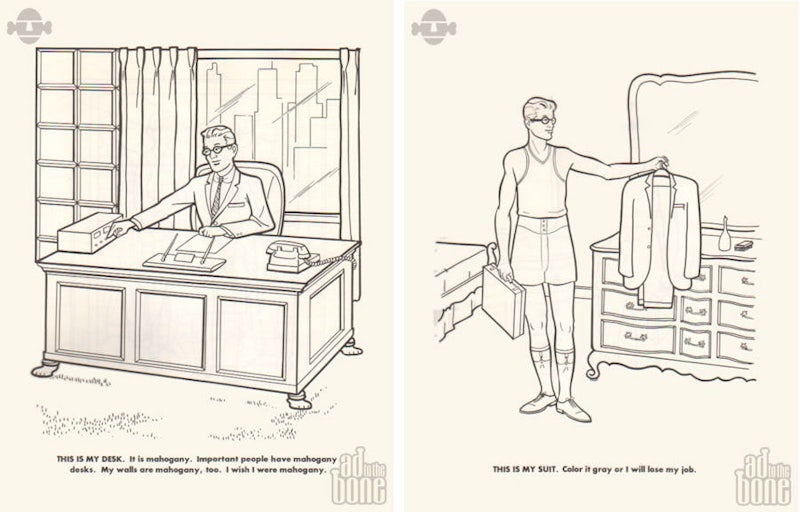
“The first adult coloring book, published in late 1961, mocked the conformism that dominated the post-war corporate workplace. Created by three admen in Chicago, the Executuve Coloring Book showed pictures of a businessman going through each stage in his day, as though teaching a child what daddy does at work. But the captions, which give instructions on how to color the image, are uniformly desolate. “This is my suit. Color it gray or I will lose my job,” reads a caption next to a picture of a man getting dressed for work. Another page shows men in bowler hats boarding their commuter train. “This is my train,” it reads. “It takes me to my office every day. You meet lots of interesting people on the train. Color them all gray.” The rare appearance of a non-gray color is even more disturbing: “This is my pill. It is round. It is pink. It makes me not care.”

From The Executive Coloring Book, 1961.Ad to the Bone

“The coloring books that followed managed to cover, between them, a selection of the decade’s neuroses: national security, the red scare, technology, sex, mental illness. Two popular books took aim at President Kennedy: Drucker’s JFK Coloring Book and Joe B. Nation’s New Frontier Coloring Book. There were coloring books that made fun of communists and coloring books that made fun of people who were scared of communists.  Krushchev’s Top Secret Coloring Book: Your First Red Reader caricatured Soviet leaders and life under communist rule, but was still deemed “objectionable” and banned in the United States Military. Meanwhile, the John Birch Society Coloring Book, which ridiculed conspiracy theorists and extremists, stretched the coloring book concept to its limits with a blank page, captioned: “How many Communists can you find in this picture? I can find 11. It takes practice.” In August 1963, the Washington Post reported on a doctor who proposed using a 12-page coloring booklet “as a diagnostic tool…to classify patients by their types of disorders” from schizophrenia to brain damage. The Post called it the ‘Psychotic’s Coloring Book’.”

Julia Felsenthal writing in the December 2015 issue of Vogue had this to say about more recent interest in adult coloring books:

“But, in spite of the fact that I do on occasion sketch and paint with watercolors, I’ve never once felt moved to pick up a coloring book and go to town. Nor did I imagine that people in my social sphere were doing so. Were those Instagram-famous coloring parties a total anomaly? Or were my other friends also secretly brandishing markers in their spare time?

“I posted the query to Facebook and the response—entirely from women—was surprisingly immediate and enthusiastic. “My aunt-in-law brought coloring books and fancy markers to Thanksgiving and I was all ‘pshhhh, really??’ ” wrote Dean, a designer in Chicago whose funky style I’ve long admired on social media. “Next thing I know, I’m suuuuper chill with a glass of wine, coloring a picture of a flower shop. It’s surprisingly kind of awesome.”

“Other ladies seemed to agree. “I do this,” an old colleague who works in video production admitted with a trace of sheepishness. A writer acquaintance raved about Chat Thérapie, a French, feline-themed coloring book she uses after dinner as a means to avoid screen-induced insomnia. A fashion-school grad explained that coloring-book patterns help her dream up jewelry designs. A mom of two avowed that the hobby keeps her sane. A friend in Austin described how coloring books have begun to appear at packed house parties, psychedelic concerts, and on camping trips. Another friend, a therapist, agreed with Beck that they’re best enjoyed while bingeing on TV.”

OK.  I get it.  But I don’t think I’ll enter the market any time soon.

Review: So Much for That

This novel attracted my attention as it is written by Lionel Schriver, the author of We Need to Talk About Kevin, which won the Orange Prize for fiction in 2005 and which has sold over one million copies in twenty-five languages. Lionel Schriver wrote seven novels before Kevin, which she called her ‘make or break’ creation after seven years of professional disappointment and ‘virtual obscurity’. Six of her seven novels were published; one failed to find a publisher. Since Kevin, Ms Schriver has written five novels, including So Much for That, which was published in 2010. She is an inspiration to all of us novelists who feel that our creations have not received the deserved recognition.

index

Lionel Schriver

So Much for That’s principal character, Shep Knacker, is an entrepreneurial handyman, who is both skilled and likeable. He is able to sell his New York City-based business for one million dollars, and his plan is to move his wife Glynis, his son Zach, and his daughter Amelia to Pemba Island off the coast of Tanzania to live her rest of their lives in low-cost, stress-free comfort. Glynis, though she has been involved in numerous searches around the world to find the perfect place for their ‘Afterlife’, has doubts. Just as she is being confronted with a decision to go or to stay, she is diagnosed with a virulent form of cancer. Escape to Pemba has to be postponed while Glynis undergoes months of treatment. The American healthcare system being what it is, Shep’s nest egg is gradually depleted by co-insurance payments and invoices for un-covered treatments. In order to keep the insurance he has, Shep must continue on the payroll of his prior company, under the unsympathetic supervision of the new owner. Glynis finds that the likely cause of her cancer is exposure to asbestos, with which she had contact in her metal-working hobby. She decides to sue the company which made the asbestos products. Just as Shep is on the verge of bankruptcy, Glynis wins her case and the money received covers an Afterlife in Pemba.

There are several other characters, including Shep’s friend, Jackson, who engages in diatribes against the Mooches (the freeloaders) and the systems that lets them take advantage of the Mugs. Jackson’s daughter, Flicka, who suffers from a horrible, terminal, childhood illness is a vehicle, along with Glynis, for debating the value of human life. There are doctors of doubtful honesty with their patients. And there are decisions about whether to be a Mooch or a Mug.

So Much for That is an entertaining story. It is human, sad, funny, heroic, and, and it is difficult to put down. I felt, at times, though, that the author was lecturing me about the dreadful state of healthcare in the US, and other assorted inequities in life. Several characters, including Flicka, and Shep’s sister, Beryl, are so polarised that one tends to lose what sympathy we should have for them. At the outset, I found it difficult to buy into Shep’s vision of the Afterlife; acceptance of his vision came when his troubles grew acute. Occasionally, I found the text somewhat oblique. For example: “It was disconcerting to be systematically punished for what might have engendered a modicum of gratitude.” Why not say: “He was annoyed to be punished for acts of kindness”? Sometimes, for me, the dialogue didn’t ring true, but perhaps I am being too picky.


I liked So Much for That. It makes some very important points about what is to be human: what’s good about our humanity and what’s not so good.

Review: A God in Ruins

For the last couple of weeks, I’ve been out of the office: my PC has been neglected, but I’ve done some reading.

A God in Ruins by Kate Atkinson is without a doubt the best book I’ve read in a long time, and it’s easy to see why it won last year’s Costa Book Award.  In fact, the judges called it, “Utterly magnificent and in a class of its own.  A genius book.”

The author has some pretty heavy-weight credentials.  Kate Atkinson won the Whitbread (now Costa) Book of the Year in 1995 with her first novel, Behind the Scenes at the Museum.  Her four bestselling novels featuring former detective Jackson Brodie became the BBC television series.  Her last novel, Life After Life, was the winner of the 2013 Costa Novel Award.  She was appointed MBE in the 2011 Queen’s Birthday Honours.

index

Kate Atkinson

A God in Ruins is the story of Teddy Todd, a would-be poet, lover of the countryside, and heroic bomber pilot during World War II.  The story begins in 1925 and zig-zags back and forth in time until its conclusion in 2012.  As the number of his completed combat missions piles up, Teddy does not expect to see the ‘Afterwards’ in which he will become a husband and a father.  Throughout the story, he faces life as it is without complaints about lost opportunities, heartbreak, or feelings un-expressed.  He is surrounded by the characters of his own family and by some of the family who are neighbours.

The writing is captivating and tight; there is no excess baggage here even though the book runs to over 500 pages.  The characters are distinct, and the story line never lags.  What most impressed me about the novel was the authenticity of the descriptions of flying bombing missions in a Halifax, but then, at the end of the book is a three page bibliography of sources.  Ms Atkinson did a lot of research!  I understand why it too two years to write this novel.  There is an interesting device she used which turns fiction on its head.  Fascinating!  But I’m not going to give it away.  Sometimes I felt slightly put off by the broken chronology, but in reading the book over a period of days, I began to feel that it was building nicely to a conclusion.  This is a novel which fully engages both one’s emotions and one’s beliefs.