Review: Tess of the D’Urbervilles

I was searching my bookshelves for something to read on holiday and I found an old, paperback copy of Hardy’s Tess of the D’Urbervilles – I have no idea where it came from.  I remember reading Far from the Madding Crowd in high school, and I thought it was time to get in touch with Hardy again.

Thomas Hardy was born in 1840 in a rural community in Dorset, England to a working-class family which did not have the means to send him to university.  He trained as an architect in Dorchester, and moved to London to pursue a career, but he was never comfortable in London, where he was acutely conscious of his class and social inferiority.  Returning to Dorset in 1867, he began his first novel, The Poor Man and the Lady, which was rejected for publication; he subsequently destroyed the manuscript, but subsequently wrote three novels: two published anonymously and one, A Pair of Blue Eyes, in his own name.   This latter novel concerns his courtship of Emma Gifford, who became his wife and encouraged him to write full time.  In 1874, Far from the Madding Crowd was published and was followed be ten novels, which attracted an increasingly hostile reception for ‘pessimism’ and ‘immorality’.  In fact, Jude the Obscure, Hardy’s last novel (1895), was burned by the Bishop or Wakefield.  In his memoir, Hardy said: “After these [hostile] verdicts from the press, its next misfortune was to be burnt by a bishop – probably in his despair at not being able to burn me.”  Hardy then turned his attention to writing poetry and short stories until hes death in 1928.  Tess was also criticised for its immorality and its implied criticism of social and religious culture, which, viewed from a 21st century perspective, is difficult to understand.

Hardy’s themes include the examination of social themes in Victorian England: marriage, education and religion, that limited people’s lives and caused unhappiness.  Hardy’s religious beliefs seem to have been a combination of agnosticism and spiritualism; he rejected the religious doctrine of his time.  For him, education was an unfair badge of social status, and the sexual mores of Victorian England were often a millstone around people’s necks.


Thomas Hardy

Tess, the lead character in Tess of the D’Urbervilles, is a beautiful farm girl whose lower class status is denied by her father who fancies that his family are descendants of the old, aristocratic, D’Urberville family.  She is sent to work for an old,  matriarch and her ne’er-do-well son, Alec, of the D’Urberville family.  She dislikes the son for his arrogance and his bothersome attentions, but she is taken advantage of by him and becomes pregnant.  How this happens is left to the reader’s imagination.  Her baby dies and she goes to work on a distant farm where she meets a middle class man, Angel Clare, with whom she falls in love.  When he asks her to marry him she is distraught, as his expectation must be that she is a virgin.  Finally, she accepts Angel’s proposal and commits to revealing her sin to him, which she does on their wedding night.  He, a man of strict morals, rejects her and emigrates to Brazil.  She is heartbroken, and goes to work on a hard-scrabble farm, where, once again, she meets Alec.  Separated by thousands of miles, Tess and Angel pine for one another, and he comes back to England to find her.  But, owing to dire financial circumstances, she has been taken by Alec as his mistress.  Angel follows her trail and finds her with Alec in a smart hotel.  The story ends tragically.

The first two thirds of the novel is beautifully written at a leisurely, captivating pace.  Hardy’s love of Tess, the English countryside and its culture shines through. At the same time there is a sense of impending disaster which pulls the reader along.

It seemed to me that the last third of the novel was written in a hurry by an author who wanted to get to the conclusion.  Character development in the first two thirds was measured and complete, but the changes in Alec and Tess toward the end seem somewhat dubious.  Alec’s transformation from scoundrel to preacher and back to a scoundrel seems barely plausible – as does Tess’ out of character change in the last few pages to pliant mistress with a hidden fury.  Strangely, Hardy has Tess swear an oath on an ancient stone monument, and one is braced for a repercussion, but none appears.  Then there is the character Lisa-Lu, Tess’s sister, who comes on stage at the last minute in an important role, without previous introduction.

I enjoyed reading Tess, and I also enjoyed finding what I think are errors by a great author.

Why Children Need to Read

This was the title of the cover story in the Review section of The Daily Telegraph on 20 January 2018.  The author is Katherine Rundell, author of The Explorer, which won the 2017 Costa Children’s Book Award. She begins the article by talking about a “state of consciousness that comes without calling.  It is as if the clamorous world has quietened and thinned. . . The other times I have experienced it were as a child, while I read.  It would take perhaps three pages, then the world became mute.  Its urgency vanished and its demands fell silent.  I could sit waiting outside a ballet class, music vibrating through the walls, and hear nothing.

“Children’s fiction accounts for 39 of the 100 bestselling books of 2017, and for about 24% of the UK book market.  There’s a lot of it about.  Still, the question I get asked most, when people hear that I write for children, is: why?  Why not write real, serious books for adults?  Because, I think, only for a child, can fiction crowbar open the world.

“The intricacies of reading evade description in the same way that dreams and music evade it, but there is, I think, something unique about the way stories colour the imagination of a child.  What do you see as an adult, when you read?  Do you deck out the characters in shoes, buttons, fingernails.  I think I don’t.  I read ‘Emma Woodhouse, handsome, clever and rich’, and I conjure up, in the space behind my eyes, an atmosphere rather than a distinct picture, colour, nose or lip. But children are doing something different when they read.  They have sometimes described to me in painstaking detail, scenes from books of mine which do not exist.  It happens relatively often: a child will tell me she loves the dance across the Paris rooftops in my book Roofhoppers, or the moment when a girl jumps from a tree onto the back of a wolf in The Wolf Wilder –  scenes I never wrote, although I wish I had.  Children, as they read, paint bright colours in the margins that fiction leaves open.  Their imaginations are snowballs.  When, as an adult, I read some of  my favourite childhood books, I was startled to see how slight some of them were, how many of the details I thought I knew by heart never even appeared; houses I had furnished myself, clothes I had embroidered, journeys  had added.  This is part of why I write for young people: children read the world into largeness.  When you write for a child, you build them a house; when they read, they expand it into a castle.

Ms Rundell tells about the illness of an older sister who died.  “I read through long periods of being alone, in hospital waiting rooms, and car journeys and friends’ houses.  Afraid, I took The Jungle Book or What Katy Did into bed with me alongside my bear, so that if my own fear overwhelmed me, there would be an exit door; I would fall asleep with an escape hatch clutched in one hand. . . . the stories I read then allowed me to believe that my sister didn’t only lose; she also won.  To fight with such gallantry and love is to win.

“The value of children’s books cannot, of course, be predicated on pain – books aren’t only valuable when we have something to escape – but, in fact, I am not sure that escapism is a large enough word for what those books did.  They taught me through the medium of wizards and lions and spies and talking spiders that this world I was newly inhabiting was one of wit and endurance.  Children’s books say: the stories of the world are infinite and various and unpredictable.  They say: you will count for something. They say: bravery will matter, love will matter.”

I was fortunate in having a mother and a grandmother who liked to read aloud.  They were probably motivated, in part, by the rapt attention I paid to stories by Rudyard Kipling, Robert Louis Stevenson and J Howard Pyle.

Rules for Writing Fiction

On the Guardian website, February 20, 2010, there is an article, Ten Rules for Writing Fiction Parts 1 & 2, which caught my eye, mainly because of the writers who were offering their opinions.  In this post I’ve picked out some that haven’t been covered before in this blog, and with which I agree or disagree.

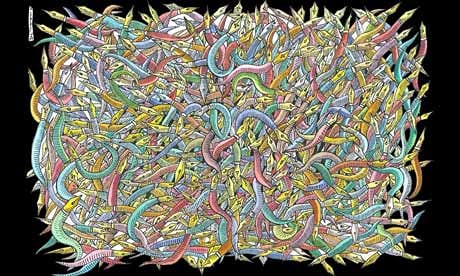
Illustration: Andrzej Krauze from the article

Is this a metaphor for writing fiction or for the opinions about it?

  • Hilary Mantel: “Description must work for its place. It can’t be simply ornamental. It ­usually works best if it has a human element; it is more effective if it comes from an implied viewpoint, rather than from the eye of God. If description is coloured by the viewpoint of the character who is doing the noticing, it becomes, in effect, part of character definition and part of the action.”      I agree!
  • Michael Moorcock: “If possible have something going on while you have your characters delivering exposition or philosophising. This helps retain dramatic tension.” and “Carrot and stick – have protagonists pursued (by an obsession or a villain) and pursuing (idea, object, person, mystery)”   Good point.
  • Will Self: ” You know that sickening feeling of inadequacy and over-exposure you feel when you look upon your own empurpled prose? Relax into the awareness that this ghastly sensation will never, ever leave you, no matter how successful and publicly lauded you become. It is intrinsic to the real business of writing and should be cherished.”    I find this quite interesting; I had only feelings of pride for my first book when completed.  More recently, with my eighth, I do feel that sense of inadequacy.
  • Zacie Smith: “Tell the truth through whichever veil comes to hand – but tell it. Resign yourself to the lifelong sadness that comes from never ­being satisfied.”     This is very similar to Will Self’s comment.
  • Rose Tremain: “Forget the boring old dictum “write about what you know”. Instead, seek out an unknown yet knowable area of experience that’s going to enhance your understanding of the world and write about that.”    I did just this with my last two novels.   By the way, when one does this, one has to be connected to the Internet – contrary to the advice of several authors.
  • Sarah Waters: “Writing fiction is not “self-­expression” or “therapy”. Novels are for readers, and writing them means the crafty, patient, selfless construction of effects. I think of my novels as being something like fairground rides: my job is to strap the reader into their car at the start of chapter one, then trundle and whizz them through scenes and surprises, on a carefully planned route, and at a finely engineered pace.”     I like the analogy.
  • Jonathan Franzen: “Write in the third person unless a ­really distinctive first-person voice ­offers itself irresistibly.”    I think this is probably good advice.  Luckily the two novels I’ve written in the first person are distinctive.
  • Esther Freud: “Cut out the metaphors and similes. In my first book I promised myself I wouldn’t use any and I slipped up ­during a sunset in chapter 11. I still blush when I come across it.”   I don’t agree with this; I think that a whimsical, unexpected metaphor can be very enlightening.
  • Neil Gaiman: “Fix it. Remember that, sooner or later, before it ever reaches perfection, you will have to let it go and move on and start to write the next thing. Perfection is like chasing the horizon. Keep moving.”  I thought it was jut my compulsive self: noticing a problem in an earlier chapter and immediately rushing to find and fix it.
  • P D James: “Increase your word power. Words are the raw material of our craft. The greater your vocabulary the more ­effective your writing. We who write in English are fortunate to have the richest and most versatile language in the world. Respect it.”   I think this is an excellent point and it is contrary to some who encourage the use of common words or discourage the use of a thesaurus.

What Is a Novel?

When I first started writing, and someone asked me the question, “What is a novel?”, I would have replied, “A good story.”  But frequently, brief replies don’t really enlighten the questioner, and the more I write, the more I understand that a ‘good story’ is actually very complicated indeed – at least when it is written down, printed, publicised, sold to the general public, and liked by its readers well enough to earn its writer more than a trivial income.

So what does a ‘good story’ consist of?  There are a number of qualities of a ‘good story’, and while some may not be directly measurable, they are all, at least scrutinisable and subject to opinion:

  • The Plot:  A plan of what happens in the story.  Is it interesting?  Is it predictable or unpredictable?
  • The Characters:  The fictional people who populate the story.  Do they come alive?  Do we care about (like or despise) them?  Are they active or passive? Are their relationships to one another interesting?  Do the characters’ beginnings and end points support the Message?
  • The Setting:  The time(s) and place(s) in which the story takes place.  Is the particular setting of interest to the particular reader?  Is it easy to place oneself as the reader comfortably into the setting?
  • The Message:  What, in an overall sense, is the author trying to say to the reader? If nothing, do we care?  If something, is it clear?  Does it make us think?
  • The Tone:  The kind of emotion which is inherent in the language the author uses.  Is it sad? angry? melancholy?  matter-of fact?  Does the tone seem to support the Message?
  • The Narrator;  Who’s telling the story?  Is the choice of narrator supportive of the above five characteristics?
  • The Tense:  Is the story told in the present or the past tense?  Is the story supported by the choice of tense?
  • The Action:  Exactly what happens.  Is it credible?  Is it attention grabbing?  Is there too much or too little action?  Is the action relevant to the Message?

And then, there are the variables which define how the story is told:

  • The Language:  At what educational level is the story pitched (toddler vs college grad)?
  • The Words:  Do the words convey an exact (vs approximate) meaning?  Are there cliches?  Are there too many or too few words?  Do they convey appropriate feelings as well as facts.
  • The Sentences:  Does the author use correct grammar and punctuaton?  Do the sentence structures facilitate understanding?   Are they readable without difficulty: not too complex; not too simple?
  • Realism vs Fantasy:  Is the author’s choice of realism vs fantasy supportive of the story overall.  If there are elements of fantasy, does the reader automatically suspend disbelief?
  • Dialogue vs Backstory vs Narrative:  Is there a balanced use of these techniques?  Does their use support the story?
  • Tension:  How much tension does the author build into the story?  Does it support the plot? is there too much or too little tension?

Perhaps there are some variables I’ve overlooked.  Please don’t hesitate to mention them.

Revising

‘Revise’ has a number of synonyms, including: improve, reconsider, update, rewrite, amend and modify.  With my current novel, having finished writing it, I am doing all this and perhaps a bit more.  It is a tedious process, but, to my surprise, I’m enjoying it, because, as I get closer to the end – I’m now about half way through – I’m feeling an increasing sense of pride in the output.

You may recall that in an earlier post, I said that I would print each chapter out in an unusual font and read it aloud, marking anything that jarred on my senses for later correction.  I have done that, and I would recommend it for any author before submitting his/her manuscript for final editing.  Before I started my reading aloud process, I had made a list of ‘lingering concerns’: issues which I felt had to be addressed.  For example, I thought that I had left the characters’ feelings to much to the reader to interpret: they needed to be clearer.

So, here is what my revising process included:

  • Restructuring:  My draft manuscript was 16 chapters long, each about 17 pages.  I thought it would be better to shorten the chapters, particularly because there is a lot that happens in the book.  I’m in the process of reducing the chapter length to about 10 pages, so there will be over 25 chapters.  I also wanted to have a title alluding to the content of each chapter, believing that this would add to reader interest and attention.  The hard part was deciding where to separate the chapters, because previously, I didn’t worry much about that.  As a compromise, I have some material which relates to the topic of a preceding or a following chapter an the beginning or the end of some chapters, but I decided that this was a better solution than having some chapters as short as 6 or 7 pages.
  • Voices: Apart from the narrator, there are two other anonymous, contrarian voices.  I did not want their identity to be obvious, so I have reduced their roles.  But, at the same time, I wanted to reinforce the relevance of these voices to the characters, because they are part of the theme.  I’ve been doing this by having the characters make oblique references to the voices.
  • Characters: I have sharpened the characters so as to make their personalities more unique by having them do or say unusual things which are still in keeping with their individuality.  There are also two minor characters which are too neglected in the original manuscript.  As I’ve mentioned above, clarity of the character’s feelings is essential.  I’ve had to add passages which define the character’s thoughts or actions which reveal feelings, or something about their body language.  I’ve tried to avoid writing ‘the character felt . . .’, but I will let the narrator clarify the character’s feelings without using the word ‘feeling’.
  • Theme:  There is a theme based on Nietzsche which has to do with the development of the individual.  I felt that this theme was well introduced but faded in the later parts.  So, I’m bringing in reminders.
  • Dialog: I have been told that I write good, believable dialog, but I know it can be unnecessarily long.  There is a lot of pruning going on.
  • Unnecessary wording: Like the previous point, I have been unmerciful in deleting text which does not contribute to the reader’s understanding.
  • Time line: The story takes place over a period of about 15 years, but I sensed it was becoming difficult to keep a strict time line in order.  I’m deleting all references to sequence or the passage of time, believing that these milestones tend to be a distraction for the reader.
  • Consistency: I’ve found that I called a restaurant ‘Poseidon’ in the early chapters and ‘Neptune’ in later chapters.  I confess to being hopeless at remembering the names of people and places.  Similarly, in one chapter a terrorist organisation was called Dhul Fikar (Sword of the Prophet) and Dhul Fakir later.  The first spelling is correct.
  • Clichés: When one is reading aloud, clichés tend to reverberate, and they can be re-written
  • Inadequate words: Similarly, an adjective or a verb or even a noun can sound and feel inadequate in best defining the character’s feeling, the situation, or the setting.  Thesaurus to the rescue!
  • Typos: I’ve read the original manuscript three or four times, but I’ve still found (a few) typos!

Review: The Bestseller Code

I mentioned The Best Seller Code in my recent post of August 4th, where I commented on a review by Sandra Elliot for The Florida Writer.  Now, having read the book, I can give you my own reactions.

First, let me say that it is a ‘must read’ for aspiring novelists, not because it reveals all the secrets of creating a bestseller (which it doesn’t), but because it will give you insights into your own writing’s weaker points.  (Assuming that there are a few.)

One aspect of the book that I found frustrating at the outset was that there was no discussion about how the ‘almost five thousand ‘ novels which were read by computer were selected.  Five hundred to these (10%) were best sellers.  Presumably all genres were represented, but in what sort of distribution?  Equal balance of male and female writers?  How about the age and background of the authors?  (There are comments on the back grounds of best-selling authors.)  What about the authors’ nationalities?  (Although all are presumably English-speaking.)  There was no mention of the age distribution of the novels, although all of the bestsellers mentioned are recent novels.  To what extent do readers’ tastes change over time?  How about the type of publisher (traditional vs indie) and the marketing budget?

There are a number of examples of the characteristics of books which tend to make them best sellers, or not, and these, of course are helpful.  But the authors admit that their computer model is only 80% accurate in predicting whether a novel will be a bestseller.  The methodology of the authors’ research used three different mapping algorithms to compare hundreds of dimensions in ‘space’.  One dimension, for example, is the use of the word ‘very’.  It turns our that authors who use ‘very’ frequently in their text are less likely to produce bestsellers.  Particular dimensions may be quite influential in predicting bestsellers.  An example is ‘human closeness’.  The computer reads the text looking for words and arrangement of words which mean that the author is writing about human closeness.  It turns out that Fifty Shades of Grey was not a best seller because of its sexual content, but because of its human closeness.

The computer was 71% accurate in identifying the gender of the author.  Three genres that have difficulty achieving bestseller status are romance, science fiction and fantasy.

Some of the dimensions which contribute to good public acceptance include: emotional cycles; active, rather than passive characters; characters who need rather than wish for; author’s distinctive style (J K Rowling’s first incognito novel was recognised not by its subject but by her style).

Topics that readers like include: marriage, death, taxes (really), modern technology, funerals, guns, school, work, doctors, presidents, kids, moms, and the media.  Less popular subjects are: sex (except in a small erotic genre), big emotions, wheeling and dealing, existential or philosophical sojourns, dinner parties.

For me, the chapter on style was particularly interesting as it included a number of specific examples and commentary on why a particular style is effective.  I also believe that I need to work harder at bringing life to what my characters are feeling in subtle but effective ways.

Having said all this, I think it’s important to keep one vital point in perspective.  There are many award-winning novels which are clearly labours of love by their authors, memorable for their readers, and which never make the bestseller list.


Plotting Problems

There is an interesting article on the Writer’s Digest website, 11 Plot Pitfalls – And How To Rescue Your Story From Them, by Laura Whitcomb (born December 19, 1958), an American writer and teacher.  Whitcomb grew up in Pasadena, California. She received a degree in English from California State University in 1993.  She is best known for her book A Certain Slant of Light, which has been optioned for a film by Summit Entertainment. Whitcomb has won three Kay Snow awards and was runner-up in the Bulwer-Lytton Writing Contest.

Laura Whitcomb

Ms Whitcomb lists the pitfalls as follows:

1. THE PLOT ISN’T ORIGINAL ENOUGH.  It may be very similar to another story, play or movie.  When I write, I have an issue or two,  the setting, and the characters in mind before I start.  I also define the direction that the novel will take, but my novels tend not to be driven by a pre-conceived plot.

2. READERS ALWAYS KNOW EXACTLY WHAT’S GOING TO HAPPEN.  This can definitely be a problem is one is working with stereotypical characters and a familiar plot.  When I start a novel, I don’t know what’s going to happen.  It depends on how the characters (who have to be pretty unique) react to the issue(s) in their particular setting.  And often, I’ll take pains to shape the story so that the character goes down an unexpected path.

3. THE PLOT IS BORING.  “Often, after thinking of wild ideas to make the story more interesting, you begin to come up with workable ones that are just as stimulating, but better suited to your book.”  I agree.

4. THE PLOT IS ALL ACTION AND THE FRENZIED PACE NUMBS READERS. Ms Whitcomb makes the point that it is important to give the characters an opportunity to reflect on what has happened, consider what might happen, and express their feelings.  Real life isn’t all action.

5. THE PLOT IS TOO COMPLEX.  “Does your protagonist have to visit her father in the hospital twice—once to bring him flowers and talk about Mom, and then again to find he has taken a turn for the worse? Couldn’t he take a turn for the worse while she’s still there the first time? Does your villain need to have three motives for revenge? Would one or two be interesting enough?”

6. THE PLOT IS TOO SHALLOW.  “Ask yourself these questions: Why am I bothering to write this story? Why does the outcome matter to the characters? How do the characters change? How did my favorite book affect me the first time I read it?”

7. SUSPENSION OF DISBELIEF IS DESTROYED.  “Readers need to buy into the reality put forward by what they’re reading. You may go too far with a plot point or not far enough with preparing your audience for that plot point.”  I think this is a very good point.  As a writer, one constantly has to ask, ‘is this believable?’  If not, something has to change.

8. TOO MANY SUBPLOTS MAKE THE PLOT OVERLY COMPLEX.  Only Agatha Christie could get away with this.

9. THE SEQUENCE IS ILLOGICAL. “If you feel the order of scenes or events in your story is off, list each scene on a separate index card and, in red ink, write a question mark on every card that doesn’t feel right where it is in the story. Shuffle the cards. I’m not kidding. Mix them up completely. Lay them out again in the order you think they might work best, giving special attention to those with red question marks.”  It’s important to feel the reaction of the reader at every point in the story.

10. THE PREMISE ISN’T COMPELLING.  “See where you might make the stakes higher, the characters more emotional, the setting more a part of the overall plot. Remember: The premise should make your readers curious.”

11. THE CONCLUSION IS UNSATISFYING.  “Do you have to create more suspense before you give the readers what they’ve been craving? Do you need to make the answer to the mystery clearer? Does the villain need to be angrier, or perhaps show remorse?”

I would add one more point: keep the suspense coming in waves.  This solves several of the problems mentioned above.

Writing Advice

On their website, The Writer’s Workshop say: “When you send your stuff off to an agent, 9 times out of 10 your work won’t actually be read. It’ll be ‘looked at’.  What does that mean? It means that an agent (or junior reader) will simply glance at the first page or two of your submission. In a large majority of cases, authors will give themselves away as amateurish in the opening chapter.  If you’re one of them, then the agent will read no further. Sure, the agent doesn’t know about your story, your characters, or your brilliant ideas. The fact is that if your writing style is poor, then those things are irrelevant.”  The website goes on to give lots of advice about writing style and techniques.  This makes sense: after all The Writer’ Workshop is selling their editorial services.  Their message is, ‘use our service and agents will read your manuscript’.

On the iUniverse website, there are tips from fiction authors, and I found it somewhat surprising that there were only two tips that mentioned writing style or technique.  These are:

“Interesting verbs are seldom very interesting.” — Jonathan Franzen, and

“Keep your exclamation points under control. You are allowed no more than two or three per 100,000 words of prose. If you have the knack of playing with exclaimers the way Tom Wolfe does, you can throw them in by the handful.” — Elmore Leonard

I wonder what Franzen means by ‘interesting verbs’.   If he means ‘unusual verbs’, why not say “Unusual verbs are seldom very effective”.  In which case, I agree.  I’m not sure Leonard’s advice is actually helpful.  What is ‘the knack of playing with exclaimers’?  And if there is a knack, why have a quota?

iUniverse is a self-publishing company, so maybe they want to be associated with important authors.  Anyway, here are some of the tips that caught my eye:

“In the planning stage of a book, don’t plan the ending. It has to be earned by all that will go before it.” — Rose Tremain  I agree!

“Always carry a note-book. And I mean always. The short-term memory only retains information for three minutes; unless it is committed to paper you can lose an idea for ever.” — Will Self   Maybe I should start carrying a notebook, but I doubt I would use it.

“It’s doubtful that anyone with an internet connection at his workplace is writing good fiction.” — Jonathan Franzen; and “Work on a computer that is disconnected from the internet.” — Zadie Smith  I disagree.  If one is writing fiction that is intended to be’real’ in time and space, how can you do it without Google?  Unless, of course, ‘good fiction’ is not real in time and space.

“Read it aloud to yourself because that’s the only way to be sure the rhythms of the sentences are OK (prose rhythms are too complex and subtle to be thought out—they can be got right only by ear).” — Diana Athill  I’ve got to do more of this.

“Don’t tell me the moon is shining; show me the glint of light on broken glass.” – Anton Chekhov  Beautiful.

“The writing life is essentially one of solitary confinement – if you can’t deal with this you needn’t apply.” — Will Self   Very true.

“Be your own editor/critic. Sympathetic but merciless!” — Joyce Carol Oates   A necessity.

“Remember: when people tell you something’s wrong or doesn’t work for them, they are almost always right. When they tell you exactly what they think is wrong and how to fix it, they are almost always wrong.” — Neil Gaiman   True, except for publishers’ editors.

“The main rule of writing is that if you do it with enough assurance and confidence, you’re allowed to do whatever you like. (That may be a rule for life as well as for writing. But it’s definitely true for writing.) So write your story as it needs to be written. Write it honestly, and tell it as best you can. I’m not sure that there are any other rules. Not ones that matter.” — Neil Gaiman  This sums it up.


Author’s Mood

In several posts, I have mentioned writer’s block.  I have said that when I have it (which is occasionally) it is usually an indication that my writing has slipped off the track, and that I should rethink my recent work, or ask myself searching questions about the direction that the novel is taking.

I will say that another important blockage for me is either being tired or in a strong mood.  If I’m tired, I can’t focus properly, and my creativity is numbed.  I don’t write when I’m tired.  If I’m in a negative mood or preoccupied with a personal  issue, I have difficulty getting  myself into the mood that the character(s) is feeling.  If I’m angry about something, I find it more difficult to feel the joy that a female character is feeling.  If I’m worried about someone, how can I fully empathize with a protagonist who is experiencing a different relationship problem?  For me, forcing myself into the mood of a character is possible only when I’m not preoccupied.

images

In fact, I find it difficult to write well about a character who is depressed if I’m in a low mood.  The empathy is there, but, if I’m in a low mood, it’s difficult to find just the right words to fully express the feelings of the character.  For me, it seems to work best if I’m in a ‘neutral mood’, empathize with the character, and then find to words to express what the character is feeling.

Let me give you an example from Sable Shadow & The Presence.  The central character is on a business trip to a Mexican oil refinery when his wife calls and tells him that his much-loved son – a military officer – has just been killed in the Somali area.

I was numb and senseless, but the pain was inescapable.  I could not really function.  I could walk, but my destination was unclear.  I could hear voices, but I had to turn toward the voice I heard and try to understand if it was addressing me.  My mind had great difficulty processing.  It was as if a powerful ray had struck my head and turned my brain to mush.  I knew David.  He helped me pack, and he rounded up the pilots.  He fastened my seat belt.  He gave me a glass of something cold, and sometimes he would reach across and hold my hand.

I had no sense of time.  I was drifting in a remote, timeless space.  Then I recognised the front door of my house.  Inside, there was Suzanne.  She was pale, years older, in that familiar blue quilted bathrobe.  We sat on the living room sofa, and she talked to me.  I don’t remember what she said.  She was very sad.  She led me to the bedroom and took off my clothes.  She removed her bathrobe.  In bed, she pulled the covers over us, and we wrapped our arms around each other.  We lay like that, weeping and dozing through the night.

There were dreams: of William trying to master a skateboard, of William holding up a small trout, of William wearing a muddied jersey number 24.

There was no mistaking the voice:  You loved William and he loved you.  Remember this.

What did you say?

But I knew what was said, and I knew the voice even though I had not heard it often for ten years or more.

Interview with Norm Goldman

I have had an e-interview with Norm Goldman, Publisher and Editor of Bookpleasures,com.

download

Norm Goldman

Norm: How did you get started in writing? What keeps you going?

William:  I had taken a writing course at university, and I always enjoyed writing reports in business, but I had never considered myself a writer of fiction.  About eight years ago, I was on holiday in Sicily and I had a series of romantic dreams in which I was involved as a bystander.  I thought: it would be fun to write these down.  I began writing and by the time I got to page 70, I decided to finish it.  That was my first novel.  Since then, I’ve derived an increasing satisfaction from completing novels which are better and better.

Norm:  What do you think most characterizes your writing?

William: There is always at least one character who is facing ethical/moral dilemmas.  I try also to give the reader a strong sense that what she is reading is true and real.

Norm: What did you find most useful in learning to write? What was least useful or most destructive?

William:  What has been most useful is the feedback I have had on my writing.  I am also a fairly avid reader, and I always publish a review of the books I read.  This sharpens my critical skills which are important when I’m writing.  I really can’t think of an experience which has been destructive.

Norm: How many times in your career have you experienced rejection? How did they shape you?

William:  Countless times.  I received several dozen rejections for my first novel, and I was ready to give up on getting it published when Eloquent Books (the predecessor of my current publisher) came to me with a co-op publishing offer.  Since then I have approached about twenty literary agents and publishers for every novel I’ve written; my approaches have been universally rejected (usually politely) or ignored.  I’ve stayed with Strategic Book Publishing.  My impression is that to get a contract with a traditional, main-stream publisher, one must have a third-party intervention or recommendation.  This is an understandable symptom of risk avoidance in the publishing industry, but it also suggests a lack of independent, creative thinking in the industry.  My lack of acceptance by main stream publishers has not deterred me.  I will carry on writing better and better novels.  Someone will almost certainly notice.

Norm:  In your bio you indicated that the spiritual/religious genre is your preferred choice. Could you explain to our readers, why?

William:  I am a religious person, but not evangelical.  The romance and the three thrillers all have religious aspects.  I started writing Sable Shadow & The Presence as a kind of experiment, and I had to re-write large portions of it, but, at the end, I felt particularly good about it.  Several excellent reviews and being awarded seven minor prizes convinced me that I had found my venue.

Norm: How did you become involved with the subject or theme of Seeking Father Khaliq? As a follow up, have you ever lived in Egypt?

William:  Before I started Seeking Father Khaliq, I decided to write about one character’s search for God, but I didn’t want a typically evangelical book. It had to involve a faith other than Christianity and a venue outside the West.  Also, the book had to have more issues than a singular focus on spirituality.  I’ve never lived in Egypt, but I’ve visited the country several times.  In creating Seeking Father Khaliq, I spent as much time on research as I did on writing.

Norm: What were your goals and intentions in this book, and how well do you feel you achieved them?

William: My intention was to leave a gentle message that if one wants to find God, He can be found, and that sometimes He is revealed in the midst of adversity.  I think the message is there and perhaps made a bit more interesting by Egypt, philosophy, Islam (good and bad), and the will-of-the-wisp Princess Basheera.

Norm: Do you worry about the human race?

William:  Not in the long term.  The short term can be a horrendous mess, but somehow we will muddle through.

Norm: How did you go about creating the character of Professor Kareem al-Busiri? (As a passing note,  I am married to someone born in Egypt and who lived there until the age of 18, I am familiar with the male Egyptian mindset and you seemed to have vividly captured it).

William:  My specifications for Kareem were:

  • A respected professor of philosophy at a prominent Egyptian university (I wanted to include philosophy to add richness)
  • He should be a secular Muslim: a sort of agnostic
  • He should be single to introduce a romantic element
  • He should be open-minded and a bit naïve (to believe Princess Basheera)
  • He should have adult children to add complexity

Norm:  What are some of the references that you used while researching this book? As a follow up, can you share some stories about people you met while researching this book?

William:  My principal reference was Classical Arabic Philosophy, an Anthology of Sources, by Jon McGinnis (Translation), David C. Reisman (Editor).  I spent countless hours on the internet to gather facts, opinions and experiences.  I don’t remember their names, but I enjoyed vivid personal accounts by pilgrims on the Hajj and Arba’een.

Norm: What was the most difficult part of writing this book and what did you enjoy most about writing this book?

William: The most difficult part was staying factual in detail, down to the specifications of the Russian-made weapon which killed Kalifa.  Most satisfying and enjoyable was integrating all the pieces of a complex story.

Norm:  Did you learn anything from writing the book and what was it?

William:  While I have read quite a lot about Islam, and I’ve read the Qur’an, I gained a perspective of Islamic culture, and its effect of the values of people.

Norm: Where can our readers find out more about you and Seeking Father Khaliq?

William: I have blog (https://williampeaceblog.com/) which has been going for six years, and which includes my opinions and experiences as a writer.  I’ll let Father Khaliq speak for himself.

Norm: What is next for William Peace?

William:  I’m writing another novel, set in East Africa, with three main young adult characters: a penniless man of traditional tribal faith; a middle class, Christian woman; and a Muslim man from a wealthy, prominent family.  All are black: there is plenty of interaction and clashes in values and beliefs.

Norm: As this interview draws to a close what one question would you have liked me to ask you? Please share your answer.

William:  What else does your ‘day job’ consist of?  Because I write with intensity only three or four hours a day, I need ‘alternative occupations’.  These include pro bono consulting work for London charities, treasurer of a charity which provides psychotherapy, and involvement with two of our daughters and their families who live nearby.