This is a book that I missed during my high school days.
It was written by Charlotte Bronte (21 April 1816 – 31 March 1855), about whom Wikipedia says: “Charlotte was the third of six siblings born to Maria Branwell and Patrick Bronté. Maria died when Charlotte was only five years old, and three years later, Charlotte was sent to the Clergy Daughters’ School at Cowan Bridge in Lancashire, along with her three sisters, Maria, Elizabeth and Emily. Conditions at the school were appalling, with frequent outbreaks of disease. Charlotte’s two elder sisters fell ill there and died shortly afterwards; Charlotte attributed her own lifelong ill-health to her time at Cowan Bridge, and later used it as the model for Lowood School in Jane Eyre.
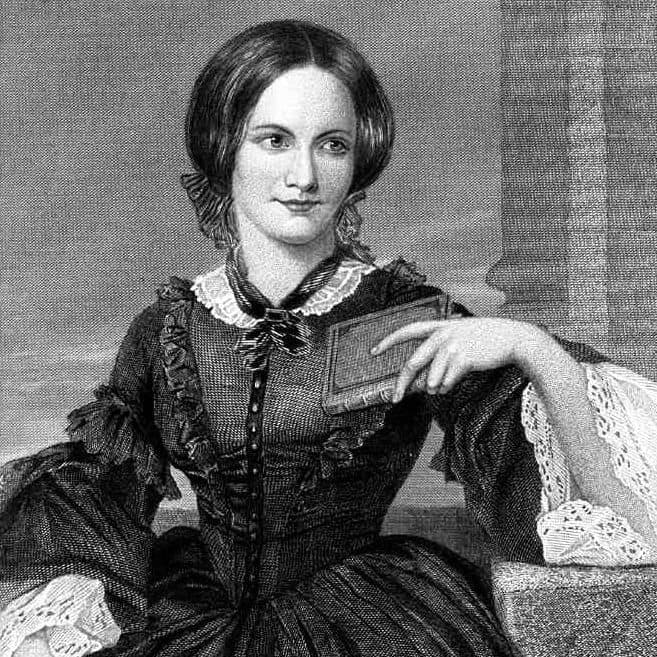
Charlotte Bronté
“In 1842, Charlotte joined the Heger Pensionnat, a girls’ boarding school in Brussels, as a student, then later as a teacher, in the hope of acquiring the skills required to open a school of her own. However, she was obliged to leave after falling in love with the school’s director, Constantin Heger, a married man, who inspired both the character of Rochester in Jane Eyre, and Charlotte’s first novel, The Professor.
“In 1820, Maria and Patrick moved with their six young children, Maria, Elizabeth, Charlotte, Branwell, Emily, and Anne to the village of Haworth, on the edge of the Yorkshire moors, where Patrick had been offered the position of perpetual curate of St Michael and All Angels Church. His salary was modest, but the post came with the use of a parsonage overlooking the churchyard and the moors. Patrick, as an Irish immigrant, struggled to be accepted in Haworth, and his children, who at first shared his Irish accent, also shared his lifelong sense of being an outsider. Living conditions in Haworth were poor, with high levels of early mortality and a water supply contaminated by runoff from the graveyard, as reported in 1850 in a damning health report. Historians have speculated that these factors may have contributed to the deaths of Charlotte and her siblings.
“In December 1836, just before her twenty-first birthday, she wrote to the Poet Laureate, Robert Southey, asking for encouragement in her hoped-for career as a poet, and announcing her ambition to ‘be forever known’. Southey wrote in response:
‘Literature cannot be the business of a woman’s life, and it ought not to be. The more she is engaged in her proper duties, the less leisure will she have for it even as an accomplishment and a recreation.’
“At the end of 1839, Charlotte wrote Farewell to Angria, a manuscript in which she explored her growing dependency on her fantasy world. Fearing for her sanity, and with the sense that she was losing her grip on reality, she finally made the decision to set Angria aside for good. In this document, she speaks of the pain of leaving her ‘friends’ and venturing into ‘lands unknown’.
“In 1846 Charlotte submitted her first novel, The Professor, to London publisher Henry Colburn, along with Emily’s Wuthering Heights and Anne’s Agnes Grey. In her accompanying letter she describes these as: “Three tales, each occupying a volume and capable of being published together or separately, as thought most advisable,” and draws Colburn’s attention to the fact that the authors have already been published elsewhere.
“The Professor was not published, though the other two novels were accepted for publication on somewhat unfavourable terms. Charlotte submitted a second manuscript, Jane Eyre, to a different publisher, Smith, Elder & Co in August 1847, and it was published soon afterwards.
“Although Emily and Anne were both opposed to their real identities being known, Charlotte discreetly revealed herself to her publisher and friends as the author of Jane Eyre. This led Charlotte to make occasional visits to London, where she began to move in more exalted social circles, becoming acquainted with William Makepeace Thackery, whose daughter, Anne Isabella, wrote the following about a visit from Charlotte:
‘ two gentlemen come in, leading a tiny, delicate, serious, little lady, with fair straight hair and steady eyes. She may be a little over thirty; she is dressed in a little barege dress with a pattern of faint green moss. She enters in mittens, in silence, in seriousness; our hearts are beating with wild excitement. This then is the authoress, the unknown power whose books have set all London talking, reading, speculating; some people even say our father wrote the books – the wonderful books. … The moment is so breathless that dinner comes as a relief to the solemnity of the occasion, and we all smile as my father stoops to offer his arm; for, genius though she may be, Miss Brontë can barely reach his elbow. My own personal impressions are that she is somewhat grave and stern, specially to forward little girls who wish to chatter. … Everyone waited for the brilliant conversation which never began at all. Miss Brontë retired to the sofa in the study, and murmured a low word now and then to our kind governess … the conversation grew dimmer and more dim, the ladies sat round still expectant, my father was too much perturbed by the gloom and the silence to be able to cope with it at all … after Miss Brontë had left, I was surprised to see my father opening the front door with his hat on. He put his fingers to his lips, walked out into the darkness, and shut the door quietly behind him.’
“Shortly before the publication of Villette, Charlotte received a proposal of marriage from the Reverend Arthur Bell Nicholls, an Irishman from County Antrim in her father’s native Ulster. Nicholls had been her father’s curate, and had long been in love with Charlotte. She initially refused him, and her father objected to the union at least partly because of Nicholls’s poor financial status. A friend, who believed that marriage provided “clear and defined duties” that were beneficial for a woman, encouraged Charlotte to consider the positive aspects of such a union and tried to use her contacts to engineer an improvement in Nicholls’s finances.
“Charlotte, meanwhile, was increasingly attracted to Nicholls and by January 1854, she had accepted his proposal. They gained the approval of her father by April and married on 29 June.
Charlotte became pregnant soon after her wedding, but her health declined rapidly and she was subject to “sensations of perpetual nausea and ever-recurring faintness”. She died, along with her unborn child, on 31 March 1855, three weeks before her 39th birthday. Her death certificate gives the cause of death as phthisis, but biographer Clare Harman, among others, suggests that she died from complications caused by severe morning sickness. She is buried in the family vault in the Church of St Michael and All Angels at Haworth.”
The story Jane Eyre begins with Jane in the care of her uncle’s family after the death of her mother. She is engaged in constant, ill-tempered skirmishes with her cousins, who are well off, financially. Her aunt is unsympathetic and cruel to her. An apothecary, Mr Lloyd, suggest that Charlotte be sent to school, a suggestion to which her aunt agrees.
Jane is enrolled in Lowood School where Mr Brocklehurst is head master. He has a philosophy of hardship for the students and plenty for his family. Jane is miserable but she makes friends with Helen Burns, a student. A massive typhus epidemic sweeps through the school, killing Helen and other students. Brocklehurst is replaced by more sympathetic management and Jane’s situation improves. She stays at Lowood for six years as a student and two years as a teacher.
Jane yearns for a new experience and she accepts the position of governess to a lively French girl, at a manor called Thornfield, where Mrs Fairfax is the housekeeper and Rochester, a dark and passionate man is the owner. Jane falls secretly in love with Rochester, and saves him from a fire that he claims was set by Grace Poole, a servant, but she is not dismissed. Jane wonders about this. Rochester brings home a pretty, vivacious girl called Blanche Ingram and Jane expects Rochester to marry her, but he proposes to Jane and she accepts.
On the wedding day, a Mr Mason announces that Rochester is already married to his sister, Bertha, who is completely mad and is kept on the third floor of Thornfield under the care of Mrs Poole. At this point, Jane decides to run away and she does this without clothing and provisions.
Penniless and hungry, Jane is forced to sleep outdoors and beg for food. At last, three siblings who live in a manor alternatively called Marsh End and Moor House take her in. Their names are Mary, Diana, and St. John (pronounced “Sinjin”) Rivers, and Jane quickly becomes friends with them.
St. John is a clergyman, and he finds Jane a job teaching at a charity school in Morton. He surprises her one day by declaring that her uncle, John Eyre, has died and left her a large fortune: 20,000 pounds. When Jane asks how he received this news, he shocks her further by declaring that her uncle was also his uncle: Jane and the Riverses are cousins. Jane immediately decides to share her inheritance equally with her three newfound relatives.
St. John decides to travel to India as a missionary, and he urges Jane to accompany him—as his wife. Jane agrees to go to India but refuses to marry her cousin because she does not love him. St. John pressures her to reconsider, and she nearly gives in. However, she realizes that she cannot abandon forever the man she truly loves when one night she hears Rochester’s voice calling her name over the moors. Jane immediately hurries back to Thornfield and finds that it has been burned to the ground by Bertha Mason, who lost her life in the fire. Rochester saved the servants but lost his eyesight and one of his hands. Jane travels on to Rochester’s new residence, Ferndean, where he lives with two servants.
At Ferndean, Rochester and Jane rebuild their relationship and soon marry. At the end of her story, Jane writes that she has been married for ten blissful years and that she and Rochester enjoy perfect equality in their life together. She says that after two years of blindness, Rochester regained sight in one eye and was able to behold their first son at his birth.
The plot of Jane Eyre is certainly a masterpiece, and I can see why it caused such a stir at the time, presenting a completely different view of women’s control over their lives.
The writing is persuasive and good. The only only comment I have is that Charlotte will often take a full page to clarify a particular setting or the attitudes of an important character. Modern novels tend to be more economical with descriptive text. My temptation was to skip ahead. Perhaps this was the way to show readers and critics that the writer has excellent creative skills.