Sorry I’ve been absent from my blog for the past eight weeks. I’ve been in the hospital.
In the middle of September, we came back to London from Sicily early because I felt I had to see a doctor. The doctor I wanted to see had treated me for polymyalgia, and I suspected I had something connected to that. He wasn’t available for a week, so I saw him on Saturday morning. He ordered some blood tests which were done right away. The next day, Sunday, he called me in the afternoon (how often have you had a call from your doctor on a Sunday?) He told me I should go to hospital emergency and tell them my blood test showed I had a very bad microbe in my blood.
At the hospital they zeroed in on my left knee which was swollen and painful. They drew a sample from it. That evening a senior nurse came in and asked if I had my situation well prepared for the future. That scared me. They put me on a heavy dose of antibiotics which are effective against the bug. I spent two days on the microbiology ward and then they operated on my knee, which had been replaced and was still dodgy. Since the microbe in question has an affinity for metal in the body, it had migrated to my left knee and would possibly migrate to my aortic valve which had been replaced in April. (Heart valve replacements are put in place in a stainless steel mesh.) The report I had on the cleaning of my knee was pretty horrendous: a lot of pus and dead tissue.
From that point I was on two antibiotics, intravenously, 24-7 for six weeks. My kidneys didn’t like the situation and had to have special treatment for a couple of weeks. I started out in the high dependency unit and was moved onto two different wards. As I began to feel better, I was desperate to be released, but my infection marker was still rising. At the beginning of my sixth week I was diagnosed with Covid, which meant a further two weeks in the hospital.
Now I am home feeling pretty good and gradually rebuilding my strength with exercises, still taking antibiotics orally until Christmas. I am back at my PC, anxious to catch back up on my blog. Here’s an article from The Conversation website by Tom Hercules Davies dated 24 July 2026, which makes it a little out of date but still interesting.
“Homer, obviously: that is what we’ve been told since the late 6th century BCE, when ancient Greeks started crediting the Odyssey to a blind bard from the rocky isle of Chios.
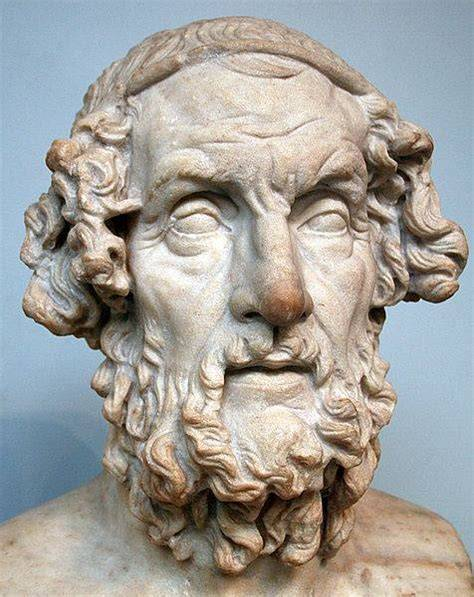
Bust of Homer: a Roman copy of a lost Greek original from the 2nd century BCE.
But this “Homer” appeared at least a century later than the poem itself. When the Odyssey first began to circulate in ancient Greece, no one knew its author. The song seems to have created the singer, not the other way around.
How can you have a poem without a poet? Two American researchers, Milman Parry and Albert Lord, came across a possible answer.
In the 1930s, Parry and Lord travelled to the Balkans to study still-living traditions of epic poetry. In Yugoslavia and Albania, they found bards who sang of heroes from long ago. These singers did not recite from a book. Most of them couldn’t read or write at all. Instead, they improvised their epics as they sang. They knew the story by heart, but told it in different words with each performance.
Balkan bards achieved this by relying on a stock of formulaic scenes, lines and phrases, which they combined on the spot. The formulae were passed down from teacher to student, so that all singers tended to sound alike.
This telltale style is just what we find in Homeric poetry. More than 20 scenes in the Odyssey begin with the same line: “when early-born Dawn shone forth with rosy fingers…”
All the poem’s major characters have a handful of constantly repeated descriptions to help fit their names into the dactylic hexameter of Homeric verse. Depending on how much space is left in a line, Odysseus appears as “divine Odysseus” (repeated 60 times in the poem), “very crafty Odysseus” (81 times), or “long-suffering divine Odysseus” (38 times).
The literal meaning of these epithets is not so important. What matters is they work for the rhythm. The Iliad, also attributed to Homer, sings of “swift-footed Achilles” when he is lying in his tent and “laughing Aphrodite” as she cries out in pain.
A poem millennia in the making
The formulaic language of the Odyssey is the work of many generations. The poem mixes different dialects of ancient Greek and linguistic forms from different periods – some formulae date back to the Mycenaean period (c. 1600-1200 BCE) or earlier.
A few scenes are even older. In the poem’s spectacular finale, Odysseus wins back his wife Penelope by stringing a massive bow and firing an arrow through 12 axeheads. In the ancient Indian Mahabharata, the hero Arjuna likewise bests the suitors of princess Draupadī by stringing a massive bow and hitting an impossible target.
The archery contest to win a wife belongs to a prehistoic Eurasian tradition of oral storytelling. It has been incorporated into these Greek and Sanskrit texts, along with other scenes and formulae.
The world of Homer therefore patches together multiple periods of history. The seams show in the occasional anachronism. In the great hall at Ithaca, the walls are hung with weapons of gleaming bronze. But when Odysseus commands his son to hide them away from the suitors, he puns: “for iron magnetises men to wield it”.
The weapons belong to the imagined historical setting of the poem, when bronze was the metal of choice for warriors, but Odysseus’ proverb belongs to a later age, when iron weapons were common throughout the Mediterranean.
From song to writing
A poem that took shape over millennia cannot have a single author – at least, not in the way Jane Austen is the author of Emma. The Odyssey understands this. It starts by asking the Muse: eipe kai hēmin, “tell it for us, too”, or in Emily Wilson’s canny interpretation, “tell the old story for our modern times”.
If no one wrote the Odyssey, we might still ask who wrote it down. After all, we have a text: at some point, the song was put to paper.
Scholars have several theories. A singer might have learned to write and recorded their version of the tales of Odysseus. Or literate scribes might have taken dictation from an oral poet.
The poem could even have taken shape by committee. In the late 6th century BCE, Pisisyratus, tyrant of Athens, mandated the annual performance of the entire Iliad and Odyssey at a festival celebrating the goddess Athena.
It takes about 20 hours to read the Odyssey aloud: too much for one voice. Singers had to divide the task, and that takes planning. The whole team must know the order of events, and share out episodes among themselves. Some scholars argue the festival fixed many songs about Odysseus into a single, canonical Odyssey, and perhaps even a script for performers to memorise.
‘Homer’ and the Homeridae
But how was a poem without an author attributed to Homer?
Homer (Homēros in Greek) is an unusual name. We know of no one else called Homer until the time of Alexander the Great. We do, however, know of a group called the Homeridae, active from the late 6th century BCE.
The Homeridae, like those Balkan bards, were professional singers. Linguist Marcello Durante has suggested the name Homeridae might have come from the Sanctuary of Zeus Homarios (Zeus the Uniter). Other professional societies took their names from sacred sites: the Asclepiadae, for instance, were a guild of healers associated with the Asclepion temple.
But the word “Homeridae” can also be understood as “the sons of Homer”. And at some point, the Homeridae began to present the poems they performed as compositions by a legendary ancestor, a “blind man from rocky Chios, whose songs will be supreme for all time”.
This line comes from Hymn to Apollo, a poem from the late 6th century BCE, which, like the Odyssey, was attributed to Homer in antiquity. One ancient scholar tells us the Hymn to Apollo was actually written by a certain Cynaethus.
Cynaethus – who happened to be from Chios – was a member of the Homeridae notorious for presenting his own poetry as the work of Homer.
Cynaethus did not write the Odyssey. But as the Hellenist Martin West argued, this little-known forger might be responsible for the legend of its author, Homer, the supreme poet.”

