Adult Coloring Books

I must live a very sheltered life because until this morning, I never heard of adult coloring books.  If I had to guess, I would have supposed that this was a very minor niche in the publishing business and that it is dedicated to adults with learning disabilities.  To my amazement, it was in part due to the sales of adult coloring books that kept print book publishing out of the red in 2015.  {Print book sales increased in 2015 over 2014, largely due to Big Publishing’s victory over Amazon: it won the right to a larger say in the pricing of ebooks.  As ebook prices increased, readers turned to the print versions.  As a whole, in 2015, the industry experienced a decline in sales (down 4.1% from 5.82 to 5.58 billion dollars)}.

So, adult coloring books are a big thing currently.  Here is what Laura Marsh had to say in an article last December in New Republic:

“In 1962, Barbra Streisand channeled all the emotional turmoil and lyric despair of an abandoned lover into what must be the strangest four minutes of pop music ever written. “Crayons ready?” she croons, “Begin to color me.”  The opening lines of the song, “My Coloring Book,” refer to that year’s fevered interest in coloring books for adults, much like the trend that has taken off recently. “For those who fancy coloring books / As certain people do,” Streisand sings, before asking listeners to fill her sorrowful life with equally sorrowful hues. When the song came out, coloring books for adults permeated pop culture, as Mort Drucker’s JFK Coloring Book spent 14 weeks at the top of the New York Times bestseller list in 1962, and sales of adult coloring books reached $1 million. Today, coloring books are perhaps even more profitable: Johanna Basford’s Secret Garden and Enchanted Forest were the two best-selling books on Amazon in April, responsible for some of the year’s recovery in print sales. (Basford has sold nearly 10 million coloring books since Secret Garden was published in 2013.) But their powerful appeal—enthusiasts say they are a “great way to de-stress” —has very little in common with adult coloring books from the 1960s. Where today’s titles offer consumers a neat package of therapy, escape and nostalgia, 1960s coloring books were both genuinely novel and subversive.

“The first adult coloring book, published in late 1961, mocked the conformism that dominated the post-war corporate workplace. Created by three admen in Chicago, the Executuve Coloring Book showed pictures of a businessman going through each stage in his day, as though teaching a child what daddy does at work. But the captions, which give instructions on how to color the image, are uniformly desolate. “This is my suit. Color it gray or I will lose my job,” reads a caption next to a picture of a man getting dressed for work. Another page shows men in bowler hats boarding their commuter train. “This is my train,” it reads. “It takes me to my office every day. You meet lots of interesting people on the train. Color them all gray.” The rare appearance of a non-gray color is even more disturbing: “This is my pill. It is round. It is pink. It makes me not care.”
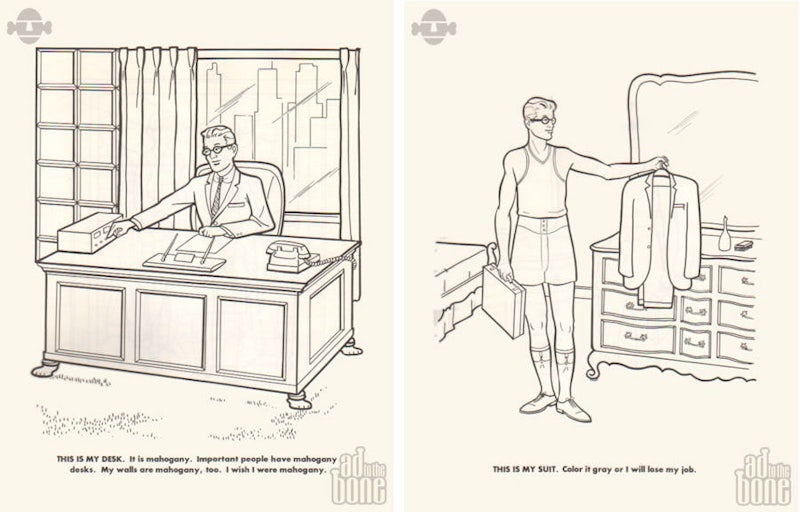
From The Executive Coloring Book, 1961.Ad to the Bone

“The coloring books that followed managed to cover, between them, a selection of the decade’s neuroses: national security, the red scare, technology, sex, mental illness. Two popular books took aim at President Kennedy: Drucker’s JFK Coloring Book and Joe B. Nation’s New Frontier Coloring Book. There were coloring books that made fun of communists and coloring books that made fun of people who were scared of communists.  Krushchev’s Top Secret Coloring Book: Your First Red Reader caricatured Soviet leaders and life under communist rule, but was still deemed “objectionable” and banned in the United States Military. Meanwhile, the John Birch Society Coloring Book, which ridiculed conspiracy theorists and extremists, stretched the coloring book concept to its limits with a blank page, captioned: “How many Communists can you find in this picture? I can find 11. It takes practice.” In August 1963, the Washington Post reported on a doctor who proposed using a 12-page coloring booklet “as a diagnostic tool…to classify patients by their types of disorders” from schizophrenia to brain damage. The Post called it the ‘Psychotic’s Coloring Book’.”

Julia Felsenthal writing in the December 2015 issue of Vogue had this to say about more recent interest in adult coloring books:

“But, in spite of the fact that I do on occasion sketch and paint with watercolors, I’ve never once felt moved to pick up a coloring book and go to town. Nor did I imagine that people in my social sphere were doing so. Were those Instagram-famous coloring parties a total anomaly? Or were my other friends also secretly brandishing markers in their spare time?

“I posted the query to Facebook and the response—entirely from women—was surprisingly immediate and enthusiastic. “My aunt-in-law brought coloring books and fancy markers to Thanksgiving and I was all ‘pshhhh, really??’ ” wrote Dean, a designer in Chicago whose funky style I’ve long admired on social media. “Next thing I know, I’m suuuuper chill with a glass of wine, coloring a picture of a flower shop. It’s surprisingly kind of awesome.”

“Other ladies seemed to agree. “I do this,” an old colleague who works in video production admitted with a trace of sheepishness. A writer acquaintance raved about Chat Thérapie, a French, feline-themed coloring book she uses after dinner as a means to avoid screen-induced insomnia. A fashion-school grad explained that coloring-book patterns help her dream up jewelry designs. A mom of two avowed that the hobby keeps her sane. A friend in Austin described how coloring books have begun to appear at packed house parties, psychedelic concerts, and on camping trips. Another friend, a therapist, agreed with Beck that they’re best enjoyed while bingeing on TV.”

OK.  I get it.  But I don’t think I’ll enter the market any time soon.

Review: A God in Ruins

For the last couple of weeks, I’ve been out of the office: my PC has been neglected, but I’ve done some reading.

A God in Ruins by Kate Atkinson is without a doubt the best book I’ve read in a long time, and it’s easy to see why it won last year’s Costa Book Award.  In fact, the judges called it, “Utterly magnificent and in a class of its own.  A genius book.”

The author has some pretty heavy-weight credentials.  Kate Atkinson won the Whitbread (now Costa) Book of the Year in 1995 with her first novel, Behind the Scenes at the Museum.  Her four bestselling novels featuring former detective Jackson Brodie became the BBC television series.  Her last novel, Life After Life, was the winner of the 2013 Costa Novel Award.  She was appointed MBE in the 2011 Queen’s Birthday Honours.

index

Kate Atkinson

A God in Ruins is the story of Teddy Todd, a would-be poet, lover of the countryside, and heroic bomber pilot during World War II.  The story begins in 1925 and zig-zags back and forth in time until its conclusion in 2012.  As the number of his completed combat missions piles up, Teddy does not expect to see the ‘Afterwards’ in which he will become a husband and a father.  Throughout the story, he faces life as it is without complaints about lost opportunities, heartbreak, or feelings un-expressed.  He is surrounded by the characters of his own family and by some of the family who are neighbours.

The writing is captivating and tight; there is no excess baggage here even though the book runs to over 500 pages.  The characters are distinct, and the story line never lags.  What most impressed me about the novel was the authenticity of the descriptions of flying bombing missions in a Halifax, but then, at the end of the book is a three page bibliography of sources.  Ms Atkinson did a lot of research!  I understand why it too two years to write this novel.  There is an interesting device she used which turns fiction on its head.  Fascinating!  But I’m not going to give it away.  Sometimes I felt slightly put off by the broken chronology, but in reading the book over a period of days, I began to feel that it was building nicely to a conclusion.  This is a novel which fully engages both one’s emotions and one’s beliefs.

Review: The Meursault Investigation

This novel, written by Kamel Daoud, reveals the hidden side of Albert Camus’ novel The Stranger.  In The Stranger, Camus has his principal character, Meursault, shoot and kill a nameless Arab for no apparent reason other than possible disorientation from sunstroke.  In The Meursault Investigation, Daoud names the murdered Arab as ‘Musa’ (Moses), and considers the implications of the murder from the viewpoint of Musa’s brother ‘Harun’ (Aaron).

Camus was a French-Algerian philosopher, an ‘absurdist’ who held that human life is absurd.  He was also regarded as an existentialist (he disagreed) and a pacifist.  He was born in 1913, won the Nobel Prize for Literature in 1957, and died in 1960.  In The Stranger, which was published in 1942, Camus used the murder of the nameless Arab for no reason as an example of the absurdity of human life.

Kamel Daoud is an Algerian journalist based in Oman.  His background is similar to that of Camus: French-speaking, Algerian writer and philosopher. The Mersualt Investigation is Daoud’s first novel, published in 2015, and it has been recognised with several prizes in France.

index

Kamel Daoud

In The Mersault Investigatiom, Harun is in a bar in Oman reflecting morosely on his brother, his mother and the book by the listener’s hero (Camus).  Included in his reflections are thoughts on Algeria, its people and its relationship to France.  The tone of the book is pessimistic and its conclusions are ambiguous (much like the tone and content of The Stranger).  One is left with the impression that there can be no God, and that life itself can have no meaning.

This is not an enjoyable book to read, because of its pessimistic philosophy, and because nothing conclusive arises from its reflective monologue.  No new ‘facts’ emerge about any of the characters, except that Musa was a real person who was loved by his mother and close the the heart of his younger brother.  Still, one has the impression that The Mersault Investigation is a classic in the absurdist philosophical tradition.  If you liked Camus’ writing, you will certainly appreciate Daoud’s.  He has created a well-written philosophical sequel to one of Camus’ great works.

Trends in Novel Genres

Chip MacGregor is a “book guy” by his own admission, and he runs the MacGregor Literary Agency.  He was asked recently: “Can you tell us the latest trends you’re seeing in fiction?”  Here is the (abbreviated) answer from his blog:

index

Chip MacGregor

The continued growth of romance — particularly historical romance. Let’s face it, last year the publisher who saw the biggest growth was Harlequin, and they did it in a down year for most publishers. Readers in a bad economy like to escape by reading romance novels. You can roll your eyes if you want to, but it’s the truth.

Thrillers aren’t selling like they used to.  James Patterson and other bestselling novelists can still move large quantities, but once you move away from the bestselling authors, it’s much slower (and, frankly, much harder to place a new novelist). 

There is a renewed interest in Americana, particularly during sunnier days. We’re seeing interest in the Victorian and Edwardian periods, for example (assuming it’s fair to use British terms for American history). That seems to be a trend away from seeing so many wartime sagas — perhaps a reflection on our fatigue with the never-ending war in Iraq. 

We’ve seen a lot of growth with fiction that surrounds historical events. Not a retelling of the events, but of stories that touch on history. So, for example, we’re not seeing novels that re-tell the assassination of President Lincoln, but we ARE seeing novels that have to do with people who were in the vicinity, or who knew John Wilkes Booth, or who were at Ford’s Theater, or who were part of the chase to catch the conspirators, etc. Again, not so much focused on the event itself, but on characters who were influenced by the event. 

Literary fiction is definitely a growth category in American publishing. Take a look at any bestseller list, and you’ll see a lot of literary fiction. Not only that, but many of the books have a clear spiritual thread — something I don’t see many people recognizing or reporting on. 

One of the most-reported growth trends has been in paranormal fiction.

 I see mixed signals in the horror category. Some think it’s up; others think it has run its course. I don’t have a firm opinion one way or the other. 

Of course there has been huge growth in the Christian/inspirational category over the past 7 or 8 years. The incredible growth has slowed, making some think religious fiction is hurting, but that’s just not true. Christian fiction is still a HUGE category, and there is still growing interest from those houses who were late to jump on board during the heyday. So while, yes, we’re not seeing the big growth in titles that we did a couple years ago, compare the number of titles and the number of genres and sub-genres to what we saw just three years ago. 

One of the most visible areas of growth in the inspirational category has been Amish fiction (or “bonnet novels”). Some people have said that it’s going to fade out, but I don’t believe it. I think it has established itself as its own sub-genre. What Bev Lewis started and Cindy Woodsmall followed has turned into its own category of fiction. That sort of thing happens sometimes — consider Louis L’Amour creating the giant interest in westerns, or Edgar Allan Poe basically establishing horror fiction. People are still buying it, so it has clearly found its audience. 

He goes on the mention the growth of small presses (including those who specialise only in the production of e-books) and the growth of e-books themselves.  He continues: “I don’t think ink-and-paper books are going away any time soon — most every reader still loves printed books. But I’ve got three kids in their 20’s, and all of them are comfortable reading a book on a screen — even an iPhone screen. That tells me when their generation is in charge, the e-book will be a core business, not a side business. It will be a major part of every publishing decision, not simply a sub-rights discussion. 

I can comment on two genres mentioned above: thrillers, and spiritual literary fiction.  Five of the soon to be seven books I’ve published are in these two categories.  The three thrillers I’ve written are all pretty gripping, and realistic.  But, I’m beginning to feel ‘been there, done that.  Sable Shadow & The Presence is spiritual literary fiction, and it has won eight (minor) awards to date.  Writing it and the reaction I’ve had to it have motivated me to (nearly) complete my seventh novel, which has a definite spiritual dimension, and is set in the Middle East.  In spite of the fact a tremendous amount to research was required, I greatly enjoyed the experience.  I’ll tell you more about it as soon as the publishing contract is signed.

Review: The Power of the Dog

This novel is probably the grittiest I have read. I mean ‘grittiest’ in the sense of terse, violent and gripping. In 541 pages, Don Winslow sets out a compelling picture of the drugs wars in the America from New York City to Columbia. Nothing is withheld, abbreviated or glossed-over: the actions, reactions and motivations of dozens of very real characters. The scope of the novel draws in not only the drugs lords, the law enforcers and their subordinates on many levels, but also the politicians, and the military, so that, ultimately, it is not just about drugs, but also about perceived national interest and long term political strategy. One has to admire the depth of research Winslow must have completed to write this novel. The details of places, organisations, and procedures are all there with crystal clarity. One is tempted to believe that this is not a novel, but a description of the real world.

index

Don Winslow

The characterisations are excellent. There are about six characters who make it all the way through the book, and dozens more who fall (or are pushed) by the wayside. Each of the characters is distinct, and none is completely repellent: we understand their motivation even if it is just survival. The dialogue is terse, but fit for purpose.

One challenge for a reader of this novel is being able to connect the threads of location, character and motivation, as the story skips around from place to place. But Winslow is not trying to tell a simple story, and his skipping about technique reinforces the overall message: this game is very complex.

I found the book hard to put down, but when I did, I looked forward to finding out ‘what happens next’.

Winslow’s style of writing is not ‘literary’. This is not a work of literary art; it is a fast-moving story told in the street language of the characters themselves.

This book is not a pleasant read: the casual violence can be gut-wrenching, but if you are a reader with a strong stomach, and a love of realistic, complex and, ultimately, important action, this is the book for you.

Review: Remains of the Day

This ‘modern classic’ was first published in 1989, and won the Booker Prize that year. While I had heard of the novel, I had never read it; I was further motivated to read it as a Booker Prize winner and by the author being a Japanese writer I didn’t know.

Kazou Ishiguro was born in Nagasaki, Japan in 1954 and moved to the UK at the age of five. He has written six novels, all of which have won prizes or received major recognition. He currently lives in London with his wife and daughter.

untitled

Kazou Ishiguro

The novel is told in the first person by Stevens, who was the butler in Darlington Hall, which was the residence of Lord Darlington in the 1930’s. Darlington Hall was a grand place, with many servants, Stevens having overall responsibility. Lord Darlington was a man of considerable wealth and influence, both socially and politically. He died after the war, and Darlington Hall was sold to an American, Mr Faraday, who has downsized both the staff and the use of the Hall.

Much of the book is Stevens’ recollections of events that took place when his lordship was in residence, and we learn that Stevens is preoccupied with the extent to which he was (like his father) a top butler. Stevens comes to define a top butler as a true professional who carries great dignity to his profession. The descriptions of relationships (and dialogue) among staff and with the lord of the manor are brilliant: they convey clearly the culture of the English aristocracy in the 20’s and 30’s.

Mr Faraday plans to be in the States for an extended period, and he suggests to Stevens that he take the motorcar on a sightseeing trip. Stevens accepts his offer and coincidently decides to call on a Miss Kenton who was the one who supervised all the housemaids at Darlington Hall. Miss Kenton left the Hall years ago, and has married. Now, Stevens wonders whether he can persuade her to return to the Hall, as there are hints that her marriage is in difficulty. The working relationship between Stevens and Kenton was very formal, but one cannot help but wonder if there is an unacknowledged attraction between them.   In the last chapter, they meet again, and the message of the novel is revealed: Stevens muses: “After all, what can we ever gain forever looking back and blaming ourselves if our lives have not turned out quite as we might have wished?”

The novel moves at a very leisurely pace, with very little action. Major events are recounted by Stevens factually and without emotion. The characters, the setting and the story-telling all completely support that retrospective, self-doubting theme. In spite of Stevens’ wordiness, his character shines through in a way that he is able to maintain the reader’s attention.

If one is looking for tale with plenty of action and excitement, The Remains of the Day would not be a good choice. But if one would like to curl up with a superbly-written story, immersed in history, and long-forgotten characters, a story that succeeds admirably in making its point, then Remains is for you.

As a sort of aside, I would add that the criteria for winning the Booker Prize may have shifted over the last twenty-five years. It’s hard to imagine that a novel with little overt physical or emotional action could win, given the level of current competition.

The Guilty Secretes of E-book Readers

There was an article in The Daily Telegraph last week which reported on the popularity of titles of e-books vs titles of physical books.

“A newly published list of Amazon.co.uk’s biggest selling e-books of the year features psychological thrillers, misery memoirs, Mills and Boon and a book by the Tory MP Nadine Dorries, whose first work was memorably described by a Telegraph reviewer as “the worst novel I’ve read in 10 years”.  Notably, 18 of the top 20 authors were women, including thriller writers Angela Marsons, Fiona Neill and Rachel Abbott.

“However a parallel list  of physical books compiled by Waterstones to cover the same period is significantly more highbrow, and features four times as many male authors.  They include Richard Flanagan, author of the Man-Booker Prize-winning The Narrows Road to the Deep North, and Anthony Doerr, with his All the Light We Cannot See.  There were also books by Colm Toibin, Ian McEwan and Victoria Hislop.  The print list is topped by Harper Lee’s Go Set a Watchman, which does not make the Amazon e-books list.

“There is some overlap.  Paula Hawkin’s runaway bestseller The Girl on the Train, and the latest risqué offering form E L James appear in the top three of both lists. But the disparity between the books we put on show and those we download suggests that e-book reads can be ‘guilty pleasures’.

“Benedict Page of The Bookseller said: ‘There are certain kinds of books that people like to own.  If they have a favourite heavyweight literary author who they have followed for many years, they are likely to want to possess the printed book because it’s beautiful and durable and represents a readerly commitment.'”

I think that Page’s analysis is probably correct in that we tend to regard e-books as disposable, and printed books something to be retained. The high proportion of female writers on the e-book list is interesting.  My theory would be that at least some of the female authors on the e-book list write primarily for women, and are more interested in achieving volume than literary recognition.  I’m also guessing that more women than men own e-book readers.  These two theories seem to converge on the supply and demand sides.

What’s your view?

Review: Writing with the Master

This is the true story of a retired businessman who’s been writing novels and having them rejected by publishers/agents.  The businessman’s friend John Grisham (the best-selling author) offers to coach him in the writing of a new novel. The book sets out, in detail, all of the coaching provided over two years.

511C2LhqQFL__UX250_imagesT0ZHRO92

Tony Vanderwarker                               John Grisham

Tony Vanderwarker is a retired advertising executive who had his own, very successful, ad agency, sold it and moved from Chicago to Charlottesville, Virginia with his family.  John Grisham, also a Charlottesville resident, is a friend of Tony’s, and one day, over lunch, John offers to ‘mentor’ Tony in writing a new novel.  Grisham had previously referred one of Tony’s works to an agent whose review was positive, but not quite good enough to be published.

The process started with John asking Tony what he wanted to write about.  Tony’s first two ideas were rejected out of hand.  His third idea was a thriller about nuclear weapons lost by the US Air Force in air crashes where the weapon was not recovered.  There are nearly a dozen such weapons, dating back to the 1950’s.  Tony prepared a three sentence description of the plot and then a full, multi-page outline.  At each stage we see portions of what Tony has written and John’s written critiques.  The critiques are blunt and to the point.  After three and a half months of trial and error, Tony revises his plot outline, and is ready to start chapter outlines.  During this process, we see a reflection of the way John Grisham writes his novels.  First, a one paragraph outline: is it interesting enough, strong enough?  Then the three page outline, complete with characters: do the subplots support the main plot or are they extraneous?  Are the events credible?  Are the characters interesting and likeable?  Then comes the first draft of the manuscript.  In Tony’s case, John tears into the manuscript and points out a number of problems:

  • the writing is sloppy: there are repeated words and phrases and factual inconsistencies.
  • there are too many distractions to the basic plot
  • the actions of a key character don’t make sense
  • too many bad guys
  • minor character isn’t fully credible
  • inserting the author’s political views into the story
  • make the dialogue real: repeat it out loud.
  • Show! Don’t Tell!

Tony is absolutely gutted by this critique!  He turns his attention to the notes John has written on individual pages of the manuscript.  Here, again, we see the text and the comment.  Tony divides the manuscript into seven piles and begins the task of rewriting, which takes a year.  Once again Grisham responds with a cover letter describing his principal concerns and returns the manuscript with page-by-page comments, including:

  • too many detours; too much backfilling
  • don’t be afraid to cut
  • not allowing the suspense to build

Tony makes the suggested changes and submits the manuscript to John’s agent, who likes it and refers it to another agent because it doesn’t fit for him.  The agent to whom it is referred is very complimentary but declines. Tony goes back to the default mode of mass submissions, without success.

When Tony has essentially given up on getting his novel published, he gets a great idea.  Why not write a book about the process that he and John Grisham have been through.  Grisham agrees, and the book is published by Skyhorse Publishing, who also agree to publish the mentored novel: Sleeping Dogs.

For anyone who is interested in the process of writing fiction, this book is a must read.  And for those with only a passing interest in the creative effort, there is enough of the rest of Tony’s life fitted neatly in to make to book a good read: his life as an advertising executive, his work for an environmental charity, his relationship with his wife and the Charlottesville area.

Personally, I’m not surprised that Sleeping Dogs didn’t get published on the first attempt.  From my point of view, there’s too much that stretches credibility.  But, I’m not surprised that Skyhorse decided to take it up.  Writing with the Master is a great promotion for Sleeping Dogs.

As for John Grisham’s advice, I think that ninety percent is spot on.  Two quibbles: I believe in outlining, but not to the extent that John does.  I think that detailed outlines can stifle creativity, and I notice that Tony has reached a similar conclusion.  There’s not much in John’s advice about the use of creative language, which I think is important to differentiate the writer and his/her text from the mundane.

Tony writes well, and I’m glad that he decided to follow-up on his brainstorm: why not write a book about the mentoring process?

Review: Nichijo: The Testimony of John Provoo

As a participant in the Reader’s Favourite book review scheme, I had to select a book from among those that had been submitted for review. Nearly all of the books submitted are in electronic format. I prefer hard copies, so I selected the book I wanted to read and bought it on Amazon.

Nichijo: The Testimony of John Provoo interested me for several reasons: It concerned the Second World War in the Pacific, and there were elements of Buddhism and Japanese culture. (I read much of the book while on a recent trip to Japan.)

IMG_20150605_0001

The author is John Oliver who has a Batchelor’s degree in Political Science and Religious Studies from the University of California at Santa Barbara.  He was working in Hawaii when he met John Provoo and decided to tell his story. The book is therefore an autobiography; as it is written in the first person.

According to his ‘testimony’, John Provoo grew up in San Francisco, having been born in 1917. He was attracted to Buddhism and believed in the sanctity of all life. In March 1940, he went to Japan to study for the Buddhist priesthood.   He returned to the US in May 1941 under the threat of imminent war, and enlisted in the US Army. He was sent to the Philippines where he worked as a clerk in Army headquarters in Manila. He was captured by the Japanese in the Battle of Corregidor and became a prisoner of war. Much of the book concerns his time as a Japanese prisoner. Because of his fluency in Japanese and his understanding of Japanese culture he often had to deal directly with his captors. This led simultaneously to somewhat more lenient treatment of fellow prisoners and suspicions by the same fellow prisoners that Provoo was giving aid and comfort to the enemy. When he returned to the US, he was accused of collaboration with the enemy, was acquitted and re-enlisted in 1946. For most of the next ten years, he was pursued by the US Justice Department for treason, and underwent several trials, during which his homosexuality was used against him. Eventually, he was acquitted and went to Japan to complete his Buddhist training and to Hawaii, where, as a high level Buddhist priest he lived the rest of his life, dying in 2001.

One has the sense, in reading the book, of an honest re-counting of history, and, as such, it makes very interesting reading: in particular, the conflicted position in which a Japanese-speaking Provoo found himself as a Japanese prisoner of war; the shameful conduct of the Justice Department in mounting a hugely costly campaign against him and in using his homosexuality against him. It appears that John Oliver undertook a considerable amount of independent research to complete this book, and that he did not rely only on what Provoo told him.

There are several areas that are worth mentioning. John Provoo was clearly a very complex character, but one does not get a full understanding of this complexity in the book. Rather, the emphasis is on the historic (what was done) rather than the psychological (why it was done). Might it have been a more interesting piece of literature if instead of being entirely in the first person, the author had intervened as the narrator now and then? In the latter part of the book, there is too much name dropping (who the various interested parties were), and on exactly what they said. I think it would have been sufficient to summarise the key points, and use footnotes where essential. While the writing is good and effective, there is very little description of the various environments in which Provoo found himself: again the emphasis on history rather than literature.

That said, Nichijo, (Provoo’s name as a Buddhist priest) is quite an interesting read. I enjoyed it.

Review: Revere Beach Boulevard

I bought Revere Beach Boulevard because there was a piece in my alumni magazine about a fellow writer and a fellow alumnus, and I read most of it while I was on a brief holiday in Sicily.

untitled

Revere Beach Boulevard is a contemporary novel set in Revere, Massachusetts, a suburb of Boston. Four of the principal characters are an Italian-American family: Lucy, the mother, is dying of cancer; Vito, the father is a retired carpenter; Peter, a son in his forties, sells real estate and has a serious gambling addiction; Joanie, the older sister with a secret, is apparently a successful newsreader for a Boston TV station. The other characters – friends and acquaintances – are part of the immigrant culture of Family, Church, and Food, and as such, the novel does them justice. The plot revolves around Peter who is heavily in debt to the local Mafioso. He hasn’t the money to pay, and friends and family are largely losing patience, as is the malevolent Chelsea Eddie, who finds that he doesn’t hold all the cards. Joanne is about the run a TV special on criminals like Eddie.

Without revealing the outcome, the plot has all the elements of a well-written thriller. I found it difficult to put it down. But there is much more to it than a thriller: the examination of values like love, trust, faith and above all: who we are as human beings. The characters, particularly Peter, Vito and Alfonse – the police chief with a secret – are very real and imperfectly human.

Without detracting much from the value and readability of this novel, one aspect that I didn’t particularly like was that each of the characters told a part of the story. This meant that one often had to read a whole paragraph before one knew which of about nine characters was talking. I felt that Peter and an omniscient narrator could have told the story equally well. I had minor reservations about two of the characters. I didn’t think that Chelsea Eddie would worry so much about what Joanie would say about him on the air: any Mafioso worth his salt has an anti-libel lawyer on standby, and Joanie had no solid evidence. Maybe is she were FBI rather than a newsreader? For me, Joanie’s loss of self-control during her visit to her dying mother didn’t ring true. She is a highly-paid TV executive who fought her way up to that position. Distressed, but not an injured child. Neither of these quibbles had any impact on the splendid plot.

The final proof-reading of the text could have been better. Frequently there were extra spaces between words, and hyphens were used instead of dashes to offset parenthetical phrases. For me, this caused confusion.

I certainly recommend Revere Beach Boulevard. It is unusual; it is interesting; it is captivating; it is well-written